Atlas entry
Light-Year: Its Year Runs 11 Minutes Longer Than the Seasons
TL;DR: A light-year is the distance light travels in a vacuum in one Julian year of exactly 365.25 days: 9,460,730,472,580.8 km, about 5.88 trillion miles. That year runs about 11 minutes longer than the year of the seasons, and the table below turns the distances of 16 bright stars into the years their light has been on the way.
In this entry10 sections
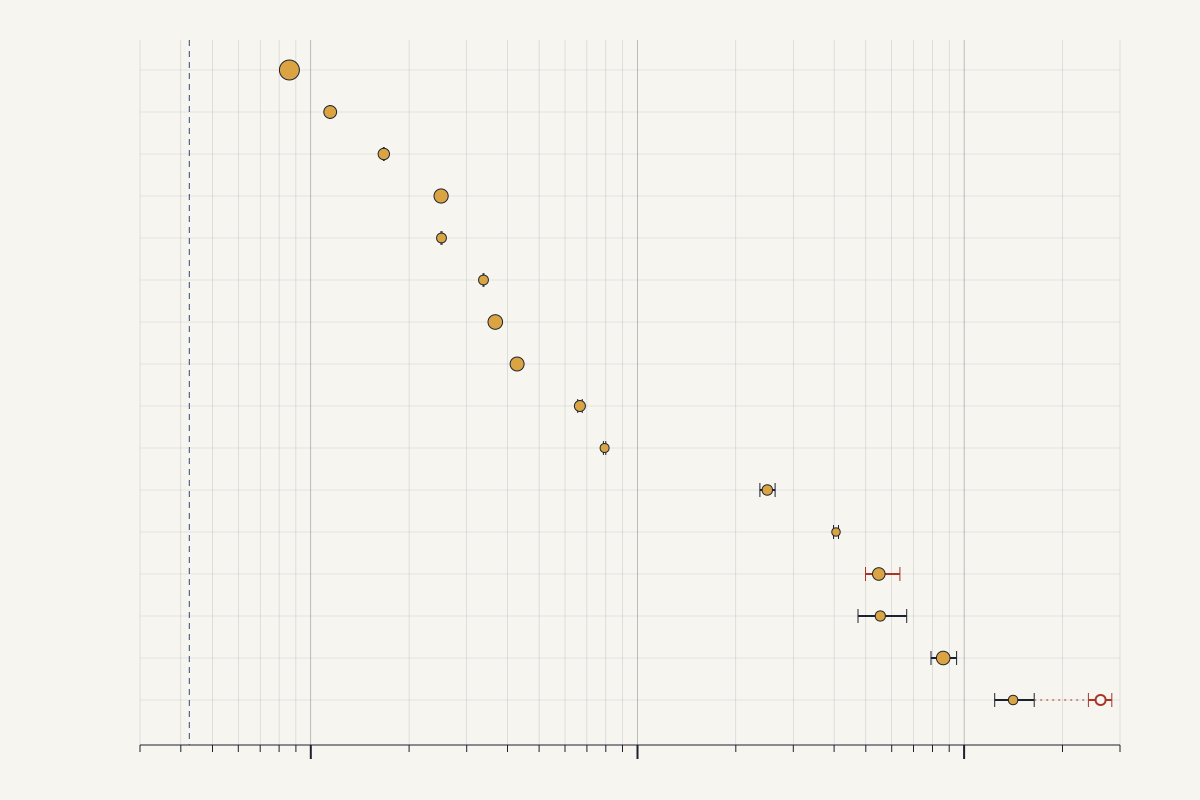
Open the chart full size to zoom in on the detail.
Figure 1. When the light left 16 stars of magnitude 1.5 or brighter that rise at 40°N. Rows from the top: Sirius, Procyon, Altair, Vega, Fomalhaut, Pollux, Arcturus, Capella, Aldebaran, Regulus, Spica, Adhara, Betelgeuse, Antares, Rigel, Deneb. Log scale from 3 to 3,000 years, with longer ticks at 10, 100 and 1,000; brighter stars get larger gold dots, and bars span one standard error. Red marks Betelgeuse's 2020 estimate and Deneb's second distance; the dashed blue line is Proxima Centauri.
No calendar on your wall has a year of 365.25 days, yet every light-year is built on one. The International Astronomical Union (IAU) defines the light-year as the distance light travels in a vacuum in one Julian year, 365.25 days of 86,400 seconds each. That makes it exactly 9,460,730,472,580.8 km, about 5.88 trillion miles. In the IAU's astronomical unit (au), a unit close to the Sun–Earth distance, it is 63,241 au.
That is a length, not a span of time. The year in its name only says how the length is built.
Why does a light-year use 365.25 days?
The Julian year is the average year of the Julian calendar, which the Gregorian reform began replacing in 1582. Three years of 365 days and one of 366 average exactly 365.25. Unless otherwise specified, the IAU treats "a year" in astronomy as this Julian year of 31.5576 million seconds.


Figure 2. January and February on the Menologium Rusticum Colotianum, a Roman marble calendar held by the National Archaeological Museum in Naples: DIES XXXI and DIES XXVIII, the Julian calendar's 31 and 28 days.
The seasons keep a shorter year. Wikipedia's article on the tropical year gives the mean tropical year, the average cycle of the seasons, as 365.24219 days in 2000. By this page's calculation, the Julian year runs 11 minutes 15 seconds longer. That excess is the drift the Gregorian calendar was built to stop, and its leap rule averages 365.2425 days.
Outside astronomy, the Julian average survives too. As a 2008 paper by Simegne Tafesse in the East African Journal of Sciences explains, Ethiopia's calendar has twelve months of 30 days and a 13th month of 5 days, or 6 every fourth year. Its years therefore also average 365.25 days.
Think of a calendar as an account reconciled against the Sun, with leap days as the adjusting entries. The Julian year inside a light-year is never reconciled. It is a fixed 31,557,600 seconds, while the mean tropical year changes slightly from one year to the next, Wikipedia's Julian year article notes.
That choice is fairly recent. According to Wikipedia's light-year article, the IAU's 1964 system of constants, used from 1968 to 1983, paired the tropical year with a measured speed of light. The Julian year and today's exact speed of light, 299,792,458 meters per second, belong to the IAU (1976) system, used since 1984.
How much does the choice of year matter?
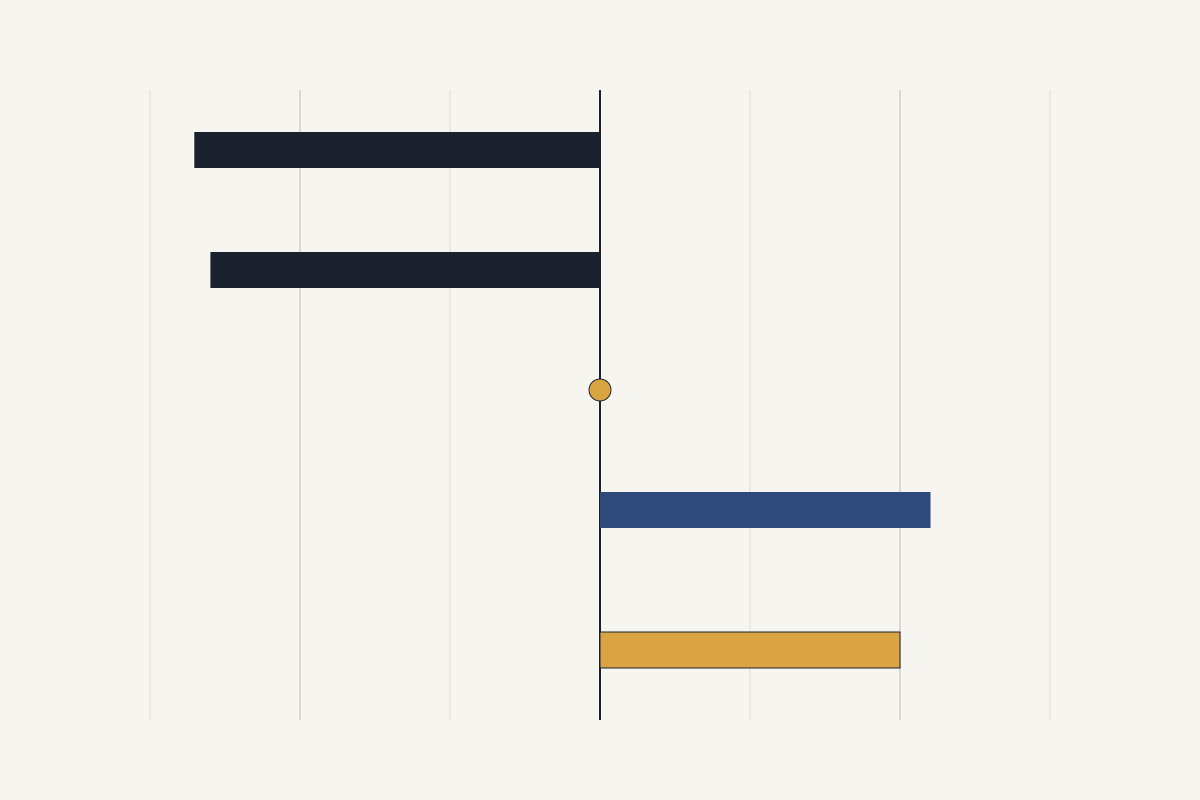
Open the chart full size to zoom in on the detail.
Figure 3. Rows from the top: the mean tropical year (2000), the Gregorian average year, the Julian year the IAU uses (gold dot on the zero line) and the sidereal year. Each bar shows how far the light-year would move, in au, if it were built on that year: dark bars to the left mean a shorter light-year, the blue bar to the right a longer one. Grid lines every 0.5 au. The gold bar at the bottom is 1 au, for scale.
Swap the year and the light-year moves. Built on the mean tropical year, it would be about 202 million km shorter, or 1.35 au, by this page's calculation. The Gregorian average would trim about 194 million km, and the sidereal year, Earth's orbit timed against the stars, would add about 165 million km. Each shift is longer than 1 au.
None of that touches a real star. The difference is about 2 parts in 100,000. Vega lies about 25 light-years away, with a catalogue uncertainty of about 0.07 light-year either way, roughly 4,400 au; changing the year would move it about 34 au. Every star distance on this page carries a larger uncertainty than the choice of year.
A sports field makes the size easier to hold. On this site's solar system scale model, where 100 m of grass spans the Sun to Neptune, one light-year runs about 210 km.
When did the light leave the bright stars you can see?
Read a distance in light-years as an age. Light covers one light-year per Julian year, so light from a star 25 light-years away set out about 25 years ago. The table does that for every star of magnitude 1.5 or brighter (lower numbers are brighter) that rises at 40°N. Most of its distances come from parallax, the tiny shift of a nearby star against distant ones as Earth circles the Sun.
| Star | Magnitude | Light left (years ago) | Range | Highest at 9 p.m. |
|---|---|---|---|---|
| Sirius | −1.44 | 8.60 | 8.57–8.64 | Feb 15–16 |
| Procyon | 0.40 | 11.46 | 11.41–11.51 | Mar 1–2 |
| Altair | 0.76 | 16.73 | 16.68–16.78 | Sep 2–3 |
| Vega | 0.03 | 25.04 | 24.98–25.11 | Aug 15 |
| Fomalhaut | 1.17 | 25.13 | 25.04–25.22 | Oct 20–21 |
| Pollux | 1.16 | 33.78 | 33.69–33.88 | Mar 3 |
| Arcturus | −0.05 | 36.72 | 36.50–36.94 | Jun 9–10 |
| Capella | 0.08 | 42.80 | 42.55–43.06 | Jan 24–25 |
| Aldebaran | 0.87 | 66.6 | 65.6–67.7 | Jan 14–15 |
| Regulus | 1.36 | 79.3 | 78.6–80.0 | Apr 8–9 |
| Spica | 0.98 | 250 | 237–264 | May 28–29 |
| Adhara | 1.50 | 405 | 398–412 | Feb 19–20 |
| Betelgeuse | 0.45 (variable) | about 550 | 499–636 | Feb 3–4 |
| Antares | 1.06 | 554 | 473–667 | Jul 13–14 |
| Rigel | 0.18 | 863 | 792–948 | Jan 23–24 |
| Deneb | 1.25 | about 1,410 or 2,620 | 1,240–1,640 or 2,400–2,830 | Sep 15–16 |
Magnitudes and distances: HYG Database v4.4, whose distances for these 16 stars come from the Hipparcos 2007 parallaxes (van Leeuwen 2007). Ranges span one standard error of that parallax, read from CDS VizieR and SIMBAD. Betelgeuse uses Joyce et al. 2020 and Deneb's second value is Schiller and Przybilla 2008, each with its published range. "Highest at 9 p.m." is local mean solar time, valid for any year from 2020 to 2039, by this page's calculation.
CSV download (CC BY-SA 4.0) (Data: HYG Database v4.4 by David Nash (astronexus), CC BY-SA 4.0, https://codeberg.org/astronexus/hyg; Hipparcos 2007 parallaxes and standard errors: F. van Leeuwen 2007, A&A 474, 653, via CDS/VizieR catalogue I/311 and SIMBAD), with its provenance note (JSON)
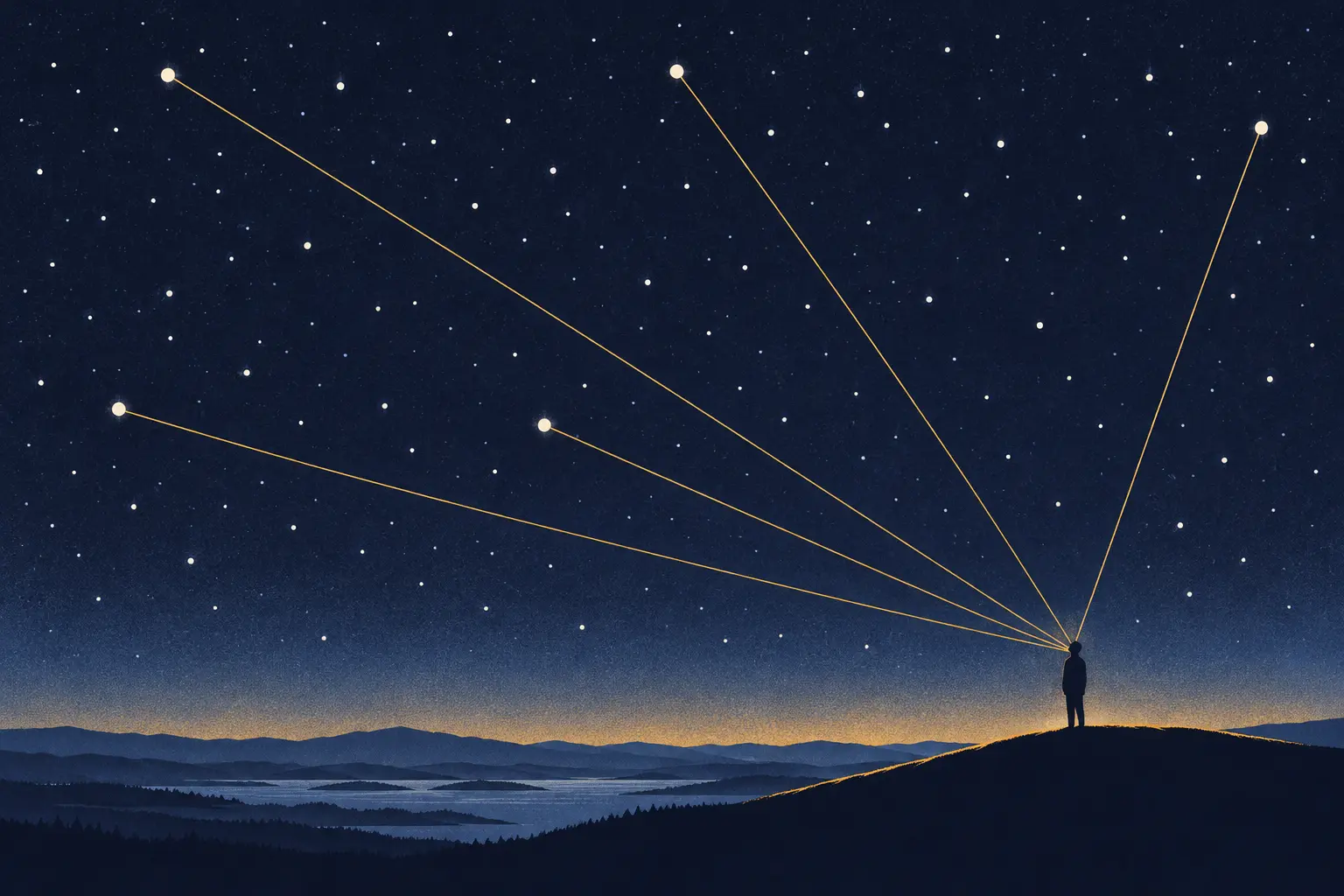
A watcher under a few bright stars. Light from a star 25 light-years away set out about 25 years ago, so a distance in light-years reads as an age.
Sirius sends the youngest light of the set. Two rows need care. Betelgeuse uses the 2020 estimate by Meridith Joyce and colleagues, about 550 light-years (Betelgeuse), while the HYG catalogue lists the 2007 parallax value, about 498 light-years.
Deneb is the open case. The 2007 parallax from the Hipparcos satellite puts it about 1,400 light-years away, near the roughly 1,600 light-years that Wikipedia's stellar parallax article gives as that satellite's reach. A 2008 study by Florian Schiller and Norbert Przybilla instead adopted 802 ± 66 parsecs, about 2,600 light-years, from Deneb's affiliation with the Cygnus OB7 star association.
Vega and Fomalhaut, both up on October evenings, differ in distance by about 0.08 light-year, less than their combined uncertainty, so the parallaxes cannot say whose light set out first. Fomalhaut, Antares and Adhara stay low from 40°N, peaking 20 to 24 degrees up.
Fainter stars run older. The HYG catalogue counts 8,920 entries of magnitude 6.5 or brighter, its count for this site's naked-eye budget; half of those with a listed distance lie beyond about 400 light-years (Bortle scale). Farther still, the Andromeda Galaxy's light left about 2.5 million years ago on most modern estimates (Andromeda Galaxy).
The nearest known star is missing from the table. Proxima Centauri lies about 4.25 light-years away by its Gaia parallax, or 268,550 ± 17 au. ESA notes that it is not visible to the naked eye; by this page's calculation, ignoring atmospheric refraction, it never rises north of about 27°N.
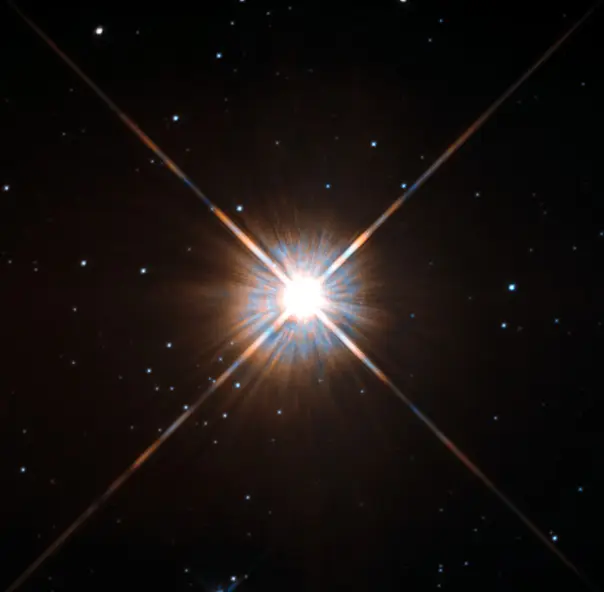

Figure 4. Proxima Centauri in a Hubble Wide Field and Planetary Camera 2 image released by ESA/Hubble in 2013. North is about 40° right of up, and the frame spans about half an arcminute. Light's departure: the light in this frame left Proxima about 4.25 years before it reached Hubble.
Where did the light-year come from?
Friedrich Bessel published a distance to the star 61 Cygni in 1838. Wikipedia's article on stellar parallax lists two other results from the same decade: Friedrich Struve published a parallax for Vega in 1837, and Thomas Henderson, who had measured Alpha Centauri in 1832 and 1833, published his in 1839. Wikipedia's light-year article says Bessel added that light takes 10.3 years to cross that distance, but he did not use the light-year as a unit.
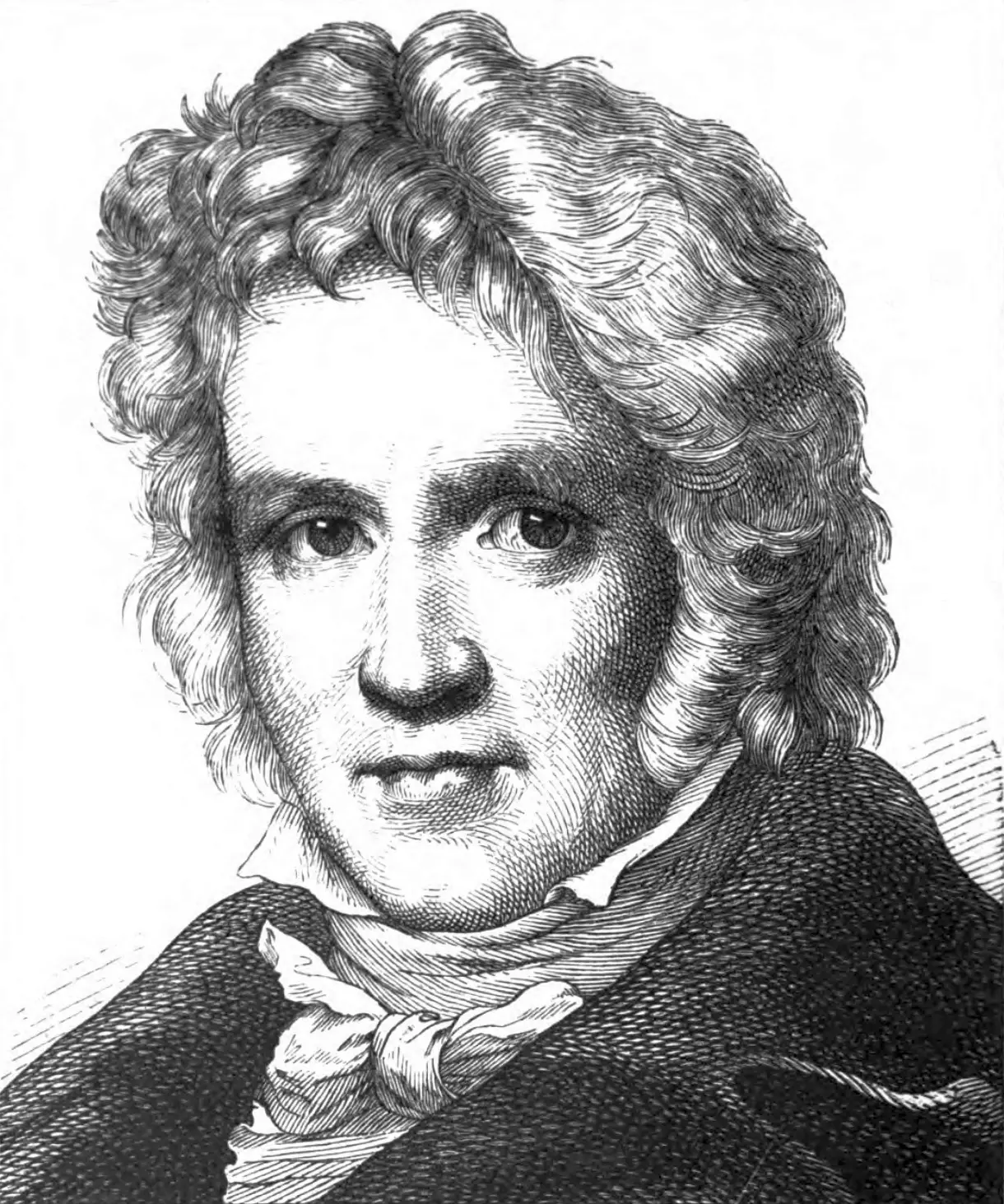

Figure 5. Friedrich Bessel in a portrait by Emil Eugen Sachse, from Ludwig Bechstein's book of 200 portraits of famous Germans (Leipzig, 1870). Bessel published his distance to 61 Cygni in 1838.
The unit came later. The same article dates it to an 1851 German popular article by Otto Ule, who explained a distance named after a year by comparing it with the walking hour. Gaia's 2020 data release puts 61 Cygni about 11.4 light-years away.
Is a light-year a unit of time?
No. A light-year measures distance, about 9.46 trillion km. The IAU notes that its use is mostly confined to popular publications; for studies of the Milky Way, the parsec is the usual choice. One parsec is about 3.26 light-years, by this page's calculation from the IAU definitions.
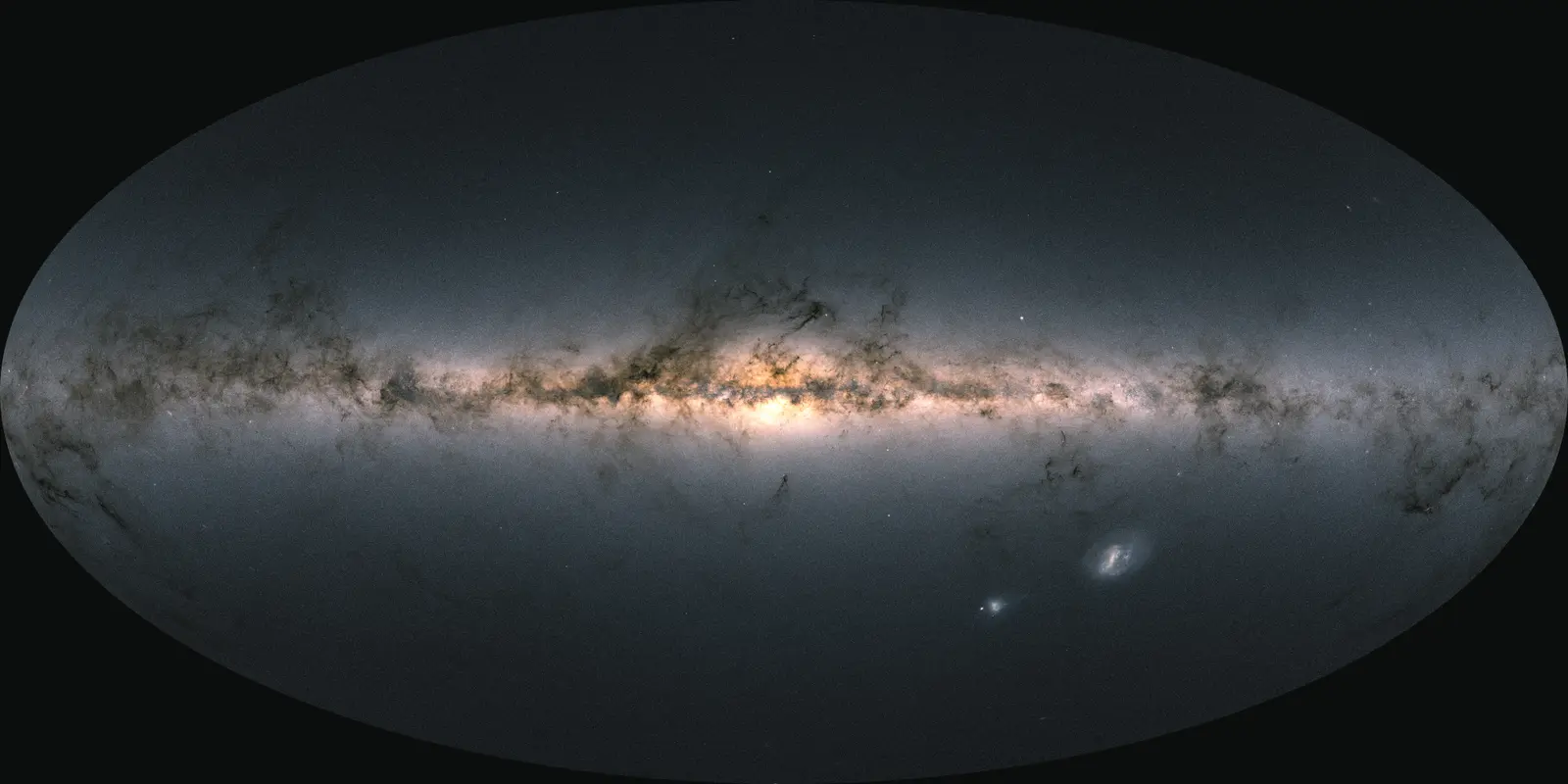

Figure 6. The whole sky from more than 1.8 billion stars in ESA's Gaia Early Data Release 3, the Milky Way's plane across the middle. That release's parallaxes set the Proxima and 61 Cygni distances above.
Light-based units also work close to home. Light crosses 1 au, close to the Sun–Earth distance, in about 8 minutes 19 seconds, by the same calculation.
Voyager 1 would need about 17,600 years to travel one light-year at its speed as of August 2024, 17.0 km per second relative to the Sun, by this page's calculation. Light needs one Julian year. Parker Solar Probe moves far faster at its closest approach to the Sun, about 430,000 mph (about 692,000 km/h), according to the mission site of the Johns Hopkins Applied Physics Laboratory, which built the spacecraft; held steady, that speed would cross a light-year in about 1,560 years, by the same calculation.
Run backward, the same arithmetic turns an old photograph into a date: Harvard's 1850 photography of Vega (first photograph of a star) recorded light that had left the star around 1825.
Sources
- International Astronomical Union, "Measuring the Universe: The IAU and astronomical units" (light-year: light's travel in vacuum in one Julian year, 9,460,730,472,580.8 km or 63,241 au, use mostly confined to popular publications; a year is a Julian year of 365.25 days, 31.5576 million seconds, unless otherwise specified; au = 149 597 870 700 m exactly per IAU 2012 Resolution B2; parsec the usual choice for the Milky Way)https://iauarchive.eso.org/public/themes/measuring/Read: full page
- National Institute of Standards and Technology, "Revised Unit Conversion Factors" (mile = 5280 ft = 1609.344 m)https://www.nist.gov/pml/us-surveyfoot/revised-unit-conversion-factorsRead: full page
- Wikipedia, "Julian year (astronomy)" (average year of the Julian calendar; defined in SI seconds and constant, while the mean tropical year varies slightly from year to year), revision 1333908396https://en.wikipedia.org/wiki/Julian_year_(astronomy)Read: full article text
- Wikipedia, "Tropical year" (mean tropical year 365.24219 days in 2000; the Gregorian calendar designed to resynchronize the calendar with the seasons), revision 1373945112https://en.wikipedia.org/wiki/Tropical_yearRead: full article text
- Simegne Tafesse, "The Mathematical Basis of the Calendar Used by the Ethiopian Orthodox Twahedo Church for Fasting Periods and Religious Holidays," East African Journal of Sciences 2 (1): 79-85 (2008), doi:10.4314/eajsci.v2i1.40368 (Ethiopia uses its own calendar: twelve 30-day months and a 13th month, Pagumen, of 5 days, or 6 every fourth year; 365.25 days as the length of the solar year)https://www.ajol.info/index.php/eajsci/article/view/40368Read: full text (PDF via AJOL)
- Wikipedia, "Light-year" (IAU definition with the Julian year, as opposed to the 365.2425-day Gregorian and 365.24219-day tropical years; IAU (1964) system used 1968 to 1983 with the tropical year and a measured speed of light; IAU (1976) system used since 1984; Bessel's 1838 61 Cygni distance and his 10.3-year light time, without using the unit; Otto Ule's 1851 article and the walking hour), revision 1378885344https://en.wikipedia.org/wiki/Light-yearRead: full article text
- National Institute of Standards and Technology, CODATA Value: speed of light in vacuum (299 792 458 m/s, exact; 2022 CODATA recommended values)https://physics.nist.gov/cgi-bin/cuu/Value?cRead: full page
- Wikipedia, "Sidereal year" (365.256363 ephemeris days in 2025; Earth's orbit measured against the fixed stars), revision 1367253351https://en.wikipedia.org/wiki/Sidereal_yearRead: full article text
- David Nash (astronexus), HYG Database v4.4 (CC BY-SA 4.0): names, magnitudes, J2000 positions, proper motions and distanceshttps://codeberg.org/astronexus/hygRead: catalogue file hyg_v44.csv.gz and repository README
- F. van Leeuwen, Astronomy & Astrophysics 474, 653 (2007), the new reduction of the Hipparcos data (CDS/VizieR catalogue I/311, "Hipparcos, the New Reduction"); parallaxes and standard errors for the 16 table stars read from VizieR I/311/hip2 and SIMBAD (bibcode 2007A&A...474..653V)https://vizier.cds.unistra.fr/viz-bin/VizieR?-source=I/311Read: catalogue values for 16 stars (VizieR and SIMBAD)
- E. M. Standish and J. G. Williams, "Approximate Positions of the Planets," Table 1 (Neptune semi-major axis 30.06992276 au, J2000, 1800–2050), the basis of this site's 100 m scale modelhttps://ssd.jpl.nasa.gov/planets/approx_pos.htmlRead: full page
- M. Joyce, S.-C. Leung, L. Molnár, M. Ireland, C. Kobayashi and K. Nomoto, "Standing on the shoulders of giants: New mass and distance estimates for Betelgeuse through combined evolutionary, asteroseismic, and hydrodynamical simulations with MESA," arXiv:2006.09837 (2020) (distance 168 +27/-15 pc)https://arxiv.org/abs/2006.09837Read: abstract
- F. Schiller and N. Przybilla, "Quantitative spectroscopy of Deneb," Astronomy & Astrophysics 479, 849 (2008), arXiv:0712.0040 (Table 2: d = 802 ± 66 pc; Sect. 3.3: distance modulus adopted from Deneb's affiliation with the Cyg OB7 association)https://arxiv.org/abs/0712.0040Read: full text (arXiv v1)
- SIMBAD astronomical database (CDS), distance measurements for M 31 (mesDistance table, 14 entries published 2007 to 2021; 13 of them run from 731 to 820 kpc, about 2.4 to 2.7 million light-years)https://simbad.cds.unistra.fr/simbad/sim-tap/sync?REQUEST=doQuery&LANG=ADQL&FORMAT=csv&QUERY=SELECT+dist%2C+unit%2C+plus_err%2C+minus_err%2C+method%2C+bibcode+FROM+mesDistance+JOIN+ident+ON+mesDistance.oidref+%3D+ident.oidref+WHERE+ident.id+%3D+%27M+31%27+ORDER+BY+bibcodeRead: full query result (14 rows with value, unit, errors, method, bibcode)
- SIMBAD Astronomical Database (CDS), Proxima Centauri: Gaia EDR3 parallax 768.0665 ± 0.0499 mas (2020yCat.1350....0G)https://simbad.cds.unistra.fr/simbad/sim-id?Ident=Proxima+CentauriRead: object record
- ESA/Hubble, Picture of the Week potw1343a, "New shot of Proxima Centauri, our nearest neighbour" (28 October 2013; nearest star to the Solar System, not visible to the naked eye; WFPC2; orientation and field of view; Credit: ESA/Hubble & NASA)https://esahubble.org/images/potw1343a/Read: full page
- Wikipedia, "Stellar parallax" (apparent shift of a nearby star against distant stars as Earth orbits the Sun; Henderson, Alpha Centauri, measured 1832–1833, published 1839; Struve, Vega, measured 1835–1836, published 1837; Bessel, 61 Cygni, observed 1837–1838, published 1838; Hipparcos launched 1989, parallaxes to about 1,600 light-years), revision 1363322722https://en.wikipedia.org/wiki/Stellar_parallaxRead: full article text
- SIMBAD Astronomical Database (CDS), 61 Cygni A: Gaia EDR3 parallax 285.9949 ± 0.0599 mas (2020yCat.1350....0G)https://simbad.cds.unistra.fr/simbad/sim-id?Ident=61+Cyg+ARead: object record
- International Astronomical Union, Resolution B2 (2015), "On recommended zero points for the absolute and apparent bolometric magnitude scales," footnote 4: the parsec is defined as exactly (648 000/π) auhttps://iauarchive.eso.org/static/resolutions/IAU2015_English.pdfRead: full text (PDF)
- Wikipedia, "Vega" (17 July 1850: Vega imaged by William Bond and John Adams Whipple at Harvard College Observatory with a daguerreotype), revision 1379711246https://en.wikipedia.org/wiki/VegaRead: full article text
- Wikipedia, "Menologia rustica" (the Menologium Rusticum Colotianum, CIL VI 2305: a four-sided marble pillar inscribed with each month's name and number of days; dated AD 19-65 by Salzman and 36-100 by Patrich; held by the National Archaeological Museum in Naples), revision 1254394645https://en.wikipedia.org/wiki/Menologia_rusticaRead: full article text
- Wikipedia, "Julian calendar" (table of months: January 31 days and February 28, 29 in leap years, as of 45 BC; three normal years and one leap year average 365.25 days), revision 1370601235https://en.wikipedia.org/wiki/Julian_calendarRead: full article text
- Ludwig Bechstein, Zweihundert Bildnisse und Lebensabrisse berühmter deutscher Männer, 3rd ed. (Leipzig: Wigand, 1870), portrait of Friedrich Wilhelm Bessel by Emil Eugen Sachse (attribution per the Wikimedia Commons file record "Friedrich Wilhelm Bessel - EESachse.jpg")https://books.google.com/books?id=BedHjOD9kugCRead: Google Books record (title, author, publisher, year) and the Commons file record
- European Space Agency, "The colour of the sky from Gaia's Early Data Release 3" (map of the entire sky from data on more than 1.8 billion stars; Milky Way plane horizontal, Galactic centre in the middle, Magellanic Clouds at lower right; Gaia EDR3 public on 3 December 2020; Credit: ESA/Gaia/DPAC; CC BY-SA 3.0 IGO. Acknowledgement: A. Moitinho)https://www.esa.int/ESA_Multimedia/Images/2020/12/The_colour_of_the_sky_from_Gaia_s_Early_Data_Release_3Read: full page
- Johns Hopkins University Applied Physics Laboratory, Parker Solar Probe mission site, "The Mission" (at closest approach, about 3.83 million miles from the Sun, the spacecraft moves at approximately 430,000 miles per hour, about 125 miles per second)https://parkersolarprobe.jhuapl.edu/The-Mission/index.phpRead: full page
Computed by this site (2026-10-12) from sources 1, 2, 4, 6, 7, 8, 9, 10, 11, 12, 13, 15, 18, 19 and 20: the light-year in km, miles and au; the gaps between the Julian, tropical, Gregorian and sidereal years and the resulting shifts in the light-year; Vega's uncertainty in au; the scale-model length; light ages, ranges, transit dates and peak altitudes; the HYG median distance; Proxima Centauri's and 61 Cygni's distances; the parsec in light-years; the light time across 1 au; and the year Vega's 1850 light set out. Added 2026-10-14 from sources 1 and 25: the times Voyager 1 and Parker Solar Probe would take to cross one light-year (Parker's speed in km/h and its crossing time recalculated 2026-11-01 from the mph figure alone).
Corrections
2026-10-14 — Added how long a spacecraft would take to cross one light-year (not covered → about 17,600 years for Voyager 1 at 17.0 km per second relative to the Sun, the speed NASA gave as of August 2024; about 1,550 years for Parker Solar Probe if its speed at closest approach to the Sun, about 430,000 mph or 700,000 km/h, were held steady; both by the page's own calculation), with sources 25 and 26 added, prompted by a recheck.
2026-11-01 — Parker Solar Probe's top speed now cites the Johns Hopkins Applied Physics Laboratory's mission site, which gives it in miles per hour only, so the metric figure and the crossing time are this page's conversion (700,000 km/h → about 692,000 km/h; about 1,550 years → about 1,560 years). Voyager 1's speed no longer names a source; the 17.0 km per second and about 17,600 years stand. Source 26 removed, sources 11, 14 and 25 replaced, prompted by a recheck.
Look up next:
Deneb, the faintest corner of the Summer Triangle, sent the light you see about 1,400 or 2,600 years ago, depending on the study. On mid-October evenings at 40°N (9 p.m. local mean solar time), this page's calculation puts it about 68 degrees up in the west-northwest. Vega, whose light is about 25 years old, shines about 24 degrees below it. If you go somewhere darker to see them, go with someone, tell a friend your plan, carry a red flashlight and stay off private land.
Read on: the Andromeda Galaxy, whose light is older still.
Related entries
- Solar System Scale Model: On a Soccer Field, Four Planets Fit in the Goal Area
- Bortle Scale: A City Sky Tops Out Near 250 Stars
- Gregorian Calendar: 1582 Dropped 10 Dates, Not 10 Days
- Andromeda Galaxy: Hubble's "VAR!" Was Right, but His Distance Wasn't
- First Photograph of a Star: Vega in 1850, or the Sun in 1845
- Betelgeuse: Sized Up in 1920, Its Distance Still Unsettled
Cite this page
Asterisms & Astrolabes. “Light-Year: Its Year Runs 11 Minutes Longer Than the Seasons.” Asterisms & Astrolabes. Published 13 October 2026; last substantive revision 1 November 2026. https://asterismsandastrolabes.com/scale/light-year/. Accessed [the date you read it].