Deep explainer
Bortle Scale: A City Sky Tops Out Near 250 Stars
TL;DR: The Bortle scale grades night skies from class 1, the darkest, to class 9, the inner city, and gives each class a limit for the faintest star you can see. Counted against those limits from 40°N, a city sky tops out near 250 stars at once, a sky on the rural-suburban edge near 2,600, and Bortle's darkest class more than 13,000 at its faintest limit, for eyes that can reach it.
In this entry12 sections
- What is the Bortle scale?
- Start with the naked-eye budget
- How many stars can you see in each Bortle class?
- Why does the horizon cost so many stars?
- Can anyone see Bortle's class 1 limit?
- What does a bright sky take besides stars?
- How do you find your own Bortle class?
- Sources
- Corrections
- Look up next
- Related entries
- Cite this page
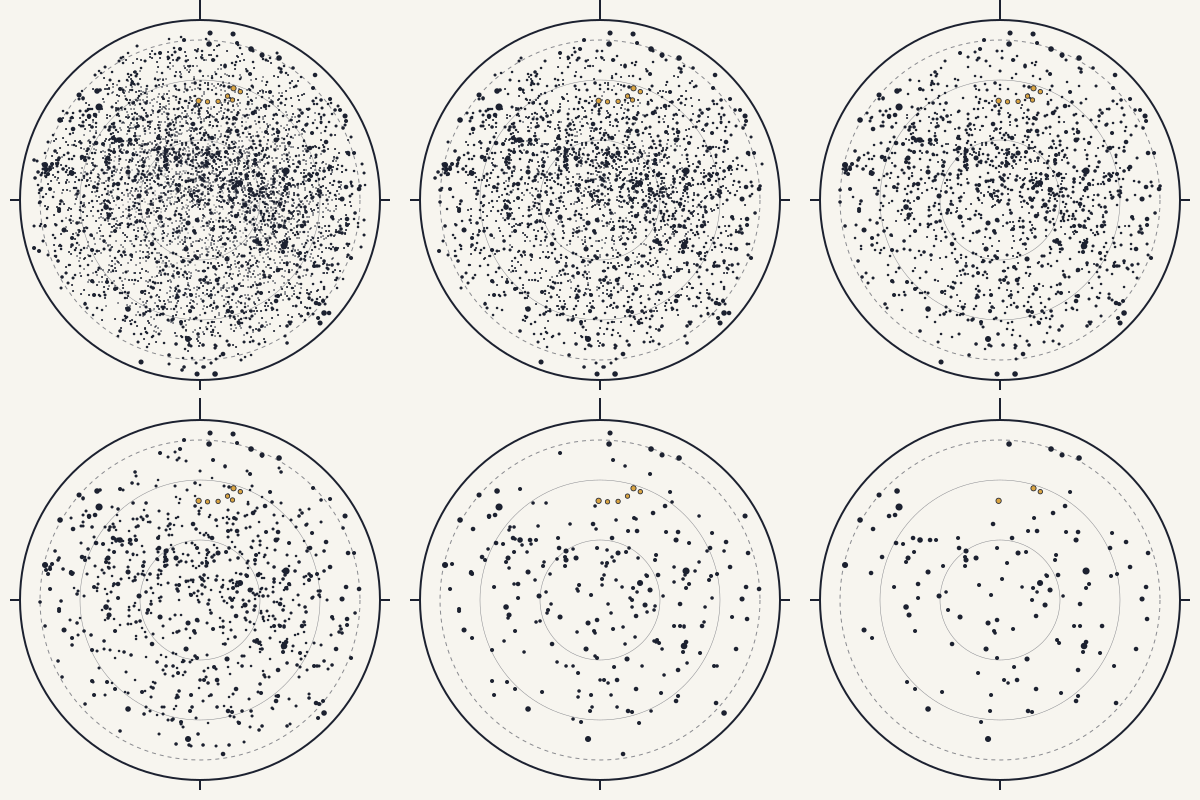
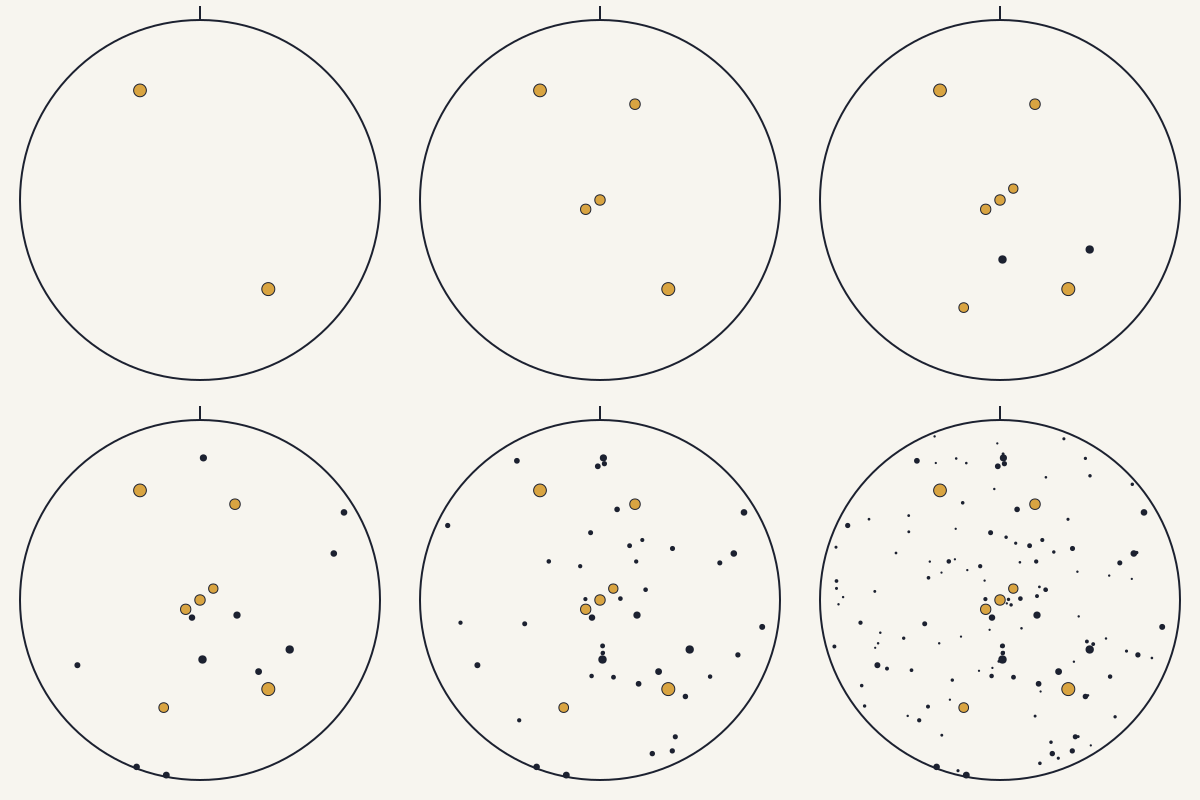
Open the chart full size to zoom in on the detail.
Figure 1. The sky from 40°N on October 15 at 9 p.m. local mean solar time, drawn six times. Top row, left to right: zenith limits 7.0, 6.5 and 6.0; bottom row: 5.5, 4.5 and 4.0, the faint ends of Bortle classes 3, 4, 5, 6, 8 and 9. Each view keeps the HYG v4.4 stars that stay within its limit after sea-level air dimming: 4,974, 2,768, 1,546, 851, 251 and 135. Zenith at center, horizon as the outer circle, dashed ring 10 degrees up, long tick at north; east is left. Gold dots mark the Little Dipper.
Count the stars over a city on a clear night, and the ceiling is about 250. That figure comes from two star catalogues, some arithmetic and the Bortle scale, a nine-class rating of night skies that amateur astronomer John E. Bortle published in Sky & Telescope in February 2001. Bortle gave each class a naked-eye limiting magnitude, the brightness of the faintest star you can see, where lower numbers mean brighter. His city sky, class 8, reaches magnitude 4.5 at best, and by this page's calculation that leaves about 250 stars visible at any moment from 40°N.
Darker classes add stars quickly. By the same calculation, a class 4 sky, on the line between rural and suburban, shows about 2,600 at once on its best night. Like the solar system scale model on a soccer field, every step below is a calculation a reader can redo.
What is the Bortle scale?
Bortle built the scale to replace a single number. In the 2001 article he called naked-eye limiting magnitude a poor criterion. It depends on eyesight and on how hard the observer tries, so two people under one sky can disagree by most of a magnitude. He also noted that a modest amount of light pollution degrades spread-out objects such as comets, nebulae and galaxies far more than stars.
So Bortle describes each class mostly by what else shows. At class 1, the zodiacal light is striking, the galaxy M33 is obvious to the naked eye, and the Scorpius and Sagittarius regions of the Milky Way cast diffuse shadows on the ground. By class 4, light domes rise over towns in several directions, and M33 is a difficult averted-vision object. Class 6 keeps the Milky Way only toward the zenith and class 7 loses it, or nearly so; in class 9, Bortle says, dim constellations such as Cancer and Pisces are not seen at all.
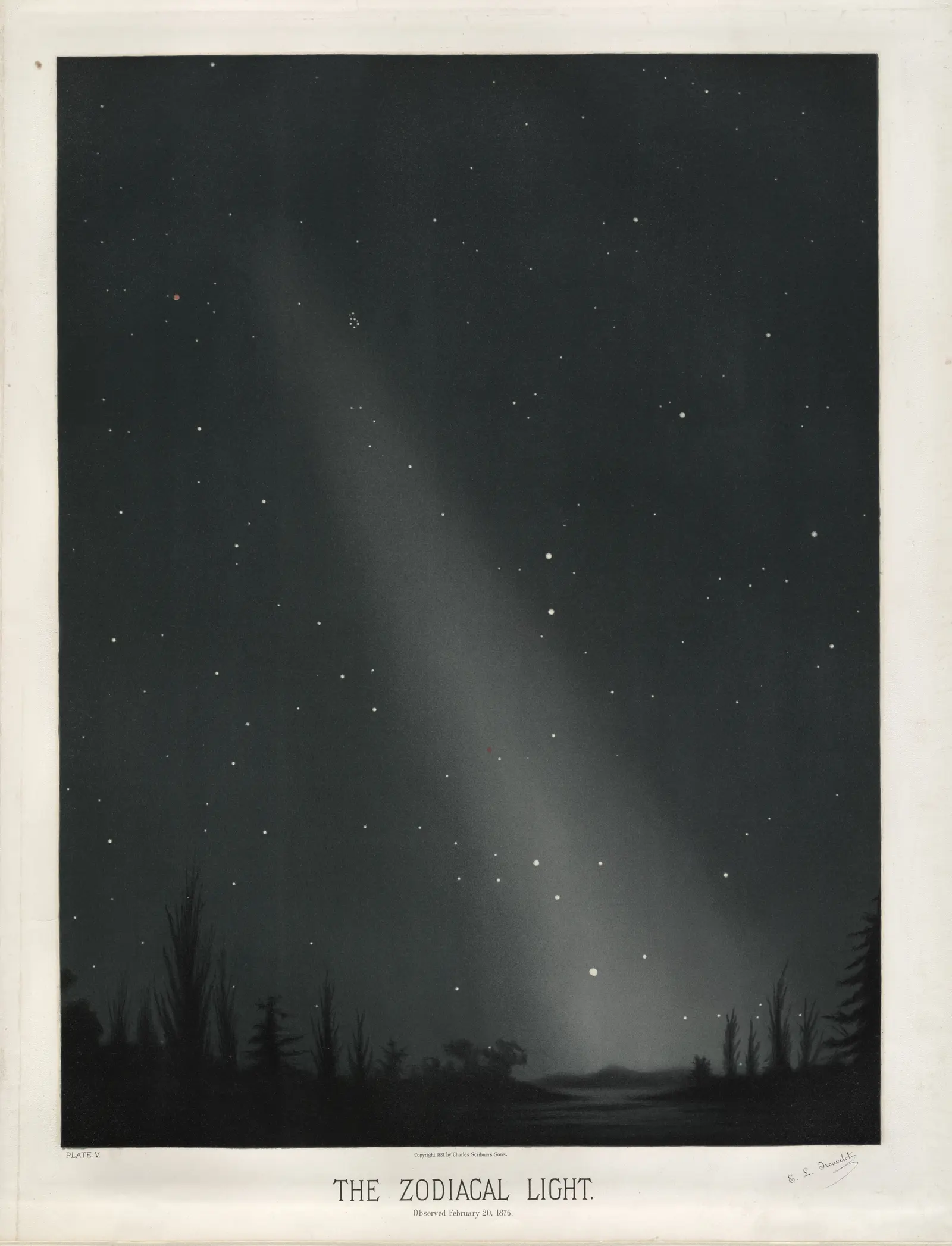

Figure 2. Plate V of The Trouvelot Astronomical Drawings (copyright 1881) by Étienne Léopold Trouvelot: the zodiacal light, observed February 20, 1876. Bortle lists it as striking in a class 1 sky.
Each class still carries a limit. Bortle gave ranges for classes 1 to 5: 7.6 to 8.0 at the dark end, 5.6 to 6.0 at the other. For the rest he gave single figures: about 5.5, then 5.0 "if you really try," 4.5 at best, and 4.0 or less. This page uses his figures as printed.
Start with the naked-eye budget
Before any glow, there is a fixed pool to draw from. This site calls it the naked-eye budget: the roughly 8,400 entries in the Yale Bright Star Catalogue that reach magnitude 6.5 or brighter across the whole sky, 8,404 to be exact. Magnitude 6.5 is also the faint end of Bortle's class 4. So the budget is what a class 4 sky offers on its best night, before the horizon and the air take their share.
The horizon takes the first cut. By this page's calculation, from 40°N, 1,161 of those entries never rise because they lie within 40 degrees of the south celestial pole, and 1,020 never set. At any moment about 3,940 to 4,230 are above a flat horizon, close to half.
The air takes the second cut. Skyglow takes the rest. Think of the budget as a ledger page: the horizon and the air are the first two deductions, and each Bortle class adds one more line for skyglow. What follows is a Fermi estimate in that order: whole sky, above the horizon, then visible.
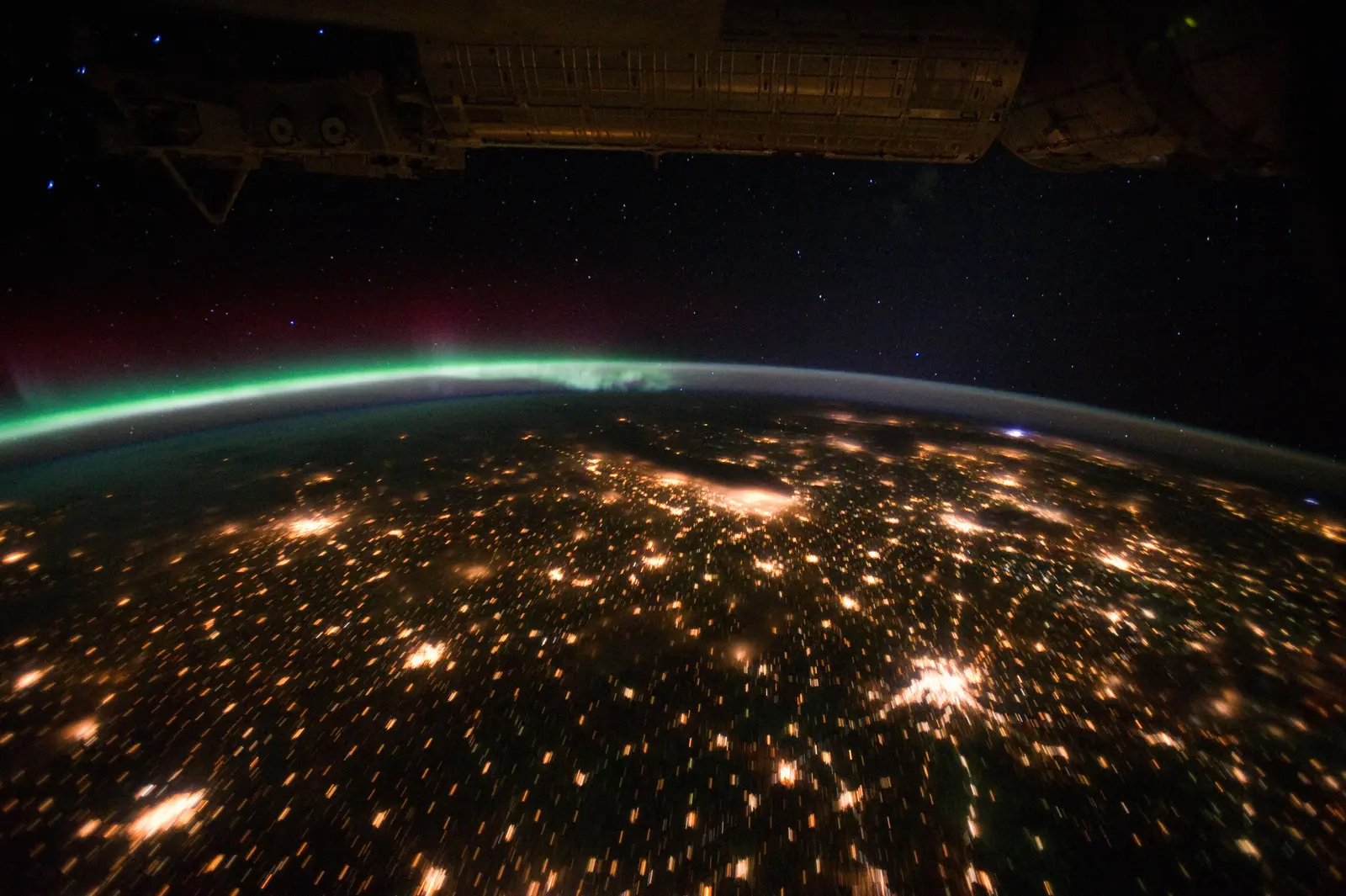
Figure 3. The light behind skyglow: towns and cities across the Midwestern United States, seen from the International Space Station on September 29, 2011. Chicago glows at center, beside dark Lake Michigan; green is aurora.
How many stars can you see in each Bortle class?
The table applies Bortle's limits to two catalogues. "Above the horizon" is an average over a full turn of the sky from 40°N. "Visible at once" also drops every star that the air dims past the limit, using the sea-level extinction formula in the next section. It assumes the observer reaches the class's limit straight overhead, under a sky equally bright in every direction.
| Bortle class | Bortle's name | Naked-eye limit | Whole sky | Above the horizon | Visible at once |
|---|---|---|---|---|---|
| 1 | Excellent dark-sky site | 7.6–8.0 | 28,494–41,486† | 14,070–20,480† | 8,970–13,360† |
| 2 | Typical truly dark site | 7.1–7.5 | 17,273–25,790† | 8,460–12,720† | 5,260–8,080† |
| 3 | Rural sky | 6.6–7.0 | 9,980–15,597† | 4,850–7,600† | 2,980–4,700† |
| 4 | Rural/suburban transition | 6.1–6.5 | 5,642–8,404 | 2,720–4,100 | 1,690–2,620 |
| 5 | Suburban sky | 5.6–6.0 | 3,249–5,080 | 1,560–2,450 | 950–1,510 |
| 6 | Bright suburban sky | about 5.5 | 2,887 | 1,390 | 850 |
| 7 | Suburban/urban transition | 5.0 | 1,630 | 780 | 460 |
| 8 | City sky | 4.5 at best | 904 | 410 | 250 |
| 9 | Inner-city sky | 4.0 or less | 518 | 230 | 145 |
Counts by this page's calculation. Classes 4 to 9 tally the Yale Bright Star Catalogue; classes 1 to 3 (marked †) reach past its 6.5 line and tally HYG v4.4, which holds 8,920 entries at 6.5 or brighter, 516 more than Yale. Ranges run from the bright end to the faint end of Bortle's limits. Above-horizon and visible figures are averages for 40°N, rounded to the nearest 10 (nearest 5 below 200).
CSV download (CC BY-SA 4.0) (Data: HYG Database v4.4 by David Nash (astronexus), CC BY-SA 4.0, https://codeberg.org/astronexus/hyg; Yale Bright Star Catalogue, 5th Revised Ed., by D. Hoffleit and W. H. Warren Jr. (1991), CDS V/50, https://cdsarc.cds.unistra.fr/ftp/V/50/ReadMe (tallies only)), with its provenance note (JSON)
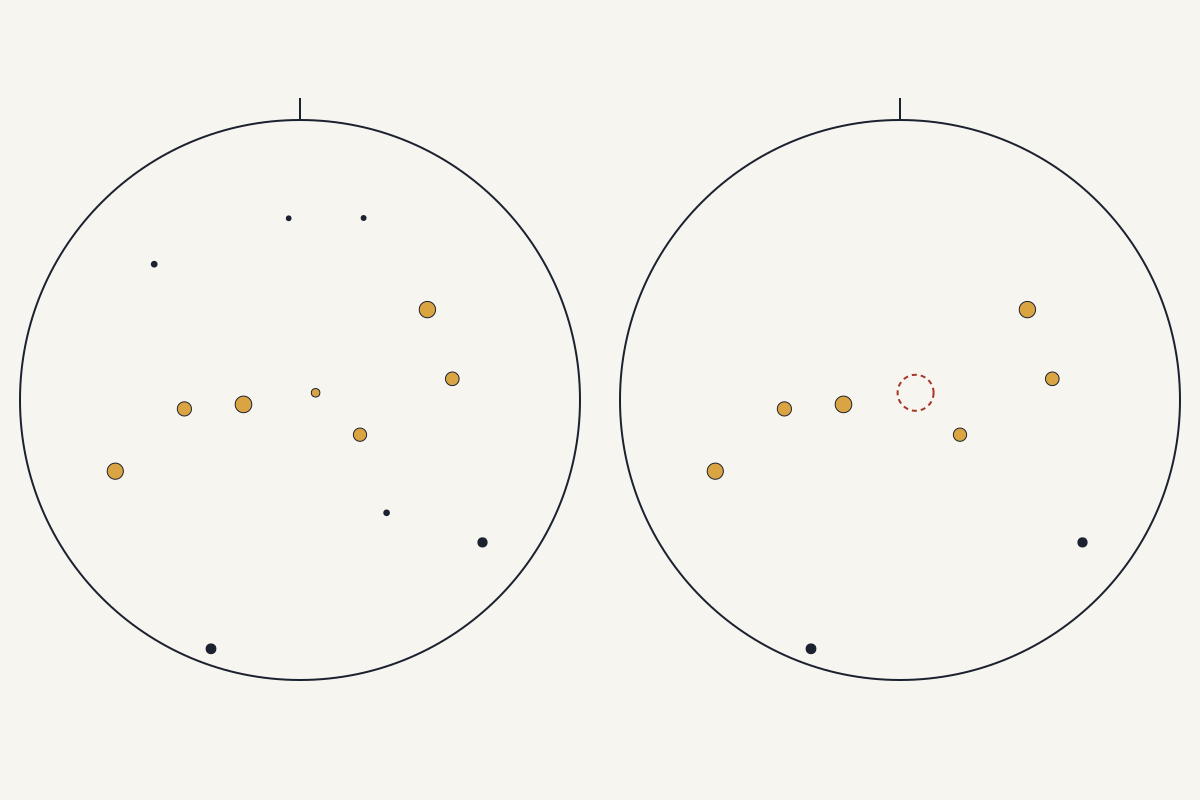
A city sky's best night, class 8, leaves about 250 stars at once, roughly 3 percent of the budget. The inner city, class 9, leaves about 145 at a limit of 4.0. Bortle's "or less" matters: at a limit of 3.0, the count drops to about 45, and the Big Dipper's faintest star, Megrez at magnitude 3.3, is gone (Big Dipper).
Open the chart full size to zoom in on the detail.
Figure 4. The Big Dipper at catalogue limits 4.0 (left) and 3.0 (right); north up, east left. At 3.0, Megrez, where the handle meets the bowl, drops out, leaving the red dashed ring empty.
The steps are close to even. Each half magnitude of limit lost removes 42 to 46 percent of the visible stars in this calculation. That matches the shape of the budget: its faintest half magnitude, 6.0 to 6.5, holds about 40 percent of the 8,404 entries. So within the budget, the step from 6.5 to 6.0 costs the most stars outright, about 1,100 of the 2,620 visible on class 4's best night.
Fainter also means farther, on average. In HYG, the median entry at magnitude 4.0 or brighter lies about 180 light-years away; at 6.5, about 400; at 8.0, about 580. Half of the entries at 4.0 or brighter sent tonight's light less than about two centuries ago; a dark site adds stars whose light set out several centuries back (light-year). Treat these medians as rough.
Why does the horizon cost so many stars?
Light from a low star crosses more air. That path is measured in air masses: one straight overhead, and nearly 6 at 10 degrees up, according to a 1992 extinction procedure by Daniel W. E. Green in the International Comet Quarterly. Green's sea-level formula dims a star by about 0.28 magnitude per air mass. In his table, a star 10 degrees up loses 1.3 magnitudes more than one at the zenith, and a star 30 degrees up loses 0.28 more.
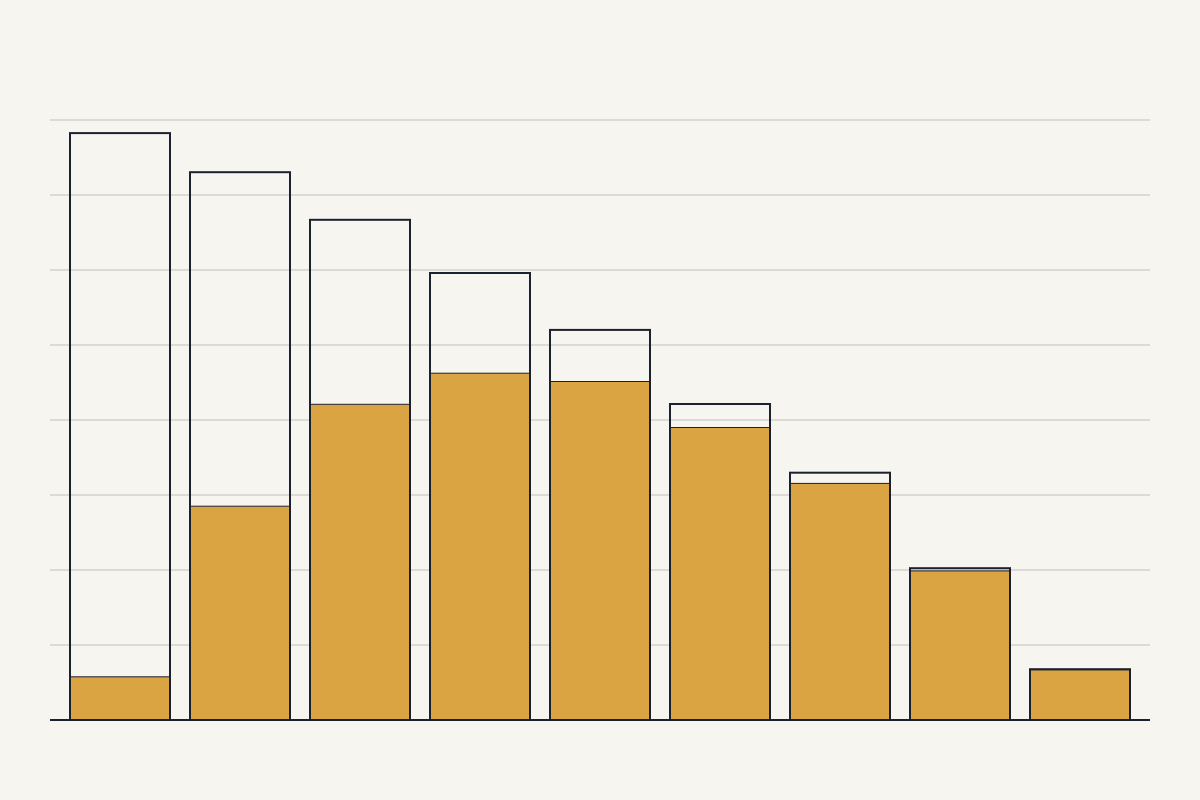
Stars crowd the sky overhead and thin out toward the horizon. Light from a low star crosses more air: nearly 6 air masses at 10 degrees up, against one straight overhead (Green, 1992).
That is the whole rule behind the "visible" column. A star counts if its catalogue magnitude, plus the extra dimming at its altitude, still reaches the zenith limit.
In this calculation, the lowest 10 degrees hold about 18 percent of the entries above the horizon. The air removes about twice that share, 36 percent at a limit of 6.5 in the Yale count (39 percent in HYG, Figure 5), because faint stars fail well above the horizon. Nearly half of the losses fall below 10 degrees, about three-quarters below 20, and about one in eight above 30.
Open the chart full size to zoom in on the detail.
Figure 5. Stars above the horizon at 40°N in nine 10-degree bands of altitude, horizon at left and zenith at right, averaged over a full turn of the sky (HYG v4.4, limit 6.5). Outline: entries above the horizon in each band; gold: entries still within the limit after sea-level air dimming. Gridlines every 100 entries. In the lowest band, 783 entries shrink to 58.
The calculation treats the sky as equally bright in every direction. Real skyglow is not even: in Bortle's class 6, the sky within 35 degrees of the horizon glows grayish white, so true counts near the horizon would be lower. The extinction value cuts the other way. Green, citing Schaefer (1985), gives 0.20 magnitude per air mass for a good night at a dry sea-level site or an average night on a mountain; with it, class 4's best night rises from about 2,620 to about 2,860.
Can anyone see Bortle's class 1 limit?
Bortle's class 1 limit comes with a qualifier: "with effort." This site's naked-eye budget stops at magnitude 6.5, and by this page's calculation even a class 4 sky at its best shows about 2,600 stars at one time.
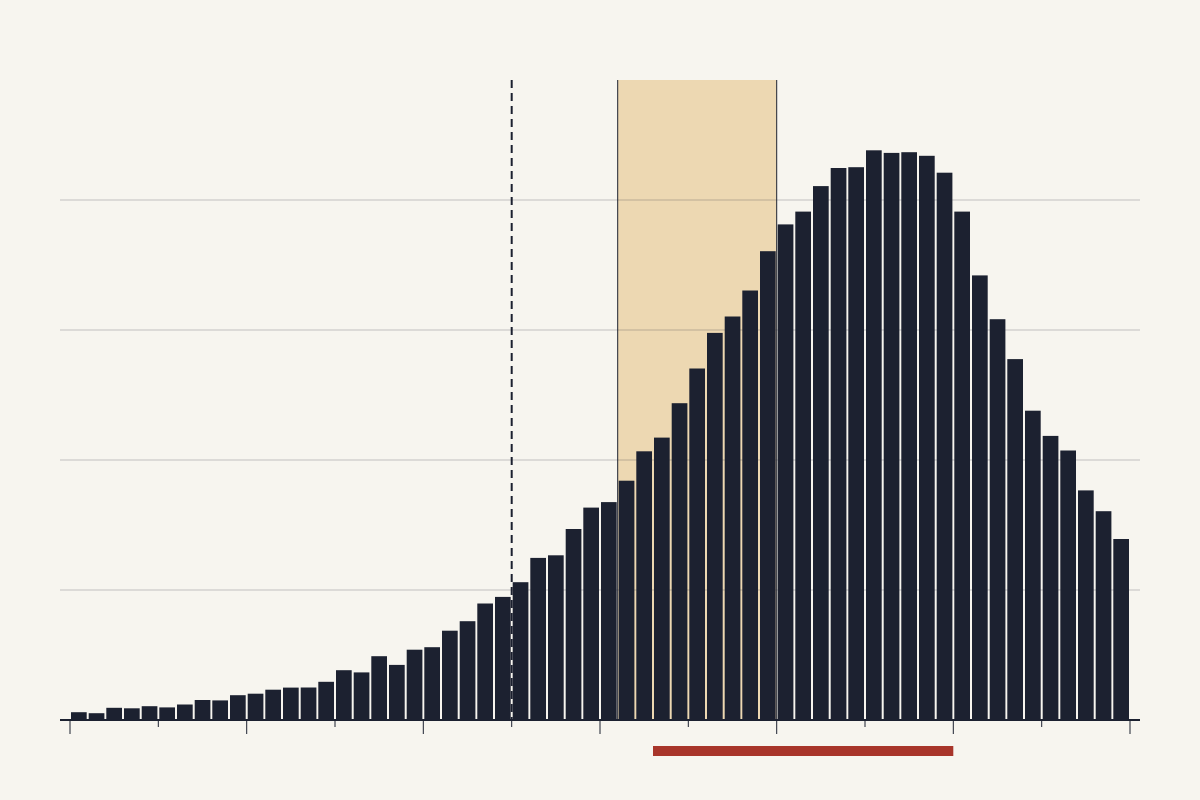
For classes 1 and 2, Bortle's limits run 0.6 to 1.5 magnitudes past that 6.5. A 2014 paper by Andrew Crumey in Monthly Notices of the Royal Astronomical Society notes that a 1947 study by Weaver upheld a typical dark-sky limit of just over 6. Crumey calls the higher modern figures, Bortle's among them, "a substantial raising of achievement and expectation." Apart from unusual eyesight or special techniques, he suggests, such limits may often come from twinkling, with momentary glimpses taken as the usual threshold.
The catalogue thins out at that end too. HYG combines the Hipparcos, Yale and Gliese catalogues. Wikipedia's account of Hipparcos describes its input survey as aimed at completeness only to about magnitude 7.3 to 9.0, depending on a star's spectral type and galactic latitude. Read the class 1 and 2 rows as counts for eyes that reach Bortle's limits, drawn from a catalogue that may already be missing stars near magnitude 8.
Open the chart full size to zoom in on the detail.
Figure 6. HYG entries per tenth of a magnitude climb steeply past 6.5 (dashed line) through Bortle's class 1 and 2 limits (gold), then fall after 9. Red: the Hipparcos survey's completeness limits, 7.3 to 9.0.
What does a bright sky take besides stars?
The Milky Way drops out in stages. Bortle's descriptions fade it near the horizon in class 5, keep only a trace toward the zenith in class 6, and lose it entirely or nearly so in class 7, a sky that by this page's count still shows about 460 stars. A 2016 world atlas of artificial sky brightness, led by Fabio Falchi, was built from 2014 satellite data and calibrated with more than 35,000 measurements. The atlas estimated that the Milky Way is hidden from more than one-third of humanity, including nearly 80 percent of North Americans.
Volunteer observations point the same way. A 2023 study in Science led by Christopher C. M. Kyba used 51,351 naked-eye star-visibility reports from 2011 to 2022. It found that the drop in visible stars could be explained by skies brightening 7 to 10 percent a year in the band human eyes see.
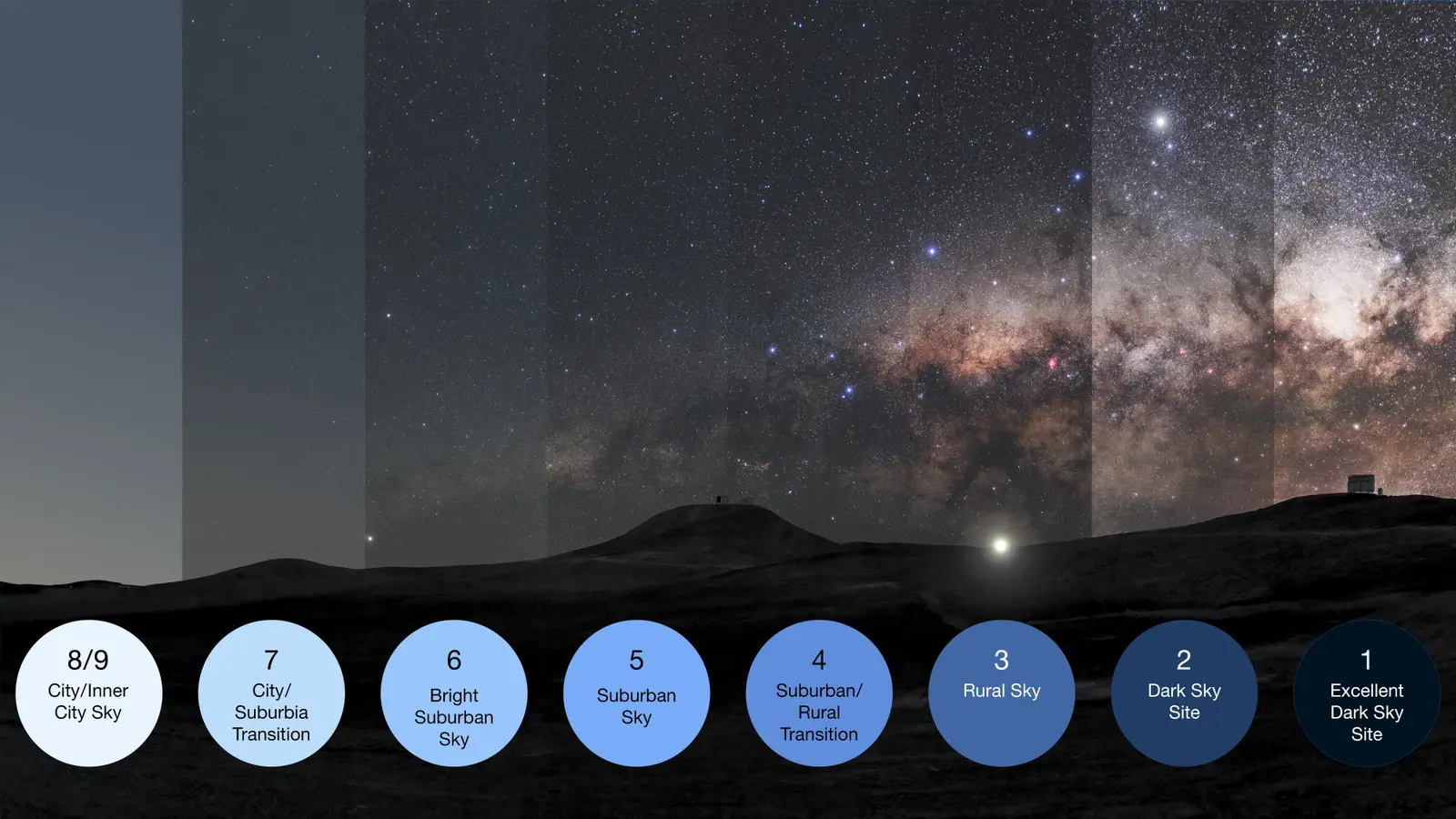

Figure 7. ESO's illustration of the Bortle scale, not a set of separate photographs: ESO describes it as a modification of one original photograph taken at Paranal Observatory in Chile, a site with excellent dark-sky conditions. Bands run from city skies at left, where classes 8 and 9 share one band, to class 1 at right.
This site's position is that a dark sky is a heritage site, worth keeping the way an old building is kept. Many star names, myths and calendars were written against a sky their authors could see. Cancer's brightest entry in HYG is magnitude 3.5, and only two of its entries reach 4.0, so a class 9 sky leaves Cancer with almost nothing to show. The worry is the reference object: the story survives on the page while the figure it describes leaves the sky.
Where is the nearest dark sky?
The nearest dark sky depends on where you live; two kinds of guide help you find it. A National Park Service list, updated in April 2025, names over 40 parks certified as International Dark Sky Places, by state. Light-pollution maps cover the rest: the 2016 Falchi atlas maps North America and counts the Boston-to-Washington corridor among the widest regions where the Milky Way is lost. Whichever site you choose, bring a companion, leave your route and return time with a friend, use a red light and keep off private land.
How do you find your own Bortle class?
Count stars against a chart. Globe at Night, a citizen-science campaign run by NSF's NOIRLab, prints Orion charts that show the constellation's stars cut off at limits from magnitude 1 to 7. You pick the chart that matches the faintest stars you can see. For the charts' constellation itself, see Orion.
Open the chart full size to zoom in on the detail.
Figure 8. Orion's field at catalogue limits 1 to 6, reading across then down: 2, 5, 9, 18, 51 and 137 entries. North up, east left; Betelgeuse is the gold dot at upper left.
Globe at Night's 2026 activity guide says to go out at least an hour after sunset with no Moon up, to let your eyes adapt for at least 10 minutes, and to bring a red light to preserve night vision. A darker site makes the table concrete. If you drive somewhere darker to compare, go with someone, tell someone where you will be and when you will be back, carry a red flashlight, and stay off private land, roads and cliff edges.
Once you know your limit, every constellation you can name becomes a gauge for your own sky.
Sources
- John E. Bortle, "Introducing the Bortle Dark-Sky Scale," Sky & Telescope, February 2001, pp. 126-129https://planesynormas.mma.gob.cl/archivos/2021/proyectos/ANTECEDENTES_RECOPILADOS_POR_EL_MMA_PARTE_3_ASTRONOMI__769_A.pdfRead: pages 126-129 of the printed article, as reproduced in a public file of Chile's Ministry of the Environment (Antecedentes recopilados por el MMA, Parte 3, folios 2524-2527)
- Wikipedia, "Bortle scale" (amateur astronomer John E. Bortle; the scale devised as an alternative to raw naked-eye limiting magnitude; Crumey 2014 cited in Reception)https://en.wikipedia.org/wiki/Bortle_scaleRead: article text as of 2026-10-12
- D. Hoffleit and W. H. Warren Jr., The Bright Star Catalogue, 5th Revised Ed. (1991), CDS V/50, ReadMe and catalogue filehttps://cdsarc.cds.unistra.fr/ftp/V/50/ReadMeRead: ReadMe and catalogue file; used for counts only, no records reproduced
- David Nash (astronexus), HYG Database v4.4, data README and licence (CC BY-SA 4.0)https://codeberg.org/astronexus/hygRead: repository README and licence, and the v4.4 data file hyg_v44.csv.gz
- Daniel W. E. Green, "Magnitude Corrections for Atmospheric Extinction," International Comet Quarterly 14 (July 1992): 55-59http://www.icq.eps.harvard.edu/ICQExtinct.htmlRead: full text and Table Ia on the ICQ web page
- Globe at Night (NSF NOIRLab), "Activity Guide: Orion," 2026 campaign, edition for latitude 30°N in English, with magnitude charts prepared by Jenik Hollan (CzechGlobe): Orion charts from below magnitude 1 to magnitude 7; go out at least an hour after sunset, with no Moon; wait at least 10 minutes for the eyes to adapt; a red light to preserve night visionhttps://globeatnight.org/documents/1041/GaN_2026_ActivityGuide_Orion_lat_30N_English.pdfRead: full guide (4 pages)
- Andrew Crumey, "Human Contrast Threshold and Astronomical Visibility," Monthly Notices of the Royal Astronomical Society 442, 2600-2619 (2014); arXiv:1405.4209https://arxiv.org/abs/1405.4209Read: arXiv preprint full text (section 1.6.5, Definition of threshold); volume and pages from the Wikipedia citation
- Wikipedia, "Hipparcos" (Input Catalogue of some 118,000 stars; survey as complete as possible to V < 7.9 + 1.1 sin|b| for spectral types earlier than G5 and V < 7.3 + 1.1 sin|b| for later types)https://en.wikipedia.org/wiki/HipparcosRead: article text as of 2026-10-12
- F. Falchi, P. Cinzano, D. Duriscoe, C. C. M. Kyba, C. D. Elvidge, K. Baugh, B. A. Portnov, N. A. Rybnikova and R. Furgoni, "The new world atlas of artificial night sky brightness," Science Advances 2, e1600377 (2016)https://doi.org/10.1126/sciadv.1600377Read: full text via Europe PMC (PMC4928945)
- C. C. M. Kyba, Y. Ö. Altıntaş, C. E. Walker and M. Newhouse, "Citizen scientists report global rapid reductions in the visibility of stars from 2011 to 2022," Science 379, 265-268 (2023)https://doi.org/10.1126/science.abq7781Read: abstract only (Europe PMC, PMID 36656932)
- ESO, "How light pollution affects the dark night skies" (image dark-skies, released June 29, 2022; credit ESO/P. Horálek, M. Wallner), with ESO’s usage terms pagehttps://www.eso.org/public/images/dark-skies/Read: image page and https://www.eso.org/public/outreach/copyright/
- Wikipedia, "Sidereal time" (Earth rotation angle formula after Urban & Seidelmann 2013)https://en.wikipedia.org/wiki/Sidereal_timeRead: article text as of 2026-10-12
- Étienne Léopold Trouvelot, "The Zodiacal Light. Observed February 20, 1876," Plate V of The Trouvelot Astronomical Drawings (Charles Scribner's Sons, copyright 1881); New York Public Library scan on Wikimedia Commonshttps://commons.wikimedia.org/wiki/File:Zodiakallicht.jpgRead: the plate scan (printed title, plate number, observation date, copyright line and signature) and the Commons file page
- NASA, "Aurora Borealis and city lights on the horizon taken by the Expedition 29 crew," image ISS029-E-012564 (September 29, 2011; photographer Mike Fossum), NASA Image and Video Libraryhttps://images.nasa.gov/details/iss029e012564Read: asset record and full description, embedded metadata, and NASA Images and Media Usage Guidelines
- U.S. National Park Service, "Visit Parks with Dark Night Skies" (article; over forty parks within the National Park System are International Dark Sky Places, certified by Dark Sky International; list of certified parks by state; last updated April 16, 2025)https://www.nps.gov/articles/000/dark-sky-parks-tour.htmRead: full page
Computed by this site (2026-10-12) from sources 3, 4 and 5, with source 12 for the October 15 view: the 8,404-entry budget and its 40°N rising and setting counts, the class-by-class counts and their averages, the lowest-10-degree share and the share removed by the air, the half-magnitude steps, median distances, Cancer's entries, and the Little Dipper's altitudes and dimming.
Corrections
2026-10-14 — Added a section on finding the nearest dark sky (not covered → a National Park Service list, updated in April 2025, of over 40 parks certified as International Dark Sky Places; the 2016 Falchi light-pollution atlas for North America; a reminder to bring a companion, leave the route and return time with a friend, use a red light and keep off private land), with source 15 added. Source 1, John E. Bortle's February 2001 article, now cites its printed pages (pp. 126–129) in place of the 2006 web version; no figure on the page changed. Both prompted by a recheck.
2026-11-01 — The chart for gauging your sky is now Globe at Night's set of Orion magnitude charts, in place of a printable wheel no longer cited (limits from magnitude 1 to 6 → 1 to 7; letting your eyes adjust for 20 minutes → at least 10 minutes). The 6.5 limit for perfect skies is now this site's naked-eye budget rather than a quoted figure, and the quoted definition of limiting magnitude and the few-thousand-stars figure were removed; the page's own class 4 count of about 2,600 stands. Source 6 replaced, prompted by a recheck.
Look up next:
The Little Dipper, whose bowl hangs below and to the left of Polaris when you face north on mid-October evenings. Its seven stars run from magnitude 1.97 to 4.95 in HYG: Polaris, Kochab and Pherkad, then Epsilon (4.21), Zeta (4.29), Yildun (4.35) and Eta (4.95). At 9 p.m. local mean solar time in mid-October from 40°N, this page's calculation puts all seven about 32 to 41 degrees up, where the air dims them by 0.15 to 0.25 magnitude. Seeing only three puts your limit brighter than about 4.4, in Bortle's city and inner-city range; seeing all seven puts it near 5.1 or fainter. Read on: Orion, the constellation on Globe at Night's magnitude charts.
Related entries
- Solar System Scale Model: On a Soccer Field, Four Planets Fit in the Goal Area
- Light-Year: Its Year Runs 11 Minutes Longer Than the Seasons
- Naked-Eye Budget: About 8,400 Entries, Never All in One Sky
- Orion Constellation: The Winter Hunter Rises Before Dawn in August
- Big Dipper: Not a Constellation, and Two of Its Stars Are Strangers
Cite this page
Asterisms & Astrolabes. “Bortle Scale: A City Sky Tops Out Near 250 Stars.” Asterisms & Astrolabes. Published 13 October 2026; last substantive revision 1 November 2026. https://asterismsandastrolabes.com/scale/bortle-scale/. Accessed [the date you read it].