Deep explainer
First Photograph of a Star: Vega in 1850, or the Sun in 1845
TL;DR: The first photograph of a star other than the Sun showed Vega: Boston photographer John Adams Whipple made several images at Harvard College Observatory on July 17, 1850, each needing about 100 seconds. Count the Sun as a star, and Hippolyte Fizeau and Léon Foucault got there first, in Paris on April 2, 1845, in one-sixtieth of a second.
In this entry11 sections
- What was the first photograph of a star?
- Does the Sun count as the first star photographed?
- Why was a star so hard to photograph in 1850?
- Can you see the 1850 Vega plate?
- What changed when star photography moved to glass?
- How did one bright dot become a map of the whole sky?
- When can you see Vega?
- Sources
- Look up next
- Related entries
- Cite this page
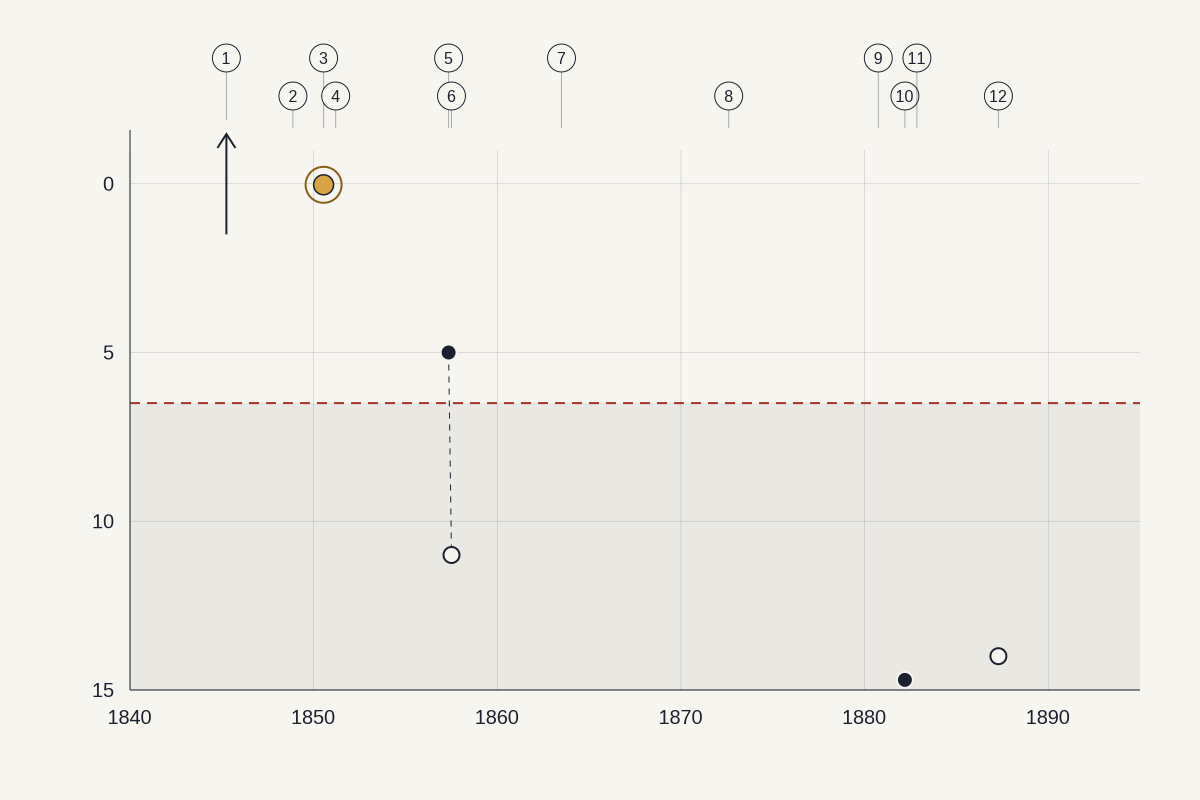
Scroll sideways to trace the whole chart, or open it full size.
Figure 1. How faint a star photograph could reach, 1845 to 1887; fainter stars sit lower. Gold dot: Vega, 1850. Filled dots: the faintest stars recorded in 1857 and 1882. Hollow dots: George Bond's 1857 forecast and the 1887 sky-map plan. Red dashed line: magnitude 6.5, the usual naked-eye limit. Arrow: the Sun, far off the scale. Numbers match the table below.
Vega needed about 100 seconds to leave a mark on a silvered plate. On July 17, 1850, the Boston photographer John Adams Whipple made several such images at Harvard College Observatory, using the daguerreotype process at the focus of its 15-inch telescope. Those plates are the standard answer to the question of the first photograph of a star.
The answer has a footnote. The Sun is a star too, and two Paris physicists had photographed it five years earlier.
Harvard's director, William Cranch Bond, reported the result that December. "We have reason to believe this to be the first successful experiment of the kind ever made, either in this country or abroad," he told the observatory's visiting committee. Note the hedge. The claim of a first began with the observatory itself, and its page on the telescope still calls the Vega image "the first daguerreotype ever made of a star."
What was the first photograph of a star?
It was Vega. The brightest star in the constellation Lyra sits at magnitude 0.03 in the HYG star catalogue (lower numbers mean brighter), fifth among the night-time stars. The daguerreotype process put the image on a sheet of silver-plated copper polished to a mirror finish.
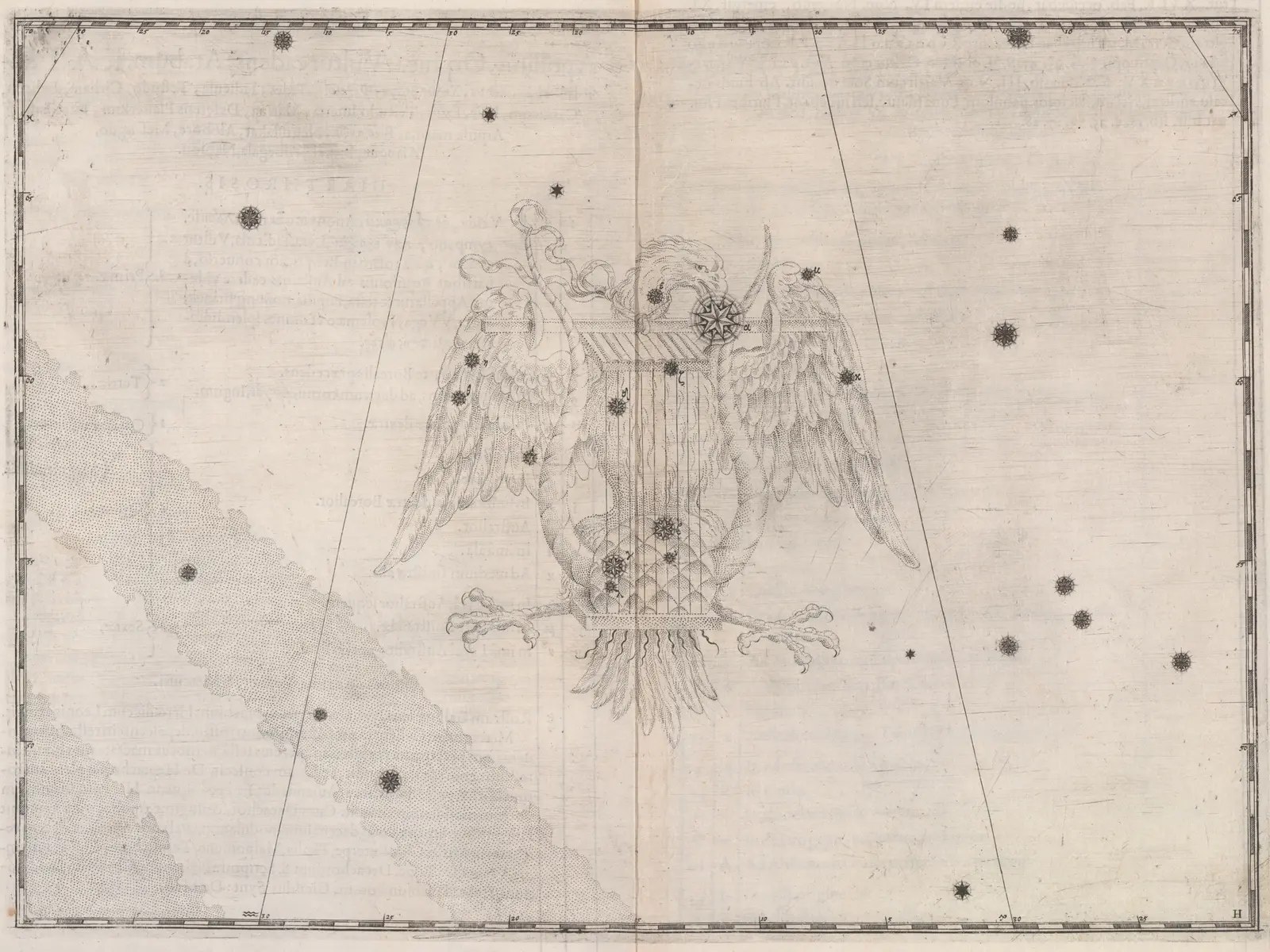

Figure 2. Lyra in Johann Bayer's star atlas Uranometria (1603). The biggest star, lettered alpha at the top of the lyre, is Vega.
George Phillips Bond, the director's son and assistant, spoke to the American Academy of Arts and Sciences in 1857. He credited "the well-known artist, Mr. J. A. Whipple of Boston," and dated the Vega images "the 17th of July, 1850." Afterward the team tried the double star Castor. It came out as "an elongated disc, but no distinct separation of its two components."
In a letter that July, quoted in H. H. Turner's 1912 history of the international sky map, Bond put a number on it. Vega "in 1850 required 100 s to impart its image to the plate, and even then imperfectly." The team had been "confined to a dozen or two of the brightest stars." What the plates proved, in his words, was "a simple but not uninteresting fact": the possibility of photographing a star at all.
Light's departure: the starlight on Whipple's plates had left Vega around 1825. The light reaching you from Vega tonight left it about 25 years ago (light-year). HYG puts Vega 25.04 light-years away. The 2007 Hipparcos parallax quoted in Wikipedia's Vega article, 130.23 ± 0.36 milliarcseconds, gives the same distance with an uncertainty of about 0.07 light-year.
Popular claims, checked
"The first photograph of a star was taken at Harvard in 1850." True for stars other than the Sun, and Harvard's own 1850 report worded it as a belief. The Sun had been photographed in Paris in 1845.
"George Bond took it." William Cranch Bond's 1850 report credits the plates to "the assistance of Mr. Whipple, daguerreotypist," and George Bond's 1857 account says Whipple obtained them at the observatory. Wikipedia's biography of George Bond says Bond took it. Daniel Baker's 1890 history of the observatory gave the "prestige of the beginning" to "the administration of the senior Bond" and added that his son "shared fully" in the work.
"It was one photograph." The 1850 report speaks of "several impressions of the star Vega."
Does the Sun count as the first star photographed?
If the Sun counts, the answer is at least five years older. On April 2, 1845, Hippolyte Fizeau and Léon Foucault photographed it in Paris in one-sixtieth of a second, a plate reproduced as figure 163 in François Arago's Astronomie populaire (1855). To see the Sun yourself, never look straight at it without protection: the American Astronomical Society's eclipse safety page says to use only eclipse glasses or handheld viewers that meet the ISO 12312-2 standard, or pinhole projection. Never look through a camera lens, binoculars or a telescope without a special solar filter, and regular sunglasses are not safe.
Wikipedia's history of astrophotography hedges even that first, saying the Sun "may have been first photographed" in Fizeau and Foucault's 1845 daguerreotype. By this page's calculation from HYG magnitudes, Vega sends Earth about 50 billion times less light than the Sun. Its exposure ran about 6,000 times longer.
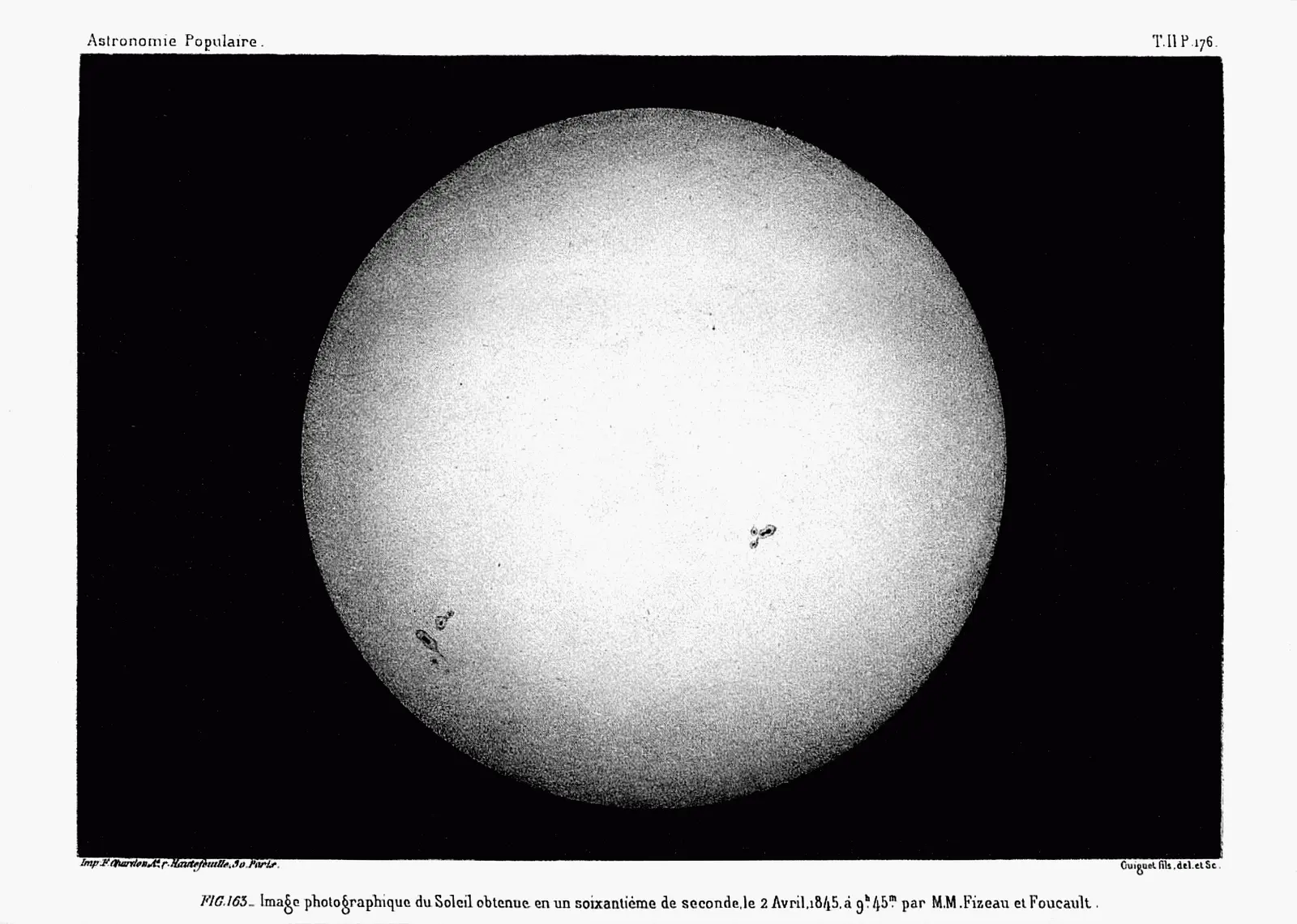

Figure 3. The Sun on April 2, 1845, from Fizeau and Foucault's daguerreotype, drawn and engraved by Guiguet fils as Figure 163 of Arago's Astronomie populaire (1855).
Other firsts carry fine print too. A 2010 article in the Science History Institute's magazine, then called Chemical Heritage, credits John William Draper with the first photographs of the Moon, taken from the roof of New York University in March 1840. A 2021 Library of Congress blog post by photography curator Micah Messenheimer dates successful lunar daguerreotypes to Whipple's work with the Bonds in 1851. George Bond, writing in 1857, dismissed one rival story outright: "The rumour of a daguerreotype of a nebula made in Italy some years since, was unfounded."
Why was a star so hard to photograph in 1850?
Two problems met at the telescope's focus. The plate was slow, and the sky moves. Earth turns once every 23 hours 56 minutes relative to the stars. A star near the celestial equator therefore crosses the sky at about 15 arcseconds each second; at Vega's declination, this page's calculation gives 11.7.
Bond's 1849 description of the observatory puts the Great Refractor's focus 22 feet 6 inches behind its lens. At that focus, by this page's calculation, Vega's image drifts about 0.4 millimeter every second unless the telescope follows it. Over a 100-second exposure, a telescope standing still would have dragged it almost 4 centimeters (1.5 inches). The best star images Bond later measured were 1 to 3 arcseconds across, only 0.03 to 0.1 millimeter at this focus.
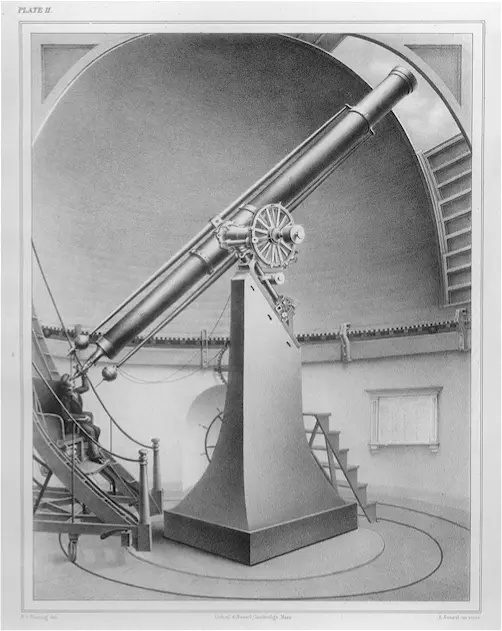

Figure 4. The Great Refractor in Plate II of William Cranch Bond's 1849 description of the observatory, drawn by B. F. Nutting and lithographed by A. Sonrel. Whipple's Vega plates were made at its focus the next year.
The telescope did not stand still. Clockwork "regulated by the friction of centrifugal balls" turned it to follow the stars. Bond himself complained in 1849 that the clock was "disproportionate to the other parts of the instrument, and in cold weather requires frequent adjustment." By 1852 he wrote that without "more powerful and accurate machinery for driving the telescope," there was little prospect of better images unless the plates became more sensitive.
Can you see the 1850 Vega plate?
Not on this page. An image titled "The first image of Vega" on Wikimedia Commons gives a social-media image link as its source, not an archive record. This site could not trace it to any collection, so it is not reproduced here.
The nearest traceable picture comes from the same team and telescope eight months later. Bond's 1851 report mentions "daguerreotypes of the moon and several of the stars" taken with Whipple. Whipple's Moon won a prize medal at the Great Exhibition in London that year.
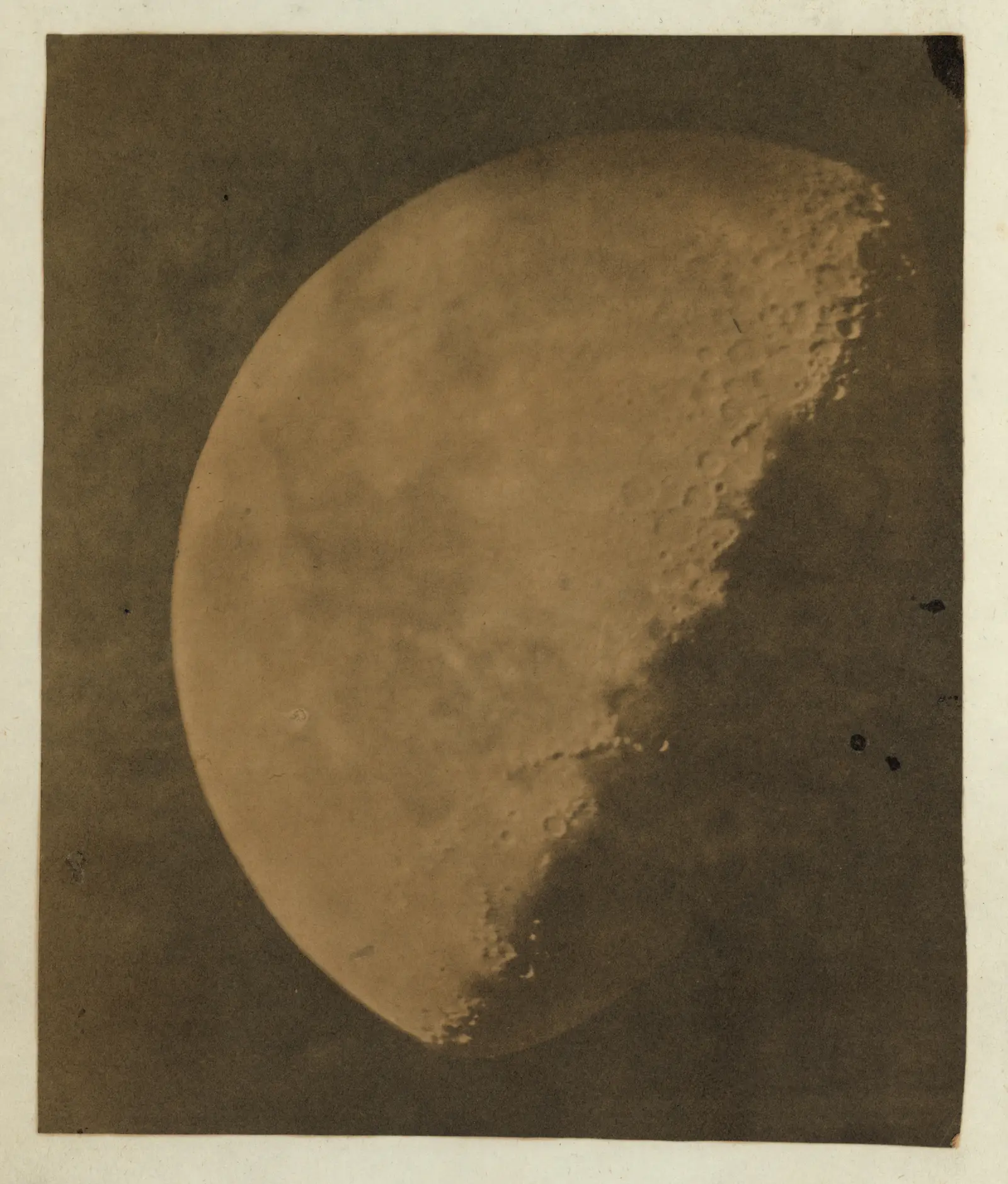

Figure 5. Stand-in for the Vega plate, which is not shown: the Moon in March 1851, photographed by John Adams Whipple at Harvard and printed in 1853 as a salted-paper copy of his daguerreotype for the frontispiece of the Photographic Art-Journal (Library of Congress record LCCN 2009632011, https://lccn.loc.gov/2009632011). Its light left the Moon about 1.3 seconds before reaching the plate.
What changed when star photography moved to glass?
The next step came in 1857, and it started with the clock. George Bond told the American Academy that progress had waited on "suitable apparatus for communicating uniform sidereal motion to the telescope." A new clock on the spring-governor principle, invented by the Bonds and built by George and Alvan Clark, replaced the original Munich clock. Whipple and his colleague Black then used the collodion process on glass and recorded stars "to the fifth magnitude, inclusive."
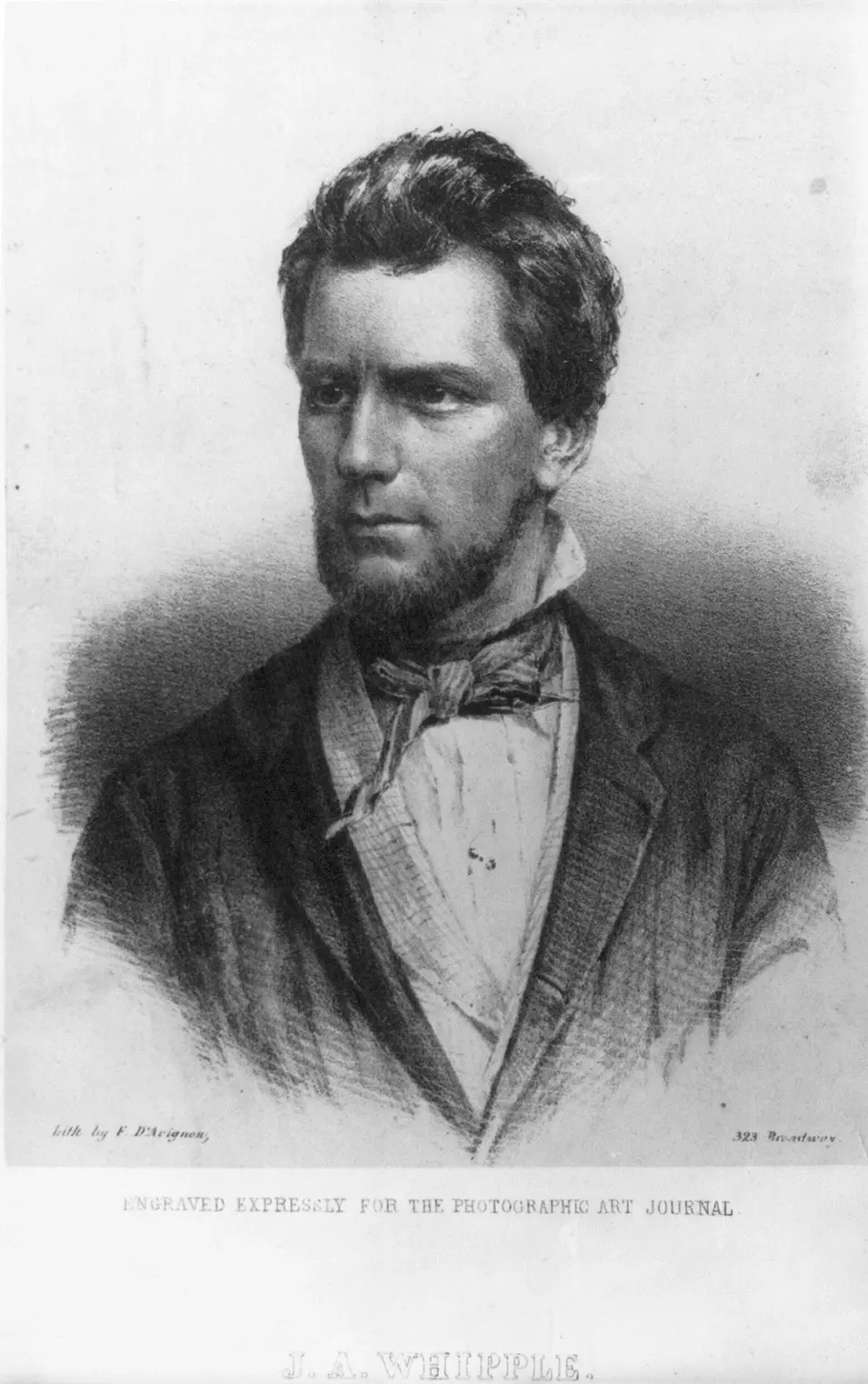

Figure 6. John Adams Whipple, who made the 1857 glass plates with Black, in Francis D'Avignon's lithograph for the Photographic Art-Journal (1851).
Their showpiece put Mizar, its companion and Alcor, in the handle of the Big Dipper, on one plate. Measured from the plates, the companion sat 14.49 arcseconds from Mizar on average. Struve's own visual measurements, as Bond quoted them, averaged 14.40. Bond put the probable error of one photographic measurement at 0.12 arcsecond, "quite as small as that attributed by Struve to a single direct measurement."
Bond guessed where it might lead in his July 1857 letter. If plates reached the seventh magnitude, a mountain site might add the eighth. A telescope three times wider could then catch "all the stars to the tenth and eleventh magnitude inclusive."
In January 1858 he explained why plates mattered. A photograph keeps "the original record," which "can at any time be resorted to, to clear up doubtful points." Think of each glass plate as a receipt stub: the night's observation can be audited again decades later. Bond also saw brightness written in the images, in their size and in how long a star took "to produce the first visible trace of chemical action."
How did one bright dot become a map of the whole sky?
Vega came back in 1872. On August 8 that year, Henry Draper photographed its spectrum with his 28-inch reflector at Hastings-on-Hudson, New York, and the plate showed four lines "very distinctly." George Barker's 1887 account calls it "the first spectrum photograph showing distinct lines." He gives the earlier record to William Huggins, whose 1863 photograph of the spectrum of Sirius was "scarcely more than a stain on the plate."
Dry plates were far more sensitive, and Barker's memoir dates Draper's switch to them to 1879. A 57-minute exposure on September 30, 1880, gave Draper what Barker calls the first photograph of the Orion Nebula. On March 14, 1882, a 137-minute exposure "showed stars of the 14.7 magnitude of Pogson's scale invisible to the eye." The clock mattered more as exposures grew: as Barker wrote, any error in the driving clock "increases with the time of exposure."
In 1882 the Great Comet sent camera owners out. Turner says the Earth's rotation spoiled their pictures. At the Cape of Good Hope, David Gill, Her Majesty's Astronomer there, invited one of them to strap his camera to a clock-driven telescope. The plates showed the comet and a striking number of stars.
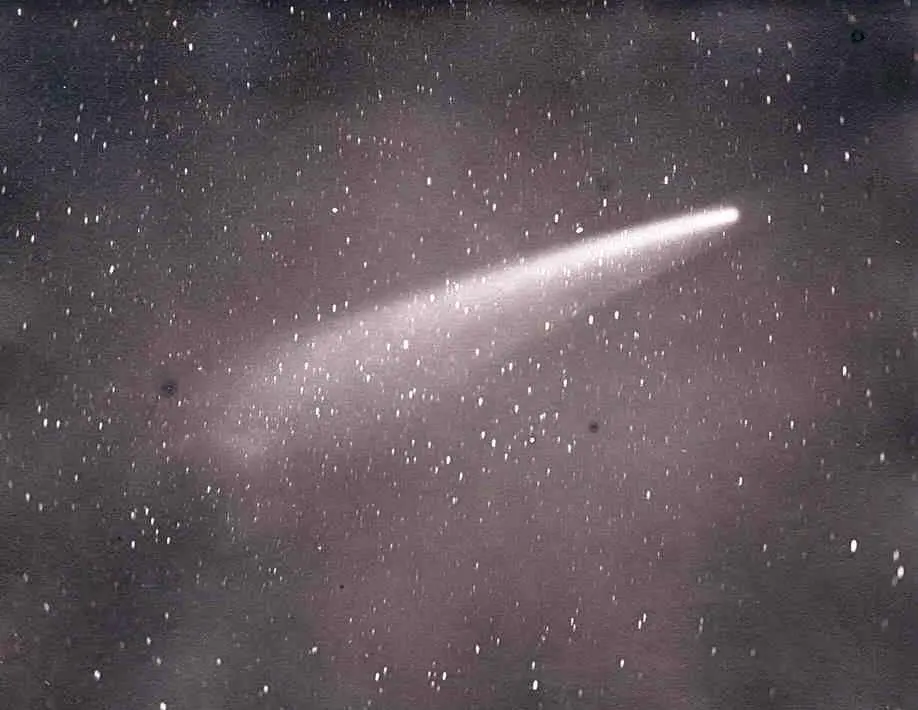

Figure 7. The Great Comet of 1882 among the stars, photographed at the Cape of Good Hope on November 7, 1882, by David Gill with the help of Edward Haggar Allis, a local photographer.
Letters between Gill and Admiral Mouchez of the Paris Observatory then led to a conference in Paris on April 16, 1887, to photograph the whole sky. Its planners expected 15-minute exposures to reach the 14th magnitude.
| # | Date | Who | What happened |
|---|---|---|---|
| 1 | 1845-04-02 | Fizeau and Foucault, Paris | The Sun, in 1/60 second |
| 2 | 1848 | W. C. Bond, Harvard | Trials at the telescope "not attended with complete success" |
| 3 | 1850-07-17 | J. A. Whipple, Harvard | Several images of Vega, about 100 seconds each |
| 4 | 1851 | J. A. Whipple, Harvard | Moon daguerreotypes win a prize medal in London |
| 5 | 1857, April–May | Whipple and Black, Harvard | Glass plates of Mizar and Alcor; stars to magnitude 5 |
| 6 | 1857-07-06 | G. P. Bond | Forecasts plates of stars to magnitude 10 and 11 |
| 7 | 1863 | William Huggins | Spectrum of Sirius, "scarcely more than a stain" |
| 8 | 1872-08-08 | Henry Draper | Spectrum of Vega with four lines |
| 9 | 1880-09-30 | Henry Draper | First photograph of the Orion Nebula, 57 minutes |
| 10 | 1882-03-14 | Henry Draper | 137-minute plate of Orion shows magnitude 14.7 |
| 11 | 1882 | David Gill, Cape of Good Hope | Camera on a clock-driven telescope records the comet and many stars |
| 12 | 1887-04-16 | Paris conference | Plan to photograph the whole sky; 15-minute plates to magnitude 14 |
Table sources: listed per row in the CSV. Magnitude for Vega: HYG v4.4.
CSV download (CC BY 4.0) (Data: HYG Database v4.4 by David Nash (astronexus), CC BY-SA 4.0, https://codeberg.org/astronexus/hyg), with its provenance note (JSON)
Harvard kept photographing. Its collection of astronomical glass plates holds over 550,000 negatives and spectral images, according to the DASCH digitization project, and hundreds of women studied and curated them. DASCH's legacy data release, DR7, covers roughly 1880 to 1990. Its scanning ended on March 28, 2024, after 435,763 plates.
Wikipedia's article on the Harvard Computers says the steady hiring of women there began with a project Mary Anna Draper funded in memory of her husband, Henry, who had photographed Vega's spectrum.
When can you see Vega?
Find Vega first, and its neighbors follow. It forms one corner of the Summer Triangle with Deneb and Altair, according to Wikipedia's Vega article. By our calculation from HYG positions, the triangle's sides measure about 24, 34 and 38 degrees.
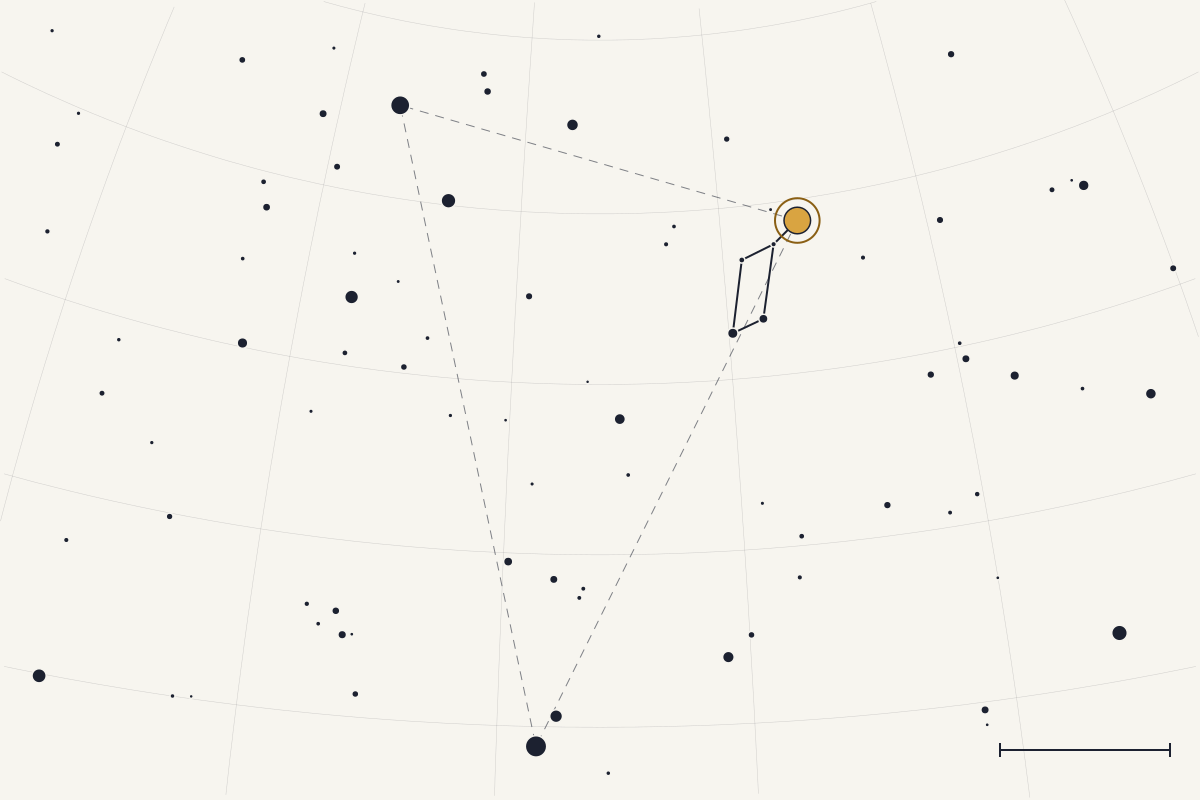
Open the chart full size to zoom in on the detail.
Figure 8. Finder chart computed from HYG v4.4 positions, north up, east left, stars to magnitude 4.7: Vega (gold, ringed), the dashed Summer Triangle to Deneb (upper left) and Altair (bottom), and Lyra's small parallelogram just southeast of Vega. The bar at lower right spans 10 degrees. Line work is this site's own drawing.
At 40°N, our calculation puts Vega 88.8 degrees up, almost overhead, when it crosses the meridian, at 9 p.m. local mean solar time around mid-August. By 9 p.m. in mid-October it has slid to about 45 degrees up in the west-northwest. Its declination of +38.8 degrees keeps it above the horizon all night north of about 51°N. South of about 51°S it never rises.
Vega is one entry in the naked-eye budget, this site's name for the roughly 8,400 catalogue entries of magnitude 6.5 or brighter across the whole sky (Naked-Eye Budget: About 8,400 Entries, Never All in One Sky). Only part of that total is above your horizon at any moment. By 1882, Figure 1 shows, a plate had gone eight magnitudes past that line.
Glass plates turned the sky into an archive that could be re-measured, which is where this site's later records pick up, from the Andromeda Galaxy to Betelgeuse.
Sources
- Harvard College Observatory, "The Great Refractor" (15-inch telescope installed 1847; the 1850 Vega daguerreotype by J. A. Whipple working under W. C. Bond; Mizar and Alcor, 1857, wet collodion)https://hco.cfa.harvard.edu/the-great-refractor/Read: full page
- William Cranch Bond, "Description of the Observatory at Cambridge, Massachusetts," Memoirs of the American Academy of Arts and Sciences, new series, vol. 4 (1849), pp. 177-188 (Merz and Mahler object glass; solar focus 22 ft 6 in; clockwork regulated by centrifugal balls; the clock "disproportionate to the other parts of the instrument")https://archive.org/details/jstor-25058158Read: full text (JSTOR Early Journal Content scan, archive.org)
- William Cranch Bond, History and Description of the Astronomical Observatory of Harvard College (Annals of the Astronomical Observatory of Harvard College, vol. 1, part 1, 1856), with the Director's reports of 1848 (November 15), 1850 (December 4), 1851 and 1852https://archive.org/details/bond-1856-history-and-description-of-the-astronomiRead: report passages on daguerreotype trials, Vega, the Moon and the driving clock (archive.org)
- George P. Bond, report on photographs of Mizar and Alcor, Four Hundred and Thirty-Ninth Meeting, May 12, 1857, Proceedings of the American Academy of Arts and Sciences, vol. 3, pp. 386-389 (Vega, July 17, 1850, by J. A. Whipple; Castor; spring-governor clock by the Clarks; collodion to the fifth magnitude; 14.49 vs 14.40 arcseconds)https://archive.org/details/jstor-20021205Read: full text (JSTOR Early Journal Content scan, archive.org)
- G. P. Bond, "Stellar Photography," Astronomische Nachrichten, vol. 48, no. 1129 (dated Cambridge, January 11, 1858), cols. 1-14 (86 photographs of Mizar; images 1 to 3 arcseconds; the original record can be resorted to; magnitude from image size and exposure)https://articles.adsabs.harvard.edu/pdf/1858AN.....48....1BRead: ADS page scans, pages 1, 5 and 7
- H. H. Turner, The Great Star Map, Being a Brief General Account of the International Project Known as the Astrographic Chart (John Murray, 1912) (George Bond's letter of July 6, 1857 to William Mitchell, from Holden's 1897 Memorials; the comet of 1882 and David Gill; Paris conference of April 16, 1887; 15-minute plates to the 14th magnitude)https://archive.org/details/cu31924031324035Read: introduction and chapters on the 1887 conference and star counting (archive.org)
- Daniel W. Baker, History of the Harvard College Observatory during the Period 1840-1890 (1890) (the 1848 and 1850 reports quoted; "the prestige of the beginning" credited to the senior Bond's administration, the son having "shared fully")https://archive.org/details/historyofharvard00bakerichRead: photography passages (archive.org)
- François Arago, Astronomie populaire, vol. 2 (Paris: Gide et J. Baudry, 1855), book XIV, chapter 27, figure 163: "Image photographique du Soleil obtenue en un soixantième de seconde le 2 avril 1845 à 9h 45m par MM. Fizeau et Foucault"https://fr.wikisource.org/wiki/Astronomie_populaire_(Arago)/XIV/27Read: chapter text on Wikisource (figure caption)
- Wikipedia, "Astrophotography," History section (the Sun "may have been first photographed" in Fizeau and Foucault's 1845 daguerreotype)https://en.wikipedia.org/wiki/AstrophotographyRead: History section
- American Astronomical Society, Solar Eclipse Task Force, "How to View a Solar Eclipse Safely," Solar Eclipse Across America (looking at the uneclipsed or partially eclipsed Sun is safe only through special-purpose solar filters, such as eclipse glasses or handheld viewers, that conform to the ISO 12312-2 international standard; ordinary sunglasses, even very dark ones, are not safe; never through an unfiltered camera, telescope, binoculars or other optical device; indirect viewing by pinhole projection)https://eclipse.aas.org/eye-safetyRead: full page
- Sky Kalfus, "Across the Spectrum," Chemical Heritage magazine (Science History Institute), Summer 2010 (John William Draper's photographs of the Moon from the roof of New York University, March 1840; archived copy of March 24, 2018)https://web.archive.org/web/20180324102519/https://www.sciencehistory.org/distillations/magazine/across-the-spectrumRead: full article (archived copy)
- Micah Messenheimer (guest post, posted by Barbara Orbach Natanson), "'A step out of and beyond nature': Picturing the Moon," Picture This, Library of Congress Blogs, July 22, 2021 (Whipple and the Bonds, Great Refractor, March 14, 1851; 1851 Great Exhibition medal; the 1853 crystalotype print)https://blogs.loc.gov/picturethis/2021/07/a-step-out-of-and-beyond-nature-picturing-the-moon/Read: full post
- Wikimedia Commons, "File:The first image of Vega.jpg" (file page; source field gives a social-media image address, not an archive record; not reproduced)https://commons.wikimedia.org/wiki/File:The_first_image_of_Vega.jpgRead: file page and file metadata
- Wikipedia, "George Phillips Bond" (says Bond took the first photograph of a star, Vega, in 1850)https://en.wikipedia.org/wiki/George_Phillips_BondRead: article text
- George F. Barker, "On the Henry Draper Memorial Photographs of Stellar Spectra," Proceedings of the American Philosophical Society, vol. 24 (1887), pp. 166-172 (Huggins, Sirius, 1863; Draper, Vega, 1872, the first spectrum photograph showing distinct lines; 28-inch reflector)https://archive.org/details/jstor-983130Read: full text (archive.org)
- George F. Barker, Memoir of Henry Draper, 1837-1882 (read before the National Academy of Sciences, 1888) (Vega spectrum, May and August 8, 1872; dry plates from 1879; Orion Nebula, September 30, 1880, 57 minutes; March 14, 1882, 137 minutes, stars of magnitude 14.7; the driving clock)https://archive.org/details/memoirofhenrydra00barkRead: full text (archive.org)
- DASCH: Digital Access to a Sky Century @ Harvard, home page (the plate collection: over 550,000 glass plate negatives and spectral images; hundreds of women studied and curated the plates)https://dasch.cfa.harvard.edu/Read: full page
- DASCH, "About DASCH" (scanning completed March 28, 2024, after 435,763 plates)https://dasch.cfa.harvard.edu/about/Read: full page
- DASCH, "Data Release 7" (light curves covering the years about 1880 to 1990)https://dasch.cfa.harvard.edu/dr7/Read: full page
- Wikipedia, "Harvard Computers" (the consistent hiring of women began with the photographic project funded by Mary Anna Draper in honor of Henry Draper)https://en.wikipedia.org/wiki/Harvard_ComputersRead: article text
- Wikipedia, "Vega" (fifth-brightest star; Summer Triangle with Deneb and Altair; declination +38.78 degrees, circumpolar north of 51 degrees N, never visible south of 51 degrees S; Hipparcos 2007 parallax 130.23 +/- 0.36 mas, citing van Leeuwen 2007)https://en.wikipedia.org/wiki/VegaRead: article text
- ERFA (Essential Routines for Fundamental Astronomy, derived from IAU SOFA), source file moon98.c: approximate geocentric position of the Moon after Jean Meeus, Astronomical Algorithms, 2nd edition (1998), with a mean Earth-Moon distance term of 385,000.56 km; BSD-3-Clausehttps://github.com/liberfa/erfa/blob/master/src/moon98.cRead: full source file
- Wikipedia, "Daguerreotype" (process: silver-plated copper polished to a mirror finish)https://en.wikipedia.org/wiki/DaguerreotypeRead: lead and process paragraph
- Richard Hinckley Allen, Star-Names and Their Meanings (1899), "Lyra" (Vega the first star submitted to the camera, July 17, 1850; Epsilon Lyrae, the celebrated Double Double, 207 arcseconds apart), LacusCurtius transcription by Bill Thayerhttps://penelope.uchicago.edu/Thayer/E/Gazetteer/Topics/astronomy/_Texts/secondary/ALLSTA/Lyra*.htmlRead: full chapter
- David Nash (astronexus), HYG Database v4.4, data README and licence (CC BY-SA 4.0)https://codeberg.org/astronexus/hygRead: catalogue file hyg_v44.csv.gz
- Johann Bayer, Uranometria omnium asterismorum continens schemata (Augsburg: Christophorus Mangus, 1603), plates engraved by Alexander Mair; ETH-Bibliothek Zürich copy on e-rara, doi:10.3931/e-rara-309 (Lyra, plate H)https://doi.org/10.3931/e-rara-309Read: e-rara catalogue record 77412; the Lyra plate through its Wikimedia Commons copy (File:Lyra Uranometria.jpg)
- Francis D'Avignon, lithograph portrait "J. A. Whipple," engraved for the Photographic Art-Journal (New York), 1851; Library of Congress Prints and Photographs Division, digital ID cph.3b02938, as transcribed on Wikimedia Commonshttps://commons.wikimedia.org/wiki/File:John_Adams_Whipple_by_Francis_D%27Avignon.jpgRead: Commons file page (LoC record transcribed there); the print's own lettering
- South African Astronomical Observatory, "Comet Pictures: Great Comet of 1882" (David Gill with the aid of a local photographer and his portrait lens; image "Great Comet of 1882 November 7"), page last updated July 13, 2007; Internet Archive copy of December 9, 2012http://web.archive.org/web/20121209135817/http://www.saao.ac.za/public-info/pictures/comet/Read: full page (archived copy)
- S2A3 Biographical Database of Southern African Science, "Allis, Mr Edward Haggar (astronomy)," compiled by C. Plug, last updated December 6, 2022 (born Bristol, May 23, 1849; died London, March 28, 1911; photographer in Mowbray and Rosebank, Cape Town, 1882-1890; supplied the camera, lens and dry plates for David Gill's 1882 comet photographs at the Cape and assisted)https://www.s2a3.org.za/bio/Biograph_final.php?serial=48Read: full entry

Computed by this site (2026-10-12) from sources 2, 21 and 25 and a sidereal day of 86,164.09 seconds: Vega's magnitude, rank and distance, the light-travel dates, the Sun-to-Vega brightness ratio, the drift rate and focal-plane drift at the Great Refractor's focus, the Summer Triangle sides, Vega's altitude and direction at 40°N in local mean solar time, its circumpolar limits, and the Epsilon Lyrae separation. The Moon's light-travel time uses source 22.
Look up next:
Epsilon Lyrae, the faint star 1.7 degrees northeast of Vega. On mid-October evenings at 40°N (9 p.m. local mean solar time), our calculation puts Vega about 45 degrees up in the west-northwest, so start there. Richard Hinckley Allen's 1899 Star-Names called its two stars "the celebrated Double Double." By his figures they sit 207 arcseconds apart (209 in HYG) and look to the ordinary eye like one elongated star; a small telescope splits each again. Read on: the Andromeda Galaxy and the 1923 plate.
Related entries
- Betelgeuse: Sized Up in 1920, Its Distance Still Unsettled
- Andromeda Galaxy: Hubble's "VAR!" Was Right, but His Distance Wasn't
- Light-Year: Its Year Runs 11 Minutes Longer Than the Seasons
- Big Dipper: Not a Constellation, and Two of Its Stars Are Strangers
- Naked-Eye Budget: About 8,400 Entries, Never All in One Sky
Cite this page
Asterisms & Astrolabes. “First Photograph of a Star: Vega in 1850, or the Sun in 1845.” Asterisms & Astrolabes. Published 13 October 2026; last substantive revision 13 October 2026. https://asterismsandastrolabes.com/archives/first-photograph-of-a-star/. Accessed [the date you read it].