Subject
Orbital Motion Models
Celestial mechanics through simple models that are actually computed: elliptical orbits, tides and the slow swing of Earth's axis.
-
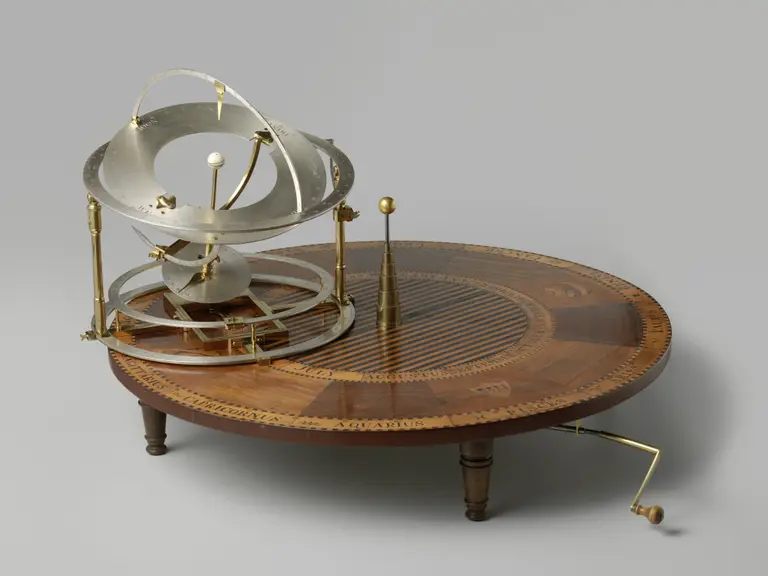
Photograph Credit
"Tafelplanetarium (table orrery), Rijksmuseum NG-NM-11700" by Hartog van Laun (instrument); photograph: Rijksmuseum, Amsterdam — https://commons.wikimedia.org/wiki/File:Tafelplanetarium,_NG-NM-11700.jpg — CC0 1.0 (https://creativecommons.org/publicdomain/zero/1.0/). Retrieved 2026-10-13.
Tides: The Sun Pulls Harder, but Its Tide Is Half the Moon's
What causes tides? The Moon stretches Earth into two bulges. The Sun pulls 179 times harder, yet its tidal force is only 0.46 of the Moon's. Computed charts.
-
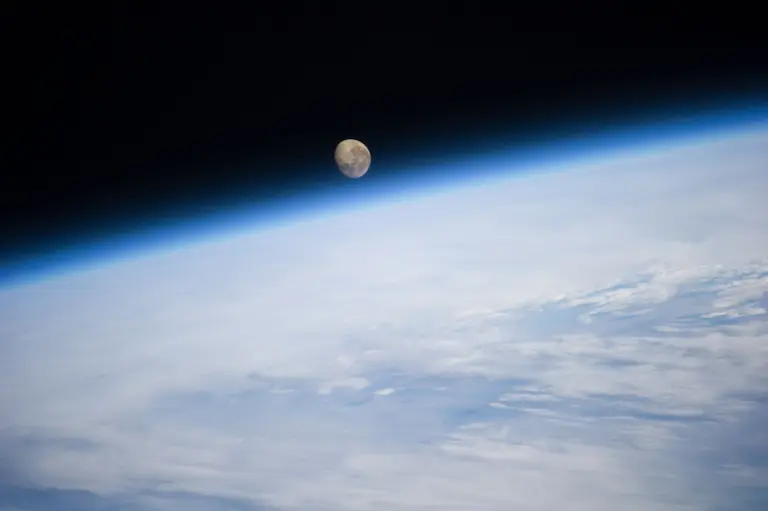
Photograph Credit
"Moon setting" by Reid Wiseman, NASA — https://images.nasa.gov/details/iss040e092688 — Public domain (photograph by NASA astronaut Reid Wiseman aboard the International Space Station, 2014; work of the US federal government (17 U.S.C. 105); no third-party credit on the NASA asset record). Retrieved 2026-10-13.
Axial Precession: Earth Usually Has No Bright North Star
Axial precession turns Earth's axis once in about 25,770 years. A star of magnitude 3 or brighter sits within 5° of the pole only about 19% of that time.
-
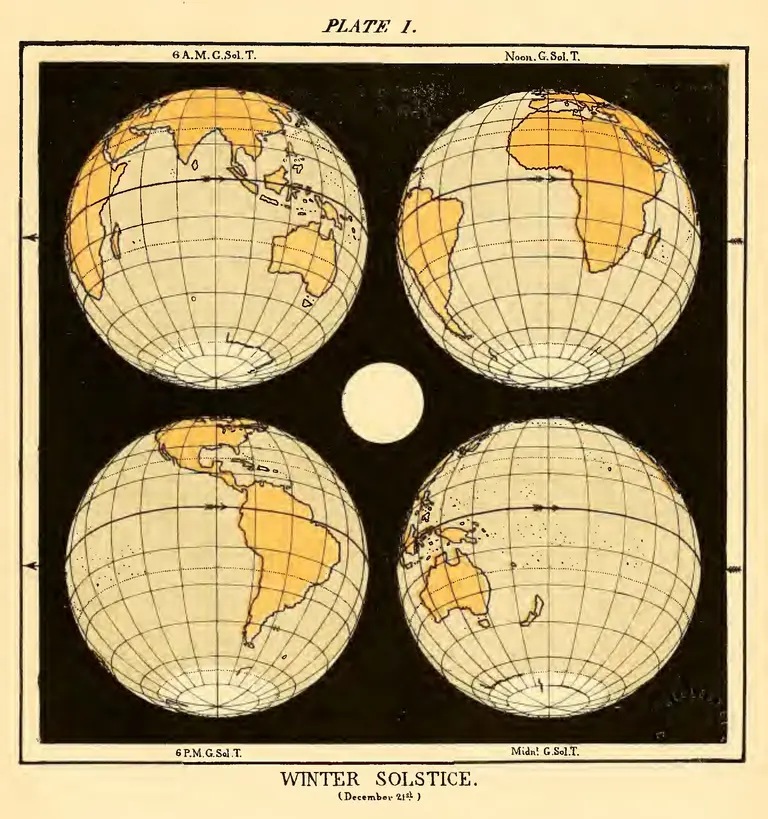
Archive scan Credit
"Sun-Views of the Earth, Plate I: Winter Solstice (December 21st)" by Richard A. Proctor — https://commons.wikimedia.org/wiki/File:Sun-views_of_the_earth,_or_The_seasons_illustrated-_comprising_forty-eight_views_of_the_earth_as_supposed_to_be_seen_for_the_sun_at_differents_hours_and_seasons_(IA_sunviewsofeartho00proc).pdf — Public domain (published New York 1867; author d. 1888; US/EU); modified: cropped from PDF page 17. Retrieved 2026-10-13.
Orbital Eccentricity: Earth's True Orbit Looks Like a Circle
Orbital eccentricity measures how far an orbit strays from a circle. Drawn true to shape, every planet's orbit looks round; the off-center Sun gives it away.
