Atlas entry
Andromeda Galaxy: Hubble's "VAR!" Was Right, but His Distance Wasn't
TL;DR: The Andromeda Galaxy lies about 2.5 million light-years away; 13 of the 14 distance estimates listed in SIMBAD fall between 2.4 and 2.7 million. Edwin Hubble showed that it sits outside the Milky Way, starting from a Cepheid star he found on a plate dated October 6, 1923, though his own distance came out about 2.7 times too short.
In this entry12 sections
- Spec card
- What did Hubble see on the VAR! plate?
- How does a Cepheid's period give a distance?
- What was the Great Debate about?
- Why was Hubble's distance short?
- Will the Andromeda Galaxy collide with the Milky Way?
- How do you find the Andromeda Galaxy tonight?
- Sources
- Corrections
- Look up next
- Related entries
- Cite this page
Spec card
- Name
- Andromeda Galaxy; Messier 31 (M31); NGC 224Source: SIMBAD (CDS)
- Type
- Spiral galaxySource: E. Hubble, "A Spiral Nebula as a Stellar System, Messier 31" (1929)
- Apparent magnitude
- 3.4 (SIMBAD lists V 3.44)Source: SIMBAD (CDS)
- Distance (light-years)
- About 2.5 million; 13 of 14 estimates listed in SIMBAD fall between about 2.4 and 2.7 millionSource: SIMBAD (CDS) distance table, 2007-2021 entries, converted by this site
- Constellation
- AndromedaSource: this site's check against the 1930 IAU boundaries (N. G. Roman 1987, CDS VI/42)
- Best viewing months
- October to December evenings at 40°N (this site's criterion: at least 60° up at 9 p.m. local mean solar time)Source: calculated by this site: at least 60° up at 9 p.m. local mean solar time, flat horizon, no refraction
Download this card as CSV (andromeda-galaxy-spec-card.csv)Provenance note for this CSV (JSON)Data: SIMBAD database, CDS, Strasbourg, https://simbad.cds.unistra.fr/ (M31 magnitude and distance table)
Name and magnitude: SIMBAD. Type: SIMBAD and Hubble (1929). Constellation: this site's check against the 1930 IAU boundaries. Viewing months: this site's own criterion, at least 60° up at 9 p.m. local mean solar time at 40°N (flat horizon, no atmospheric refraction).
Open the chart full size to zoom in on the detail.
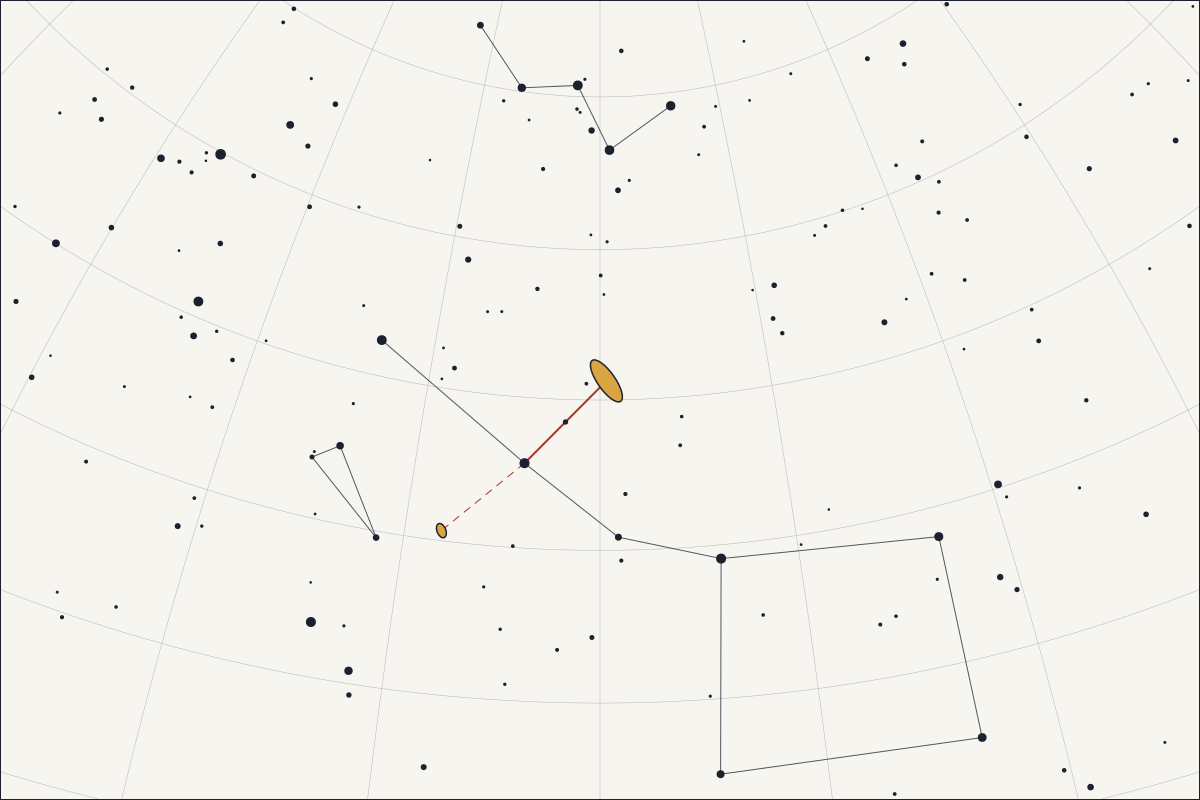
Figure 1. Star chart computed from HYG v4.4 catalogue positions (J2000), north up, east left, stars to magnitude 5.0. Thin lines are this site's own figure lines: the Great Square of Pegasus (lower right), the chain of Andromeda from Alpheratz through Mirach to Almach, Cassiopeia's W (top) and Triangulum (lower left). The red line runs from Mirach through mu Andromedae to the Andromeda Galaxy, the large gold ellipse; the dashed red line runs from Mirach to the Triangulum Galaxy, the small gold ellipse. Ellipse sizes follow SIMBAD. Faint grid: every hour of right ascension and every 10 degrees of declination.
Edwin Hubble marked three faint specks on a glass plate with an "N" for nova. One of them later lost its letter. Hubble struck out the N and wrote "VAR!", for variable, beside the star now called V1 in the Andromeda Galaxy. Its steady rhythm gave him a distance that put the galaxy far outside the Milky Way.
The famous number was short, though. Hubble's 1925 report put Andromeda's Cepheids about 285,000 parsecs away, roughly 930,000 light-years by this page's conversion; modern estimates put it near 2.5 million light-years, about 2.7 times farther (2.6 to 2.9 times on the SIMBAD estimates below). The verdict survived the error, and the reason sits in Hubble's own fine print.
What did Hubble see on the VAR! plate?
Hubble took the plate with the 100-inch Hooker telescope on Mount Wilson. Carnegie Science's page dates the plate to October 6, 1923, identifies it as plate H335H and explains the marks: each N flagged a star that looked new compared with earlier plates. Nearly three years earlier, Michelson and Pease had measured Betelgeuse with an interferometer mounted on the same 100-inch reflector.
Hubble first took one of the marked stars for a nova, Carnegie's page explains, but it turned out to vary in brightness like a Cepheid variable, a pulsating star whose period gives away its true brightness. Carnegie's page notes that Hubble, often described as reserved, marked the find with a rare exclamation point.
The plate itself does not appear here. The only copy found in the Wikimedia Commons and NASA image libraries is part of a 2011 composite that also contains another photographer's work, so the plate stays on Carnegie Science's page (source 1). Figure 2 instead shows another of Hubble's Andromeda Cepheids as George Ellery Hale printed it in 1926.
Light's departure: the light on the 1923 plate left the Andromeda Galaxy about 2.5 million years ago, using a distance of about 2.5 million light-years (light-year). Thirteen of the 14 distance estimates listed in the SIMBAD database as of 2026, published from 2007 to 2021, fall between about 2.4 and 2.7 million light-years, so the departure date carries the same spread.
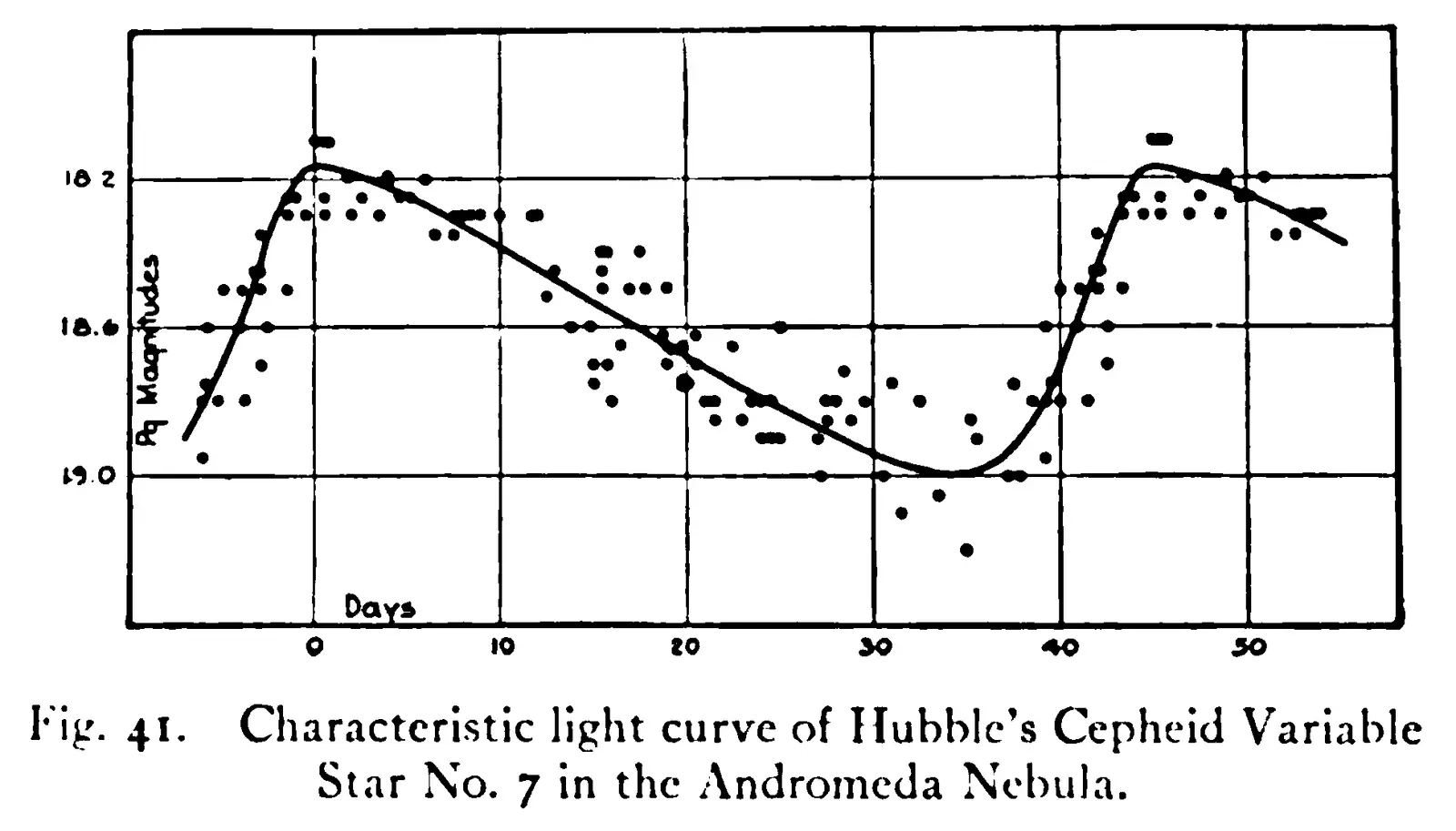
Figure 2. "Characteristic light curve of Hubble's Cepheid Variable Star No. 7 in the Andromeda Nebula," Fig. 41 in George Ellery Hale's Beyond the Milky Way (1926): photographic magnitude, brighter upward, against days. Hubble's 1925 table gives this star a period of 45.04 days. Shown in place of the VAR! plate, which is not reproduced here.
How does a Cepheid's period give a distance?
Henrietta Swan Leavitt found the rule in the Small Magellanic Cloud. A Harvard circular dated March 3, 1912, signed by director Edward C. Pickering but "prepared by Miss Leavitt," listed 25 variable stars there with their periods. The brighter variables had the longer periods. Since the stars "are probably at nearly the same distance from the Earth," the circular reasoned, their periods "are apparently associated with their actual emission of light."
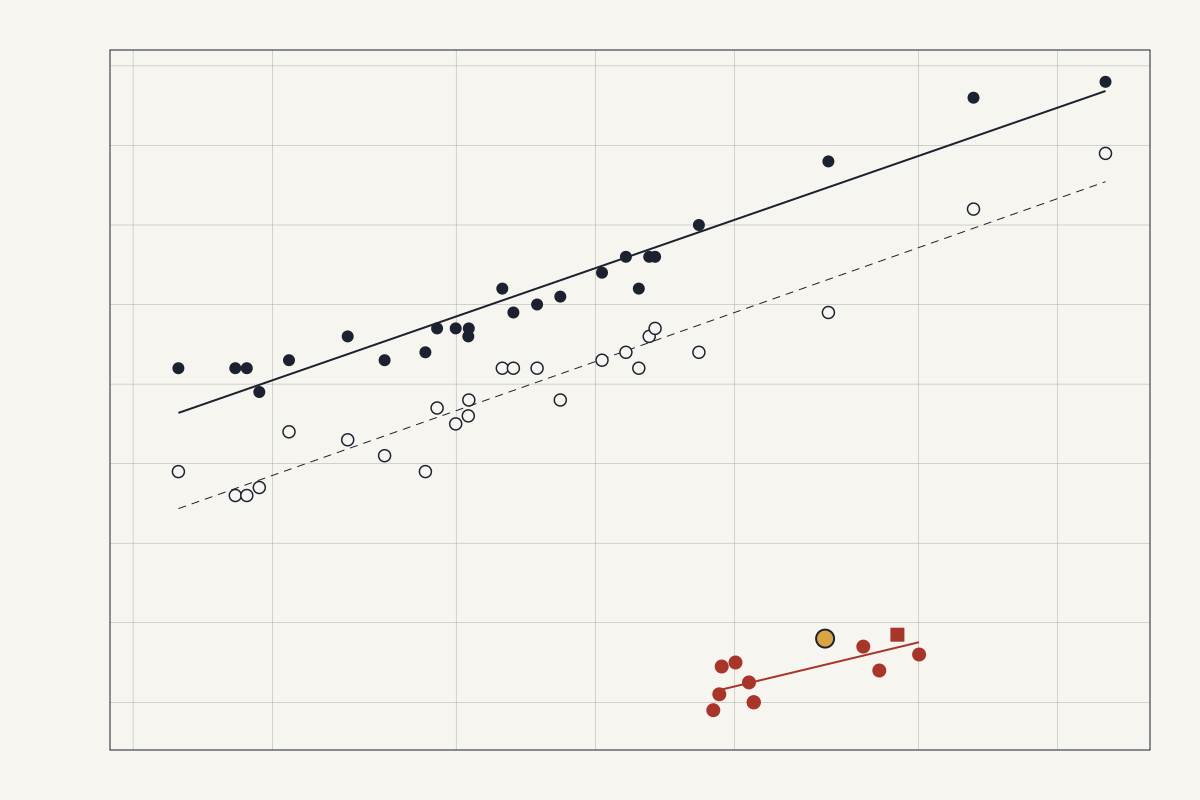
Figure 3 plots her table. By this page's least-squares fit to her maximum magnitudes, the logarithm of the period rises about 0.50 for each magnitude of extra brightness; the circular says "about 0.48." She measured stars on Harvard's photographic plates; Harvard's star photography goes back to the first photograph of a star. Leavitt died in December 1921, nearly two years before the VAR! plate, according to Wikipedia's biography of her.
One number was still missing. The rule gave relative brightness only, so someone had to measure how far away some nearby Cepheids are. Ejnar Hertzsprung did that for several Milky Way Cepheids a year after her paper, Wikipedia says, and Hubble used the curve Harlow Shapley published in 1918. Think of Leavitt's law as a ledger with every entry in the right order and the opening balance blank: the calibration fills in that balance, and every distance moves with it.
Hubble's 1925 report listed 12 Cepheids in Andromeda, with periods from 18 to 50 days; V1 appears as variable 1 at 31.41 days. Against Shapley's curve, corrected by half the stars' average range in brightness, they implied a gap of about 22.3 magnitudes between apparent and true brightness, and Hubble wrote: "The corresponding distance is about 285,000 parsecs." The inverse-square law turns 22.3 magnitudes into about 288,000 parsecs, by this page's arithmetic. Hubble added the warning himself: "The greatest uncertainty is probably in the zero point of Shapley's curve."
Open the chart full size to zoom in on the detail.
Figure 3. Period (logarithmic, grid at 1, 2, 5, 10, 20, 50 and 100 days) against photographic magnitude (brighter upward, grid every magnitude from 11 to 19). Dark dots and open circles: Leavitt's 25 Small Magellanic Cloud variables at maximum and minimum, with this page's least-squares lines. Red dots and line: Hubble's 12 Andromeda Cepheids at maximum, with Nos. 12 and 13 sharing one dot; gold: V1; red square: No. 7. The two surveys used different photographic magnitude scales, so read the vertical gap only roughly.
CSV download: the 37 transcribed rows (CC BY 4.0) (Data: H. S. Leavitt, Periods of 25 Variable Stars in the Small Magellanic Cloud, Harvard College Observatory Circular 173 (E. C. Pickering, 1912), Table I; public domain; E. P. Hubble, Cepheids in Spiral Nebulae, Popular Astronomy 33, 252 (1925), Table II; public domain), with its provenance note (JSON)
What was the Great Debate about?
On April 26, 1920, Harlow Shapley and Heber Curtis argued over the size of the universe before the National Academy of Sciences in Washington, D.C. Shapley described a Milky Way about 300,000 light-years across, with spiral nebulae such as Andromeda on its edges. Curtis held that the spirals were separate "island universes." No one had a Cepheid in a spiral.
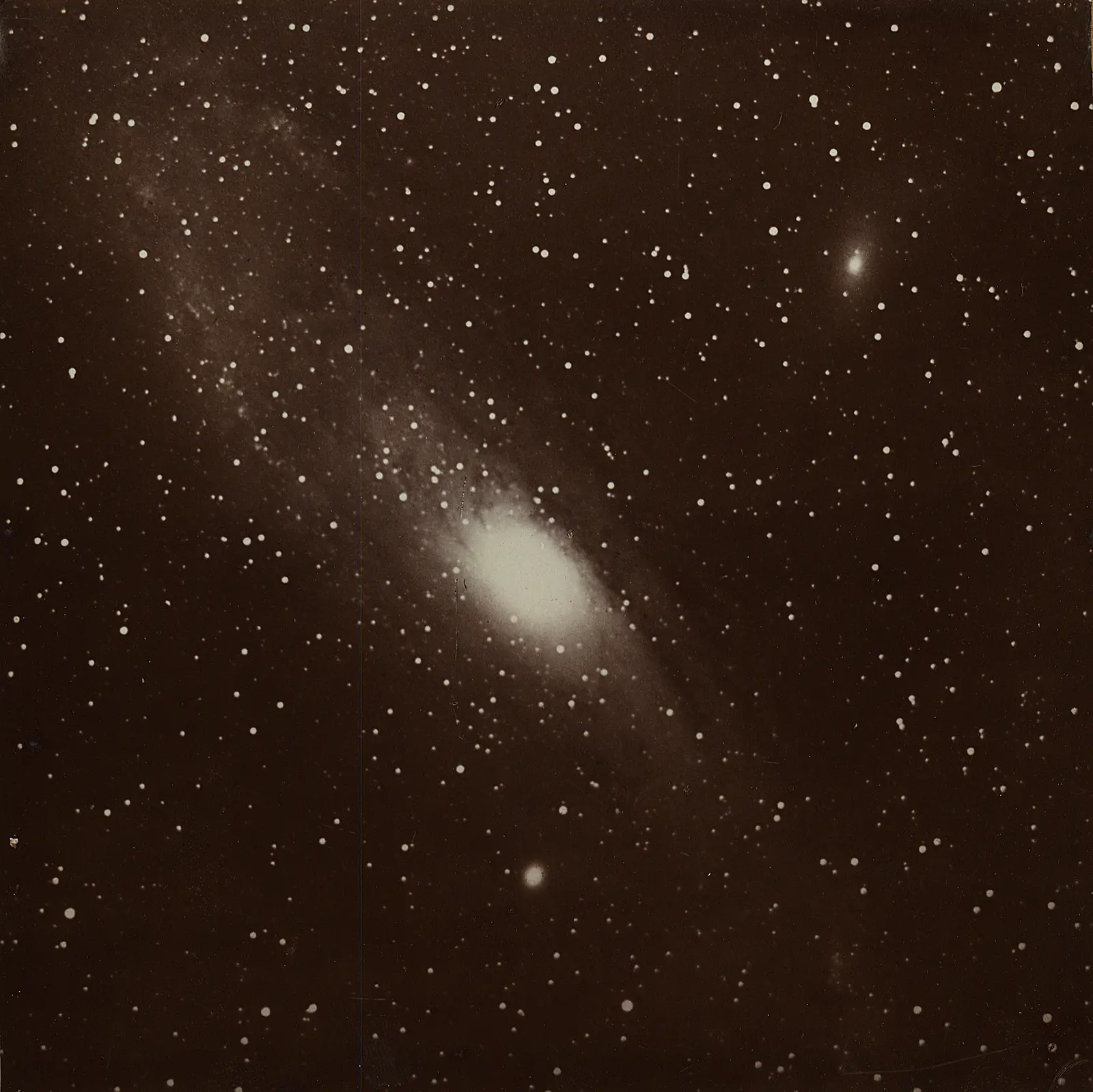
Figure 4. "Nebula in Andromeda": a print of Isaac Roberts' four-hour exposure of December 29, 1888, made with a 20-inch reflector, according to the ETH Library record. North is up, east left.
Hubble was not the first to place Andromeda far away. Comparing its novae with those in the Milky Way, Curtis put it at perhaps 500,000 light-years, as Hale's 1926 summary of his debate case records. Ernst Öpik's 1922 paper used the galaxy's rotation speed and brightness to compute 450,000 parsecs, about 1.5 million light-years by this page's conversion. Öpik also cited earlier estimates by Shapley, Curtis, K. Lundmark and others that ran from 100,000 to 1,000,000 parsecs.
Hale's 1926 book says no Cepheid had been detected in the nebula until Hubble found several. Hubble reported the find to the American Astronomical Society at its Washington meeting at the end of 1924, just over a year after the plate, as Carnegie's page notes.
Why was Hubble's distance short?
By 1929 Hubble was working from about 350 photographs of Andromeda, two-thirds of them his own, and 40 Cepheids. His paper that year placed the galaxy "about 8.5 times more distant than the Small Magellanic Cloud." Using Shapley's distance for the Cloud, he reached 275,000 parsecs, about 900,000 light-years. The ratio was Hubble's own; the absolute scale came from Shapley.
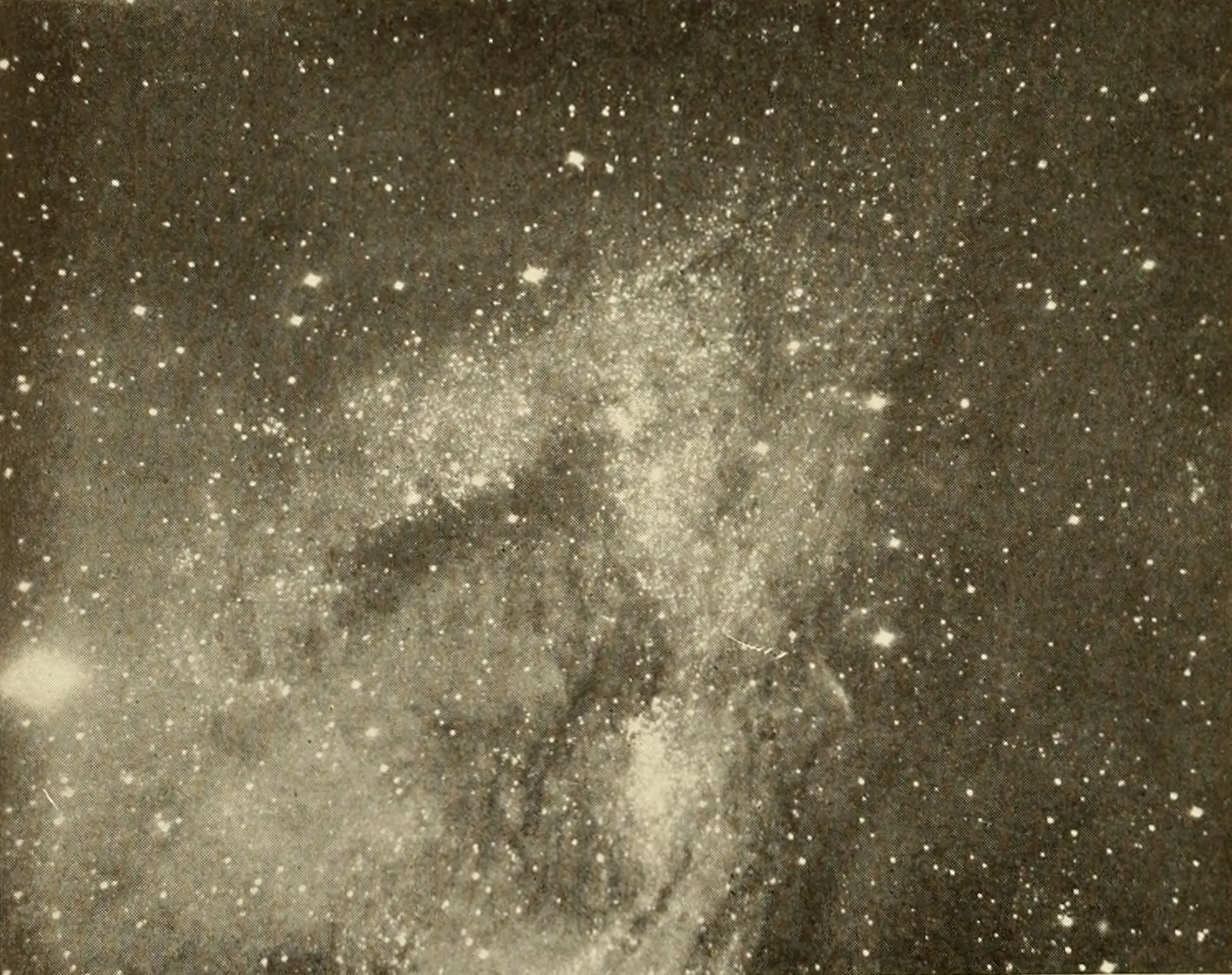

Figure 5. "Outlying regions of M 31, photographed by Hubble with the 100-inch reflector," from the Smithsonian Report for 1929. Patches that look like knots on smaller photographs resolve into stars.
The scale moved. Walter Baade's finding that Cepheids come in two types roughly doubled the Andromeda distance; Wikipedia's article on the galaxy dates the revision to 1953. Modern measurements cluster near 2.5 million light-years.
None of this rescued Shapley's picture. Even Hubble's short 930,000 light-years was about three times the 300,000-light-year Milky Way that Shapley had defended. The corrected distances are longer still.
Will the Andromeda Galaxy collide with the Milky Way?
Maybe. A 2025 paper in Nature Astronomy, led by Till Sawala, notes that a merger in around five billion years is commonly expected. Using Gaia and Hubble Space Telescope measurements, the paper found "a probability of close to 50%" that the Milky Way and the Andromeda Galaxy do not merge within the next 10 billion years. In that study, adding the Triangulum Galaxy raises the odds of a merger, and adding the Large Magellanic Cloud lowers them.
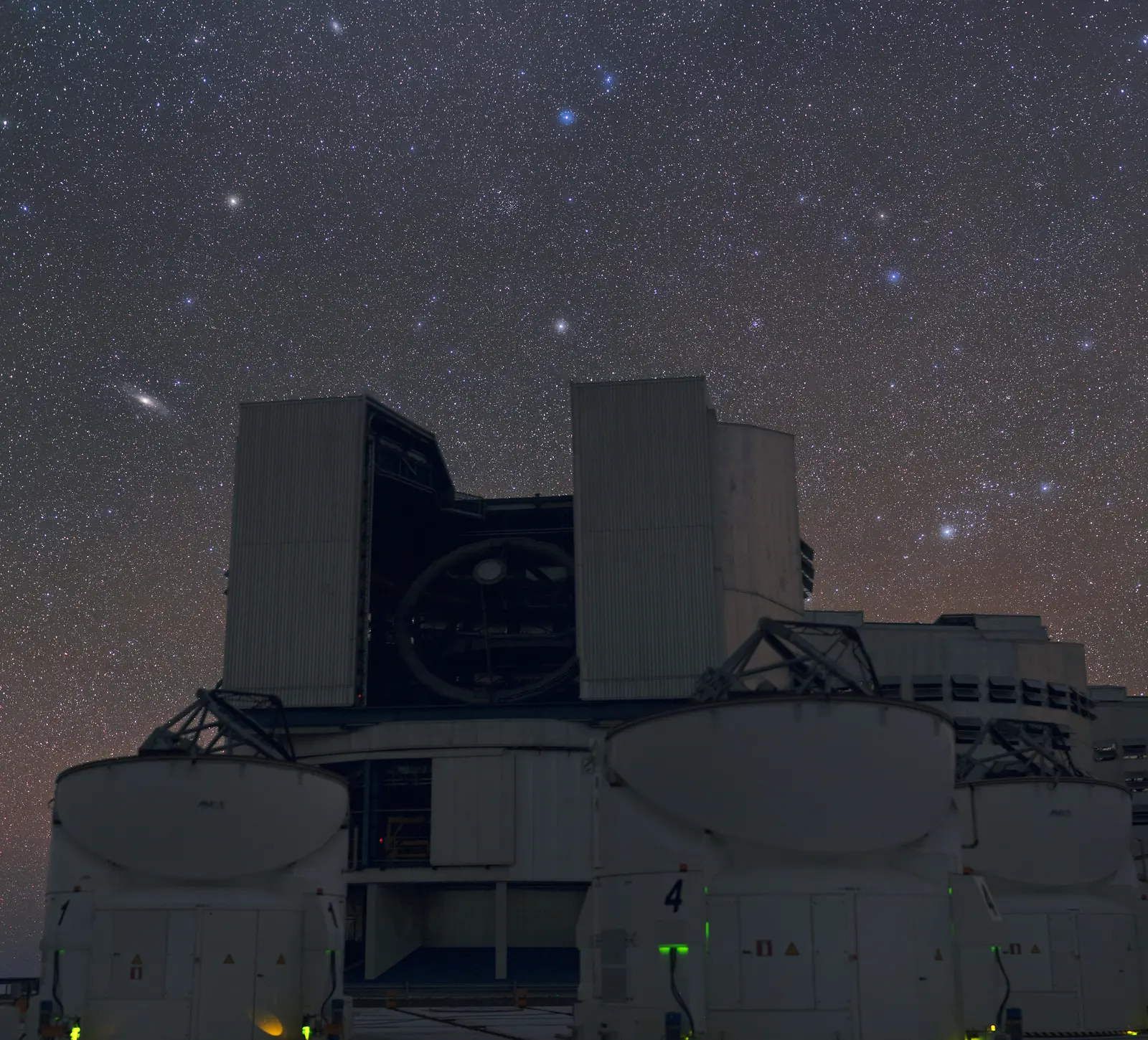
Figure 6. The Andromeda Galaxy (streak at left) and the Triangulum Galaxy (faint smudge at top) over ESO's Very Large Telescope in Chile; ESO names the bright star between them as Mirach.
How do you find the Andromeda Galaxy tonight?
Start at Mirach, the second-magnitude star in the chain of Andromeda that runs from Alpheratz, the northeast corner of the Great Square of Pegasus. Look northwest from Mirach to mu Andromedae, magnitude 3.9 in the HYG catalogue and about 3.9 degrees away. Then go the same distance again. By this page's calculation, mu sits almost exactly halfway between Mirach and the galaxy, with fainter nu Andromedae 1.3 degrees short of the target.
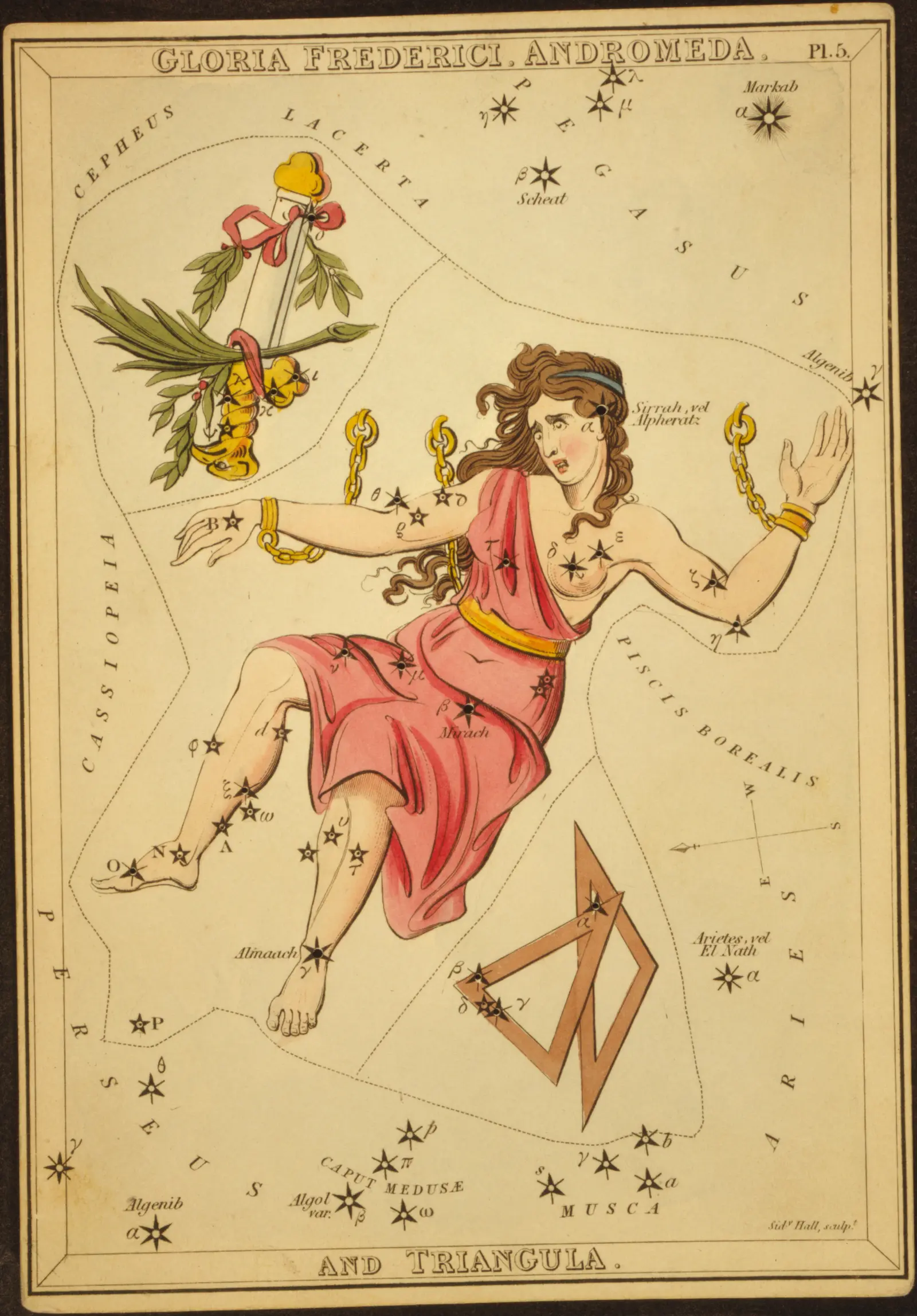
Figure 7. Andromeda on plate 5 of Urania's Mirror, engraved by Sidney Hall and first published in 1824. Mirach (β), μ and ν, the hop's stepping stones, sit on her robe; north points left.
On October 15 at 40°N, by this page's calculation, the galaxy stands about 66 degrees up in the east-northeast at 9 p.m. local mean solar time. It crosses the meridian at that hour around November 16, nearly overhead at about 89 degrees. The galaxy lies inside the official border of the constellation Andromeda (constellation boundaries).
Expect a faint smudge. Hubble's 1929 paper describes "a hazy patch about 30′ by 15′," while the galaxy's full extent spans about three degrees, six times the full Moon's width, according to Hale (1926). John Bortle's 2001 dark-sky scale calls it only modestly apparent to the unaided eye under a bright suburban sky, his class 6, and glimpsed but very indistinct in class 7 (Bortle scale). If you drive somewhere darker, go with someone, tell a friend where you will be, carry a red flashlight, and stay off private land and roads.
In true size, the Andromeda Galaxy's outer disk is faint and very wide: a 2005 Keck study by Ibata and colleagues traced a dim, disk-like structure out to about 40,000 parsecs from the center, roughly 130,000 light-years, so the disk spans about 260,000 light-years by this page's conversion.
Cepheids remain the first rung of the cosmic distance ladder. Hubble's 1925 report had already used them on a second spiral.
Sources
- Carnegie Science, "Video: VAR! Plate 100th Anniversary" (September 6, 2023; plate H335H, the N marks and the crossed-out N, "rare exclamation point", Leavitt's role; the plate image itself is shown there)https://carnegiescience.edu/news/video-var-plate-100th-anniversaryRead: full page text
- A. A. Michelson and F. G. Pease, "Measurement of the Diameter of alpha Orionis with the Interferometer," Astrophysical Journal 53, 249 (1921; Mount Wilson Contribution 203)https://ui.adsabs.harvard.edu/abs/1921ApJ....53..249M/abstractRead: pages 249-250, NASA ADS scan (abstract; Fig. 1 caption on p. 250 reads 'a, 100-inch paraboloid')
- E. P. Hubble, "Cepheids in Spiral Nebulae," Popular Astronomy 33, 252-255 (1925; Thirty-Third Meeting of the American Astronomical Society, Washington, 1924), Table IIhttps://ui.adsabs.harvard.edu/abs/1925PA.....33..252H/abstractRead: full text, NASA ADS scan (articles.adsabs.harvard.edu/pdf/1925PA.....33..252H)
- George Ellery Hale, Beyond the Milky Way (New York: Charles Scribner's Sons, 1926), pp. 83-96 and Fig. 41; Wikimedia Commons scan of HathiTrust uc1.$b250666https://commons.wikimedia.org/wiki/File:Hale_-_Beyond_the_Milky_Way,_1926.pdfRead: full chapter text and page images of pp. 93-96
- E. C. Pickering (prepared by H. S. Leavitt), "Periods of 25 Variable Stars in the Small Magellanic Cloud," Harvard College Observatory Circular 173, 1-3 (March 3, 1912)https://ui.adsabs.harvard.edu/abs/1912HarCi.173....1L/abstractRead: full text, NASA ADS scan (articles.adsabs.harvard.edu/pdf/1912HarCi.173....1L)
- Wikipedia, "Henrietta Swan Leavitt" (revision 1372005490, 2026-08-29: died December 12, 1921; plate collection work; Hertzsprung calibrated Cepheid distances one year after her result)https://en.wikipedia.org/wiki/Henrietta_Swan_LeavittRead: full article text
- Wikipedia, "Great Debate (astronomy)" (revision 1365691300: April 26, 1920, U.S. National Museum, National Academy of Sciences meeting; Shapley's 300,000-light-year Milky Way; Curtis's island universes)https://en.wikipedia.org/wiki/Great_Debate_(astronomy)Read: full article text
- Wikipedia, "Andromeda Galaxy" (revision 1379849512, 2026-10-12: Baade's two types of Cepheid doubled the distance, dated 1953)https://en.wikipedia.org/wiki/Andromeda_GalaxyRead: full article text
- E. Oepik (Öpik), "An Estimate of the Distance of the Andromeda Nebula," Astrophysical Journal 55, 406 (1922)https://ui.adsabs.harvard.edu/abs/1922ApJ....55..406O/abstractRead: pages 406-407, NASA ADS scan (abstract and method)
- E. Hubble, "A Spiral Nebula as a Stellar System, Messier 31," Astrophysical Journal 69, 103 (1929)https://ui.adsabs.harvard.edu/abs/1929ApJ....69..103H/abstractRead: pages 103-105, NASA ADS scan (abstract and introduction)
- N. G. Roman, "Identification of a Constellation from a Position," Publications of the Astronomical Society of the Pacific 99, 695 (1987), CDS catalogue VI/42 (lookup table of the 1930 IAU constellation boundaries)https://cdsarc.cds.unistra.fr/ftp/VI/42/Read: lookup table data.dat and ReadMe
- SIMBAD Astronomical Database (CDS, Strasbourg), M 31: basic data (J2000 position, size 199.53' x 70.79', position angle 35 degrees), V = 3.44 (2007ApJS..173..185G), and the 14-row distance table (2007-2021)https://simbad.cds.unistra.fr/simbad/sim-id?Ident=M31Read: query results (basic, flux, mesDistance)
- T. Sawala et al., "No certainty of a Milky Way–Andromeda collision," Nature Astronomy 9, 1206-1217 (2025), doi:10.1038/s41550-025-02563-1 (arXiv:2408.00064)https://arxiv.org/abs/2408.00064Read: abstract only (arXiv)
- David Nash (astronexus), HYG Database v4.4, data README and licence (CC BY-SA 4.0)https://codeberg.org/astronexus/hygRead: catalogue file
- SIMBAD Astronomical Database (CDS, Strasbourg), M 33: J2000 position, size 60.26' x 35.48', position angle 22 degrees, V = 5.72 (2007ApJS..173..185G)https://simbad.cds.unistra.fr/simbad/sim-id?Ident=M33Read: query results (basic, flux)
- ERFA (Essential Routines for Fundamental Astronomy, liberfa/erfa) source files ltpequ.c, ltpecl.c and ltp.c (Vondrák, Capitaine & Wallace 2011 long-term precession) and era00.c, gmst06.c (IAU 2006 sidereal time)https://github.com/liberfa/erfaRead: source code of the five routines
- ETH-Bibliothek Zürich, Bildarchiv, "Nebula in Andromeda" (photograph by Isaac Roberts, December 29, 1888; 20-inch reflector, four-hour exposure; paper print, Ans_02775-132), record as uploaded by the ETH-Bibliothek to Wikimedia Commonshttps://commons.wikimedia.org/wiki/File:ETH-BIB-Nebula_in_Andromeda-Ans_02775-132.tifRead: Commons file page (revision 1221343051)
- F. H. Seares, "Counting the Stars and Some Conclusions," Annual Report of the Board of Regents of the Smithsonian Institution for the year ending June 30, 1929 (Washington: Government Printing Office, 1930), Plate 4, Fig. 2: "Outlying regions of M 31, photographed by Hubble with the 100-inch reflector"https://archive.org/details/annualreportofbo1929smitRead: title page, article opening and plate captions (Internet Archive scan); plate image via Wikimedia Commons
- ESO, "Two naked-eye galaxies above the VLT" (Picture of the Week potw1342a, October 21, 2013; photograph by ESO photo ambassador Babak Tafreshi)https://www.eso.org/public/images/potw1342a/Read: full page text
- Sidney Hall (engraver), "Gloria Frederici, Andromeda, and Triangula," plate 5 of Urania's Mirror (London); Library of Congress print, digital ID cph.3g10054, dated 1825 in its Wikimedia Commons recordhttps://commons.wikimedia.org/wiki/File:Sidney_Hall_-_Urania%27s_Mirror_-_Gloria_Frederici,_Andromeda,_and_Triangula_-_original.tifRead: Commons file page (revision 1123468512)
- Wikipedia, "Urania's Mirror" (revision 1333597889: 32 cards first published in November 1824, engraved by Sidney Hall)https://en.wikipedia.org/wiki/Urania%27s_MirrorRead: full article text
- John E. Bortle, "Introducing the Bortle Dark-Sky Scale," Sky & Telescope, February 2001, pp. 126-129 (class 6, bright suburban sky: M31 only modestly apparent to the unaided eye; class 7, suburban/urban transition: M44 or M31 may be glimpsed with the unaided eye but are very indistinct)https://planesynormas.mma.gob.cl/archivos/2021/proyectos/ANTECEDENTES_RECOPILADOS_POR_EL_MMA_PARTE_3_ASTRONOMI__769_A.pdfRead: pages 126-129 of the printed article, as reproduced in a public file of Chile's Ministry of the Environment (Antecedentes recopilados por el MMA, Parte 3, folios 2524-2527)
- R. Ibata, S. Chapman, A. M. N. Ferguson, G. Lewis, M. Irwin and N. Tanvir, "On the Accretion Origin of a Vast Extended Stellar Disk around the Andromeda Galaxy," Astrophysical Journal 634, 287-313 (2005), doi:10.1086/491727 (arXiv:astro-ph/0504164)https://arxiv.org/abs/astro-ph/0504164Read: abstract
Computed by this site (2026-10-12) from sources 3, 5, 9, 10, 12, 14, 15 and 16: star separations and directions, altitudes and dates at 40°N, the viewing window in the spec card, parsec and light-year conversions and distance ratios, the 22.3-magnitude check, and the least-squares fits in Figure 3. From source 11: the constellation check (2026-11-01). Added 2026-10-14 from source 23: the outer disk's 40,000 parsecs in light-years, and its double as the disk's width (2026-11-01).
Corrections
2026-10-14 — Added the galaxy's true size, which the page had given only as an angle on the sky (not covered → a disk about 260,000 light-years across, from a 2006 NASA/JPL release; a dim, disk-like structure out to about 40,000 parsecs from the center, roughly 130,000 light-years, traced by Ibata and colleagues in 2005; more stars than the Milky Way, which may still outweigh it, from a 2010 JPL release), with sources 23 to 25 added, prompted by a recheck.
2026-11-01 — The spec card's magnitude now follows SIMBAD (3.1 → 3.4, from SIMBAD's V 3.44). The VAR! plate's date now follows Carnegie Science (a plate from the night of October 5–6, 1923 → a plate dated October 6, 1923), and the 45-minute exposure and poor seeing, which that page does not give, were removed; Hubble's report to the American Astronomical Society is dated to its Washington meeting (the end of December 1924 → the end of 1924). The disk's width of about 260,000 light-years is now this page's doubling of Ibata and colleagues' 40,000 parsecs; the Milky Way comparison, the star-count comparison and quotations from a news release no longer cited were removed. Naked-eye visibility under light pollution now cites John Bortle's 2001 scale; sources 2 and 25 removed, sources 12 and 23 replaced, and the sources renumbered, prompted by a recheck.
Look up next:
The Triangulum Galaxy (M33), the other spiral in Hubble's 1925 Cepheid report. From Mirach, jump the opposite way: by this page's calculation it lies about 7.1 degrees to the southeast, against 7.7 degrees northwest to the Andromeda Galaxy. At 9 p.m. local mean solar time on October 15 at 40°N it stands about 53 degrees up in the east. SIMBAD lists it at magnitude 5.72, against 3.44 for Andromeda in the same table, about eight times fainter.
Read on: light-year.
Related entries
- First Photograph of a Star: Vega in 1850, or the Sun in 1845
- Betelgeuse: Sized Up in 1920, Its Distance Still Unsettled
- Light-Year: Its Year Runs 11 Minutes Longer Than the Seasons
- Constellation Boundaries: The 88 Borders Run on an 1875 Grid
- Bortle Scale: A City Sky Tops Out Near 250 Stars
Cite this page
Asterisms & Astrolabes. “Andromeda Galaxy: Hubble's "VAR!" Was Right, but His Distance Wasn't.” Asterisms & Astrolabes. Published 13 October 2026; last substantive revision 1 November 2026. https://asterismsandastrolabes.com/archives/andromeda-galaxy/. Accessed [the date you read it].