Atlas entry
Betelgeuse: Sized Up in 1920, Its Distance Still Unsettled
TL;DR: Betelgeuse is the red supergiant at Orion's shoulder, usually near magnitude 0.5 but variable from about 0.0 to 1.6. In 1920 it became the first star beyond the Sun to have its apparent size measured; its distance is still unsettled, at roughly 430 to 720 light-years.
In this entry12 sections
Spec card
- Name
- Betelgeuse; Alpha Orionis (α Ori), HR 2061, HIP 27989Source: IAU Catalog of Star Names (Working Group on Star Names, approved 2016-06-30); HYG Database v4.4
- Type
- Red supergiant; semiregular variable (SRC), period about 423 daysSource: AAVSO International Variable Star Index (VSX), alf Ori; Wikipedia, "Betelgeuse"
- Apparent magnitude
- Usually near 0.5; range about 0.0 to 1.6 (V); mean minimum 1.614 during 2020 February 7–13Source: Wikipedia, "Betelgeuse"; AAVSO VSX; Guinan et al., The Astronomer's Telegram 13512
- Distance (light-years)
- About 550 (about 500 to 640), Joyce et al. 2020. Other published estimates since 1997 center on about 430 to 720Source: Joyce et al. 2020; Hipparcos (ESA 1997); van Leeuwen 2007; Harper et al. 2008 and 2017; light-year conversion by this site
- Constellation
- OrionSource: HYG Database v4.4 (constellation field); IAU Catalog of Star Names
- Best viewing months
- December to March evenings: above 30° at 9 p.m. from early December to the end of March; due south at 9 p.m. around February 3Source: Calculated by this site from HYG Database v4.4 positions: 40°N, local mean solar time, flat horizon, no atmospheric refraction
Download this card as CSV (betelgeuse-spec-card.csv)Provenance note for this CSV (JSON)Data: HYG Database v4.4 by David Nash (astronexus), CC BY-SA 4.0, https://codeberg.org/astronexus/hyg
Times: our calculation from HYG v4.4 (40°N, local mean solar time, flat horizon).
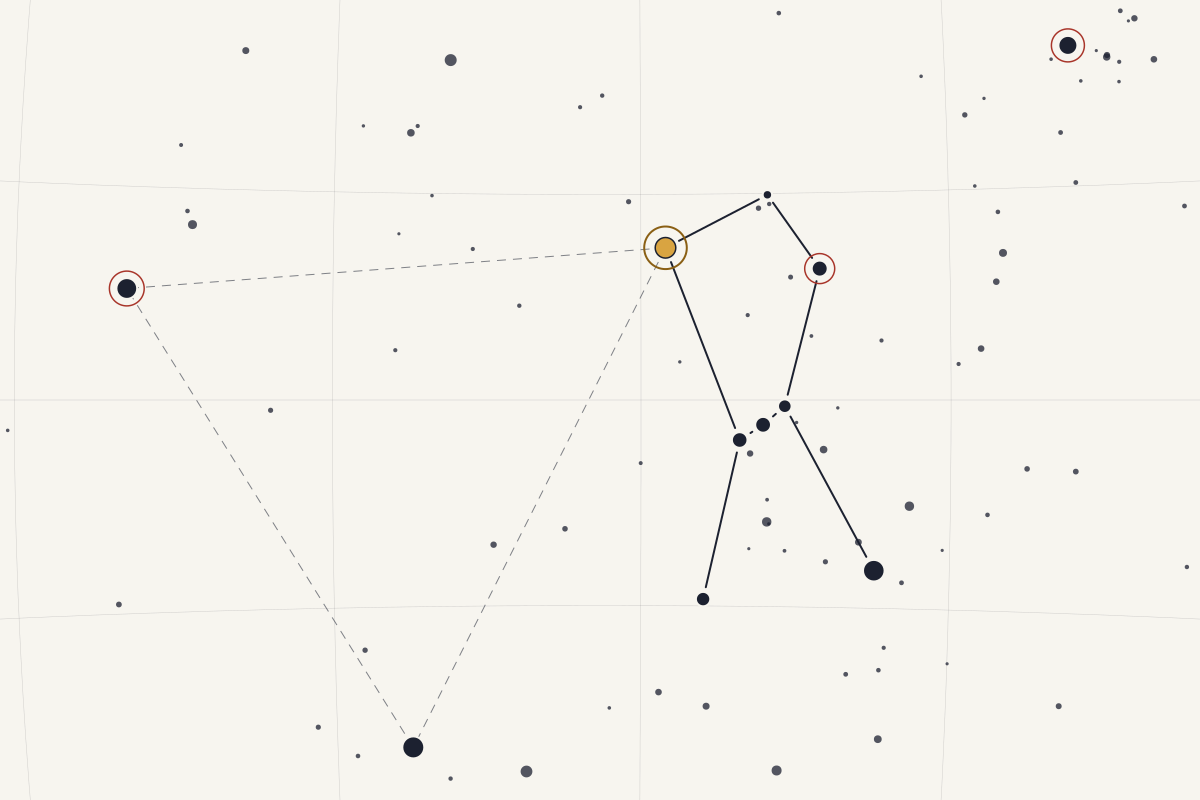
Open the chart full size to zoom in on the detail.
Figure 1. Finder chart from HYG v4.4, north up, east left. Betelgeuse is gold; dashed lines link it to Procyon (far left) and Sirius (bottom left). Red rings: comparison stars Procyon, Aldebaran (upper right) and Bellatrix. Line work is this site's own.
On December 13, 1920, Betelgeuse became the first star beyond the Sun to have its apparent size measured. Turning that angle into miles needed a distance. The one used then was about a third of a 2020 estimate.
It is the orange-red star at Orion's shoulder, upper left as seen from mid-northern latitudes: a red supergiant that varies, usually near magnitude 0.5 (lower is brighter). A 2020 study by Joyce and colleagues put Betelgeuse about 550 light-years away; other estimates since 1997 center between about 430 and 720. A supernova is expected. No study cited here gives a date.
How do you find Betelgeuse?
Face south on a winter evening and find Orion's belt, a short row of three stars. Betelgeuse is the orange-red star above and left of it.
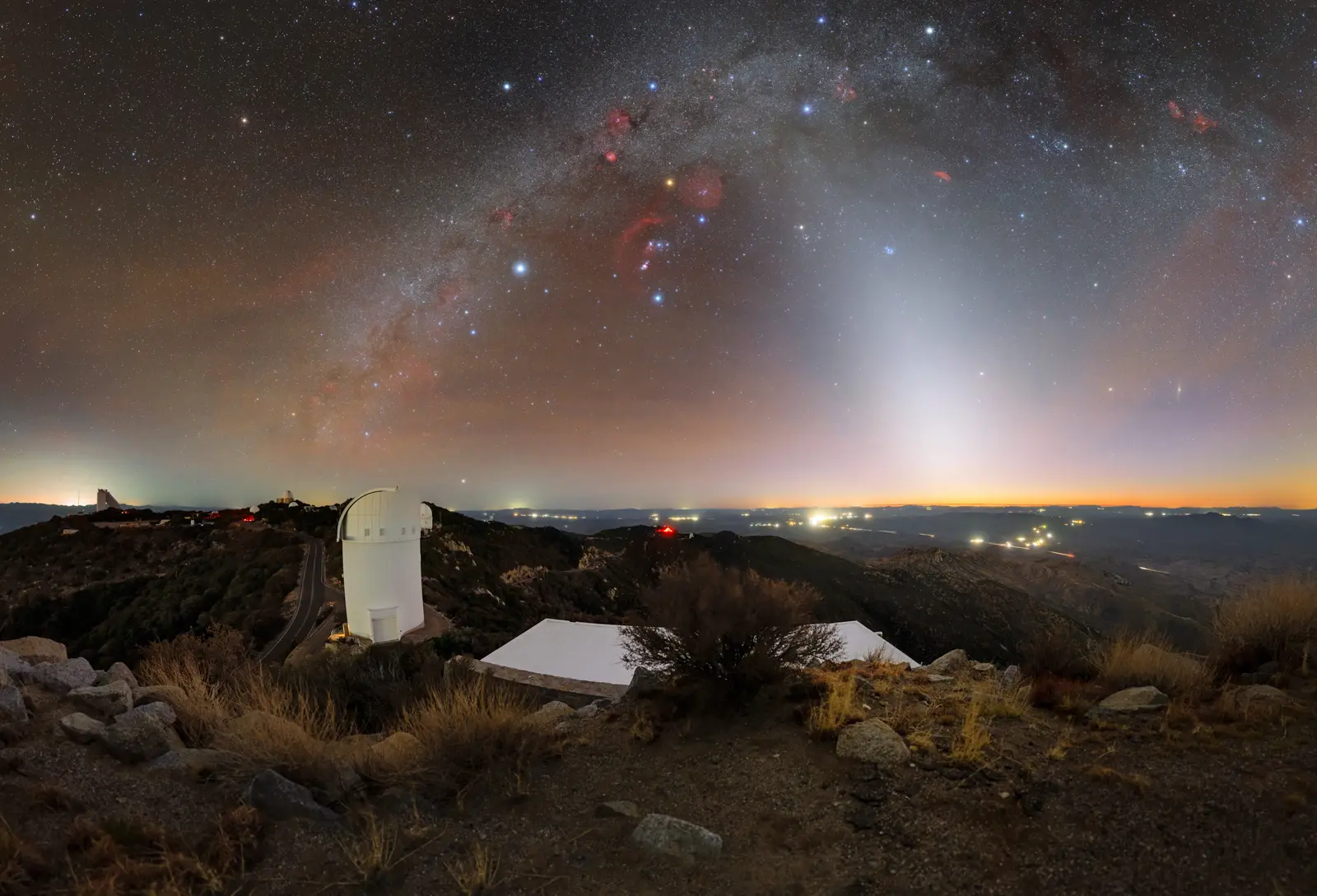

Figure 2. Betelgeuse is the orange star at upper center in this view from Kitt Peak National Observatory. The wide frame tilts Orion, so here it sits above the belt and slightly right.
At 40°N, our calculation puts Betelgeuse due south at 9 p.m. local mean solar time around February 3, about 57 degrees up. At 9 p.m. it is above 30 degrees from early December to the end of March; in mid-October it rises in the east around 10 p.m.
With Procyon and Sirius it forms the Winter Triangle, whose sides in HYG measure 26.0, 27.1 and 25.7 degrees.
Check its brightness against neighbors. HYG lists Procyon at magnitude 0.40, Aldebaran at 0.87 and Bellatrix at 1.64. Betelgeuse usually falls between the first two. In February 2020 it sank to about Bellatrix's level.
How was Betelgeuse measured in 1920?
Telescopes show stars as points. Before this work, Mount Wilson's director George Ellery Hale wrote in 1922, astronomers "had no means of measuring the diameters of the stars." A photograph records a star (the first photograph of a star), but its round image, Hale explained, is light spreading around a point.
The workaround was interference, suggested by Hippolyte Fizeau in 1868. In 1874, Hale recounts, Stephan could only show that many stars are much smaller than 0.158 arcsecond.
At Mount Wilson, Albert Michelson and Francis Pease mounted a 20-foot steel beam on the upper end of the 100-inch Hooker telescope. Four 6-inch mirrors on it fed two pencils of starlight into the telescope to form interference fringes. Spread the outer mirrors far enough, and a star with a measurable disk loses its fringes.
On December 13, 1920, in very good seeing, the team checked the adjustment with the outer mirrors 121 inches apart, on Beta Persei and Gamma Orionis (Bellatrix). On Betelgeuse, no fringes could be found. Procyon, next, showed them at once.
The result was 0.047 arcsecond, good to about 10 percent for a uniformly bright disk, or about 17 percent more if the disk darkens toward its edge. Hale likened it to "a ball one inch in diameter, seen at a distance of seventy miles."
That was a first measurement, not a first clue or picture. Merrill had already seen Betelgeuse's fringes weaken with a smaller interferometer, the paper notes. Pictures came later: Wikipedia's article credits ground-based interferometer images from around 1990.
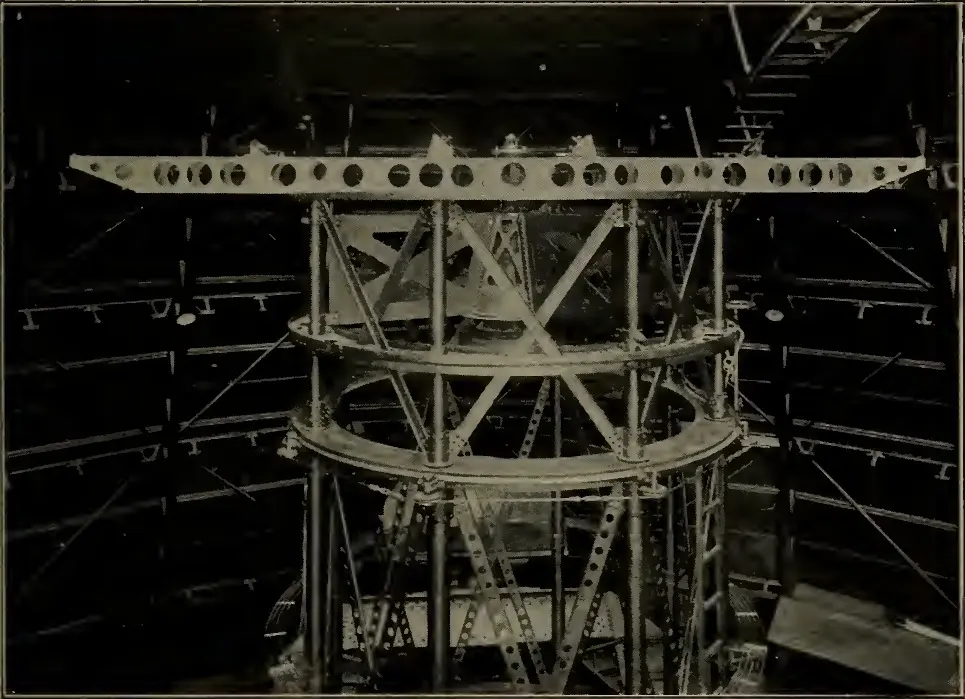
Figure 3. The 20-foot interferometer on the 100-inch Hooker telescope, Fig. 24 in Hale's The New Heavens (1922); the 1921 paper prints the same view as Plate IV a.
How far away is Betelgeuse?
Parallax is the small yearly shift in a star's position as Earth circles the Sun. The 1921 paper adopted 0.018 arcsecond, a weighted mean of three earlier values: about 180 light-years by this page's conversion. Hale's 1922 book used 0.020 and wrote that the light "spends 160 years on its journey."
Think of the distance as a ledger entry that keeps being restated.
| Year | Source | Method | Distance (light-years) |
|---|---|---|---|
| 1921 | Michelson and Pease | Parallax | about 181 |
| 1922 | Hale | Parallax | about 163 (Hale: 160) |
| 1997 | Hipparcos Catalogue | Satellite | 427 (352–545) |
| 2007 | van Leeuwen (used in HYG v4.4) | Satellite, re-reduced | 498 (442–570) |
| 2008 | Harper et al. | Satellite plus radio | 643 (529–822) |
| 2017 | Harper et al. | Satellite plus radio | 723 (614–879) |
| 2020 | Joyce et al. | Stellar modeling | 548 (499–636) |
Ranges: each source's stated uncertainty, converted by this site (1/parallax; Joyce et al. as published, 168 +27/−15 parsecs).
CSV download (CC BY 4.0), with its provenance note (JSON)
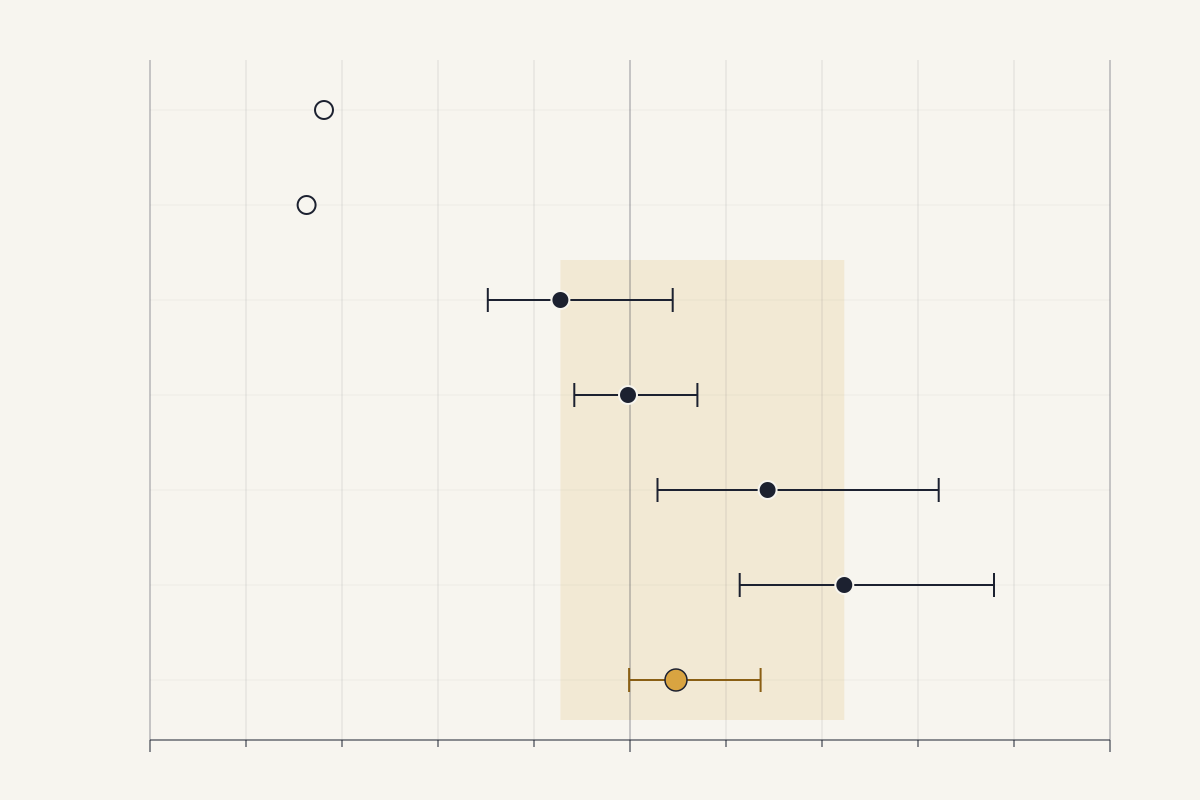
Open the chart full size to zoom in on the detail.
Figure 4. Rows as in the table, 1921 at top; gridlines every 100 light-years from 0, heavier at 500. Hollow: no uncertainty given. Gold: Joyce et al. Band: central values since 1997.
The distance is still unsettled. The star is far too bright for the Gaia satellite, Joyce and colleagues note, and its surface has uneven patches more than 2 au across. Harper's 2017 team says such patches blur its apparent center, and puts the core problem plainly: the parallax "is small compared to the stellar angular diameter." That disk, about 44 milliarcseconds, is six to ten times the parallaxes measured since 1997.
Distance turns the angle into a size. With the 1921 parallax, 0.047 arcsecond means a star about 2.6 au across, "slightly less" than Mars's orbit, the paper said. At the 2020 distance it means about 7.9 au, by this page's calculation. Three times larger.
Light's departure: tonight's light left Betelgeuse roughly 500 to 640 years ago on the 2020 estimate (light-year), or 430 to 720 years on the central values since 1997.
What caused the Great Dimming?
John Herschel noticed the star varying in 1836, says the AAVSO's Variable Star Index. In late 2019 it faded far more than usual. Villanova's Edward Guinan and colleagues reported a mean V magnitude of 1.614 for February 7 to 13, 2020, about one magnitude fainter than in September 2019.
A 2021 Nature paper led by Miguel Montargès found Betelgeuse's southern hemisphere ten times darker than usual in visible light. The paper's explanation: gas the star had shed condensed into dust when a patch of the surface cooled.
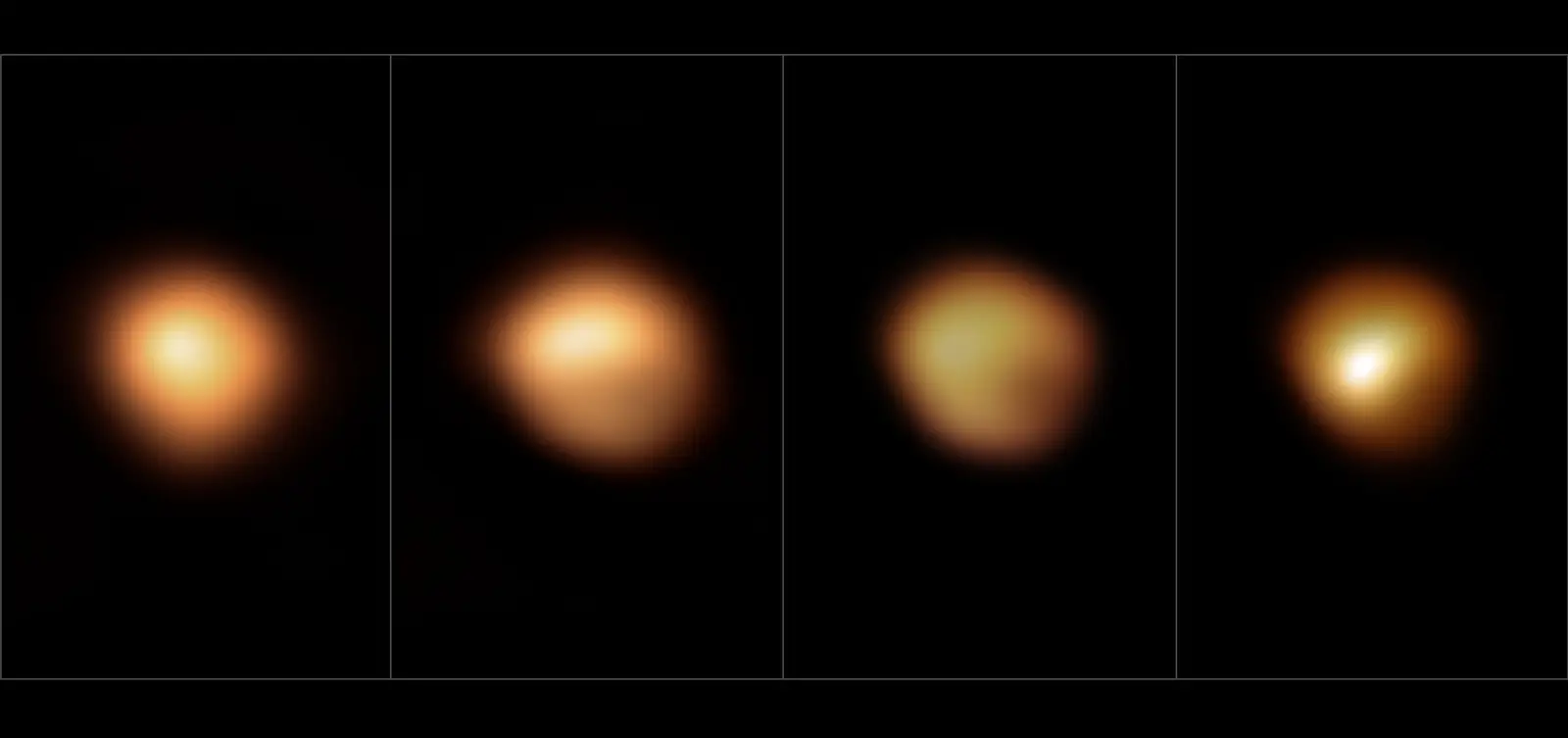

Figure 5. Betelgeuse's surface imaged by ESO's Very Large Telescope: January 2019, December 2019, January 2020, March 2020 (left to right).
Not everyone settled on dust. A 2020 study led by Thavisha Dharmawardena found the star about 20 percent fainter at submillimetre wavelengths too, and pointed to the star itself. In 2022 Andrea Dupree and colleagues reported that Hubble and other observations show a substantial surface mass ejection, which moved out through the star's extended atmosphere and led to dust production.
When will Betelgeuse explode?
Joyce's 2020 study places the star "definitively in the core helium-burning phase." Wikipedia's summary of stellar evolution models gives a "best guess" of under 100,000 years for a non-rotating 20-solar-mass model, far longer for rotating models or lower-mass stars.
A 2023 study by Hideyuki Saio and colleagues read the pulsations differently, finding Betelgeuse "likely in the late stage of core carbon burning." About a week later, László Molnár, Joyce and Shing-Chi Leung replied that the star's measured angular diameter conflicts with the radius their models require.
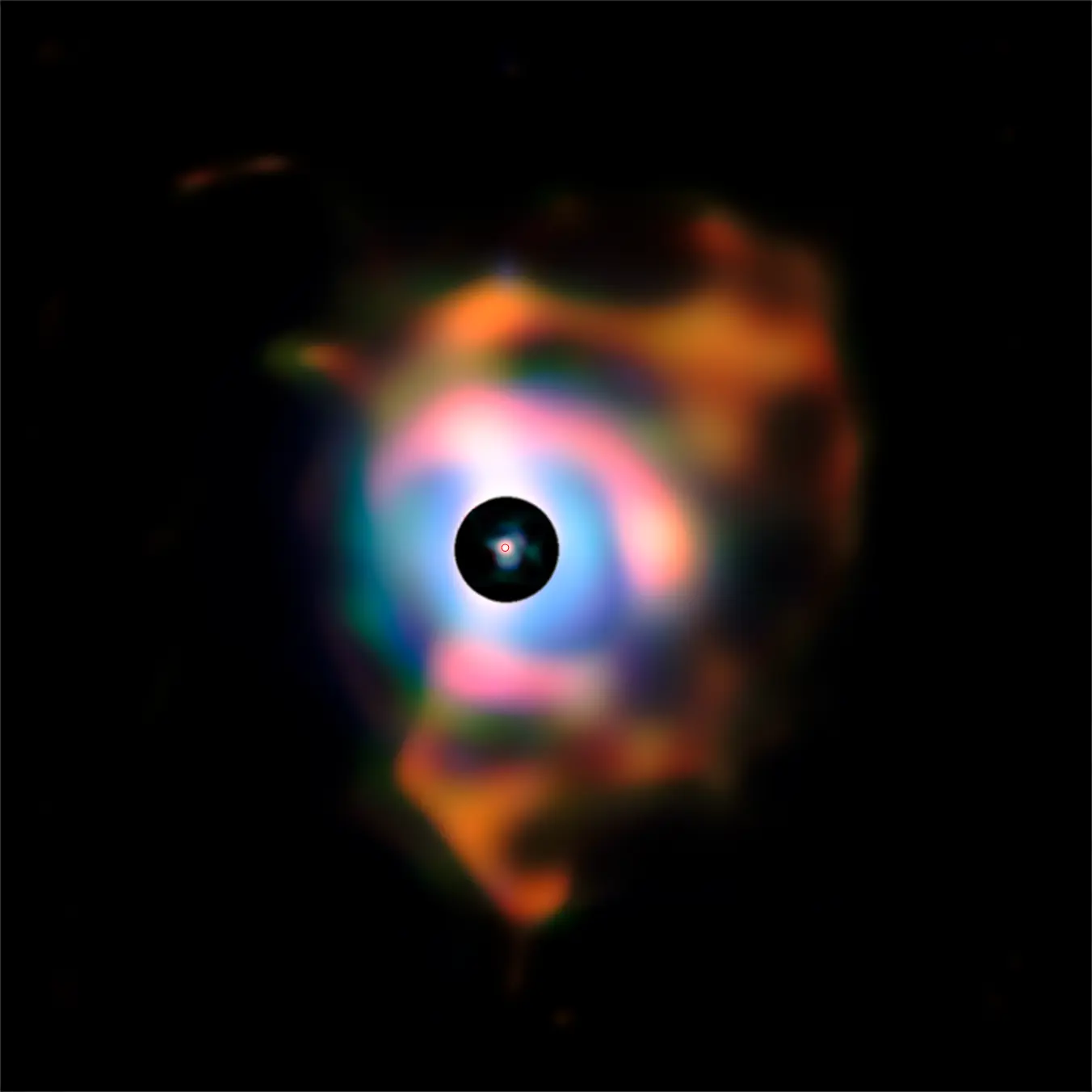
Figure 6. ESO's 2011 infrared image of material shed by Betelgeuse; the small red circle marks the star's visible surface. ESO calls red supergiants "one of the last stages in the life of a massive star."
The dimming was no countdown. ESO said in 2021 it "was not an early sign" of a supernova.
Would a Betelgeuse supernova harm Earth?
A Betelgeuse supernova would be too distant to be lethal on Earth, judging by a 2023 study led by Ian Brunton. In that study, X-rays from supernovae that plow into dense surrounding gas could destroy enough ozone to be lethal up to about 50 parsecs away, roughly 160 light-years by this page's conversion, farther than earlier estimates. Joyce's 2020 study puts Betelgeuse about 550 light-years away. A 2023 review by J. Craig Wheeler and Emmanouil Chatzopoulos expects a pinpoint about as bright as a quarter Moon for about three months.
Where does the name Betelgeuse come from?
Ptolemy described "the bright, reddish star on the right shoulder" without naming it, Ian Ridpath notes. In the tenth century al-Ṣūfī recorded two Arabic names: mankib al-jauzāʾ, the shoulder of al-jauzāʾ, and yad al-jauzāʾ, the hand. Betelgeuse descends from the hand, through a medieval Latin misreading of the first letter, y, as b (Wikipedia).
The popular "armpit of the central one" is a later misreading, repeated by R. H. Allen in Star-Names and Their Meanings (1899). Hale's 1922 book glossed the name as "the giant's shoulder."
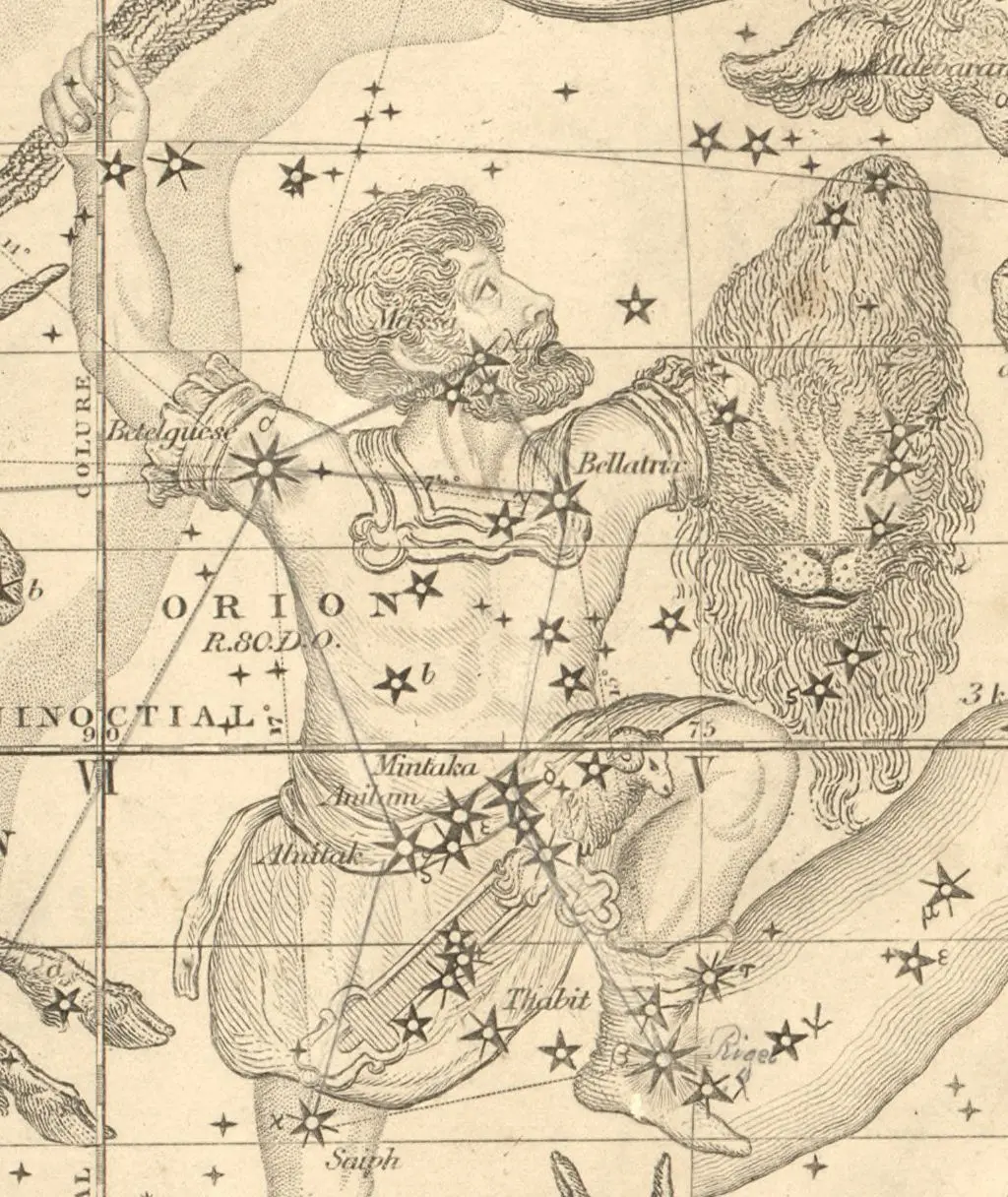

Figure 7. Orion on Map III of the 1856 atlas for Burritt's Geography of the Heavens. The star at the shoulder under his raised club is labeled "Betelguese."
Wikipedia records other readings. In traditional Chinese astronomy it is Shēnxiùsì, the fourth star of the Three Stars; in Sanskrit, Ārdrā, "the moist one." For Aboriginal people of South Australia's Great Victoria Desert it is the club of Nyeeruna, filling with fire-magic and fading, a story linked to its changing light.
Each restated distance also restates when tonight's light set out, which is where the light-year comes in.
Sources
- A. A. Michelson and F. G. Pease, "Measurement of the Diameter of Alpha Orionis with the Interferometer," Astrophysical Journal 53, 249-259 (1921), Mount Wilson Contribution No. 203 (20-foot beam and four 6-inch mirrors; Merrill's earlier decrease in fringe visibility at 100 inches; checks on Beta Persei and Gamma Orionis at 121 inches; no fringes on Alpha Orionis on 1920 December 13, fringes on Procyon; 0.047 arcsec within 10 per cent for a uniform disk, about 17 per cent more with limb darkening; adopted parallax 0.018 arcsec; 240 million miles, slightly less than the orbit of Mars; Plate IV)https://articles.adsabs.harvard.edu/pdf/1921ApJ....53..249MRead: full text, NASA ADS scan of the printed article (12 pages)
- George Ellery Hale, The New Heavens (New York: Charles Scribner's Sons, 1922), preface (instrument photographs by Ferdinand Ellerman) and chapter II, "Giant Stars" (pp. 35-52 used: stars as points; Fizeau 1868 and Stephan 1874; the 20-foot interferometer, Fig. 24; the ball one inch across at seventy miles; parallax 0.020 arcsec and light that spends 160 years on its journey; Betelgeuse glossed as 'the giant's shoulder'), scan on Wikimedia Commonshttps://commons.wikimedia.org/wiki/File:The_new_heavens_(IA_newheavens00hale).pdfRead: full chapter in the Commons PDF scan
- Wikipedia, "Betelgeuse," revision 1379724405 of 2026-10-11 (first angular diameter of a star beyond the Sun, 1920; magnitude usually near 0.5; aperture-masking images of the late 1980s and early 1990s; remaining lifetimes from stellar evolution models, best guess under 100,000 years for a non-rotating 20-solar-mass model; dimmer than Aldebaran in early 2020; medieval misreading of y as b; R. H. Allen 1899; Shenxiusi, Ardra, club of Nyeeruna)https://en.wikipedia.org/wiki/Betelgeuse
- David Nash (astronexus), HYG Database v4.4, data README and licence (CC BY-SA 4.0): positions, V magnitudes (Betelgeuse 0.45, Procyon 0.40, Aldebaran 0.87, Bellatrix 1.64), distance 152.6718 pchttps://codeberg.org/astronexus/hyg
- AAVSO, The International Variable Star Index (VSX), "alf Ori" (variability type SRC, range 0.0-1.6 V, period 423 d, discoverer John Herschel 1836)https://vsx.aavso.org/index.php?view=detail.top&oid=24710
- ESA, The Hipparcos Catalogue (1997), CDS VizieR I/239/hip_main, HIP 27989: parallax 7.63 +/- 1.64 mashttps://vizier.cds.unistra.fr/viz-bin/VizieR-5?-source=I/239/hip_main&HIP=27989
- F. van Leeuwen, Hipparcos, the New Reduction of the Raw Data (2007), CDS VizieR I/311/hip2, HIP 27989: parallax 6.55 +/- 0.83 mashttps://vizier.cds.unistra.fr/viz-bin/VizieR-5?-source=I/311/hip2&HIP=27989
- G. M. Harper, A. Brown and E. F. Guinan, "A New VLA-Hipparcos Distance to Betelgeuse and Its Implications," Astronomical Journal 135, 1430 (2008) (Hipparcos plus VLA radio positions; parallax 5.07 +/- 1.10 mas; 197 +/- 45 pc; original Hipparcos 131 +/- 30 pc)https://iopscience.iop.org/article/10.1088/0004-6256/135/4/1430Read: abstract and astrometric solution tables on the publisher page
- G. M. Harper et al., "An Updated 2017 Astrometric Solution for Betelgeuse," Astronomical Journal 154, 11 (2017), arXiv:1706.06020 (parallax 4.51 +/- 0.80 mas, 222 +48/-34 pc; surface inhomogeneities add centroid uncertainty; parallax small compared to the 44 mas angular diameter)https://arxiv.org/abs/1706.06020Read: abstract
- M. Joyce, S.-C. Leung, L. Molnár, M. Ireland, C. Kobayashi and K. Nomoto, "Standing on the Shoulders of Giants: New Mass and Distance Estimates for Betelgeuse," Astrophysical Journal 902 (2020), doi:10.3847/1538-4357/abb8db, arXiv:2006.09837 (168 +27/-15 pc; parallax 5.95 +0.58/-0.85 mas; core helium-burning phase; beyond Gaia's brightness limit; >2 au surface asymmetries)https://arxiv.org/abs/2006.09837Read: abstract and section 2 of the arXiv full text (v5, published version)
- E. Guinan, R. Wasatonic, T. Calderwood and D. Carona, "The Fall and Rise in Brightness of Betelgeuse," The Astronomer's Telegram 13512 (22 February 2020) (mean light minimum V = 1.614 +/- 0.008 during 2020 February 7-13; about 1.0 mag fainter than September 2019; lower half of the star dimmed in the late-2019 SPHERE image)https://www.astronomerstelegram.org/?read=13512
- ESO, "Mystery of Betelgeuse's dip in brightness solved," press release eso2109, 16 June 2021 (VLT SPHERE images January 2019 to March 2020; dust after a surface patch cooled; normal brightness by April 2020; "not an early sign" of a supernova)https://www.eso.org/public/news/eso2109/
- M. Montargès et al., "A dusty veil shading Betelgeuse during its Great Dimming," Nature (2021), doi:10.1038/s41586-021-03546-8, arXiv:2201.10551 (southern hemisphere ten times darker than usual in the visible; dust clump after a cool photospheric patch; distance quoted as roughly 220 pc or 724 light-years)https://arxiv.org/abs/2201.10551Read: abstract
- T. E. Dharmawardena et al., "Betelgeuse fainter in the sub-millimetre too: an analysis of JCMT and APEX monitoring during the recent optical minimum," Astrophysical Journal Letters 897, L9 (2020), arXiv:2006.09409 (about 20 per cent fainter in the submillimetre; photospheric change rather than dust)https://arxiv.org/abs/2006.09409Read: abstract
- A. K. Dupree, K. G. Strassmeier, T. Calderwood, T. Granzer, M. Weber, K. Kravchenko, L. D. Matthews, M. Montargès, J. Tappin and W. T. Thompson, "The Great Dimming of Betelgeuse: a Surface Mass Ejection (SME) and its Consequences," Astrophysical Journal 936, 18 (2022), doi:10.3847/1538-4357/ac7853, arXiv:2208.01676 (a substantial surface mass ejection moved out through the extended atmosphere and led to dust production; observations include the Hubble Space Telescope)https://arxiv.org/abs/2208.01676Read: arXiv preprint full text
- H. Saio, D. Nandal, G. Meynet and S. Ekström, "The evolutionary stage of Betelgeuse inferred from its pulsation periods," arXiv:2306.00287 (2023; accepted for publication in MNRAS) (likely in the late stage of core carbon burning; a good candidate for the next Galactic Type II supernova)https://arxiv.org/abs/2306.00287Read: abstract
- L. Molnár, M. Joyce and S.-C. Leung, "Comment on the feasibility of carbon burning in Betelgeuse," Research Notes of the AAS 7, 119 (2023), arXiv:2306.05600 (angular diameter measurements conflict with the stellar radius required by their models)https://arxiv.org/abs/2306.05600Read: abstract
- Ian Ridpath, "Star Tales – Orion 2" (Ptolemy's "bright, reddish star on the right shoulder"; al-Sufi's mankib al-jauza' and yad al-jauza'; "armpit" as a misreading perpetuated by R. H. Allen; al-jauza' as a female figure covering Orion and Gemini)http://www.ianridpath.com/startales/orion2.html
- IAU Working Group on Star Names, "IAU Catalog of Star Names (IAU-CSN)," text edition maintained by WGSN secretary E. Mamajek, last updated 2022-04-04 (Betelgeuse, HR 2061, alpha Ori, approved 2016-06-30)https://www.pas.rochester.edu/~emamajek/WGSN/IAU-CSN.txt
- NOIRLab, "Stellar Red Giant Above KPNO," Image of the Week iotw2319a, 10 May 2023 (photograph from Kitt Peak National Observatory behind the UArizona Bok 2.3-meter Telescope; the orange star at the center of the image is the red supergiant Betelgeuse, marking a shoulder of Orion, and glows a cool red compared to its hot, bright blue neighbors; credit KPNO/NOIRLab/NSF/AURA/T. Slovinský)https://noirlab.edu/public/images/iotw2319a/Read: image page and caption
- ESO, "The Flames of Betelgeuse," press release eso1121, 23 June 2011, and image eso1121a (VISIR infrared image from the VLT of the nebula of material shed by Betelgeuse; the small red circle represents the location of the visible surface and the black disc masks the brightest part; "Red supergiants like Betelgeuse represent one of the last stages in the life of a massive star"; credit ESO/P. Kervella)https://www.eso.org/public/news/eso1121/Read: full release text and the eso1121a image page
- H. Mattison, Atlas designed to illustrate Burritt's Geography of the Heavens (New York, 1856), Map III, "The Constellations" (March, February, January), engraved by W. G. Evans under the direction of E. H. Burritt; Library of Congress Geography and Map Division, G1000 .M3 1856 (Orion's shoulder star labeled "Betelguese"), scan on Wikimedia Commonshttps://commons.wikimedia.org/wiki/File:Atlas_designed_to_illustrate_Burritt%27s_Geography_of_the_heavens_..._LOC_77370907-4.jpgRead: plate scan and Commons file page (LoC catalogue data, https://www.loc.gov/item/77370907/)
- I. R. Brunton, C. O'Mahoney, B. D. Fields, A. L. Melott and B. C. Thomas, "X-Ray-luminous Supernovae: Threats to Terrestrial Biospheres," Astrophysical Journal 947, 42 (2023), doi:10.3847/1538-4357/acc728 (arXiv:2210.11622)https://doi.org/10.3847/1538-4357/acc728Read: full text, arXiv version 2, which the authors state matches the ApJ version (CC BY 4.0): abstract and sections 1.2, 2.1-2.3 and 4.1
- J. Craig Wheeler and Emmanouil Chatzopoulos, "Betelgeuse: a review," Astronomy & Geophysics 64(3), 3.11-3.27 (2023), doi:10.1093/astrogeo/atad020 (arXiv:2306.09449)https://arxiv.org/abs/2306.09449Read: section 5, The Explosion to Come, in the preprint (arXiv version 1); the journal version was not read
Computed by this site (2026-10-12) from sources 1, 2, 4 and 6 to 10: rising and transit times and altitudes at 40°N, the Winter Triangle sides, the 1921 angle check (1.22 × 575 nm ÷ 121 inches), parsec-to-light-year conversions, the 2.6 and 7.9 au sizes, and the disk-to-parallax ratio. Added 2026-10-14 from source 23: the 50-parsec lethal range in light-years.
Corrections
2026-10-14 — Added a section on whether a Betelgeuse supernova would harm Earth (not covered → too distant to be lethal, judging by a 2023 study led by Ian Brunton in which X-rays from supernovae that plow into dense surrounding gas could be lethal up to about 50 parsecs, roughly 160 light-years, while Joyce's 2020 study puts Betelgeuse about 550 light-years away; a 2023 review by J. Craig Wheeler and Emmanouil Chatzopoulos expects a point of light about as bright as a quarter Moon for about three months), with sources 23 and 24 added, prompted by a recheck.
Look up next:
Aldebaran, the orange star in Taurus. In mid-October at 40°N it rises in the east-northeast around 8 p.m. local mean solar time; by 11 p.m. our calculation puts it about 33 degrees up, with Betelgeuse about 13 degrees up below it. Betelgeuse usually outshines Aldebaran, but not in early 2020. Read on: Orion.
Related entries
- First Photograph of a Star: Vega in 1850, or the Sun in 1845
- Andromeda Galaxy: Hubble's "VAR!" Was Right, but His Distance Wasn't
- Orion Constellation: The Winter Hunter Rises Before Dawn in August
- Light-Year: Its Year Runs 11 Minutes Longer Than the Seasons
Cite this page
Asterisms & Astrolabes. “Betelgeuse: Sized Up in 1920, Its Distance Still Unsettled.” Asterisms & Astrolabes. Published 13 October 2026; last substantive revision 14 October 2026. https://asterismsandastrolabes.com/archives/betelgeuse/. Accessed [the date you read it].