Comparison and data page
Solar System Scale Model: On a Soccer Field, Four Planets Fit in the Goal Area
TL;DR: Shrink Neptune's average distance from the Sun to the 100 m of a soccer field and the Sun becomes a 3.1 cm ball on one goal line, with Earth a 0.28 mm speck 3.3 m (3.6 yd) away. At their average distances, Mercury, Venus, Earth and Mars all land inside the 5.5 m goal area, Jupiter lands just outside the penalty area, and Neptune sits on the far goal line.
In this entry13 sections
- How big is the Sun on a 100-meter field?
- Where does each planet go on the field?
- Why can't one drawing show sizes and distances?
- What if the Sun were the soccer ball?
- Does it work on an American football field?
- Where would the Moon, Pluto and the nearest star go?
- How do I scale the model to my own field?
- How were the numbers computed?
- Sources
- Corrections
- Look up next
- Related entries
- Cite this page
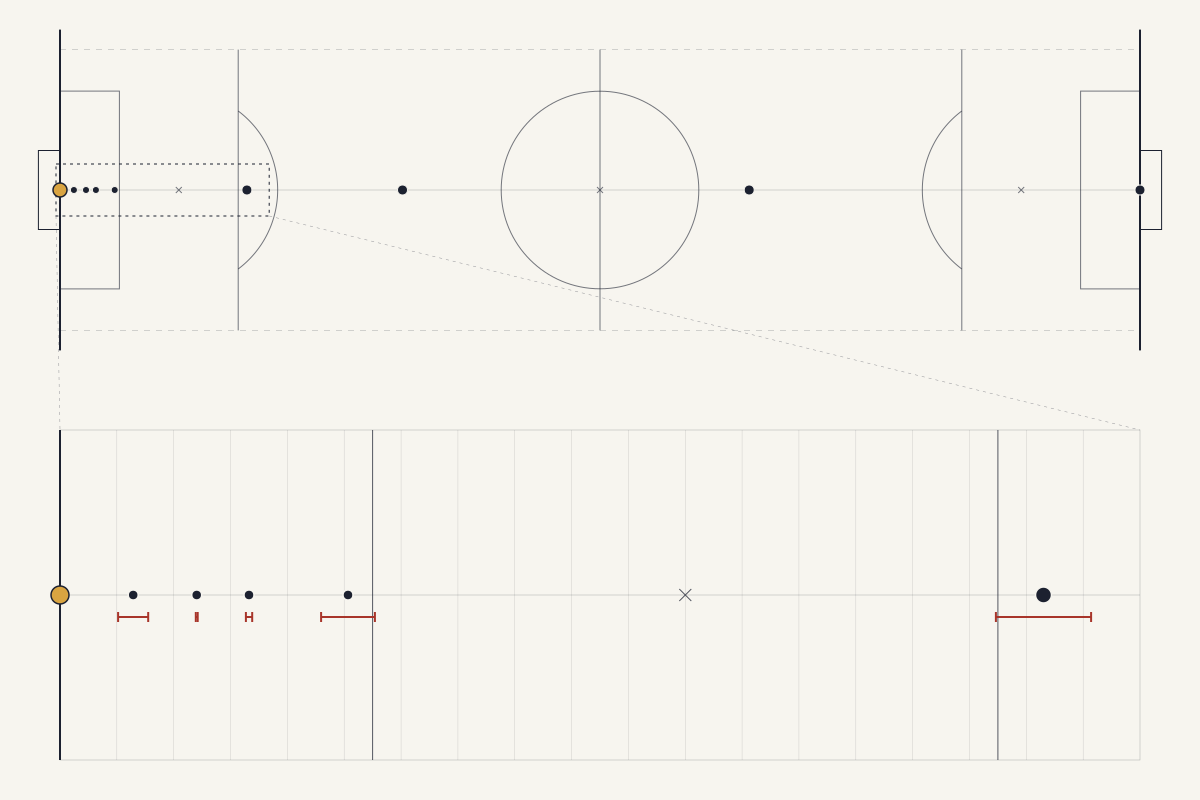
Open the chart full size to zoom in on the detail.
Figure 1. Top: the whole field, cropped to a central strip, with the Sun (gold) on the left goal line and one dot at each planet's average distance; left to right, Mercury, Venus, Earth and Mars sit inside the goal area, then come Jupiter, Saturn, Uranus and Neptune on the far goal line. Bottom: the first 19 m enlarged, one faint line per meter, with darker lines for the goal area (5.5 m) and the penalty area (16.5 m) and a cross at the penalty mark (11 m); the dots are Mercury, Venus, Earth, Mars and Jupiter, and red bars run from each planet's closest to its farthest distance from the Sun. Marker sizes are not to scale.
Put the Sun on one goal line and Neptune on the other: Earth lands 3.3 m out. This solar system scale model shrinks Neptune's average distance from the Sun, 30.07 astronomical units (au), to 100 m of grass. At that scale the Sun is a ball 3.1 cm (1.2 in) across. Earth is a speck 0.28 mm wide.
At their average distances, all four inner planets stop inside the goal area. Every model number on this page comes from one division. Any calculator can check it.
How big is the Sun on a 100-meter field?
The astronomical unit is a fixed length, exactly 149,597,870,700 m. The International Astronomical Union (IAU) set it in 2012 as a unit approximating the Earth-Sun distance. Divide 100 m by 30.07 au and you get the model's single conversion factor, 2.223 × 10⁻¹¹. The factor works like the exchange rate on a one-line ledger: 1 m of grass stands for about 45 million km of space, and 1 mm for about 45,000 km.
The IAU's nominal solar radius is 695,700 km, so the Sun's 1,391,400 km diameter converts to 30.9 mm. The Laws of the Game, soccer's rulebook from the International Football Association Board (IFAB), allow field lines up to 12 cm wide, almost four times the width of this Sun. Earth, 12,742 km across by its mean radius, converts to 0.28 mm. Jupiter, the largest planet, comes out at 3.1 mm.
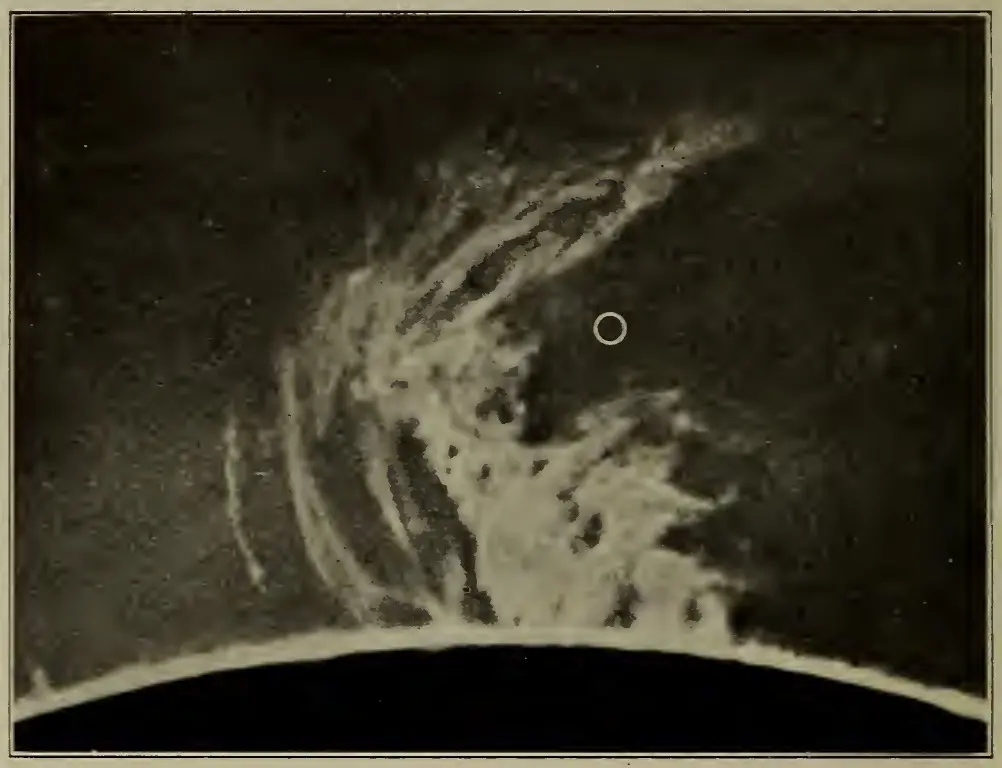
Figure 2. Ferdinand Ellerman's photograph of a prominence at the Sun's edge, from George Ellery Hale's The New Heavens (1922). The white circle shows Earth's size to the same scale.
A 100 m field is a real size. It is the shortest touchline the Laws allow for international matches, which may run up to 110 m. Other fields may measure 90 to 120 m.
Where does each planet go on the field?
| Body | Average distance (au) | Position on a 100 m field | Same, in yards | Diameter (mm) | Diameter (in) |
|---|---|---|---|---|---|
| Sun | 0 | 0 m | 0 yd | 30.93 | 1.218 |
| Mercury | 0.387 | 1.29 m | 1.41 yd | 0.11 | 0.004 |
| Venus | 0.723 | 2.41 m | 2.63 yd | 0.27 | 0.011 |
| Earth | 1.000 | 3.33 m | 3.64 yd | 0.28 | 0.011 |
| Mars | 1.524 | 5.07 m | 5.54 yd | 0.15 | 0.006 |
| Jupiter | 5.203 | 17.30 m | 18.92 yd | 3.11 | 0.122 |
| Saturn | 9.537 | 31.71 m | 34.68 yd | 2.59 | 0.102 |
| Uranus | 19.189 | 63.82 m | 69.79 yd | 1.13 | 0.044 |
| Neptune | 30.070 | 100.00 m | 109.36 yd | 1.09 | 0.043 |
Average distance is the semi-major axis from Standish and Williams's approximate orbital elements for 1800 to 2050 (the Earth row is the Earth-Moon barycenter); diameters use mean radii. Computed by this page; the CSV adds closest and farthest points, the Moon, Pluto, Proxima Centauri and two other versions of the model.
CSV download (CC BY 4.0), with its provenance note (JSON)
To lay the model out on a field:
- Center a ball 3.1 cm across, the Sun, on the outer edge of one goal line, because the Laws of the Game measure field markings from the outside of the lines.
- Measure each planet's distance in the table from the Sun's center, along one straight line toward the far goal line.
- For a field of another length, multiply every meter figure by that length and divide by 100.
Now read the table against the paint. The goal area reaches 5.5 m (6 yd) from the goal line, so Mercury, Venus, Earth and Mars all stop inside it, Mars with 43 cm to spare. Jupiter lands 80 cm beyond the 16.5 m front line of the penalty area. Saturn, at 31.7 m, stops short of the center circle, which runs from 40.85 m to 59.15 m, and Uranus, at 63.8 m, is already past it.
Those stops are averages. Each planet follows an ellipse, so it has a closest and a farthest point from the Sun, shown as red bars in Figure 1. At its farthest, Mars would sit about 4 cm outside the goal area; at its closest, Jupiter would sit 3.5 cm inside the penalty area. Even at their extremes, no planet enters the center circle, and the true shapes of those ellipses are drawn in orbital eccentricity.
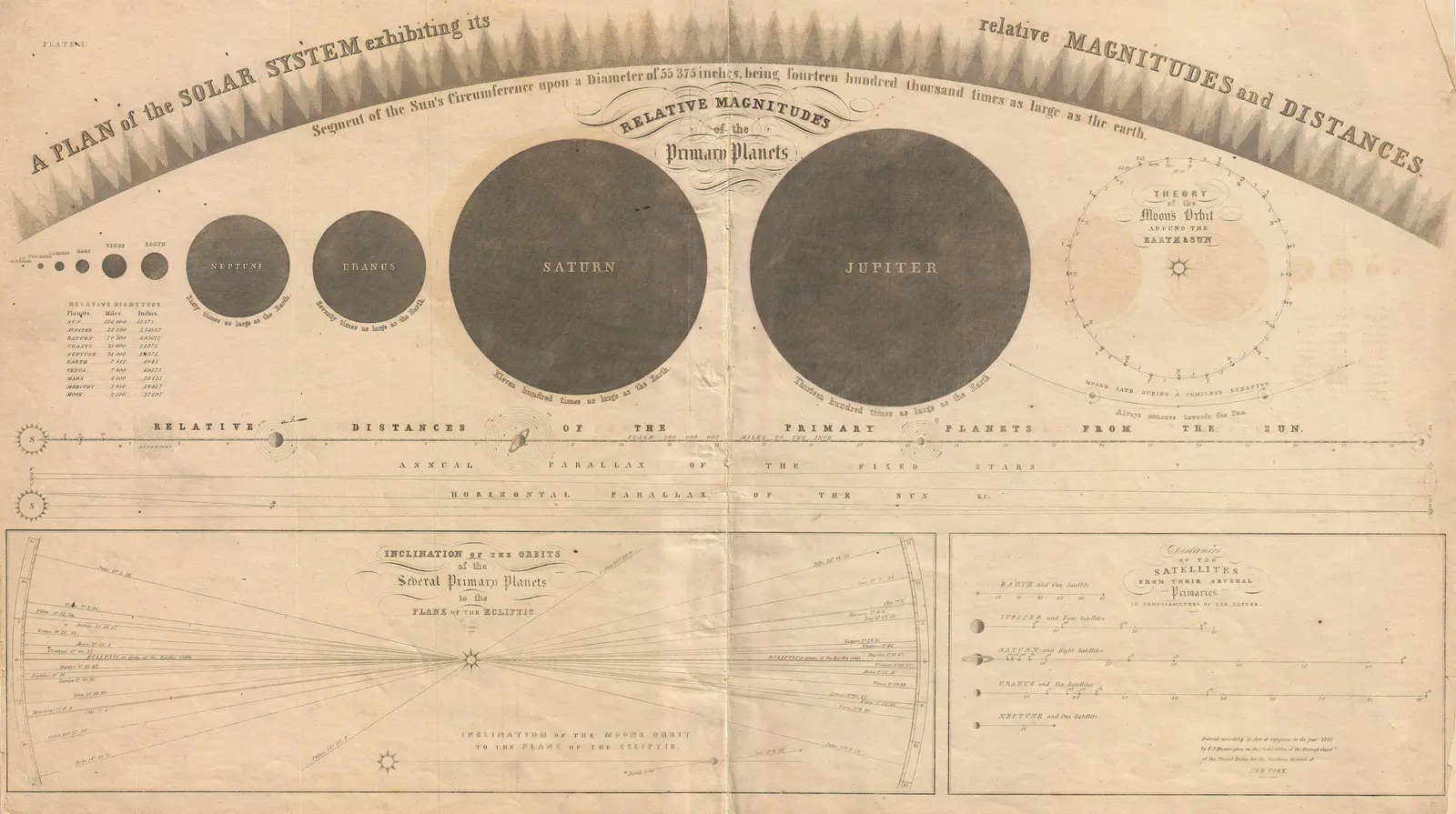

Figure 3. Plate I of the 1856 atlas to Burritt's Geography of the Heavens. Across the middle, the planets sit on one line out from the Sun at far left, at 100,000,000 miles to the inch.
Why can't one drawing show sizes and distances?
Earth sits about 11,700 of its own diameters from the Sun. That ratio holds at any scale. Draw this 100 m field 1,000 pixels wide and Earth would be 0.003 of a pixel, which is why Figure 1 uses markers far too big for the planets. Any page-sized diagram that shows planets as visible disks has to shrink the gaps or swell the planets.
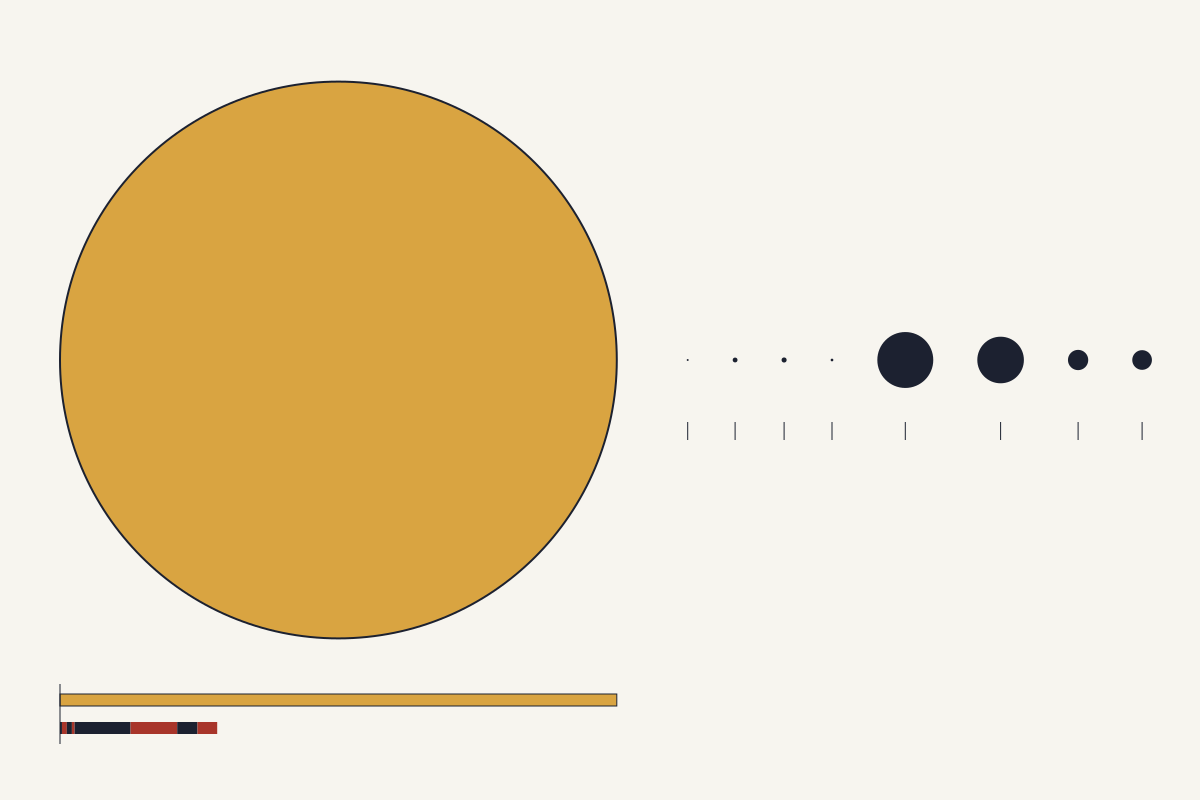
Open the chart full size to zoom in on the detail.
Figure 4. The Sun and the eight planets at soccer-field scale, enlarged by the same amount so the relative sizes are exact; Saturn's rings are left out. The planets run left to right from Mercury to Neptune, each above a tick mark so the smallest can be found. Bottom bars: the Sun's 30.9 mm diameter (gold) against all eight planet diameters laid end to end (8.7 mm), in the same order, alternating dark and red.
Line up all eight planets and the row is 8.7 mm long, less than a third of the Sun's width. Jupiter and Saturn make up about two-thirds of that row.
What if the Sun were the soccer ball?
Law 2 sets a ball's circumference at 68 to 70 cm, which makes it about 22 cm across. Make a 22 cm ball the Sun and every length grows about sevenfold: Earth becomes 2 mm across and sits 23.7 m away, Jupiter sits 123 m out, and Neptune 711 m (778 yd) away, just over seven fields end to end. With the smallest and largest legal balls, Neptune lands between about 700 m and 720 m.
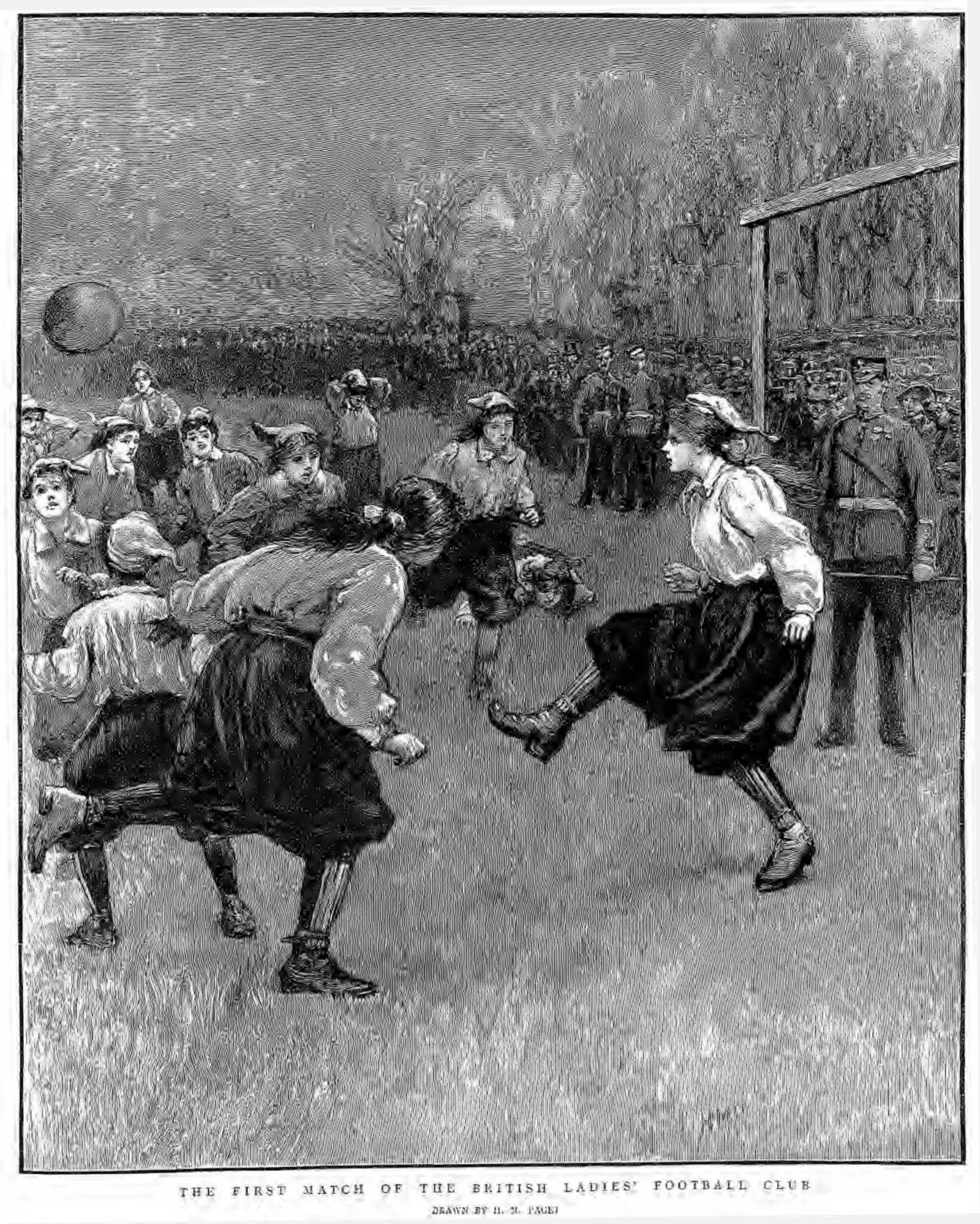

Figure 5. H. M. Paget's drawing of the British Ladies' Football Club's first match, The Graphic, March 1895; the ball flies at upper left. As the Sun, a 22 cm ball puts Neptune 711 m away.
This model starts from the field instead. All eight average distances fit on one pitch.
Does it work on an American football field?
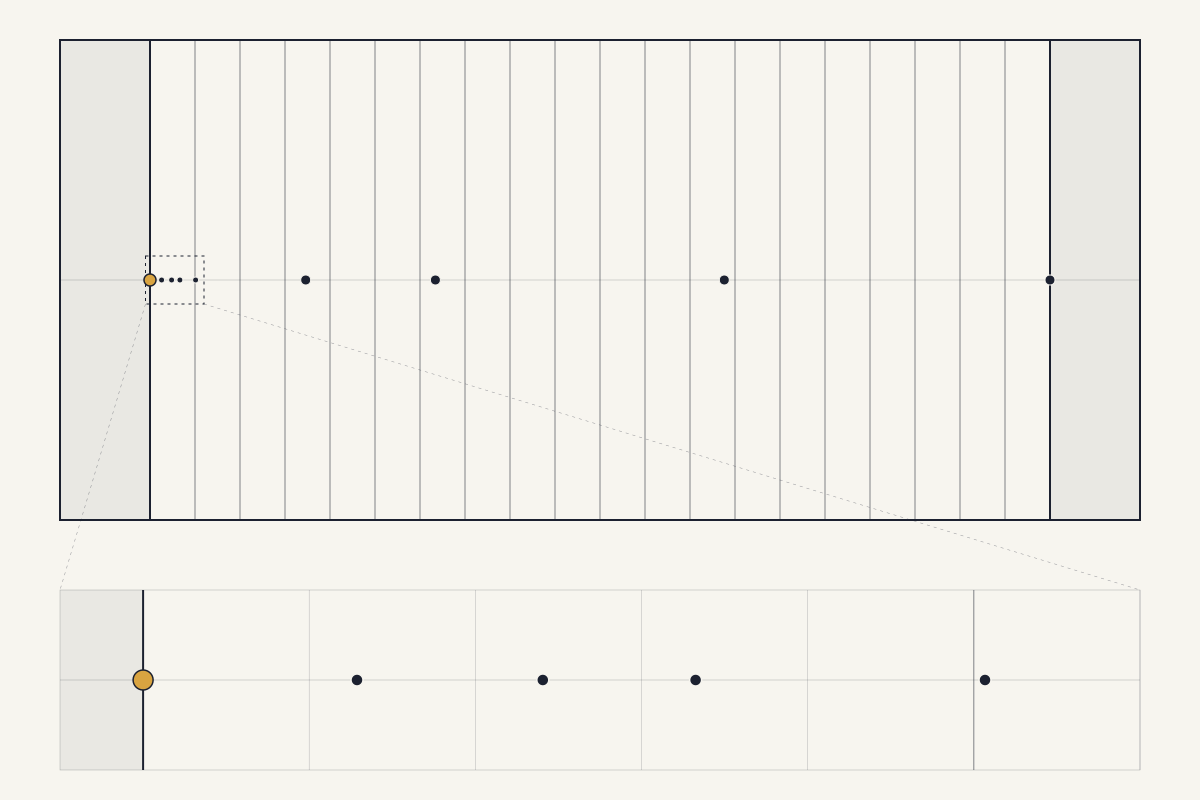
Yes, with yards in place of meters. An American football field is 100 yards between the goal lines, not 100 m: the NFL rulebook sets the field at 360 feet, with each goal line 10 yards in from an end line. A yard is exactly 0.9144 m, so goal line to goal line is 91.44 m, and end line to end line about 109.7 m.
With the Sun on one goal line and Neptune on the other, every meter figure in the table becomes the same number of yards: Earth 3.33 yd out, Jupiter 17.3 yd, Saturn 31.7 yd, Uranus 63.8 yd. Sizes shrink by the same factor of 0.9144. The Sun is then 28.3 mm (1.11 in) across, and Earth 0.26 mm.
Open the chart full size to zoom in on the detail.
Figure 6. Top: the Sun (gold) on one goal line, then Mercury to Mars, Jupiter, Saturn, Uranus and Neptune on the far goal line. Bottom: the first 6 yards, with Mars just past the 5-yard line.
Where would the Moon, Pluto and the nearest star go?
The Moon circles Earth's 0.28 mm speck at 8.5 mm, and is itself 0.08 mm wide. Pluto does not stay put. Between perihelion and aphelion, the dwarf planet swings from 98.6 m, just inside the far goal line, out to 162 m. Neptune's own distance varies too, from 99.1 m to 100.9 m.
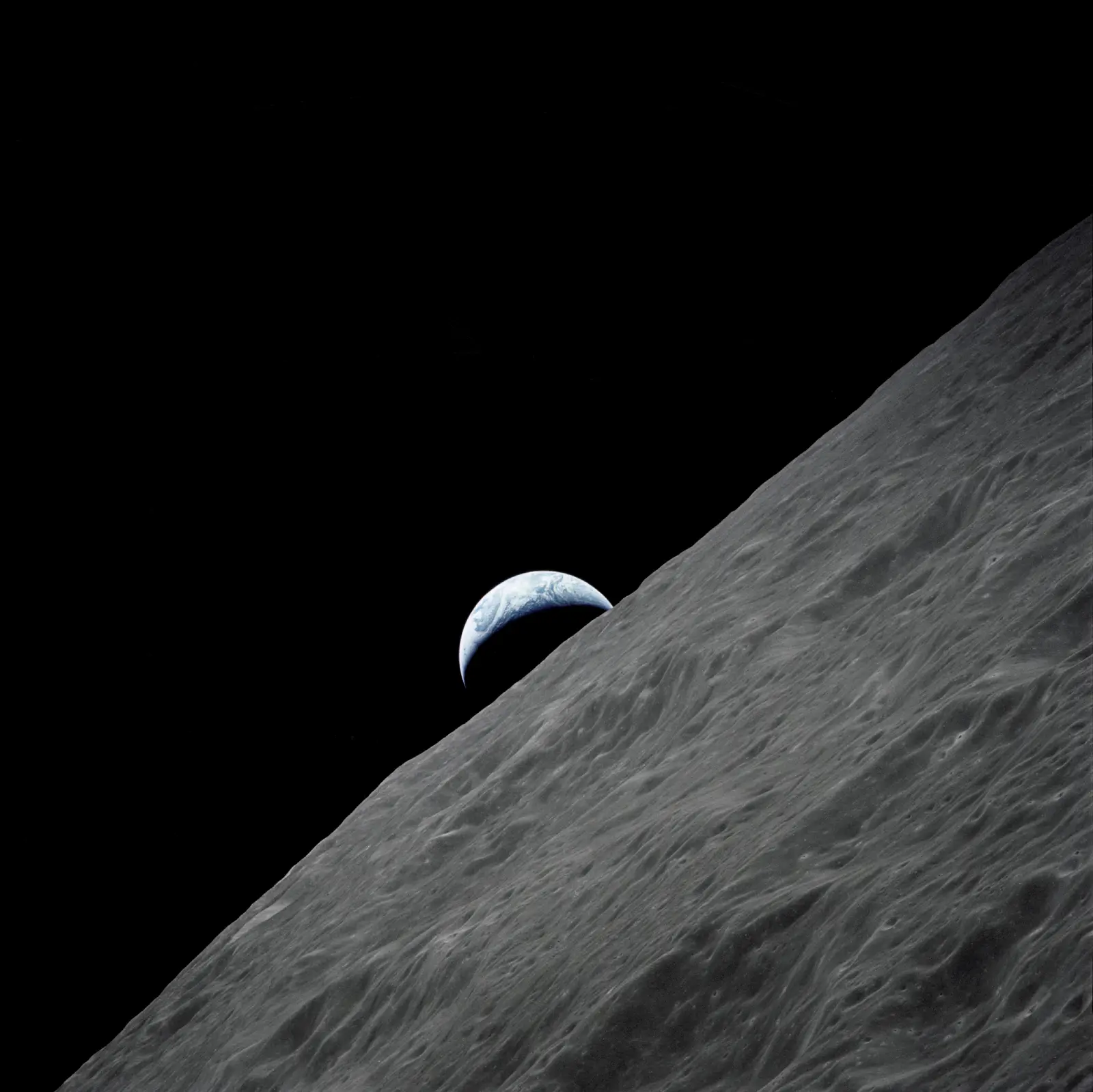
Figure 7. A crescent Earth rising above the Moon's horizon, photographed from the Apollo 17 spacecraft in lunar orbit in December 1972. On the soccer field, the two would be specks 8.5 mm apart.
The nearest star, Proxima Centauri, is about 268,550 au away, give or take 17 au, according to the parallax in the European Space Agency's Gaia catalog (Early Data Release 3, 2020). That distance is about 4.25 light-years, a unit explained on the light-year page. On the same scale Proxima lands about 893 km (555 miles) from the field.
How do I scale the model to my own field?
Enter the length you have for Sun to Neptune, or the width of the ball you want as the Sun. Every row below follows, starting from this page's 100 m field. Distances run from the Sun, except the Moon's, which runs from Earth.
Sun to Neptune: 100.00 m (109.36 yd). Sun: 30.93 mm (1.218 in) across.
| Body | Distance metric, US | Diameter metric, US |
|---|---|---|
| Sun | 0 m 0 yd | 30.93 mm 1.218 in |
| Mercury | 1.29 m 1.41 yd | 0.11 mm 0.004 in |
| Venus | 2.41 m 2.63 yd | 0.27 mm 0.011 in |
| Earth | 3.33 m 3.64 yd | 0.28 mm 0.011 in |
| Mars | 5.07 m 5.54 yd | 0.15 mm 0.006 in |
| Jupiter | 17.30 m 18.92 yd | 3.11 mm 0.122 in |
| Saturn | 31.71 m 34.68 yd | 2.59 mm 0.102 in |
| Uranus | 63.82 m 69.79 yd | 1.13 mm 0.044 in |
| Neptune | 100.00 m 109.36 yd | 1.09 mm 0.043 in |
| Moon, from Earth | 8.55 mm 0.336 in | 0.08 mm 0.003 in |
| Pluto | 130.48 m 142.70 yd | 0.05 mm 0.002 in |
| Proxima Centauri | 893.09 km 554.94 mi | n/a n/a |
How were the numbers computed?
Each position is 100 m × (distance in au ÷ 30.06992), and each size is the real diameter × 2.223 × 10⁻¹¹. Planet distances are semi-major axes, half the long axis of each ellipse and the average of its closest and farthest distances, taken from the approximate orbital elements of E. M. Standish and J. G. Williams, fitted to the years 1800 to 2050. Planet sizes use mean radii, the radius of a sphere with the planet's volume, and the Sun uses the IAU's 2015 nominal radius.
The model puts every planet on one straight line, an arrangement the real planets do not hold, and ignores the small tilts between orbits. The CSV lists every input with its source.
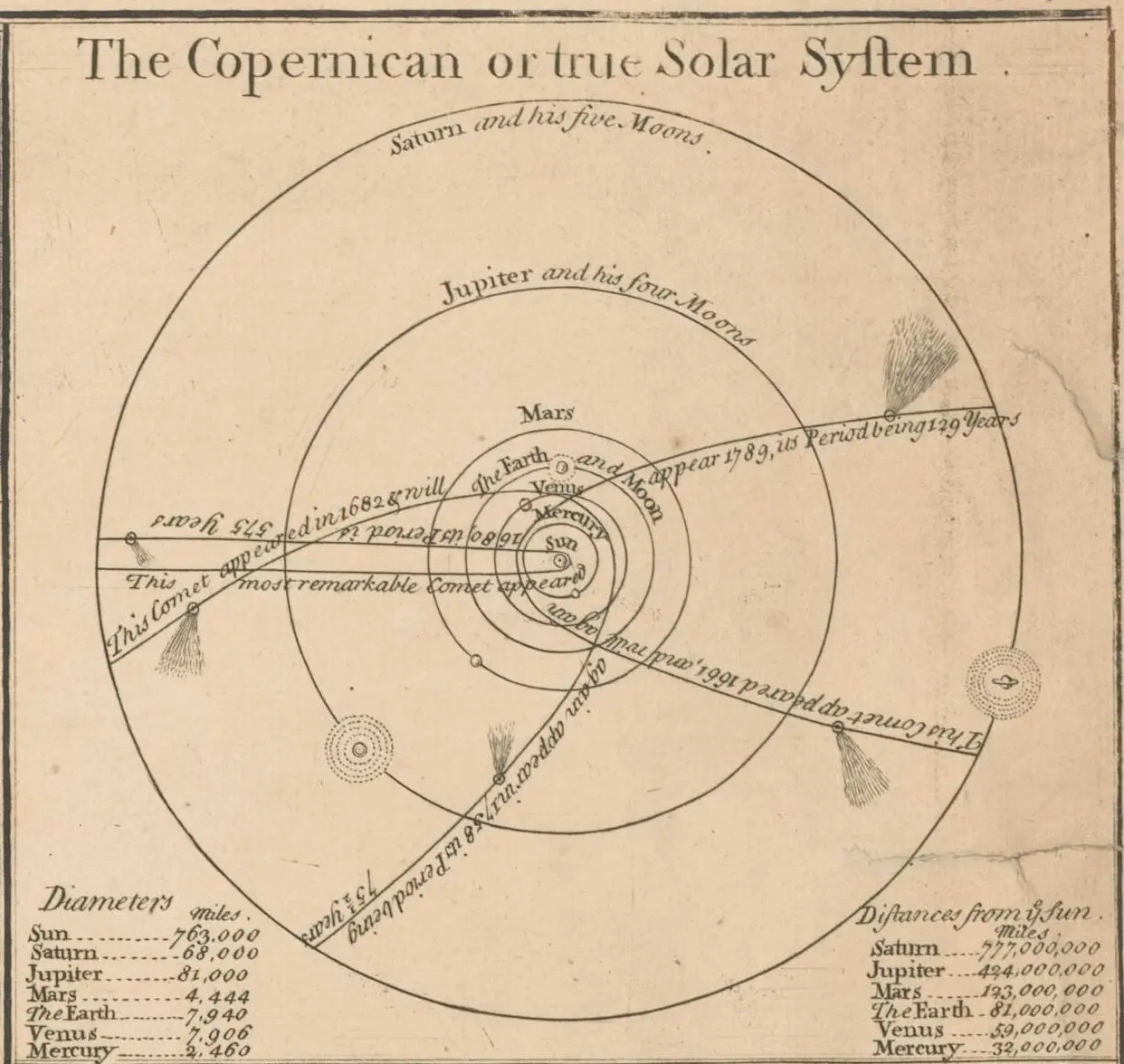

Figure 8. "The Copernican or true Solar System," a panel of a 1733 orrery sheet engraved by Emanuel Bowen. Each planet sits somewhere on its own orbit, not on one shared line as in this model.
The planets fit on one field. The stars need a different unit altogether, the light-year.
Sources
- International Astronomical Union, "Resolution B2 on the re-definition of the astronomical unit of length," XXVIII General Assembly, 2012 (au = 149 597 870 700 m exactly; a unit approximating the Sun-Earth distance)https://iauarchive.eso.org/static/resolutions/IAU2012_English.pdfRead: full text of Resolution B2 (PDF)
- International Astronomical Union, "Resolution B3 on recommended nominal conversion constants for selected solar and planetary properties," XXIX General Assembly, 2015 (nominal solar radius 6.957 × 10^8 m)https://iauarchive.eso.org/static/resolutions/IAU2015_English.pdfRead: full text of Resolution B3 (PDF)
- E. M. Standish and J. G. Williams, "Approximate Positions of the Planets" (Table 1: Keplerian elements at J2000, valid 1800 AD to 2050 AD; EM Bary = Earth-Moon barycenter)https://ssd.jpl.nasa.gov/planets/approx_pos.htmlRead: full page including Table 1 and the note that the elements are best-fit values for the stated interval
- The International Football Association Board (IFAB), Laws of the Game 2026/27, "Law 1 – The Field of Play" (dimensions, international dimensions, goal area 5.5 m, penalty area 16.5 m, centre circle radius 9.15 m, lines not more than 12 cm wide, measurements from the outside of the lines)https://www.theifab.com/laws/latest/the-field-of-play/Read: full text of Law 1
- The International Football Association Board (IFAB), Laws of the Game 2026/27, "Law 2 – The Ball" (circumference between 68 cm and 70 cm)https://www.theifab.com/laws/latest/the-ball/Read: full text of Law 2.1
- National Football League, 2026 NFL Rulebook, "Rule 1. The Field," Section 1, Article 1 (rectangular field 360 feet long; goal lines 10 yards from and parallel to each end line)https://operations.nfl.com/the-rules/nfl-rulebook/Read: Rule 1 Section 1 Article 1 text, and Rule 1 in the 2026 rulebook PDF linked from this page (Section 1 Article 1, field 360 by 160 feet; Section 2 Article 1, yard line markings at intervals of 5 yards)
- NIST, "NIST Guide to the SI, Appendix B.9: Factors for units listed by kind of quantity or field of science" (Special Publication 811; yard = 0.9144 m and inch = 2.54 cm, boldface = exact)https://www.nist.gov/pml/special-publication-811/nist-guide-si-appendix-b-conversion-factors/nist-guide-si-appendix-b9Read: Length table and the note that boldface factors are exact
- CDS Sesame name resolver, SIMBAD record for Proxima Centauri (parallax 768.0665 ± 0.0499 mas from Gaia EDR3, SIMBAD reference 2020yCat.1350....0G; ESA/Gaia/DPAC)https://cds.unistra.fr/cgi-bin/nph-sesame/-oI/SNV?Proxima%20CentauriRead: resolver output (parallax line and its reference code)
- NIST, "CODATA Value: speed of light in vacuum" (299 792 458 m/s, exact; 2022 CODATA recommended values)https://physics.nist.gov/cgi-bin/cuu/Value?cRead: full page
- SIMBAD Astronomical Database (CDS, Strasbourg), M 31: basic data and V = 3.44 (2007ApJS..173..185G)https://simbad.cds.unistra.fr/simbad/sim-id?Ident=M31Read: query results (basic, flux)
- CDS Sesame name resolver, SIMBAD record for M 31 (J2000 position RA 00 42 44.330, Dec +41 16 07.50)https://cds.unistra.fr/cgi-bin/nph-sesame/-oI/SNV?M31Read: resolver output
- SIMBAD astronomical database (CDS), distance measurements for M 31 (mesDistance table, 14 entries published 2007 to 2021; 13 of them run from 731 to 820 kpc, the outlier being a redshift-based 700 kpc)https://simbad.cds.unistra.fr/simbad/sim-tap/sync?REQUEST=doQuery&LANG=ADQL&FORMAT=csv&QUERY=SELECT+dist%2C+unit%2C+plus_err%2C+minus_err%2C+method%2C+bibcode+FROM+mesDistance+JOIN+ident+ON+mesDistance.oidref+%3D+ident.oidref+WHERE+ident.id+%3D+%27M+31%27+ORDER+BY+bibcodeRead: full query result (14 rows with value, unit, errors, method, bibcode)
- George Ellery Hale, The New Heavens (New York: Charles Scribner's Sons, 1922), Fig. 19, "Gaseous prominence at the sun's limb, 140,000 miles high (Ellerman)", p. 36; scan on Wikimedia Commons from the Internet Archive (Library of Congress copy)https://commons.wikimedia.org/wiki/File:The_new_heavens_(IA_newheavens00hale).pdfRead: copyright page, preface and page 36 with the Fig. 19 caption (PDF scan)
- Plate I, "A Plan of the Solar System exhibiting its relative Magnitudes and Distances", in Atlas Designed to Illustrate Burritt's Geography of the Heavens, 1856 edition (plate entered for copyright 1855 by F. J. Huntington; engraved by W. G. Evans of New York); scan provided to Wikimedia Commons by Geographicus Rare Antique Mapshttps://commons.wikimedia.org/wiki/File:1856_Burritt_-_Huntington_Chart_of_the_Solar_System_-_Geographicus_-_SolarSystem-burritt-1856.jpgRead: Commons file record and the full-resolution plate (title, plate number, scale line, copyright line)
- H. M. Paget, "The First Match of the British Ladies' Football Club," wood engraving, The Graphic (London), 30 March 1895; scan on Wikimedia Commonshttps://commons.wikimedia.org/wiki/File:First_match_british_ladies_by_paget.jpgRead: Commons file record (source line "The Graphic, 1895-03-30, p. 3", author, upload comment) and the full-resolution scan with its printed title and "Drawn by H. M. Paget" credit
- NASA Image and Video Library, "Cresent [sic] Earth rises above lunar horizon", AS17-152-23274 (Apollo 17, 7-19 Dec. 1972, photographed from the spacecraft in lunar orbit; Johnson Space Center)https://images.nasa.gov/details/as17-152-23274Read: full asset record (title, date, description naming the crew, photographer and secondary-creator fields, center) and the file metadata
- Rijksmuseum, RP-P-AO-29-2, "Sphaera Nova Astronomica, The Orrery Improv'd, and The Principles of Astronomy made Easy", engraved by Emanuel Bowen, made by Charles Butcher at Bedford, 1733 (panel "The Copernican or true Solar System")http://hdl.handle.net/10934/RM0001.COLLECT.702408Read: Rijksmuseum object record as carried on the Wikimedia Commons file page, and the full sheet image
- International Astronomical Union, "Measuring the Universe" (light-year defined with the Julian year; the IAU regards a year as a Julian year of 365.25 days unless otherwise specified)https://iauarchive.eso.org/public/themes/measuring/
Computed by this site (2026-10-12) from the sources above: the conversion factor, every model position and size, closest and farthest points, the soccer-ball and football-field versions, the Moon, Pluto and Proxima Centauri positions (Proxima's distance from its Gaia parallax), the Andromeda Galaxy's distance at field scale, the range of its SIMBAD distance measurements in light-years, and its altitude at 40°N.
Corrections
2026-11-01 — The Andromeda Galaxy's magnitude in Look up next now follows SIMBAD (3.1 → about 3.4, from SIMBAD's V 3.44). Planet distances are credited to E. M. Standish and J. G. Williams by name, and the speed of light and the Julian year behind the light-year now cite NIST's CODATA value and the IAU; the mean radii and the Moon and Pluto values no longer name a source. No position or size in the model changed; sources renumbered, prompted by a recheck.
2026-11-09 — Added a section that rescales the model to your own field (not covered → a converter that takes a Sun-to-Neptune length or a Sun-ball width and recalculates every row of the table, starting from this page's 100 m field). No position or size in the 100 m model changed.
Look up next:
The Andromeda Galaxy, magnitude about 3.4 (V 3.44 in SIMBAD). On mid-October evenings at 40°N (9 p.m. local mean solar time), this page's calculation puts it about 66 degrees up in the east-northeast, close to overhead around 11 p.m.
Its light left about 2.5 million years ago by a rounded distance of 2.5 million light-years; 13 of the 14 distance estimates listed in the SIMBAD database as of 2026 run from about 2.4 to 2.7 million light-years. Even at soccer-field scale, that rounded distance would stretch about 526 million km, more than three times the real gap between Earth and the Sun. Its story on a glass plate: Andromeda Galaxy: Hubble's "VAR!" Was Right, but His Distance Wasn't.
If you travel somewhere darker to find it, go with someone, tell a friend where you'll be, carry a red flashlight, and stay off private land. How dark is dark enough is the subject of the Bortle scale.
Related entries
- Bortle Scale: A City Sky Tops Out Near 250 Stars
- Light-Year: Its Year Runs 11 Minutes Longer Than the Seasons
- Orbital Eccentricity: Earth's True Orbit Looks Like a Circle
- Andromeda Galaxy: Hubble's "VAR!" Was Right, but His Distance Wasn't
Cite this page
Asterisms & Astrolabes. “Solar System Scale Model: On a Soccer Field, Four Planets Fit in the Goal Area.” Asterisms & Astrolabes. Published 13 October 2026; last substantive revision 9 November 2026. https://asterismsandastrolabes.com/scale/solar-system-scale-model/. Accessed [the date you read it].