Deep explainer
Gregorian Calendar: 1582 Dropped 10 Dates, Not 10 Days
TL;DR: The Gregorian calendar replaced the Julian calendar in October 1582, when Thursday the 4th was followed directly by Friday the 15th. The skip was meant to pull the March equinox back toward March 21, the date the church used to set Easter. The Gregorian leap-year rule drops three leap days every 400 years, and other countries followed as late as 1923, skipping 10 to 13 dates.
In this entry12 sections
- Why did the Gregorian calendar skip 10 days?
- Who made the Gregorian calendar?
- How does the Gregorian calendar stay accurate?
- When did each country adopt the Gregorian calendar?
- How did Protestant Germany switch in 1700?
- What happened in Britain and the American colonies in 1752?
- Does the Gregorian calendar follow the stars?
- Sources
- Corrections
- Look up next
- Related entries
- Cite this page
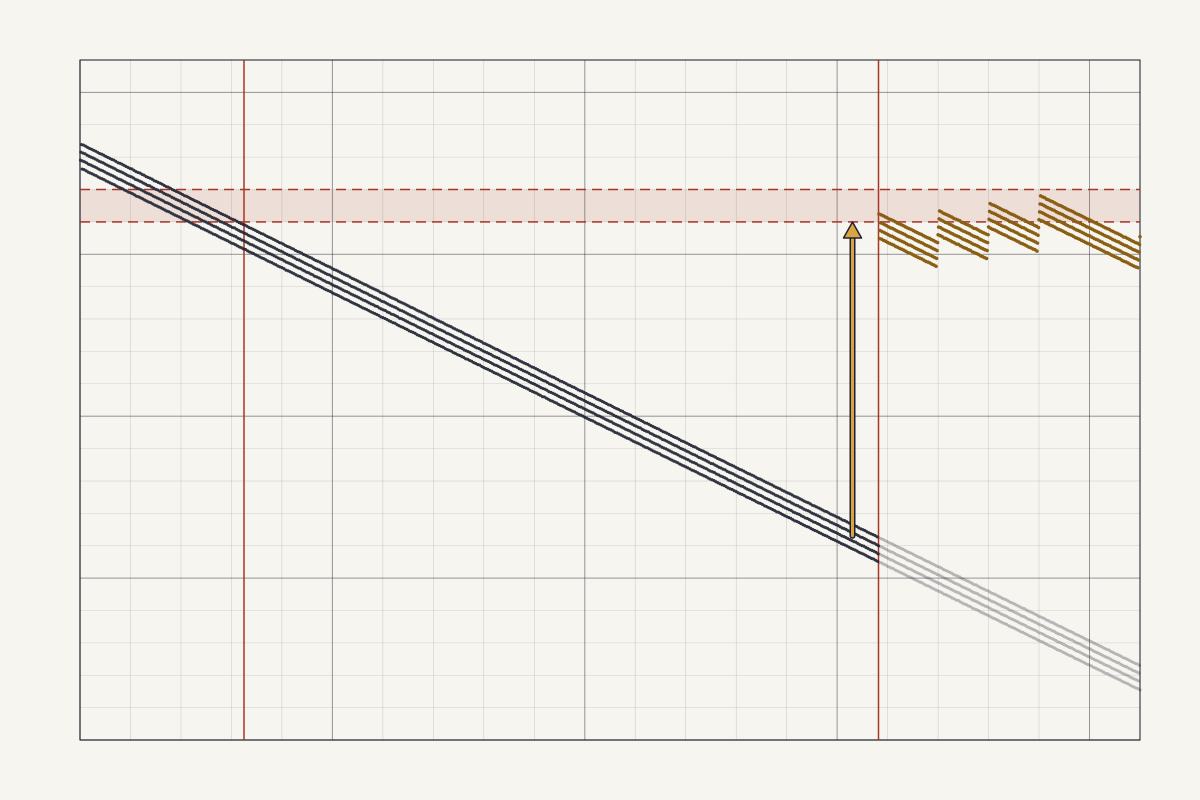
Open the chart full size to zoom in on the detail.
Figure 1. Date of each March equinox at Greenwich, AD 1 to 2100, by this page's calculation (Jean Meeus's formulas with the Espenak–Meeus Delta T polynomials). Dark dots: Julian calendar, faint after 1582. Brown dots: Gregorian calendar from 1582. The four parallel strands are the four years of the leap-year cycle. Shaded band: March 21. Red verticals: AD 325 and 1582. Gold arrow: the ten-day jump. Gridlines every century and every day.
In Rome, Thursday, October 4, 1582, was followed by Friday, October 15. That jump started the Gregorian calendar, the civil calendar used across most of the world today, which Pope Gregory XIII ordered as a repair of the Julian calendar. Ten dates vanished. No time did: the seven-day week ran on unbroken, and the papal decree told judges to push back any payment falling due by ten days.
The skip had one job, to move the March equinox back near March 21, the date the church used for reckoning Easter. A new leap-year rule, with three fewer leap days every 400 years, keeps it there.
Why did the Gregorian calendar skip 10 days?
The Julian calendar adds a leap day every fourth year, so its average year lasts 365.25 days. The seasons keep a shorter year. Their average cycle, the mean tropical year, was 365.24219 days in 2000. That leaves the Julian year about 11 minutes too long, which by this page's calculation adds up to a full day every 128 years.
Think of the leap-day rule as bookkeeping that over-credits the calendar by 11 minutes a year. The entries pile up. Bede, writing in the eighth century, put the accumulated error at more than three days; Roger Bacon, in the thirteenth century, at seven or eight.
The error mattered because of Easter. The church fixed the spring equinox at March 21 for its Easter reckoning, so the reckoning drifted away from the sky it was meant to follow as the real equinox crept earlier in the calendar. Gregory's decree, the bull Inter gravissimas, says the equinox had receded "by about ten days since the Council of Nicaea" in 325 and orders it returned to March 21.
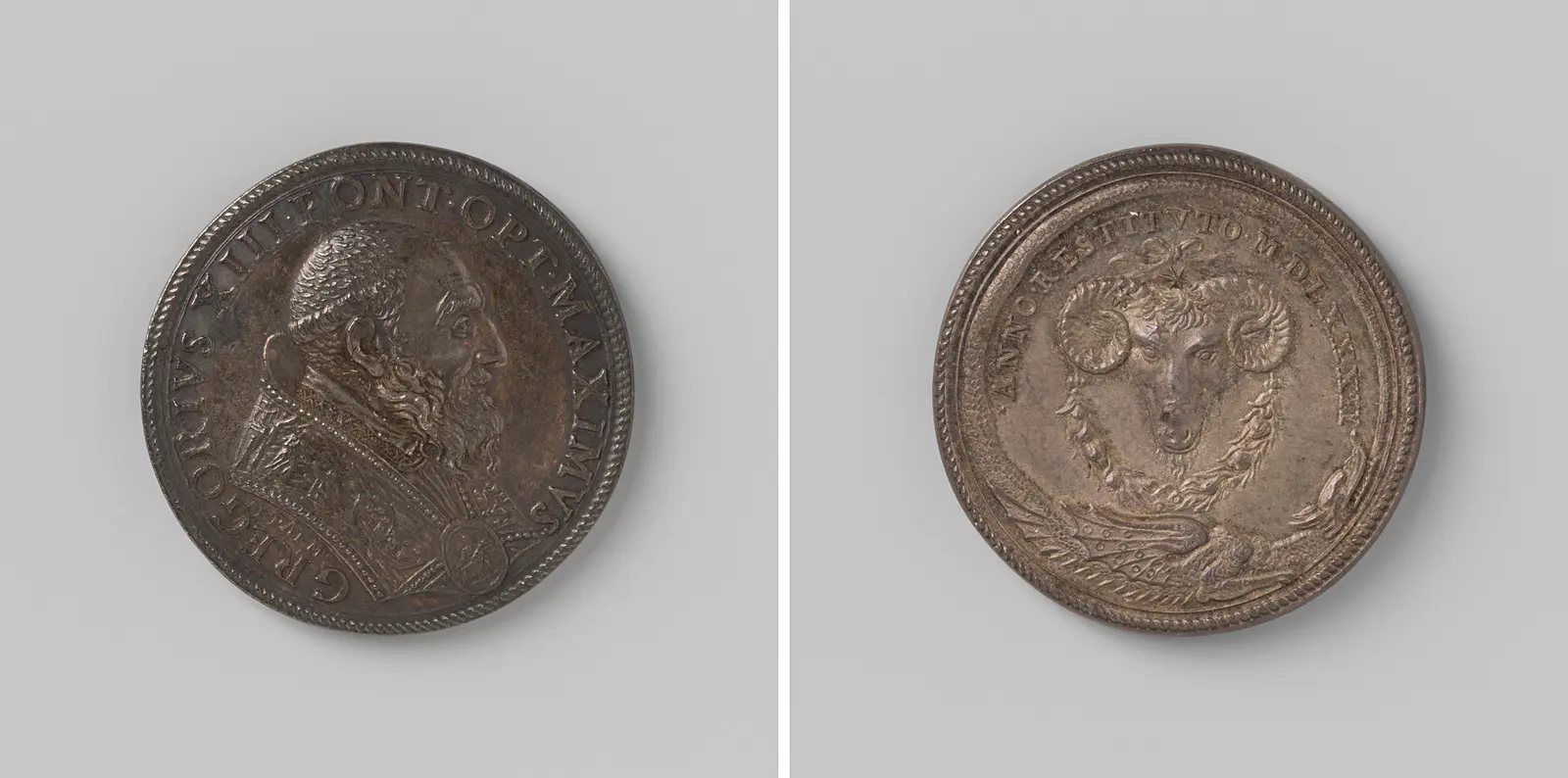

Figure 2. Silver medal by Lorenzo Parmense, Rome, 1582, for the new calendar. Left, Gregory XIII; right, a ram's head ringed by a snake biting its tail, and ANNO RESTITVTO MDLXXXII, "the year restored, 1582."
This page's calculation agrees (Figure 1). By Jean Meeus's equinox formulas, the equinox fell on March 20 of the Julian calendar in every year from 320 to 330, and on March 10 or 11 in the years just before 1582. Ten dates, removed in one stroke, put it back on March 20 or 21.
The 2,100 March equinoxes behind Figure 1, AD 1 to 2100, CSV (CC BY 4.0), with its provenance note (JSON)
A town asleep, one window lit. The Gregorian calendar began with a jump: Thursday, October 4, 1582, was followed by Friday, October 15, and ten dates vanished; no time did.
The cut stopped there. The reform restored the calendar as it stood at Nicaea, not as it stood in the first century. By the same calculation, the equinox in the first years AD fell on March 22 or 23, so matching that era would have meant cutting about two more days.
Who made the Gregorian calendar?
Gregory XIII issued Inter gravissimas on February 24, 1582. The plan behind it came from Aloysius Lilius (Luigi Lilio), a physician and astronomer from Calabria who died in 1576, six years before the change. His brother Antonio presented the manuscript to the pope, and the bull itself credits "a book previously written by his brother Aloysius."
The Jesuit mathematician Christopher Clavius sat on the reform commission and later wrote defenses and explanations of the result. Lilius had suggested easing back gradually, by dropping the leap day ten times over forty years. Clavius argued for a single correction. His advice prevailed.
The bull also allowed for slow mail. Places too far away to hear in time could make the same change in October 1583, or in a later October once the bull reached them. It could command the clergy. It could only ask kings, princes and republics to follow.
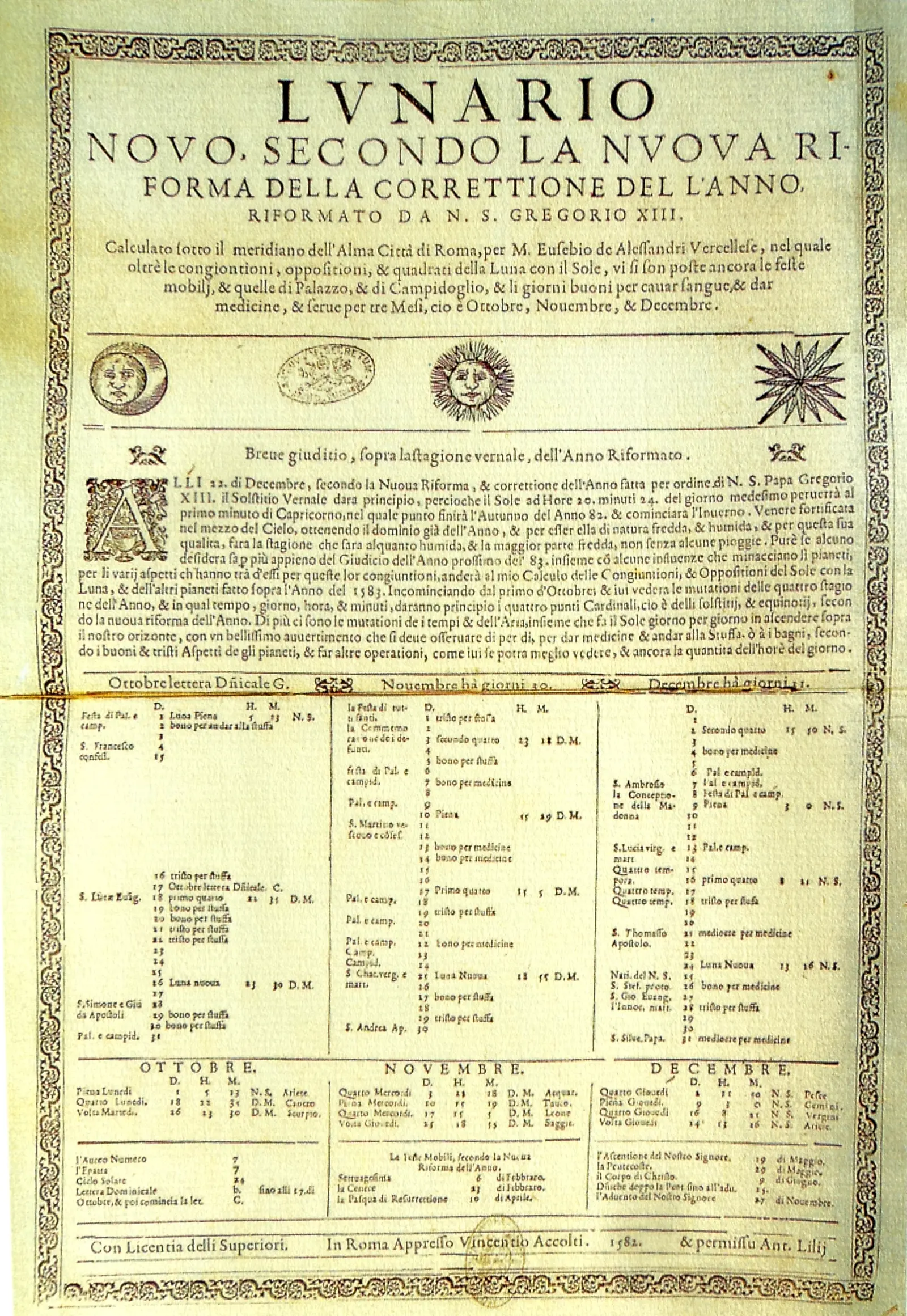

Figure 3. "Lunario Novo," an almanac sheet for October, November and December 1582, printed in Rome by Vincenzo Accolti with Antonio Lilio's permission. In the October column (left), the 4th, the feast of St. Francis, is followed directly by the 15th.
Printers moved quickly. The sheet in Figure 3, one of the first calendars printed in Rome after the reform, was calculated for the meridian of Rome by Eusebio de Alessandri of Vercelli, as its heading says. It follows the bull to the letter, down to the feast of St. Luke on October 18.
How does the Gregorian calendar stay accurate?
Every year divisible by 4 is a leap year, except century years, which are leap years only if divisible by 400. The bull spelled out the consequence itself: 1600 and 2000 keep February 29, while 1700, 1800 and 1900 do not. That removes three leap days every 400 years and sets the average year at 365.2425 days.
One full cycle of 400 Gregorian years holds 146,097 days. That is exactly 20,871 weeks, so the pattern of dates and weekdays repeats every 400 years.
The Gregorian year is still about 27 seconds longer than the mean tropical year of 2000. By this page's calculation that adds up to one day in roughly 3,200 years; published estimates run from about 3,000 to 3,300 years, depending on the tropical-year value used. Measured against the average interval between March equinoxes near 2000, 365.24237 days, the error shrinks to about one day in 7,700 years.
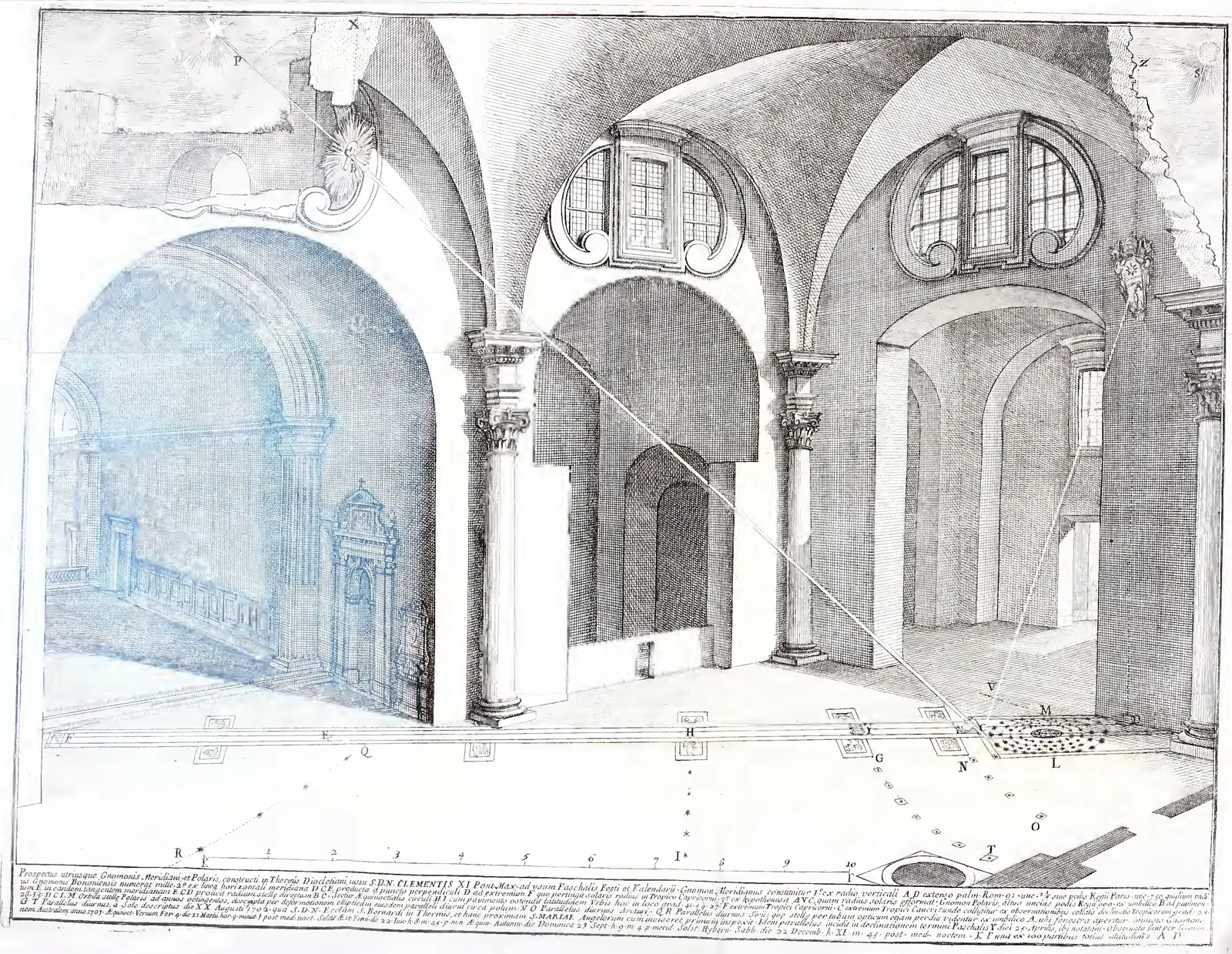
Figure 4. A 1703 plate from Francesco Bianchini's account of his meridian line in Santa Maria degli Angeli, Rome, built for Easter and the calendar. Its legend puts that year's March equinox on March 21.
The rule manages only one clock. The day, the Moon's cycle of phases and the year do not divide evenly into one another, which this site calls the three-clock problem. The Gregorian calendar tracks only the year. Easter still needs the Moon, so the reform also replaced the church's lunar tables; lunisolar calendars keep both cycles in the calendar itself.
The old year lives on in astronomy. The International Astronomical Union treats a year as a Julian year of exactly 365.25 days unless stated otherwise, and defines the light-year as the distance light travels in one Julian year.
When did each country adopt the Gregorian calendar?
Only governments could make the change law. On September 29, 1582, Philip II decreed it for Spain, Portugal and much of Italy, which switched on the bull's date along with Poland–Lithuania and the Papal States. France followed in December. Protestant and Orthodox states held out, some for centuries.
Every century year that the Julian calendar kept as a leap year, and the Gregorian did not, widened the gap by a day. Switch before 1700 and you dropped 10 dates; in the 1700s, 11; in the 1800s, 12; from 1900 on, 13 (Figure 5).
| Place | Last old-style day | First new-style day | Dates dropped |
|---|---|---|---|
| Papal States, Spain, Portugal, Poland–Lithuania, most of Italy | Thu., Oct. 4, 1582 | Fri., Oct. 15, 1582 | 10 |
| France | Sun., Dec. 9, 1582 | Mon., Dec. 20, 1582 | 10 |
| Protestant German states, Denmark–Norway | Sun., Feb. 18, 1700 | Mon., March 1, 1700 | 11 |
| Great Britain, Ireland and the colonies | Wed., Sept. 2, 1752 | Thu., Sept. 14, 1752 | 11 |
| Sweden, with Finland | Wed., Feb. 17, 1753 | Thu., March 1, 1753 | 11 |
| Alaska | Sat., Oct. 7, 1867 | Fri., Oct. 18, 1867 | 10 (see below) |
| Japan | 2nd day, 12th month, Meiji 5 (lunisolar) | Wed., Jan. 1, 1873 | not applicable |
| Bulgaria | Thu., March 31, 1916 | Fri., April 14, 1916 | 13 |
| Russia | Wed., Jan. 31, 1918 | Thu., Feb. 14, 1918 | 13 |
| Romania | Sun., March 31, 1919 | Mon., April 14, 1919 | 13 |
| Greece | Wed., Feb. 15, 1923 | Thu., March 1, 1923 | 13 |
Switch dates: sources 1, 6 to 9 and 11, which the CSV cites row by row. Weekdays and dates dropped: this page's calculation. The CSV adds four more rows from the Low Countries and Switzerland.
Adoption dates CSV (CC BY 4.0), with its provenance note (JSON)
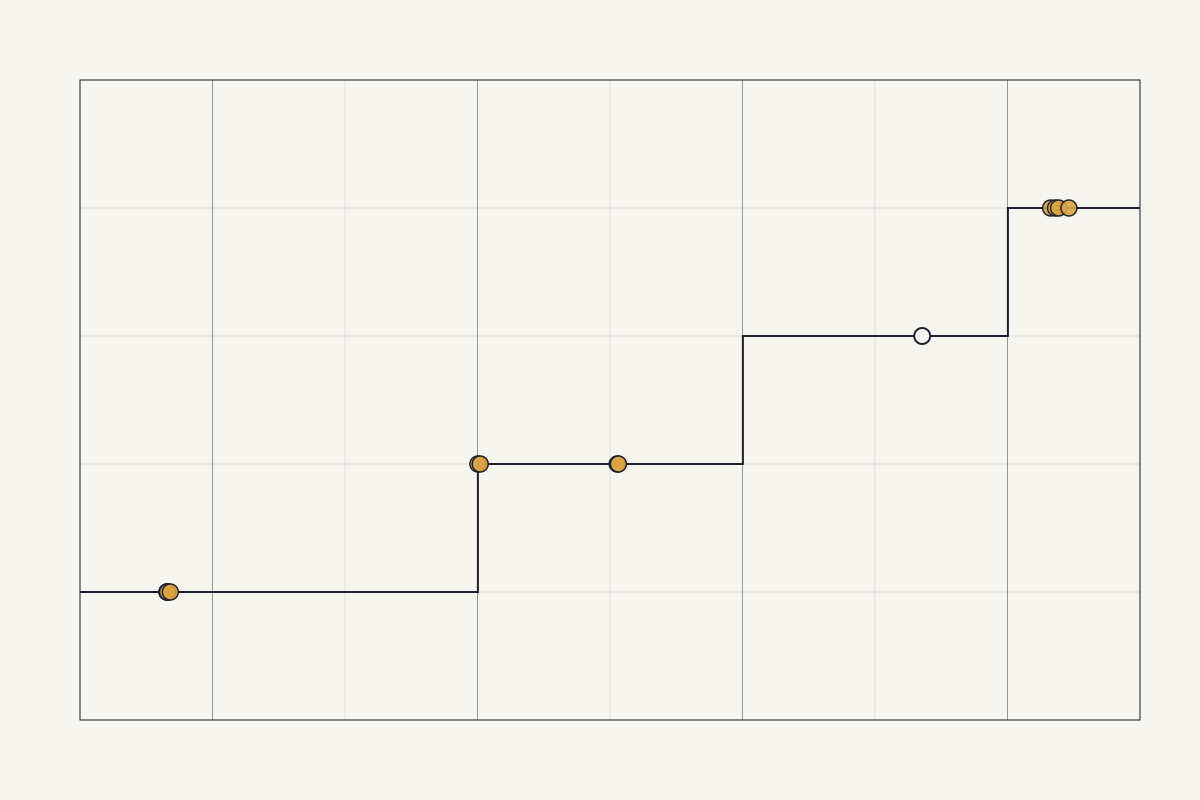
Open the chart full size to zoom in on the detail.
Figure 5. Days the Gregorian date runs ahead of the Julian date, 1550 to 1950 (dark staircase). Dots mark each switch in the CSV, left to right: Catholic Europe 1582 to 1584; Protestant Germany with Denmark–Norway in 1700 and Protestant Swiss cantons in 1701; Britain and its colonies 1752; Sweden 1753; Alaska 1867 (open dot); Bulgaria, Russia, Romania and Greece, 1916 to 1923. Gridlines every 50 years and every day.
Julian–Gregorian gap by century, CSV (CC BY 4.0), with its provenance note (JSON)
Sweden tried a gradual route much like the one Lilius had proposed. It skipped the leap day of 1700 as the first step of a planned series, then made no further skips, which left it in step with nobody. In 1712 it added a February 30 to get back onto the Julian calendar, and in 1753 it jumped 11 dates in one go.
Alaska changed calendars when the United States took it over in 1867, and it moved from the Eurasian side of the International Date Line to the American side. At noon on Saturday, October 7, the date became Friday, October 18, so one day carried both dates. The 12-day Julian lag, less one day for the date line, moved the calendar ahead 11 days. October 8 to 17 never appeared.
Who still uses the Julian calendar?
As of 2026, the Russian Orthodox Church and some other Orthodox churches still keep the Julian calendar, Claus Tøndering's Calendar FAQ says. Their December 25 falls on the Gregorian January 7 until 2100, when the gap grows to 14 days, by this page's calculation. Others, including the Church of Greece, follow a Revised Julian calendar, proposed in 1923, that matches the Gregorian until 2800. Both still date Easter by the Julian calendar, Tøndering writes; Finland's Orthodox Church is the exception, per Wikipedia and a 2001 World Council of Churches paper.
How did Protestant Germany switch in 1700?
For more than a century, Catholic and Protestant Germany kept different dates. Catholic states switched between 1583 and 1585; the Protestant states waited for a decision of their joint body, the Corpus Evangelicorum, at Regensburg on September 23, 1699. In those states and in Denmark–Norway, Sunday, February 18, 1700, was followed by Monday, March 1.
They called the result the improved calendar, der Verbesserte Kalender, and it largely followed a plan by the Jena mathematician Erhard Weigel, who had died in March 1699. It took Gregory's leap-year rule but not his Easter tables. Easter would instead be computed from the astronomical equinox and full moon, using Johannes Kepler's Rudolphine Tables.
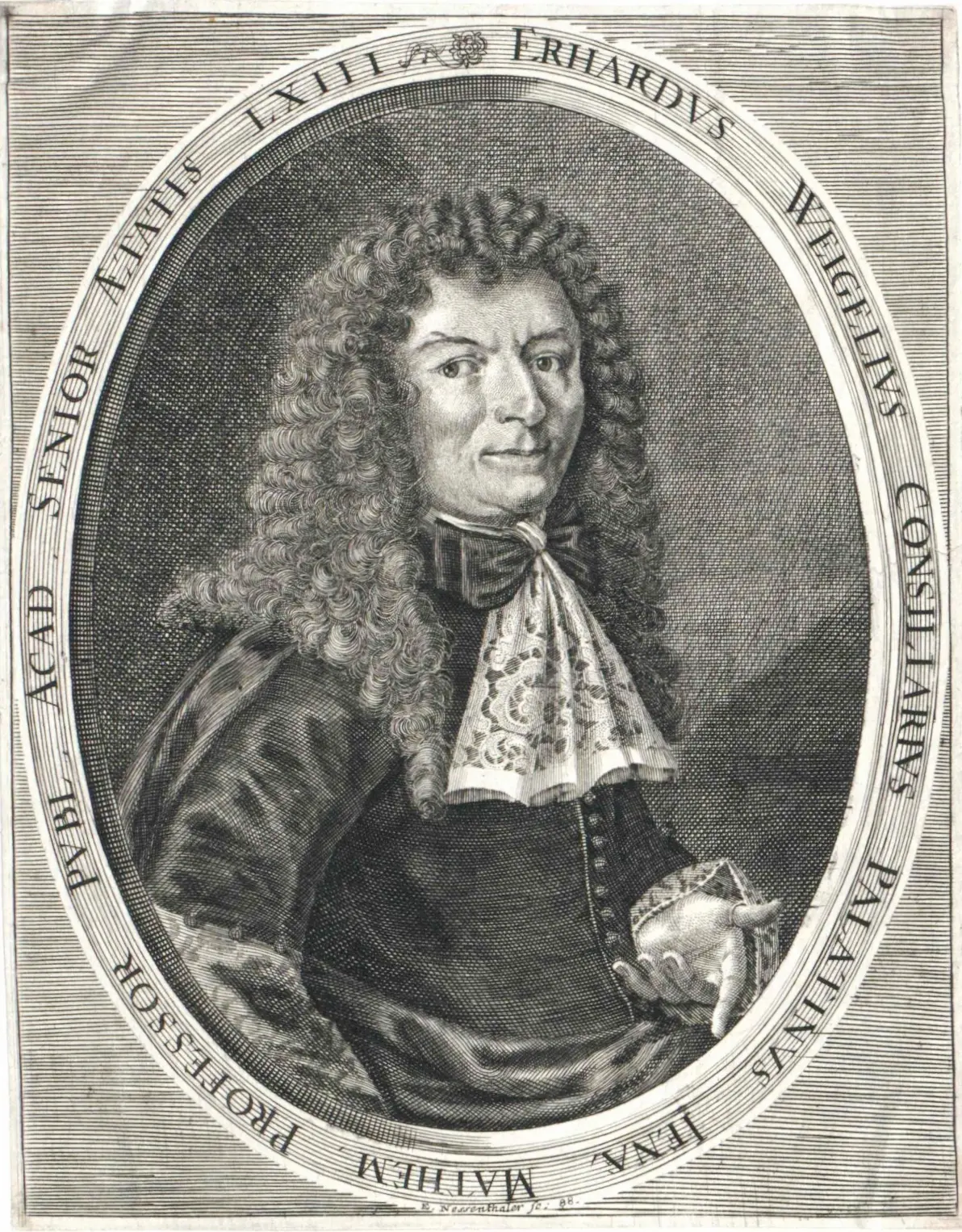

Figure 6. Erhard Weigel at 63, Jena's professor of mathematics, in a 1688 engraving by E. Nessenthaler.
The two methods did not always agree. In 1724 Protestant Easter fell on April 9 and Catholic Easter on April 16; in 1744 the dates were March 29 and April 5. Johann Leonhard Rost pointed out the 1724 clash in 1723.
Frederick the Great settled the question for Prussia in 1775. The other Protestant states followed. The Corpus Evangelicorum agreed on December 13, 1775, under a name that avoided the pope's: the Verbesserter Reichskalender, the improved imperial calendar.
What happened in Britain and the American colonies in 1752?
Britain held out until Parliament passed the Calendar (New Style) Act 1750. Its text says the spring equinox, which at the Council of Nicaea "happened on or about the twenty-first day of March, now happens on the ninth or tenth day of the same month." By this page's calculation, every March equinox from 1745 to 1752 fell on March 9 of the Julian calendar, Greenwich time.
The act ordered that the day after September 2, 1752, be counted as September 14, "omitting for that time only the eleven intermediate nominal days." A Wednesday was followed by a Thursday. The same act moved the start of the legal year from March 25 to January 1 (Scotland had done so in 1600), so 1751 lasted only 282 days, from March 25 to December 31. It applied in Britain's American colonies too.
That is why George Washington has two birth dates. The National Archives gives February 11, 1731, by the calendar then used in Virginia, where the year still ran until March 24. Renumber the year from January 1 and add the 11-day gap, and the same day is February 22, 1732.
Like Gregory's bull, the act protected people with money due. Rents and similar payments did not fall due until the day they would have under the old calendar, eleven days later.
Popular claims, checked
"Crowds rioted in 1752, demanding 'Give us our eleven days.'" Wikipedia's article on the act, drawing on historian Robert Poole's 1995 study, reports no contemporary record of such riots in the riot depositions at the Public Record Office. It traces the story to two satirical sources: Lord Chesterfield's journal The World and William Hogarth's An Election Entertainment (Figure 7).
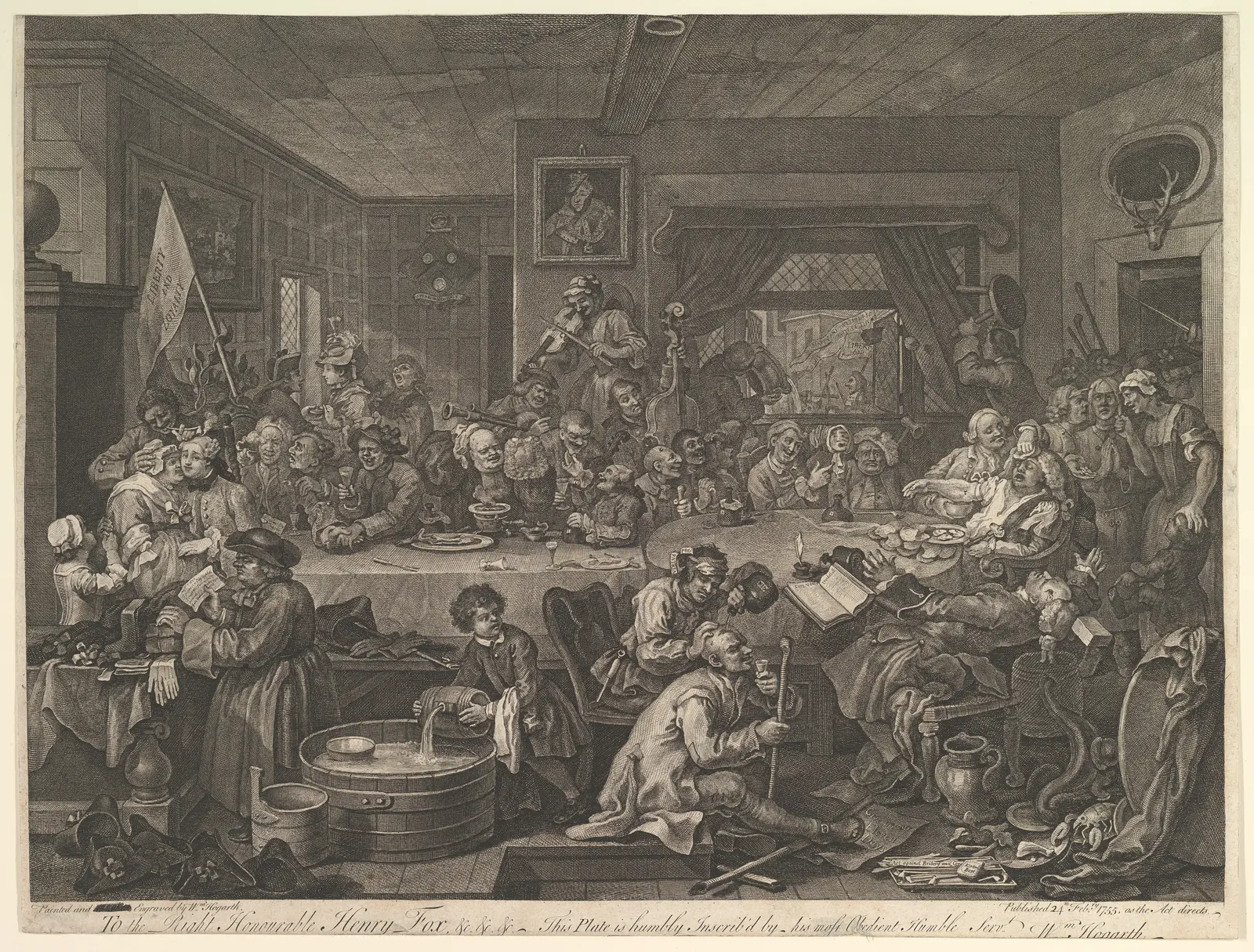

Figure 7. William Hogarth, "An Election Entertainment," the first of his "Four Prints of an Election," published February 24, 1755 (this impression is a later state). The placard "Give us our Eleven Days" lies on the floor at lower right, under a man's foot. Hogarth loosely based the scene on the 1754 Oxfordshire election, where the calendar change was one of the issues raised against the Whig candidate.
Does the Gregorian calendar follow the stars?
No. It follows the equinox. A year measured against the background stars, the sidereal year, runs 20 minutes and 24.7 seconds longer than the tropical year, because Earth's axis slowly swings around in a motion called axial precession. At the IAU 2006 precession rate, one full cycle takes about 25,770 years.
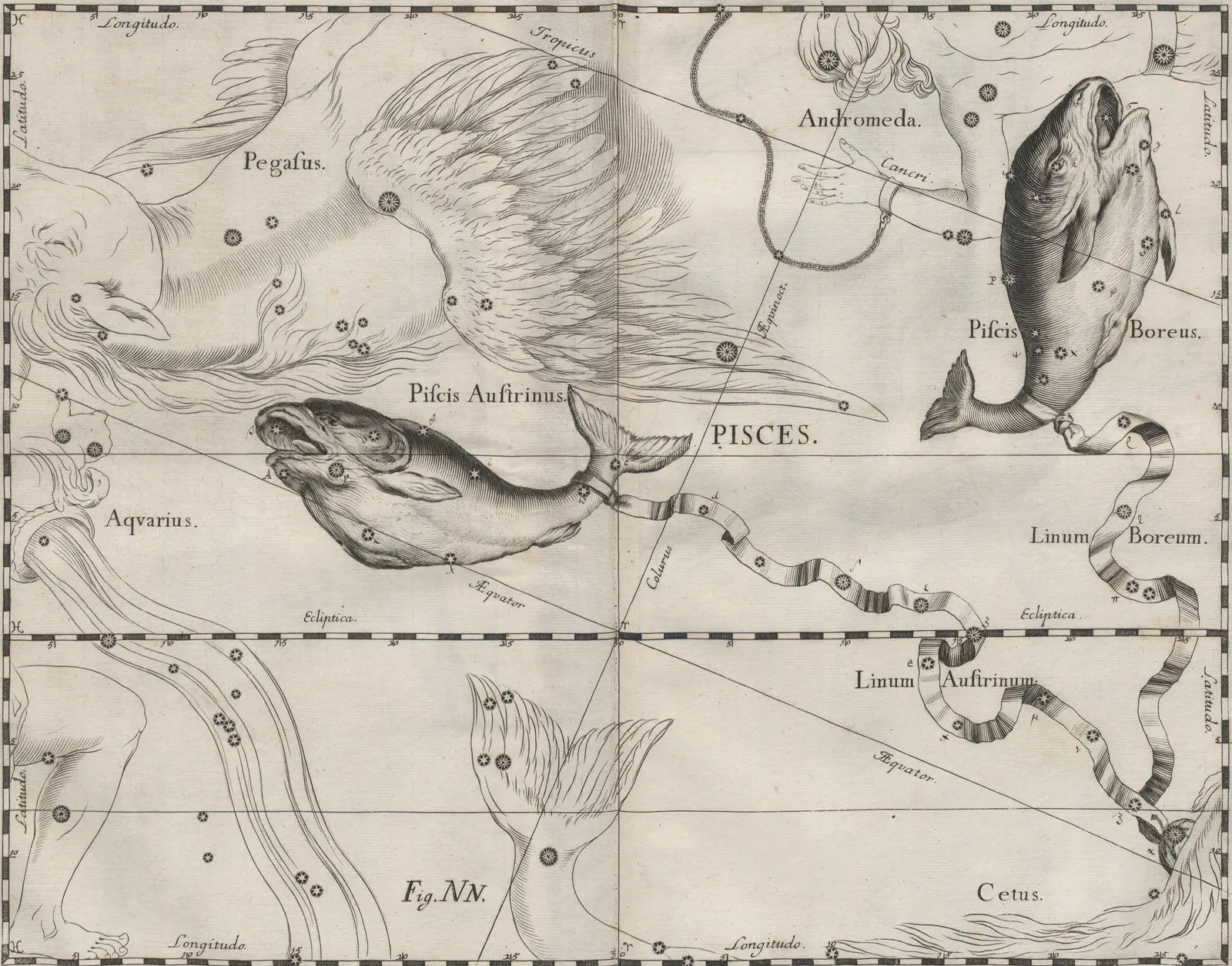

Figure 8. Pisces in Johannes Hevelius's 1690 star atlas, east at right. Where the lines marked Æquator and Ecliptica cross, at the sign of Aries, lies the March equinox point, which slowly drifts west against these stars.
Over one cycle, those 20 minutes add up to roughly a whole year, by this page's arithmetic. So the stars overhead at a given hour on a given date slowly change over the millennia, while the seasons stay put on the calendar (axial precession explains the wobble).
The Gregorian rule fixed the year and left the Moon to separate tables; calendars that keep both in step take a different path, through leap months.
Sources
- Pope Gregory XIII, Inter gravissimas (bull dated 24 February 1582), English translation on Wikisource from the Latin text in Clavius, Opera Mathematica vol. 5 (1612) (ten days removed from October 1582; payment due dates extended ten days; equinox "receded by about ten days since the Council of Nicaea"; 1700, 1800, 1900 not leap years, 1600 and 2000 leap; distant regions may change in October 1583; credits Antonio Lilio and his brother Aloysius; St Luke on 18 October)https://en.wikisource.org/wiki/Translation:Inter_gravissimasRead: full translation (Wikisource translation, CC BY-SA 3.0 US; short extracts quoted)
- U.S. Naval Observatory, Astronomical Applications Department, "Introduction to Calendars" (Julian calendar of 45 BC; 21 March as the ecclesiastical equinox for Easter; Gregorian leap-year rule; archived copy of 13 January 2026)https://web.archive.org/web/20260113143248/https://aa.usno.navy.mil/faq/calendarsRead: full page, archived copy
- Wikipedia, "Gregorian calendar" (bull dated 24 February 1582; Bede and Roger Bacon on the accumulated error; Lilius proposed a gradual 40-year correction, Clavius a single one; mean tropical year 365.24219 days; equinox on 10 or 11 March by 1582; Lunario Novo printed by Vincenzo Accolti; 400-year cycle of 146,097 days; accuracy estimates; equinox-year 365.24237 days)https://en.wikipedia.org/wiki/Gregorian_calendarRead: revision 1379683376
- Wikipedia, "Aloysius Lilius" (c. 1510-1576, from Calabria, physician and astronomer; brother Antonio presented the manuscript)https://en.wikipedia.org/wiki/Aloysius_LiliusRead: revision 1377290892
- Wikipedia, "Christopher Clavius" (Jesuit mathematician on the reform commission; later wrote defences and an explanation of the calendar)https://en.wikipedia.org/wiki/Christopher_ClaviusRead: revision 1373011050
- Wikipedia, "Adoption of the Gregorian calendar" (Philip II decree of 29 September 1582; switch dates and weekdays for Catholic states, France, the Low Countries, Protestant Germany and Denmark-Norway with astronomical Easter from the Rudolphine Tables, Britain, Sweden, Alaska, Japan, Bulgaria, Russia, Romania, Greece)https://en.wikipedia.org/wiki/Adoption_of_the_Gregorian_calendarRead: revision 1377458140
- Claus Tøndering, "The Gregorian calendar" (Calendar FAQ) (country-by-country switch dates; 10, 11, 12 or 13 days dropped by century; Catholic German states 1583-1585)https://www.tondering.dk/claus/cal/gregorian.php
- Wikipedia, "Swedish calendar" (1700 leap day omitted as the first step of a gradual change; 30 February 1712; 17 February followed by 1 March 1753)https://en.wikipedia.org/wiki/Swedish_calendarRead: revision 1365289269
- Wikipedia (Deutsch), "Gregorianischer Kalender" (Protestant estates switched in 1700 by decision of the Corpus Evangelicorum, 18 February followed by 1 March; Easter differed in 1724 and 1744; Corpus Evangelicorum decision of 13 December 1775 and the name "Verbesserter Reichskalender"; Swiss cantons)https://de.wikipedia.org/wiki/Gregorianischer_KalenderRead: revision 268575048
- Wikipedia (Deutsch), "Erhard Weigel" (died 21 March 1699 in Jena; his proposal with Easter from Kepler's Rudolphine Tables; adopted by the Protestant estates at Regensburg on 23 September 1699; Johann Leonhard Rost flagged the 1724 Easter clash in 1723; Frederick the Great ruled for Prussia in 1775)https://de.wikipedia.org/wiki/Erhard_WeigelRead: revision 269032931
- Calendar (New Style) Act 1750 (24 Geo. 2. c. 23), text on legislation.gov.uk (equinox "on or about the twenty-first day of March" at Nicaea, "now happens on the ninth or tenth day"; the day after 2 September 1752 to be the fourteenth, "omitting for that time only the eleven intermediate nominal days")https://www.legislation.gov.uk/apgb/Geo2/24/23
- Wikipedia, "Calendar (New Style) Act 1750" (2 September followed by 14 September 1752, Wednesday to Thursday; legal year moved to 1 January, 1751 a short year of 282 days; applied to the American colonies; payment dates deferred eleven days; the "calendar riot" story traced to The World and Hogarth, with no riot depositions found, citing Robert Poole 1995)https://en.wikipedia.org/wiki/Calendar_(New_Style)_Act_1750Read: revision 1375330290; Poole's 1995 Past & Present article (doi:10.1093/past/149.1.95) not consulted directly
- U.S. National Archives, Center for Legislative Archives, "George Washington's Birthday" (born 11 February 1731 by the Julian calendar then used; 22 February 1732 after the 1752 change)https://www.archives.gov/legislative/features/washington
- The Metropolitan Museum of Art, William Hogarth, "An Election Entertainment, Plate I: Four Prints of an Election," February 24, 1755, etching and engraving, eighth state of eight, accession 91.1.76 (Open Access record)https://www.metmuseum.org/art/collection/search/404840Read: Met Collection record for object 404840 and the Commons copy of the record
- Wikipedia, "Tropical year" (mean tropical year 365.24219 days in 2000; sidereal year 20 minutes 24.7 seconds longer because of precession; March equinox times of 2009 and 2010 used as a check)https://en.wikipedia.org/wiki/Tropical_yearRead: revision 1373945112
- ERFA (Essential Routines for Fundamental Astronomy, derived from IAU SOFA), source file p06e.c: IAU 2006 precession angles from Capitaine, Wallace and Chapront (2003, A&A 412, 567), with general precession in longitude of 5,028.796195 arcseconds per Julian century at J2000; BSD-3-Clausehttps://github.com/liberfa/erfa/blob/master/src/p06e.cRead: full source file
- International Astronomical Union, "Measuring the Universe" (light-year defined with the Julian year; the IAU regards a year as a Julian year of 365.25 days unless otherwise specified)https://iauarchive.eso.org/public/themes/measuring/
- J. Meeus, Astronomical Algorithms, chapter 27 "Equinoxes and Solstices" (mean March equinox polynomials and 24 periodic terms), coefficients as published in the open-source Go package soniakeys/meeus v3, package solstice (MIT licence)https://github.com/soniakeys/meeus/blob/master/v3/solstice/solstice.goRead: package source code; the book itself not consulted directly
- F. Espenak and J. Meeus, "Polynomial Expressions for Delta T" (based on Morrison and Stephenson 2004)https://eclipse.gsfc.nasa.gov/SEhelp/deltatpoly2004.html
- U.S. Naval Observatory, "Converting Between Julian Dates and Gregorian Calendar Dates" (Fliegel and Van Flandern 1968 algorithm; worked example; archived copy of 3 January 2026)https://web.archive.org/web/20260103204700/https://aa.usno.navy.mil/faq/JD_formulaRead: full page, archived copy
- Wikipedia, "Julian day" (Julian-calendar to Julian Day Number formula after L. E. Doggett 1992; E. G. Richards' inverse algorithm; weekday from the day number)https://en.wikipedia.org/wiki/Julian_dayRead: revision 1373709161
- Wikipedia, "Conversion between Julian and Gregorian calendars" (table from the 1961 Explanatory Supplement to the Astronomical Ephemeris, used as a check)https://en.wikipedia.org/wiki/Conversion_between_Julian_and_Gregorian_calendarsRead: revision 1366567166
- Wikipedia, "Date of Easter" (anonymous Gregorian algorithm of 1876, the Meeus/Jones/Butcher method; Easter 2026 on 5 April)https://en.wikipedia.org/wiki/Date_of_EasterRead: revision 1366577142
- U.S. Naval Observatory, "Approximate Solar Coordinates" (simple solar formula, used as a cross-check of the equinox calculation; mean obliquity; archived copy of 10 January 2026)https://web.archive.org/web/20260110213654/https://aa.usno.navy.mil/faq/sun_approxRead: full page, archived copy
- U.S. Naval Observatory, "Computing Approximate Sidereal Time" (GMST formula; archived copy of 7 December 2025)https://web.archive.org/web/20251207123221/https://aa.usno.navy.mil/faq/GASTRead: full page, archived copy
- David Nash (astronexus), HYG Database v4.4, data README and licence (CC BY-SA 4.0) (positions of Alpheratz and Algenib and the stars near the March equinox point)https://codeberg.org/astronexus/hyg
- Rijksmuseum, Amsterdam, "Paus Gregorius XIII, op de invoering van de nieuwe tijdrekening," silver medal by Lorenzo Parmense, Rome, 1582, object NG-VG-1-442 (obverse a bust within the legend; reverse a ram's head within the legend and a snake biting its own tail)http://hdl.handle.net/10934/RM0001.COLLECT.57583Read: Rijksmuseum collection records https://id.rijksmuseum.nl/2009207 and 2029207, and the record as copied to Wikimedia Commons
- Francesco Bianchini, De kalendario et cyclo Caesaris ... his accessit enarratio per epistolam ad amicum, De nummo et gnomone Clementino (Rome, 1703), plate "Prospectus utriusque Gnomonis Meridiani, et Polaris" (meridian line in Santa Maria degli Angeli, built by order of Clement XI "ad usum Paschalis Festi et Kalendarii"; spring equinox of 1703 on Wednesday, 21 March), Getty Research Institute copyhttps://archive.org/details/dekalendarioetcy00bianRead: the plate and its engraved legend (PDF page 232 of the Commons copy) and the catalogue record; the Latin text of the book not read
- E. Nessenthaler, engraved portrait of Erhard Weigel, lettered "Erhardus Weigelius ... Jenae Mathem. Professor Publ. ... Aetatis LXIII" and signed "E. Nessenthaler sc. 88" (1688), scan on Wikimedia Commonshttps://commons.wikimedia.org/wiki/File:ErhardWeigelNessenthaler.jpgRead: the engraving's own lettering; file page revision 1231889331
- Johannes Hevelius, Firmamentum Sobiescianum, sive Uranographia, in Prodromus astronomiae (Gdańsk: Johann Zacharias Stolle, 1690), plate Fig. NN, Pisces (lines lettered Aequator, Ecliptica and Colurus; ecliptic longitude scale), National Library of Poland copy on Polonahttps://polona.pl/item/johannis-hevelii-prodromus-astronomiae-exhibens-fundamenta-quae-tam-ad-novum,NTU5MDc2MA/89/Read: the plate (Commons copy) and the Polona catalogue record
- Wikipedia, "Pisces (constellation)" (the ecliptic and the celestial equator intersect in Pisces at the first point of Aries; the March equinox lies in Pisces and, because of precession, is drifting westward)https://en.wikipedia.org/wiki/Pisces_(constellation)Read: revision 1379867455
- Claus Tøndering, "The Julian calendar" (Calendar FAQ) (the Orthodox church in Russia still uses it, as do some other Orthodox churches)https://www.tondering.dk/claus/cal/julian.phpRead: full page
- Claus Tøndering, "Easter" (Calendar FAQ), section "What about Greek Orthodox Easter?" (the Orthodox Church uses the Julian calendar when calculating Easter, even in churches that otherwise use the Gregorian calendar; the Greek Orthodox Church's 1923 change to a Revised Julian calendar)https://www.tondering.dk/claus/cal/easter.phpRead: section What about Greek Orthodox Easter?
- Wikipedia, "Julian calendar" (Modern usage: the Orthodox churches of Jerusalem, Russia, Serbia and others continue to use the Julian calendar; all Orthodox churches celebrate Easter according to the Julian calendar except the Finnish Orthodox Church)https://en.wikipedia.org/wiki/Julian_calendarRead: revision 1370601235
- Wikipedia, "Revised Julian calendar" (proposed in 1923 by Milutin Milanković; aligns with the Gregorian calendar from 1 March 1600 through 28 February 2800; adopted by the Church of Greece in March 1924 and other churches; not adopted by the Russian Orthodox Church)https://en.wikipedia.org/wiki/Revised_Julian_calendarRead: revision 1375522663
- Metropolitan Ambrosius of Oulu (Orthodox Church of Finland), "The gift of a common calendar - vital to mission and witness in secular society," World Council of Churches, Commission on Faith and Order document, April 9, 2001https://www.oikoumene.org/resources/documents/the-gift-of-a-common-calendar-vital-to-mission-and-witness-in-secular-societyRead: full page
Computed by this site (2026-10-12) from sources 15 to 26: the March equinox dates in Figure 1 and in the text, the Julian–Gregorian gaps, the weekday of every switch date and the dates dropped, the 400-year cycle in weeks, the year-length errors, Catholic Easter in 1724 and 1744, the 282 days of 1751, Washington's two dates, and the star-hop below. Added 2026-10-14 from source 34: the Gregorian dates of the Julian December 25 up to and after 2100.
Corrections
2026-10-14 — Added a section on who still uses the Julian calendar (not covered → as of 2026, the Russian Orthodox Church and some other Orthodox churches, whose December 25 falls on the Gregorian January 7 until 2100, when the gap grows to 14 days; others, including the Church of Greece, follow a Revised Julian calendar, proposed in 1923, that matches the Gregorian until 2800; both date Easter by the Julian calendar, with Finland's Orthodox Church the exception), with sources 32 to 36 added, prompted by a recheck.
Look up next:
The March equinox point, the spot on the sky this calendar is built to track. Around 9 p.m. local mean time in mid-October at 40°N, find the Great Square of Pegasus high in the southeast. Its eastern side runs from Alpheratz down to Algenib, 14 degrees apart. Carry that line about the same distance past Algenib and, by this page's calculation, you land within about 5 degrees of the point, some 46 degrees up in the south-southeast, among the faint stars of Pisces. Why it sits in Pisces rather than Aries: Axial Precession: Earth Usually Has No Bright North Star.
Related entries
- Seven-Day Week: The Day Names Skip Two Planets Each Time
- Lunisolar Calendar: Why 7 Years in 19 Get a 13th Month
- Three-Clock Problem: 12 Moons Fall 11 Days Short of a Year
- Axial Precession: Earth Usually Has No Bright North Star
- Light-Year: Its Year Runs 11 Minutes Longer Than the Seasons
Cite this page
Asterisms & Astrolabes. “Gregorian Calendar: 1582 Dropped 10 Dates, Not 10 Days.” Asterisms & Astrolabes. Published 13 October 2026; last substantive revision 14 October 2026. https://asterismsandastrolabes.com/calendars/gregorian-calendar/. Accessed [the date you read it].