Atlas entry
Naked-Eye Budget: About 8,400 Entries, Never All in One Sky
TL;DR: The naked-eye budget is this site's name for the number of entries in a named star catalogue that are magnitude 6.5 or brighter across the whole sky: 8,404 in the Yale Bright Star Catalogue. It sets an upper limit for any single night, because half the sky is always below your horizon, low stars dim in thick air, and lit skies lower the limit.
In this entry11 sections
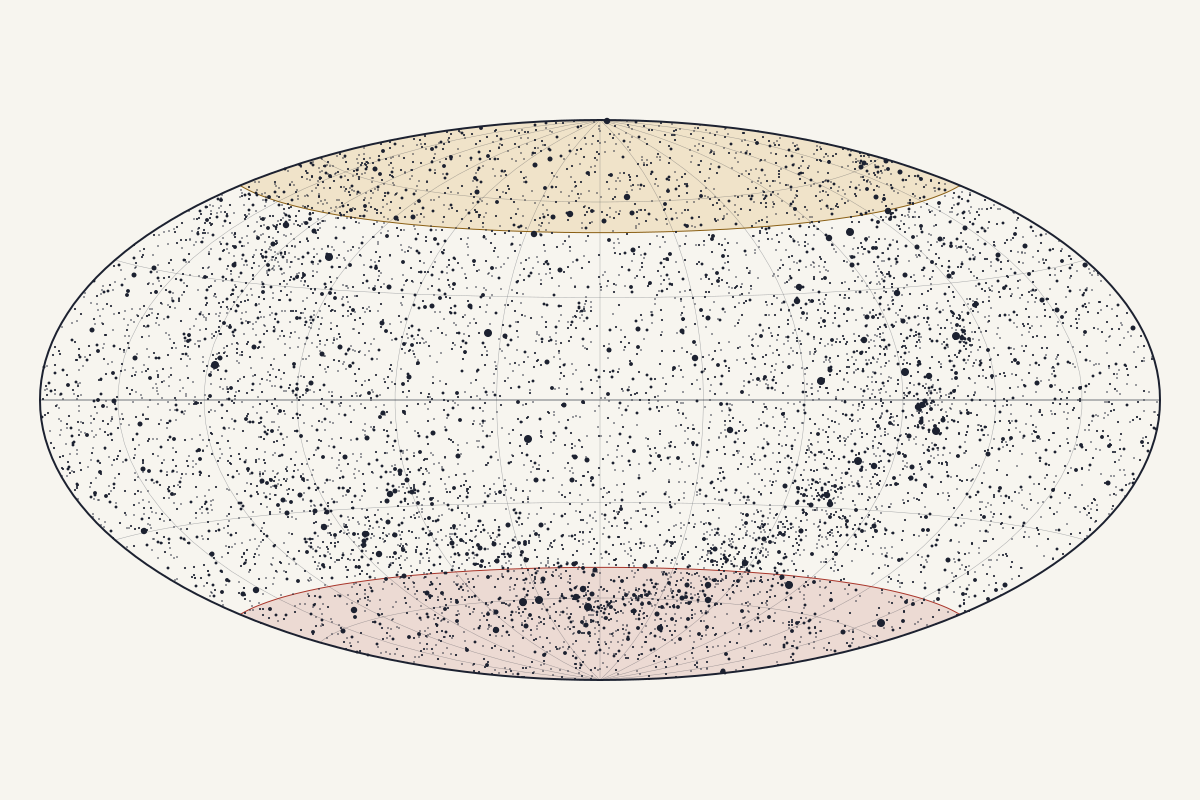
Open the chart full size to zoom in on the detail.
Figure 1. Whole-sky equal-area map computed from HYG v4.4 positions, north up, east left, centered on right ascension 12h. Each dot is one of the 8,920 HYG entries of magnitude 6.5 or brighter; bigger dots are brighter. Seen from 40°N, the red cap (1,268 HYG entries) never rises and the gold cap (1,071) never sets; the Yale counts used in the text are 1,161 and 1,020.
About 8,400 catalogue entries are bright enough for the unaided eye, and no sky shows them all at once. That figure is the naked-eye budget, this site's name for the number of entries in a named star catalogue that reach magnitude 6.5 or brighter, counted across the whole sky. In the Yale Bright Star Catalogue the count is 8,404. From 40°N, 1,161 of those entries never rise at all.
What is the naked-eye budget?
It is a metaphor, not a scientific quantity. A budget records what is in the account; what you can spend tonight is a smaller figure. This term works the same way. Three settings fix the number: a named catalogue, the whole celestial sphere (the full globe of sky around Earth, both hemispheres), and a brightness cutoff.
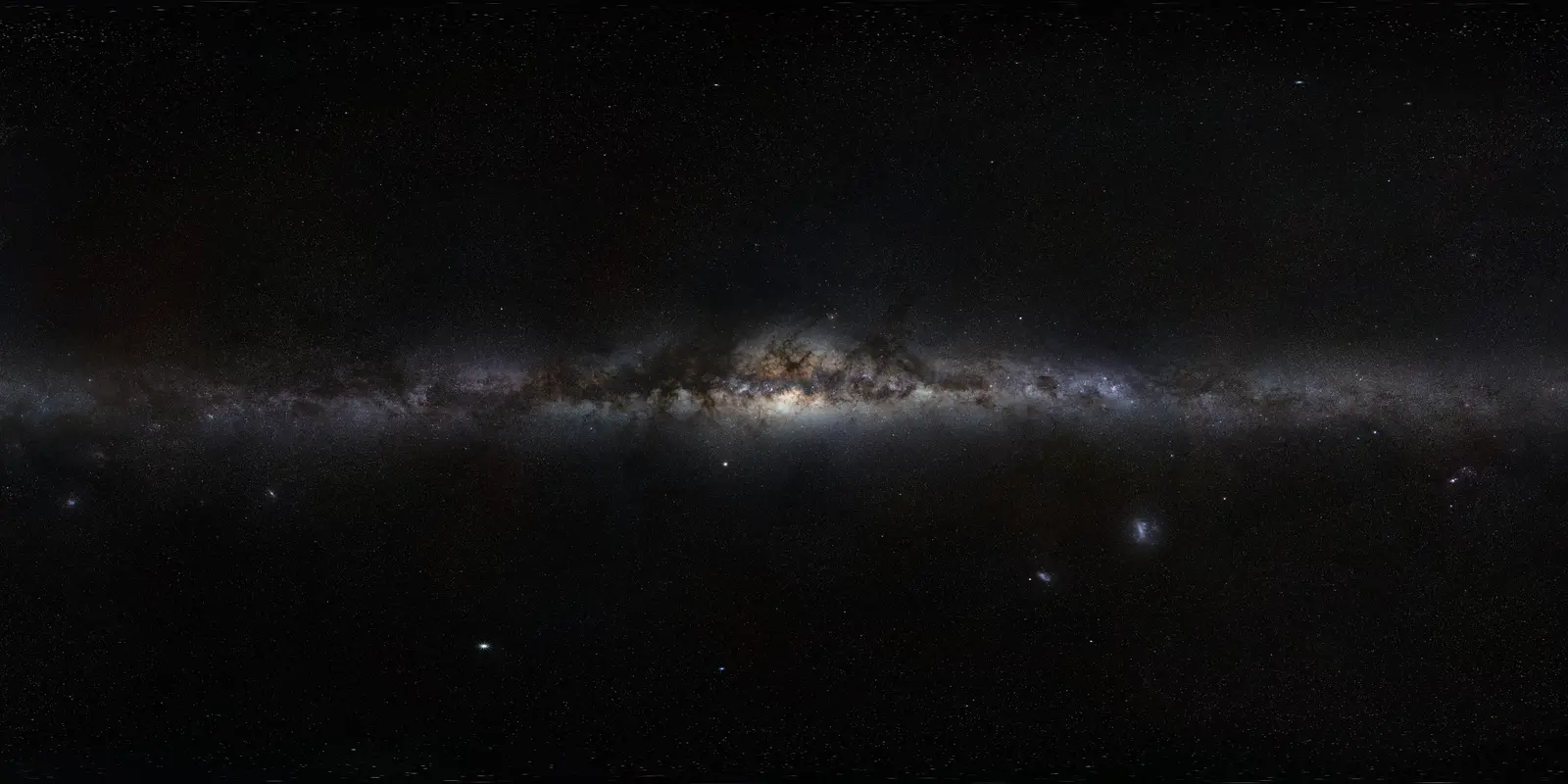
Figure 2. The whole celestial sphere, northern and southern, in one 360-degree panorama, with the plane of the Milky Way running across the middle. The budget counts entries across all of it.
Brightness here is apparent magnitude. Lower numbers mean brighter, and five magnitudes make a factor of exactly 100, so a magnitude 1 star appears 100 times brighter than a magnitude 6 star. The budget stops at magnitude 6.5, the faintest naked-eye limit John Bortle's 2001 dark-sky scale gives for a class 4 sky, at the rural-suburban edge; only darker skies reach fainter stars.
This site's fixed reference is the Yale Bright Star Catalogue, fifth revised edition, by Dorrit Hoffleit and Wayne H. Warren Jr. (1991). The CDS data center archives it as catalogue V/50. Counting the catalogue's V-magnitude column gives 8,404 entries at 6.5 or brighter and 5,080 at 6.0 or brighter.
| Magnitude cutoff | Yale Bright Star Catalogue | HYG v4.4 |
|---|---|---|
| 2.0 or brighter | 50 | 50 |
| 3.0 or brighter | 174 | 179 |
| 4.0 or brighter | 518 | 523 |
| 5.0 or brighter | 1,630 | 1,637 |
| 6.0 or brighter | 5,080 | 5,070 |
| 6.5 or brighter | 8,404 | 8,920 |
Counted by this site from both catalogues (2026-10-12); the Sun is left out of HYG.
Each step of one magnitude roughly triples the count. The last half magnitude, from 6.0 to 6.5, holds 3,324 entries, about 40 percent of the budget.
Why "entries" and not "stars"?
The Yale catalogue numbers 9,110 objects. Its documentation says 9,096 are stars, while 14 are novae or extragalactic objects from the original compilation of 1908, kept to preserve the numbering. Their data are mostly blank, so they never enter the count.
Of the 9,096 stars, 692 are fainter than 6.5, down to magnitude 7.96. The documentation still describes the catalogue as a source for stars brighter than 6.5. So 9,096 counts the catalogue's stars; the count at 6.5 or brighter is 8,404.
Double stars blur things further. In 67 cases, two or more budget entries share one number in Aitken's Double Star Catalog, 138 entries in all, so one system can fill two lines. Many other doubles fill just one. For that reason, this site writes "about 8,400 catalogue entries" and never "8,404 stars."
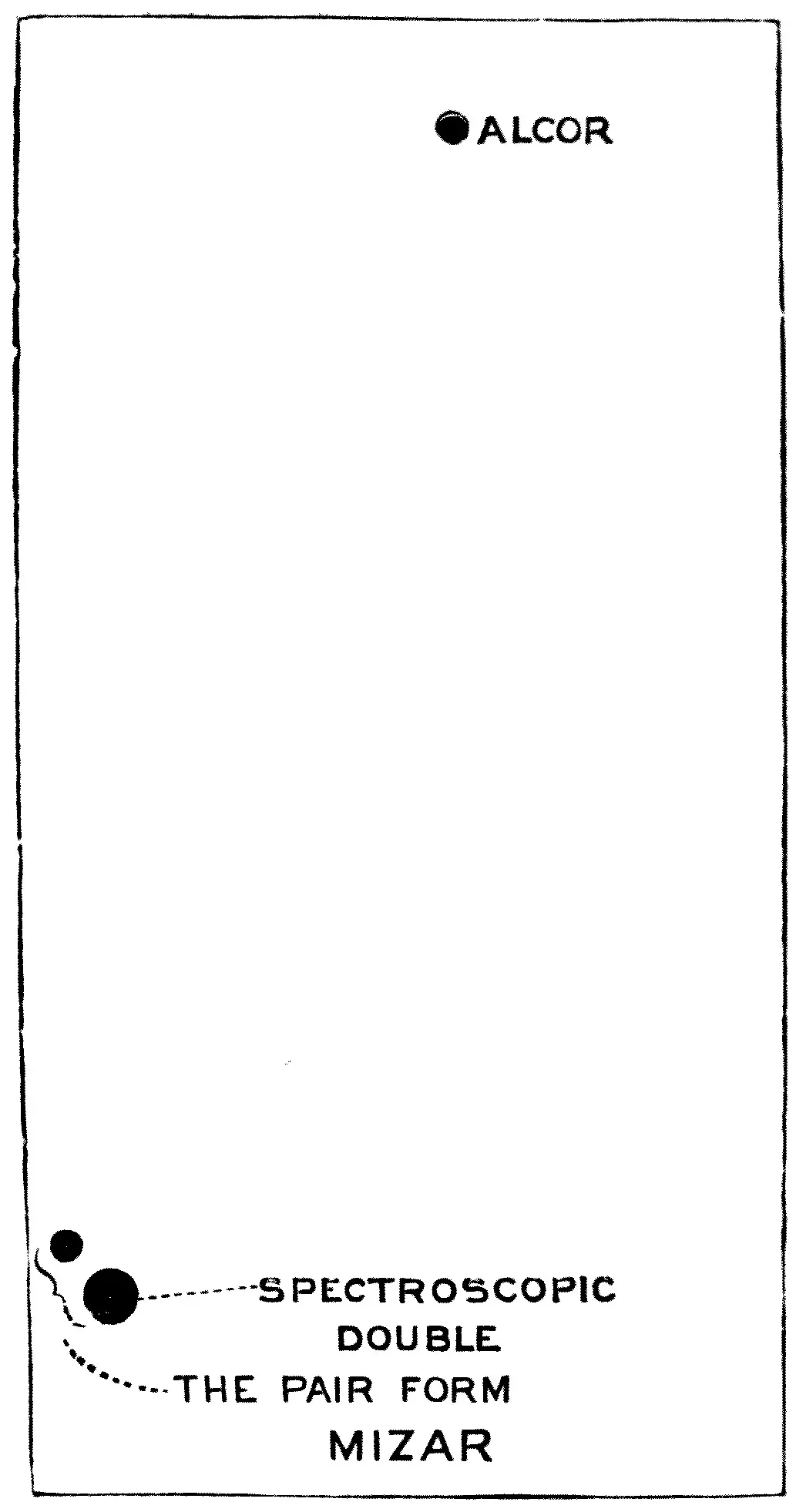

Figure 3. Mizar, drawn as a pair, and Alcor in Robert Stawell Ball's In the High Heavens (1910). The Yale catalogue gives Mizar's two stars separate entries under one number in Aitken's Double Star Catalog.
Does the catalogue change the budget?
Yes. That is why the catalogue sits inside the definition. HYG v4.4, an open database that combines the Hipparcos, Yale Bright Star and Gliese catalogues, gives 8,920 entries at the same cutoff, 516 more than Yale. Of those, 577 have no Bright Star number at all.
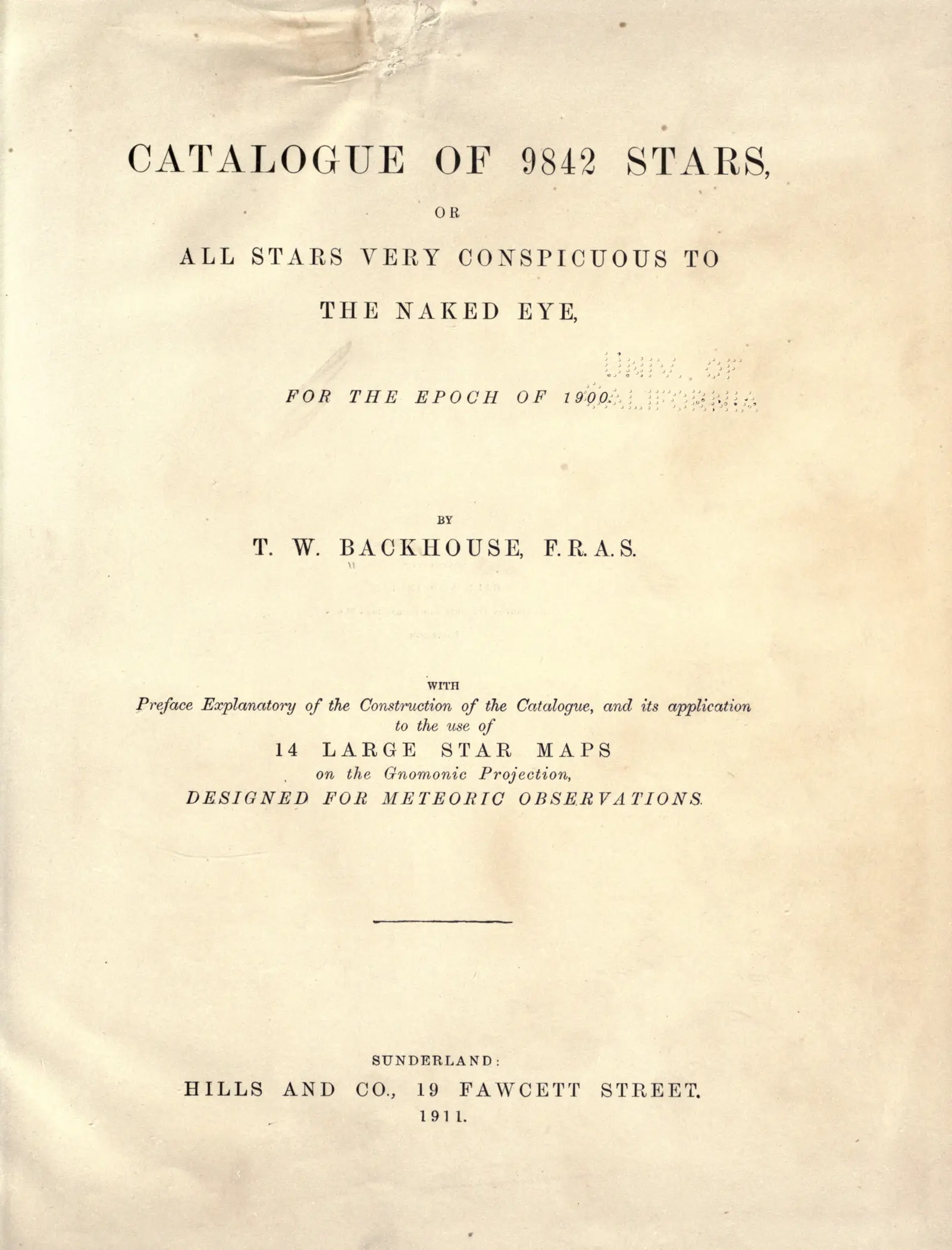
Figure 4. The title page of T. W. Backhouse's Catalogue of 9842 Stars, or All Stars Very Conspicuous to the Naked Eye, for the Epoch of 1900 (Sunderland, 1911), a different catalogue with its own count.
Where the two share a star, they can still place it on opposite sides of the line. By this site's cross-match on Bright Star numbers, 93 Yale entries at 6.5 or brighter are fainter than 6.5 in HYG, and 83 go the other way.
The charts and downloads on this page use HYG, whose CC BY-SA 4.0 license allows reuse with credit, provided adaptations keep the same license. The fixed figure stays with Yale.
How many stars can you see with the naked eye?
Far fewer than the budget. Three deductions lead from the catalogue total toward a few thousand; this site's Bortle-scale count puts a class 4 sky at its best near 2,600 at one time.
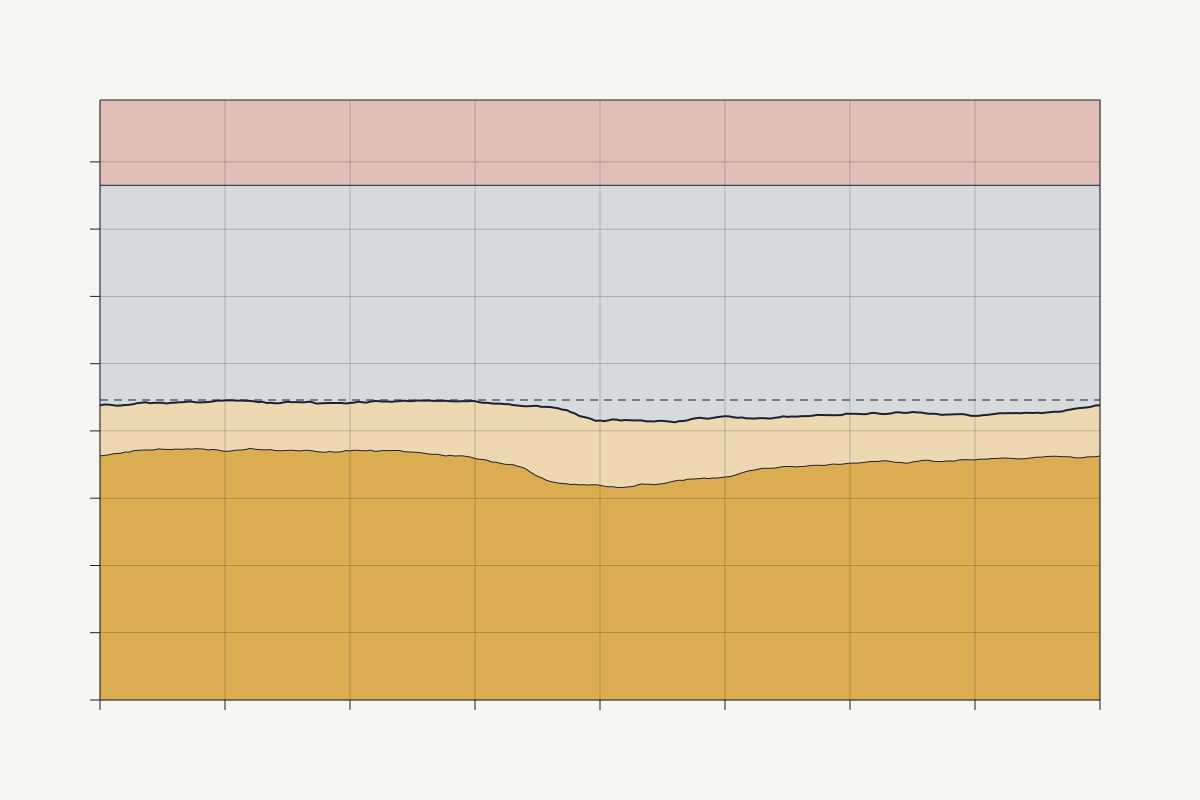
Half the sky is underfoot. At any moment, half of the celestial sphere lies below a flat horizon. From 40°N, by this site's calculation (no atmospheric refraction), the Yale entries above the horizon range from about 3,940 to 4,230 over one turn of the sky, because the entries are not spread evenly. Within 40 degrees of the south celestial pole, 1,161 entries never rise from that latitude; within 40 degrees of the north celestial pole, 1,020 never set.
Low stars fade. Starlight from right at the horizon crosses about 38 times as much air as light from straight overhead, so stars low in the sky look dimmer than they would higher up. From 40°N, an average of about 18 percent of the entries above the horizon sit in the lowest 10 degrees, between 15 and 26 percent depending on the hour. That band is where the dimming is strongest.
Light and eyes set the real limit. Your limiting magnitude is the faintest star you can see looking straight up, and artificial light pushes it brighter: the 2016 world atlas of night-sky brightness led by Fabio Falchi found the Milky Way hidden from more than one-third of humanity. The faintest half magnitude holds about 40 percent of the budget, so a limit of 6.0 instead of 6.5 already removes that much. The level-by-level count, from pristine sites to city centers, belongs to the Bortle scale page.
Open the chart full size to zoom in on the detail.
Figure 5. One full turn of the sky at 40°N: 24 hours of local sidereal time, the clock the stars keep, with gridlines every 3 hours, computed from HYG v4.4. Bands from the bottom: entries at least 10° up (dark gold), entries 0° to 10° up (light gold), entries below the horizon that will rise later (blue), and entries that never rise (red). The thick line is the total above the horizon, 4,128 to 4,455 of 8,920 HYG entries (about 3,940 to 4,230 of 8,404 with Yale); the dashed line marks half. Horizontal gridlines every 1,000 entries.
Counts by magnitude cutoff, HYG v4.4 (CSV, CC BY-SA 4.0) (Data: HYG Database v4.4 by David Nash (astronexus), CC BY-SA 4.0, https://codeberg.org/astronexus/hyg), with its provenance note (JSON)
One turn of the sky at 40°N in six-minute steps, HYG v4.4 (CSV, CC BY-SA 4.0) (Data: HYG Database v4.4 by David Nash (astronexus), CC BY-SA 4.0, https://codeberg.org/astronexus/hyg), with its provenance note (JSON)

A stargazer on a small hill, stars reaching down to a level horizon. Half the sky is underfoot: at any moment, half of the celestial sphere lies below a flat horizon.
What does the budget leave out?
Dark shapes, for a start. The International Astronomical Union's constellation page notes that the Inca paired each season with "dark constellations," figures formed from the dark clouds of the Milky Way rather than from stars. A count of catalogue entries has no line for those.
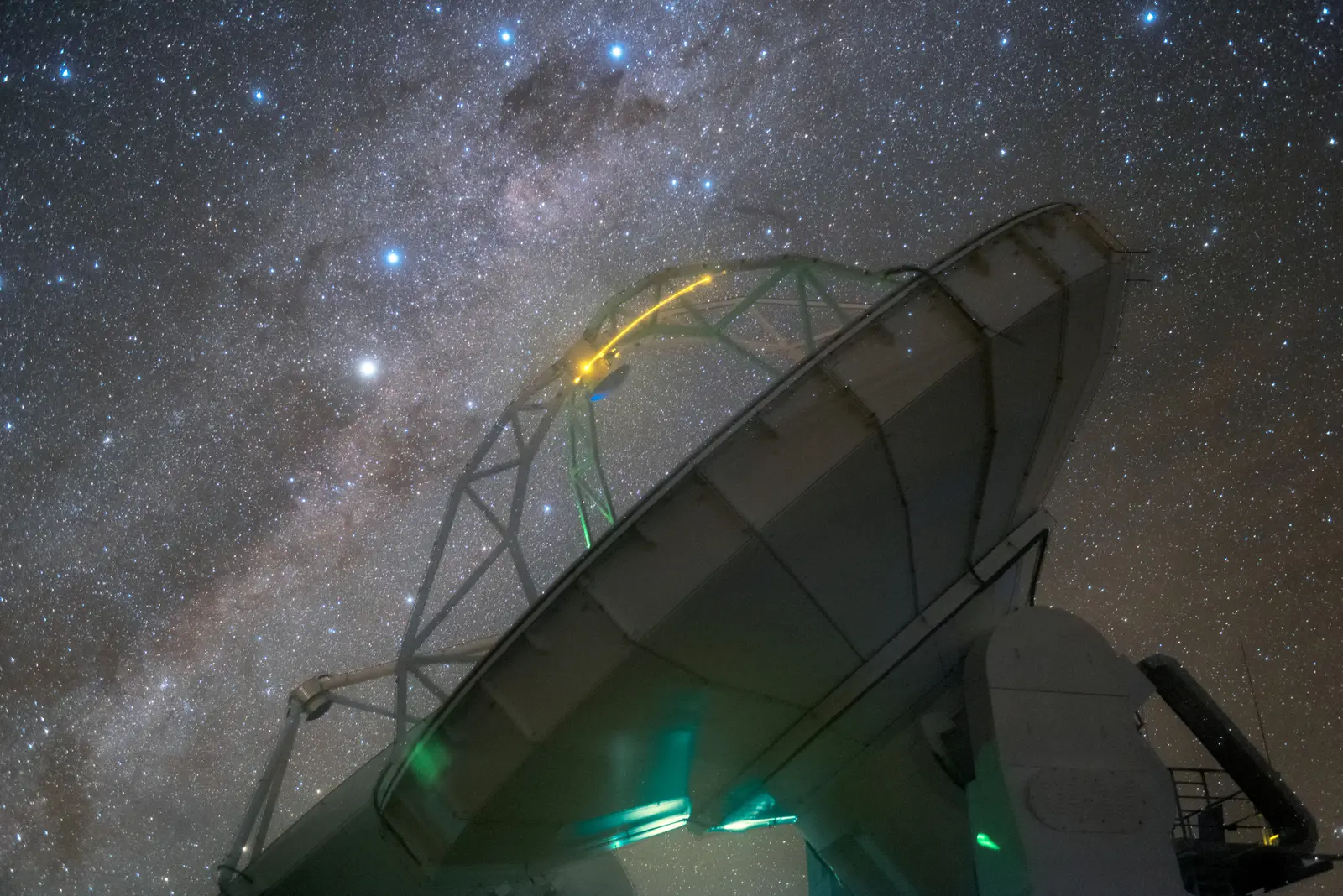
Figure 6. The Coalsack, the dark patch below a pair of bright stars of Crux at the top, above an ALMA antenna in Chile. Inca astronomers named this patch Yutu, after a partridge-like bird, ESO notes.
The budget counts points of starlight only, so planets, the Moon and the glow of the Milky Way sit outside it too.
How does this site use the term?
As a fixed reference count. Every entry sits inside one of the 88 constellations, because the list the IAU agreed in 1922 covers the entire sky; how those borders were drawn is the story of the 88 constellation borders. The seven stars of the Big Dipper are seven entries in the budget.
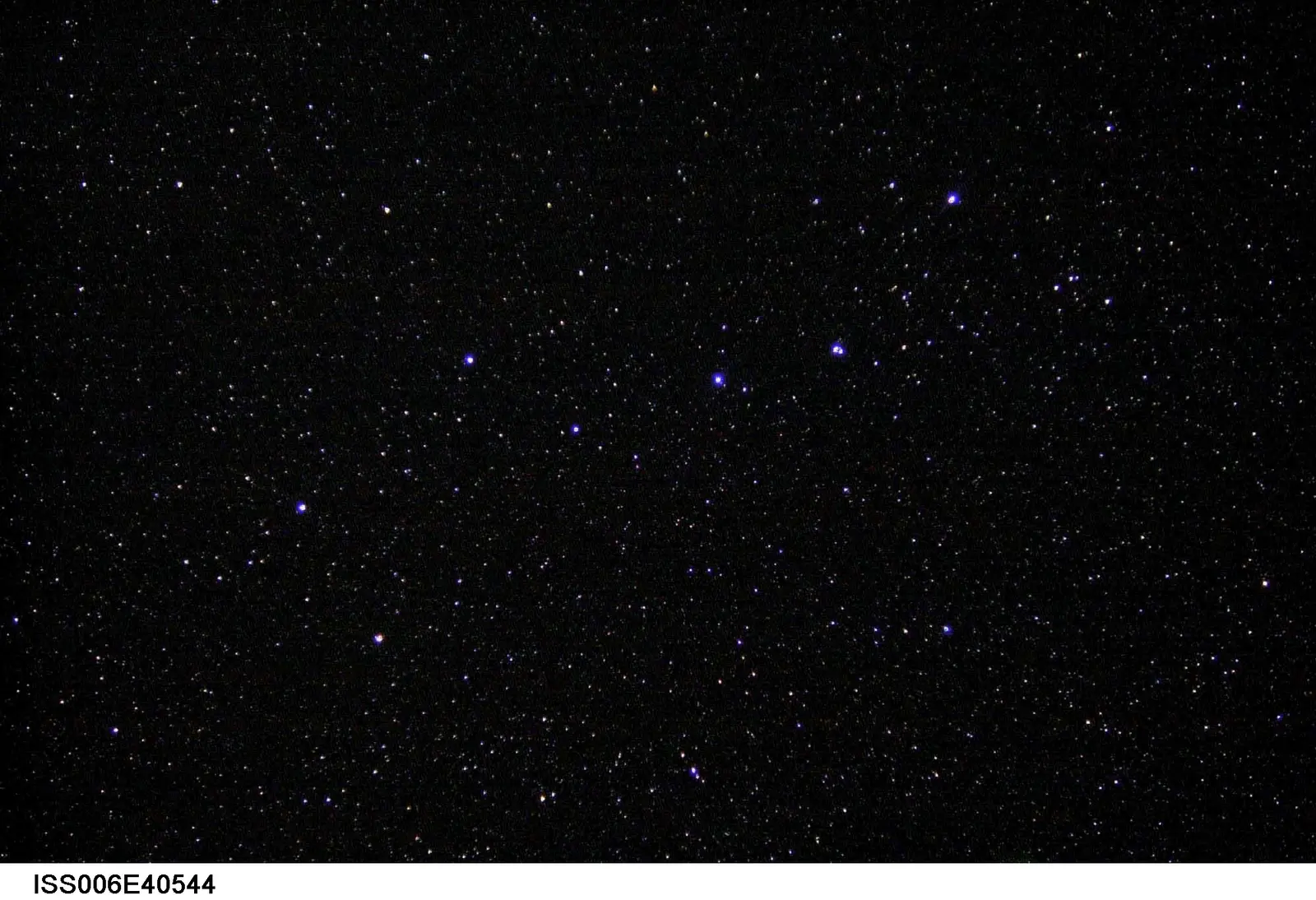
Figure 7. The whole Big Dipper, upside down, photographed from the International Space Station by astronaut Donald R. Pettit in March 2003. The bowl sits at center left; the handle reaches toward the upper right.
Orion, the constellation of Globe at Night's magnitude charts for judging your limiting magnitude, has its own entry. The next question is local: how much of the budget your own sky leaves you.
Sources
- D. Hoffleit and W. H. Warren Jr., The Bright Star Catalogue, 5th Revised Ed. (Preliminary Version) (1991), CDS catalogue V/50: ReadMe (9,110 objects, 9,096 stars, 14 objects from the 1908 compilation kept to preserve the numbering; byte-by-byte layout) and catalogue file (counted only, not redistributed)https://cdsarc.cds.unistra.fr/ftp/V/50/ReadMeRead: ReadMe in full; catalogue file from the same directory
- David Nash (astronexus), HYG Database v4.4, data README (fields; combines the Hipparcos, Yale Bright Star and Gliese catalogues) and licence (CC BY-SA 4.0)https://codeberg.org/astronexus/hygRead: repository README and data README in full; v4.4 catalogue file
- Globe at Night (NSF NOIRLab), "Activity Guide: Orion," 2026 campaign, edition for latitude 30°N in English, with magnitude charts prepared by Jenik Hollan (CzechGlobe): Orion charts from below magnitude 1 to magnitude 7; go out at least an hour after sunset, with no Moon; wait at least 10 minutes for the eyes to adapt; a red light to preserve night visionhttps://globeatnight.org/documents/1041/GaN_2026_ActivityGuide_Orion_lat_30N_English.pdfRead: full guide (4 pages)
- International Astronomical Union, "The Constellations" (IAU themes page: the 1922 list of 88 constellations covering the entire sky; the Inca "dark constellations" formed from dark clouds in the Milky Way, citing Gullberg et al. 2020)https://iauarchive.eso.org/public/themes/constellations/Read: full page text
- Wikipedia, "Air mass (astronomy)" (relative air mass about 38 at the horizon; objects nearer the horizon appear less bright than nearer the zenith)https://en.wikipedia.org/wiki/Air_mass_(astronomy)Read: article text
- Wikipedia, "Sidereal time" (Earth rotation angle as a linear function of the UT1 Julian date, after Urban and Seidelmann 2013, p. 78)https://en.wikipedia.org/wiki/Sidereal_timeRead: article text
- ESO, "The Milky Way panorama", image eso0932a (GigaGalaxy Zoom), 14 September 2009 (360-degree panoramic image covering the entire southern and northern celestial sphere; Galactic Plane running horizontally through the image)https://www.eso.org/public/images/eso0932a/Read: full image page
- Robert Stawell Ball, In the High Heavens (London: Pitman, 1910), figure 30, "The System of Mizar" (Wikimedia Commons file page; Internet Archive record inhighheavens00ballrich)https://commons.wikimedia.org/wiki/File:In_the_High_Heavens_-_Ball_(1910)_-_Figure_30.jpgRead: the figure, its Commons file page and the Internet Archive catalogue record
- T. W. Backhouse, Catalogue of 9842 Stars, or All Stars Very Conspicuous to the Naked Eye, for the Epoch of 1900 (Sunderland: Hills and Co., 1911), title page (Wikimedia Commons scan; Internet Archive catalogueof9842s00backrich)https://commons.wikimedia.org/wiki/File:Catalogue_of_9842_stars,_or,_All_stars_very_conspicuous_to_the_naked_eye,_for_the_epoch_of_1900_(IA_catalogueof9842s00backrich).pdfRead: title page and contents of the scan; Internet Archive metadata
- ESO, "Coalsack, Emu, Tinamou?", Picture of the Week potw2112a, 22 March 2021 (a pair of bright stars in Crux at the top of the frame; the Coalsack dark nebula just below; Inca astronomers named the patch Yutu, after the tinamou, a partridge-like bird; ALMA antenna, northern Chile)https://www.eso.org/public/images/potw2112a/Read: full image page and caption
- NASA, "View of stars taken during Expedition Six", ISS006-E-40544 (March 2003), NASA Image and Video Library (the entire Big Dipper, photographed by astronaut Donald R. Pettit on board the International Space Station; bowl at center left, handle extending toward the upper right, upside down)https://images.nasa.gov/details/iss006e40544Read: NASA Image and Video Library record and asset metadata (description, center, date)
- John E. Bortle, "Introducing the Bortle Dark-Sky Scale," Sky & Telescope, February 2001, pp. 126-129https://planesynormas.mma.gob.cl/archivos/2021/proyectos/ANTECEDENTES_RECOPILADOS_POR_EL_MMA_PARTE_3_ASTRONOMI__769_A.pdfRead: pages 126-129 of the printed article, as reproduced in a public file of Chile's Ministry of the Environment (Antecedentes recopilados por el MMA, Parte 3, folios 2524-2527)
- F. Falchi, P. Cinzano, D. Duriscoe, C. C. M. Kyba, C. D. Elvidge, K. Baugh, B. A. Portnov, N. A. Rybnikova and R. Furgoni, "The new world atlas of artificial night sky brightness," Science Advances 2, e1600377 (2016)https://doi.org/10.1126/sciadv.1600377Read: full text via Europe PMC (PMC4928945)
Computed by this site (2026-10-12) from sources 1 and 2: every catalogue count, the cross-match between the two catalogues, the never-rise and never-set totals at 40°N, the above-horizon ranges and lowest-10° shares, and the Great Square counts (sides drawn as straight lines between the corner stars). The Square's position uses the Earth rotation angle formula quoted in source 6, with year-2000 star positions.
Corrections
2026-11-01 — Dark-adaptation advice now follows Globe at Night (letting your eyes adjust for 20 minutes → at least 10 minutes), and the chart for judging your limit is Globe at Night's Orion magnitude charts in place of a printable wheel no longer cited. The 6.5 cutoff is now explained by John Bortle's 2001 scale, light pollution by the 2016 Falchi atlas, and the few thousand stars visible at once by this site's Bortle-scale count. Source 3 replaced; sources 12 and 13 added, prompted by a recheck.
Look up next:
The Great Square of Pegasus. On mid-October evenings at 40°N, this site's calculation puts its center about 68 degrees up in the southeast at 9 p.m. local mean solar time, crossing due south about an hour later.
Inside its four corner stars, the Yale catalogue holds 31 budget entries and none brighter than magnitude 4; four reach magnitude 5 and 13 reach magnitude 6. Let your eyes adjust for at least 10 minutes, as Globe at Night advises, then count: about four suggests a limit near 5, about 13 a limit near 6. If you drive somewhere darker to compare, go with a friend, tell someone your plan, carry a red flashlight and stay off private land. Then read the level-by-level count on the Bortle scale page.
Related entries
- Big Dipper: Not a Constellation, and Two of Its Stars Are Strangers
- Constellation Boundaries: The 88 Borders Run on an 1875 Grid
- Orion Constellation: The Winter Hunter Rises Before Dawn in August
- Bortle Scale: A City Sky Tops Out Near 250 Stars
Cite this page
Asterisms & Astrolabes. “Naked-Eye Budget: About 8,400 Entries, Never All in One Sky.” Asterisms & Astrolabes. Published 13 October 2026; last substantive revision 1 November 2026. https://asterismsandastrolabes.com/constellations/naked-eye-budget/. Accessed [the date you read it].