Subject
Scale & Estimation
Comparison charts of astronomical scales and timescales, and Fermi estimates.
-
Photograph Credit
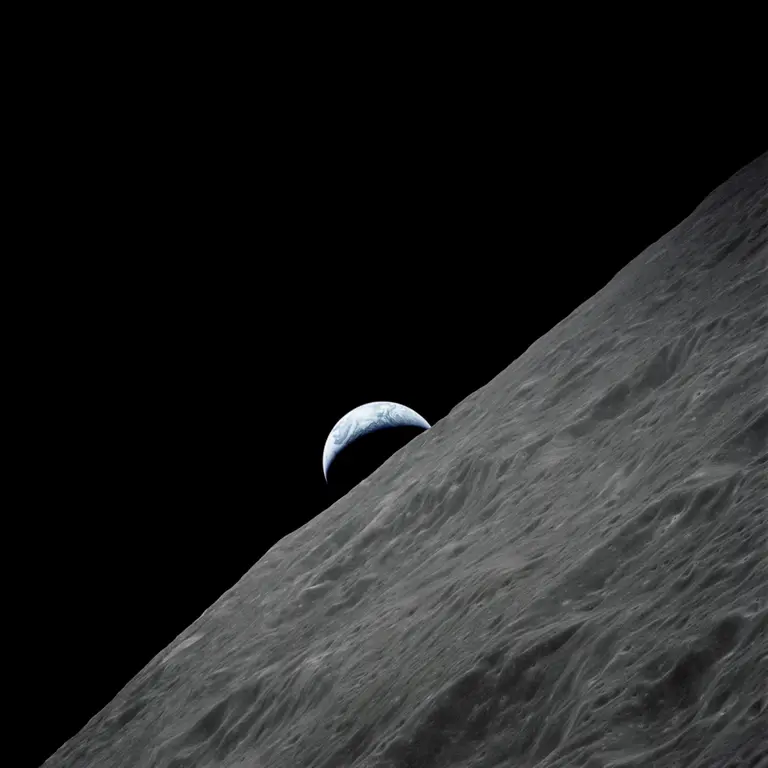
"Crescent Earth rises above lunar horizon (AS17-152-23274)" by NASA (Apollo 17 crew) — https://images.nasa.gov/details/as17-152-23274 — Public domain (taken by the Apollo 17 crew, all three US federal employees (NASA astronauts); US government work, 17 U.S.C. 105; no third-party credit). Retrieved 2026-10-13.
Solar System Scale Model: On a Soccer Field, Four Planets Fit in the Goal Area
A solar system scale model on a 100 m soccer field: the Sun is a 3.1 cm ball, Earth a 0.28 mm speck 3.3 m out, and four planets fit in the goal area.
-
Photograph Credit
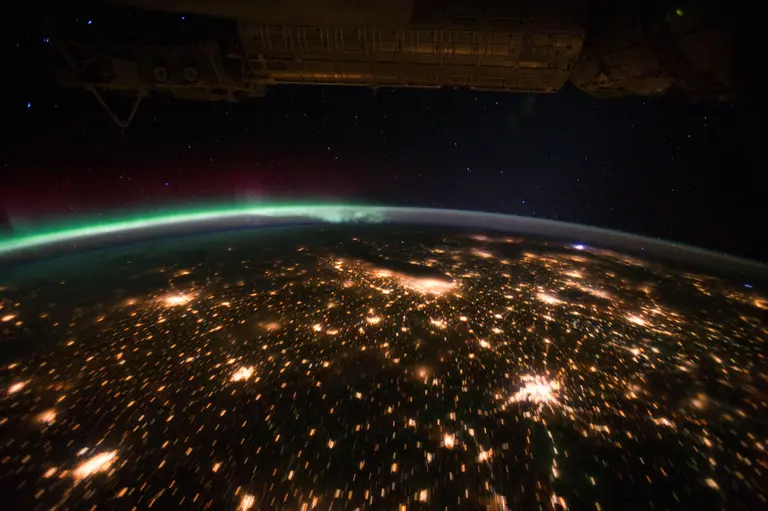
"Aurora Borealis and city lights on the horizon taken by the Expedition 29 crew (ISS029-E-012564)" by Mike Fossum, NASA — https://images.nasa.gov/details/iss029e012564 — Public domain (photograph by NASA astronaut Mike Fossum aboard the International Space Station, 2011; work of the US federal government (17 U.S.C. 105); no third-party credit on the NASA asset record). Retrieved 2026-10-13.
Bortle Scale: A City Sky Tops Out Near 250 Stars
The Bortle scale grades skies from class 1 to 9. Counted from star catalogues at 40°N, a city sky shows about 250 stars at once, a rural-edge sky about 2,600.
-
Photograph Credit
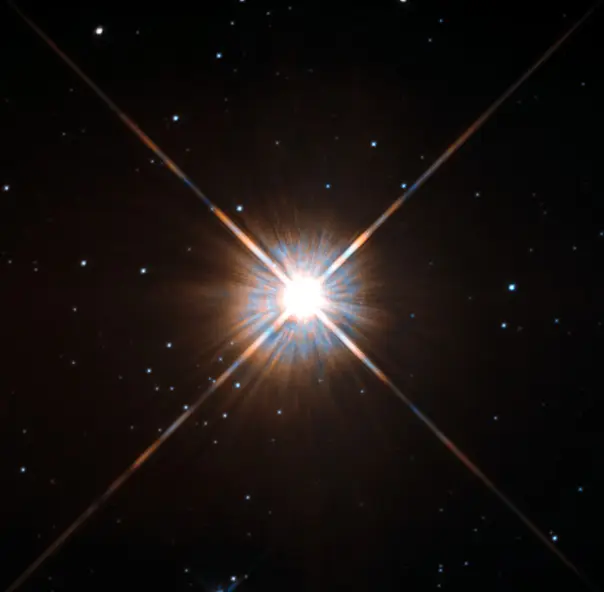
"New shot of Proxima Centauri, our nearest neighbour" by ESA/Hubble & NASA — https://commons.wikimedia.org/wiki/File:New_shot_of_Proxima_Centauri,_our_nearest_neighbour.jpg — CC BY 4.0 (https://creativecommons.org/licenses/by/4.0/). Retrieved 2026-10-12.
Light-Year: Its Year Runs 11 Minutes Longer Than the Seasons
A light-year is about 5.88 trillion miles, light's travel in a 365.25-day Julian year. Why that year was picked, and when light left 16 bright stars.
