Atlas entry
Orion Constellation: The Winter Hunter Rises Before Dawn in August
TL;DR: Orion is the hourglass of seven bright stars that rules northern winter evenings, with three belt stars in a short, straight row at its waist. The belt's line points to Sirius one way and Aldebaran the other. From 40°N its belt last clears 10° in a dark evening sky in late April and returns before dawn around August 10.
In this entry12 sections
Spec card
- English name
- Orion, the HunterSource: International Astronomical Union, "Constellations"
- IAU abbreviation
- OriSource: International Astronomical Union, "Constellations"
- Genitive
- OrionisSource: International Astronomical Union, "Constellations"
- Area (square degrees)
- 594.1; 26th largest of the 88Source: Ian Ridpath, "The Constellations 2" (areas calculated by A. E. Levin, 1935); Wikipedia, "Orion (constellation)" (594, 26th)
- Brightest star
- Rigel, magnitude 0.18; variable Betelgeuse can outshine itSource: HYG Database v4.4; Wikipedia, "Betelgeuse"
- Best viewing months
- Evenings, December to March; belt due south at 9 p.m. in late January (40°N)Source: Calculated by this site from HYG Database v4.4 positions for the 15th of each month at 40°N: months when the belt stands at least 10° high in a fully dark sky within an hour of nightfall and for at least 3 hours; local mean solar time, flat horizon, no atmospheric refraction
- Visibility
- Straddles the celestial equator; all seven main stars rise between about 80°N and 83°SSource: Wikipedia, "Orion (constellation)"; latitudes calculated by this site from HYG Database v4.4 positions: flat horizon, no atmospheric refraction
- Bordering constellations
- Taurus, Eridanus, Lepus, Monoceros, GeminiSource: Wikipedia, "Orion (constellation)"
- Myth sources
- Homer, Odyssey; Aratus; Eratosthenes; Hyginus; OvidSource: Ian Ridpath, "Star Tales – Orion" and "Star Tales – Orion 2"
Download this card as CSV (orion-constellation-spec-card.csv)Provenance note for this CSV (JSON)Data: HYG Database v4.4 by David Nash (astronexus), CC BY-SA 4.0, https://codeberg.org/astronexus/hyg
Magnitudes: HYG Database v4.4. Months, times and latitudes: this page's calculation, local mean solar time, flat horizon, no atmospheric refraction.
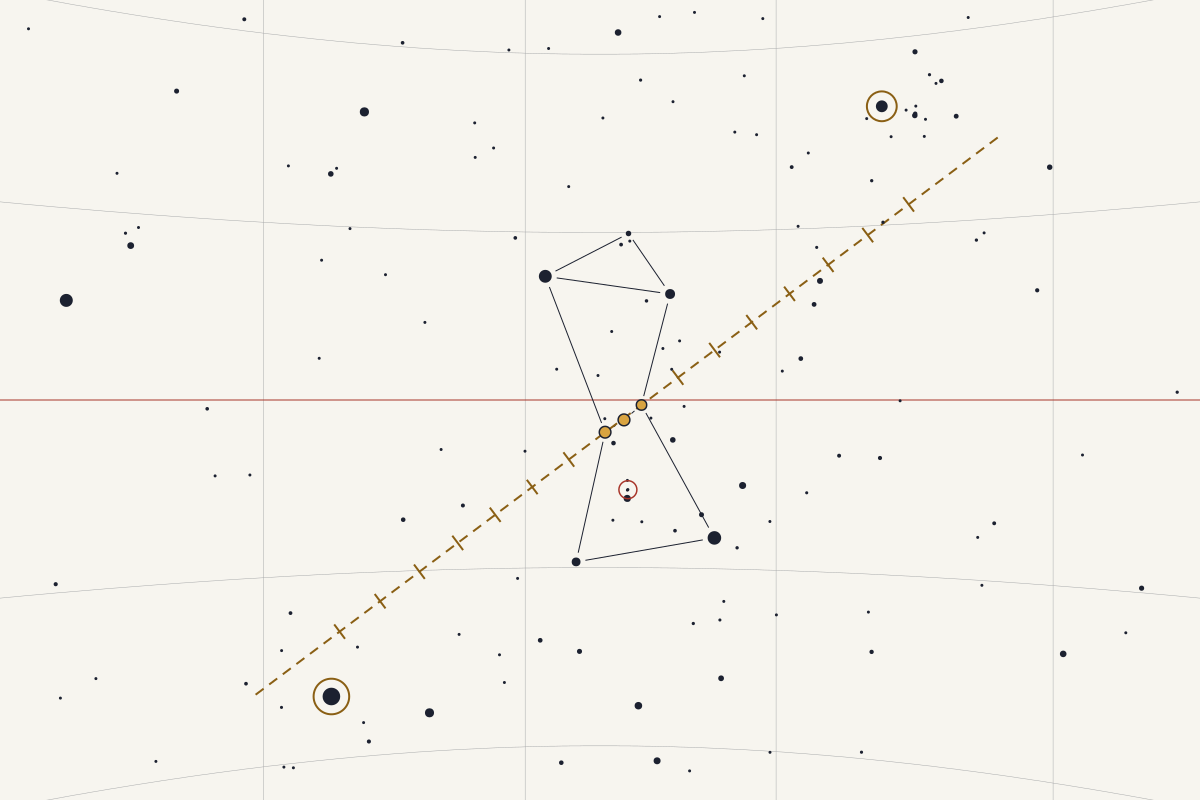
Open the chart full size to zoom in on the detail.
Figure 1. Finder chart computed from HYG v4.4 positions, north up, east left, stars to magnitude 5. The gold dots are the belt. The dashed line through it reaches Sirius (ringed, lower left) and Aldebaran (ringed, upper right), and each tick repeats the belt's 2.7° length. Betelgeuse is the large dot at the figure's upper left, Rigel at its lower right, and Procyon the bright dot at the far left edge. Red line: the celestial equator. Red circle: the Orion Nebula. Line work is this site's own drawing.
Orion is the constellation of winter evenings, yet it climbs back into a dark predawn sky in August. The Orion constellation is built around an hourglass of seven bright stars: Betelgeuse and Bellatrix at the shoulders, Saiph and Rigel at the lower corners, and three belt stars across the waist. By this page's calculation for 40°N, over a flat horizon without refraction, the belt last stands 10 degrees high in a fully dark evening sky in late April. It returns, before dawn, around August 10.
Fully dark here means the Sun is more than 18 degrees below the horizon. The belt is an asterism, a pattern inside a constellation, like the Big Dipper. Orion is the official region around it: about 594 square degrees, 26th in size among the International Astronomical Union's 88, inside the 26-sided border set by Eugène Delporte in 1930 (constellation boundaries).
How do you find Orion's Belt?
Face south on a January evening and look about halfway up. Three bright stars sit in a straight row 2.7 degrees long. From west to east Orion's belt stars are Mintaka, Alnilam and Alnitak. Ian Ridpath traces Mintaka and Alnitak to Arabic words for the belt, and Alnilam to "the string of pearls."
When Orion stands due south, carry that line down and to the left about eight belt-lengths, 22 degrees, and you reach Sirius. At magnitude −1.44 it is the brightest star in the HYG catalogue after the Sun, and the line misses it by 2.6 degrees. The other way, up and to the right, a similar run leads to Aldebaran, but the line passes 5.2 degrees from it. Sirius is the more reliable target.
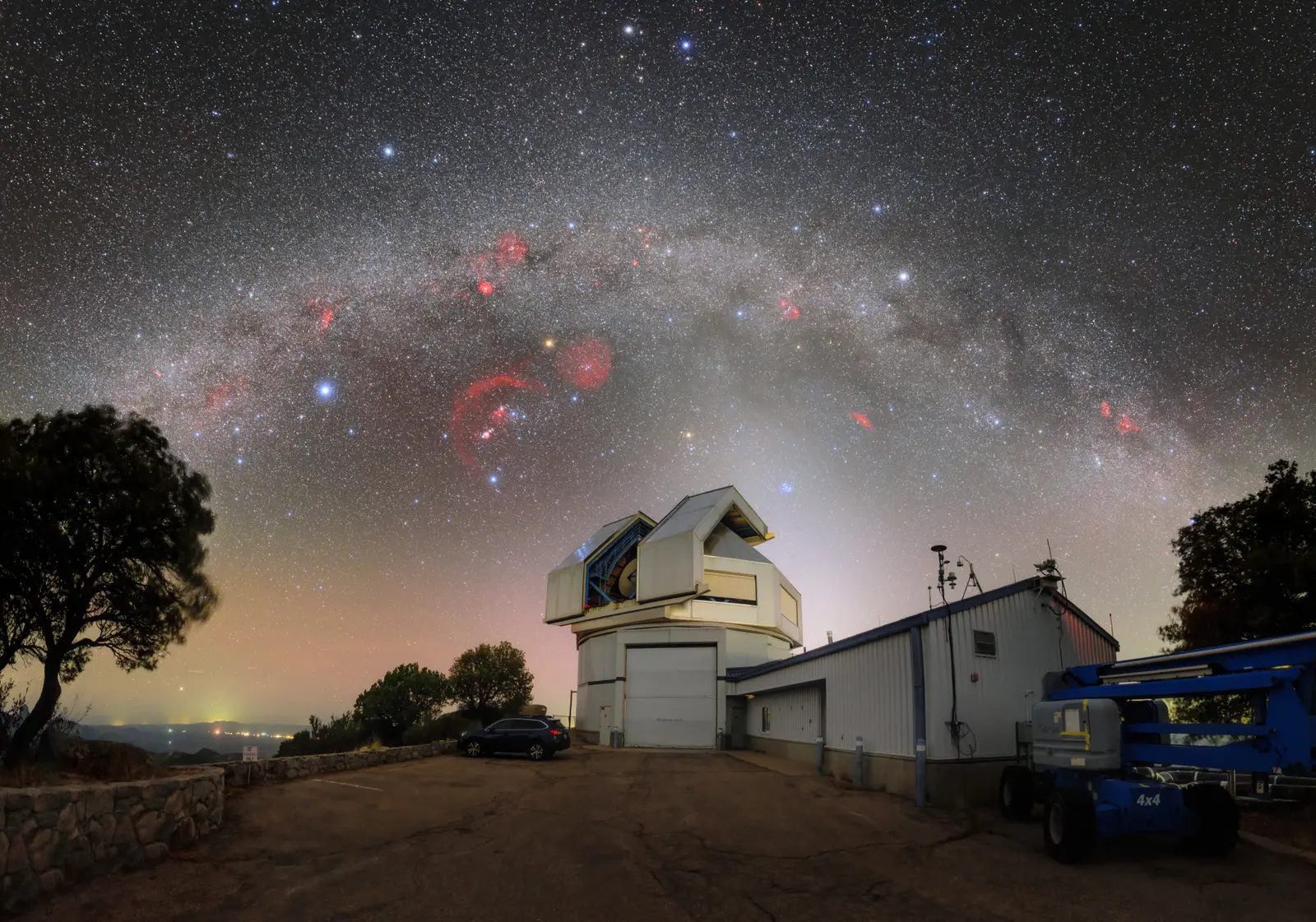
Figure 2. Orion over the WIYN 3.5-meter Telescope on Kitt Peak. In NOIRLab's description, Sirius is at left near the tree, with Orion's belt and red Betelgeuse to its right and Taurus farther right.
Mintaka also marks a compass point. It sits about 0.3 degrees south of the celestial equator, the sky's projection of Earth's equator. By this page's calculation, it rises within 1 degree of due east and sets within 1 degree of due west anywhere between about 74°S and 74°N, over a flat horizon and ignoring refraction. In mid-October at 40°N it comes up due east at about 9:55 p.m. local mean solar time, which is not the same as clock time.
When can you see Orion?
From 40°N the belt peaks 49 degrees above the southern horizon. By this page's calculation it crosses the meridian, the north–south line through the overhead point, at 9 p.m. around January 29 and at 10 p.m. around January 14, in line with Wikipedia's rule of thumb of 9 p.m. in January.
| Mid-month, 40°N | Belt rises | Belt highest | Belt at least 10° up in a dark sky |
|---|---|---|---|
| January | 4:00 p.m. | 9:55 p.m. | 6:35 p.m. to 3:00 a.m. |
| February | 2:00 p.m. | 7:55 p.m. | 7:05 p.m. to 12:55 a.m. |
| March | 12:10 p.m. | 6:05 p.m. | 7:40 to 11:05 p.m. |
| April | 10:05 a.m. | 4:00 p.m. | 8:15 to 9:05 p.m. |
| May | 8:05 a.m. | 2:05 p.m. | none |
| June | 6:05 a.m. | 12:00 noon | none |
| July | 4:05 a.m. | 10:00 a.m. | none |
| August | 2:05 a.m. | 8:00 a.m. | 2:55 to 3:30 a.m. |
| September | 12:00 midnight | 5:55 a.m. | 12:55 to 4:10 a.m. |
| October | 10:05 p.m. | 4:00 a.m. | 10:55 p.m. to 4:40 a.m. |
| November | 8:00 p.m. | 1:55 a.m. | 8:55 p.m. to 5:10 a.m. |
| December | 6:05 p.m. | 12:00 midnight | 6:55 p.m. to 5:00 a.m. |
The night of the 15th of each month, by this page's calculation from HYG v4.4 positions: 40°N, local mean solar time rounded to 5 minutes, flat horizon, no refraction. "Dark sky" means the Sun is more than 18° below the horizon; times after midnight fall on the next morning. The belt is represented by its middle star, Alnilam.
CSV download (CC BY 4.0) (Data: HYG Database v4.4 by David Nash (astronexus), CC BY-SA 4.0, https://codeberg.org/astronexus/hyg), with its provenance note (JSON)
The blank stretch lasts about 106 nights at 40°N. It shrinks to about 90 nights at 30°N and grows to about 127 at 50°N. On the 2026 return morning at 40°N, the belt reaches 10 degrees at 3:20 a.m., about three minutes before the Sun climbs back to 18 degrees below the horizon. Across the 2020s and 2030s that morning falls on August 10 every year, by the same calculation.
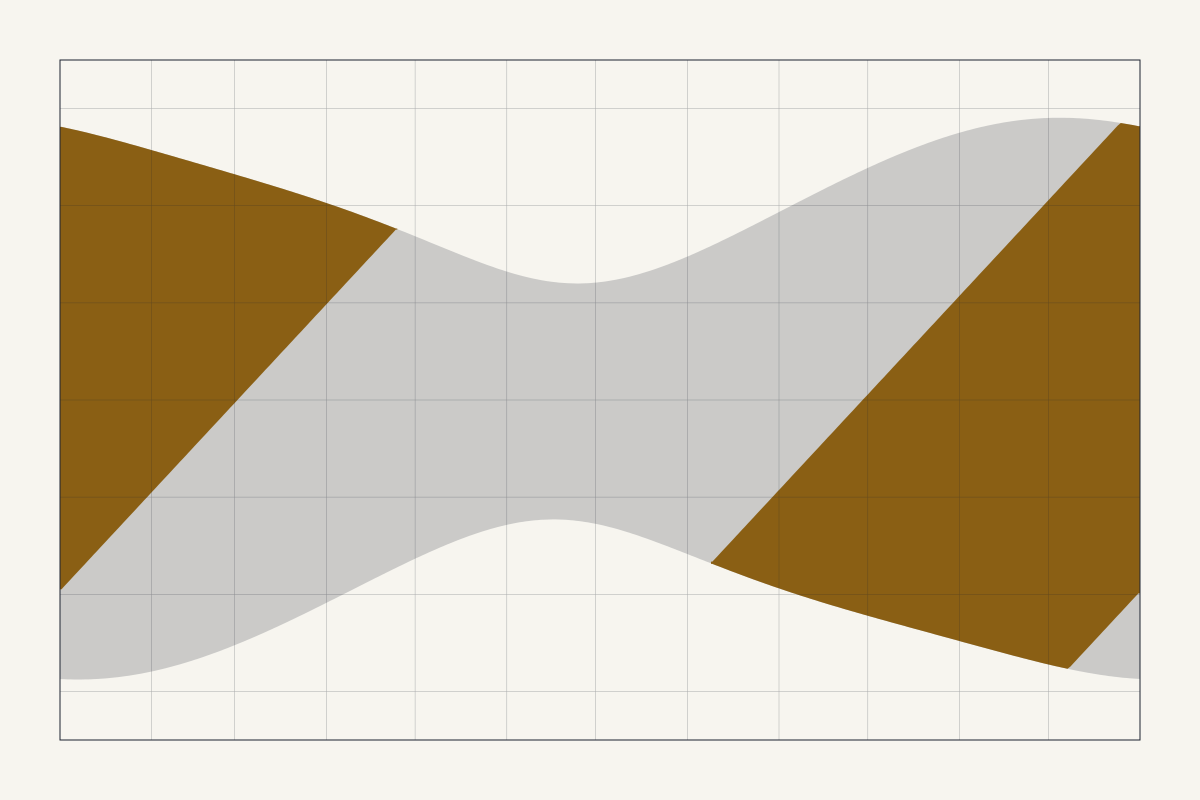
Open the chart full size to zoom in on the detail.
Figure 3. Computed for 40°N in 2026: months left to right, 5 p.m. to 7 a.m. local mean solar time top to bottom. Grey is fully dark sky; dark gold, where the belt also clears 10°.
That return is an old calendar signal. Around 700 BC, the Greek poet Hesiod told farmers to winnow grain "when strong Orion first appears," in Hugh Evelyn-White's 1914 translation, which dates the moment to July.
At 38°N, with a long-term model of axial precession, the slow wobble of Earth's axis, this page applied one test to both eras: the first morning the belt stands 10 degrees up with the Sun more than 18 degrees below the horizon. In 700 BC that came about 25 days after the June solstice; today it comes about 48 days after. The test is stricter than a first glimpse, so it compares the two eras but does not date Hesiod's sighting. Both figures assume a flat horizon and no refraction, with a simplified solar formula meant for 1950 to 2050 and stretched back to 700 BC.
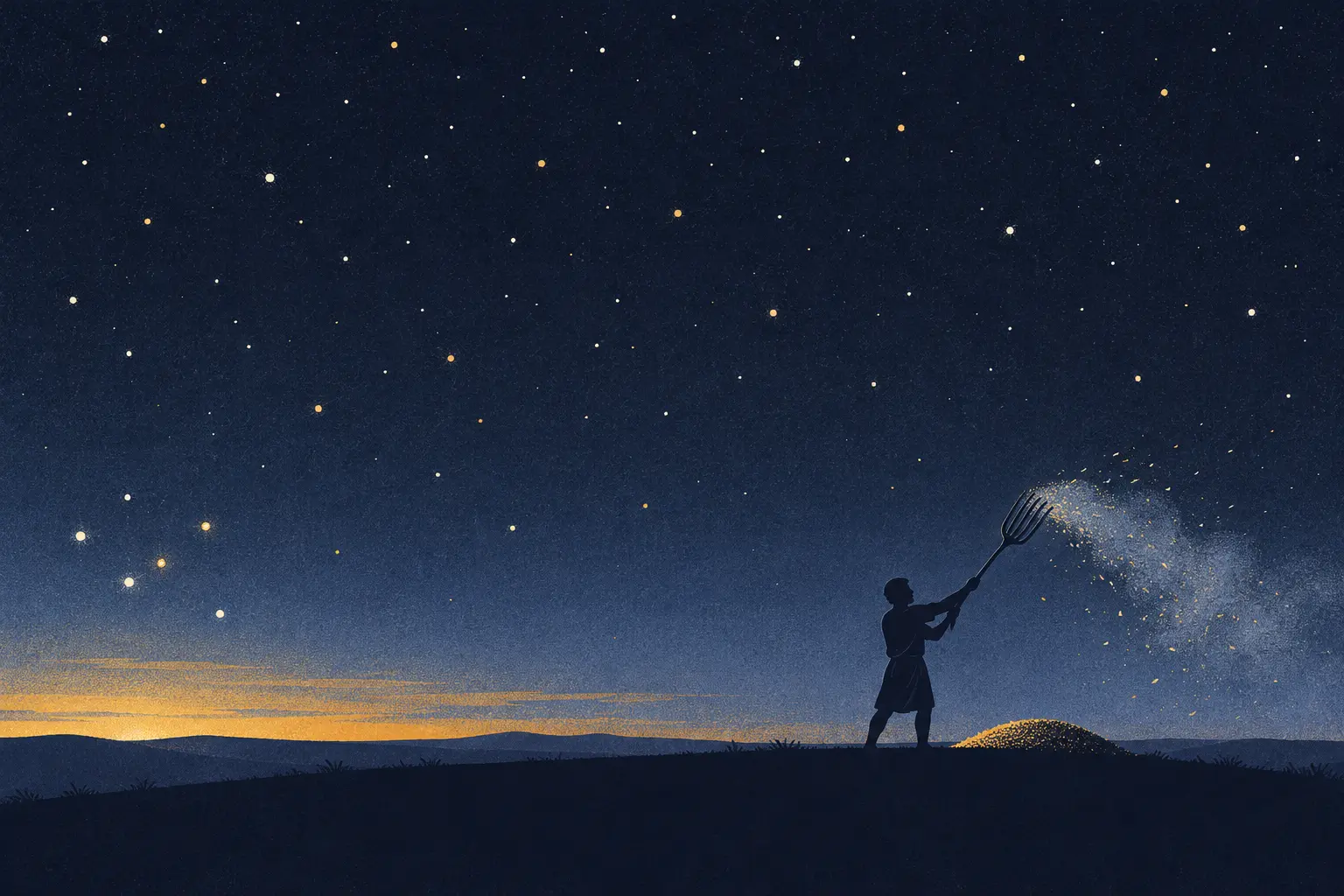
Winnowing on a hilltop before dawn, bright stars low in the east. Around 700 BC, Hesiod told farmers to winnow grain "when strong Orion first appears" (Evelyn-White's translation).
Rigel or Betelgeuse: which is brighter?
Rigel usually wins. It sits at lower right when Orion stands due south. HYG lists it at magnitude 0.18, where lower numbers mean brighter. Its 2007 Hipparcos parallax, the tiny yearly shift that gives a star's distance, puts it about 860 light-years away, roughly 790 to 950, as listed in the SIMBAD database.
Betelgeuse, the reddish shoulder star at upper left, usually sits near magnitude 0.5 but varies between about 0.0 and 1.6, Wikipedia reports, so at its peak it can outshine Rigel. Edward Guinan and colleagues measured a mean magnitude of 1.614 for February 7 to 13, 2020, close to Bellatrix's 1.64. A 2020 study led by Meridith Joyce put Betelgeuse about 550 light-years away, with a range of 499 to 636. Its size and its 2020 dimming have their own entry (Betelgeuse).
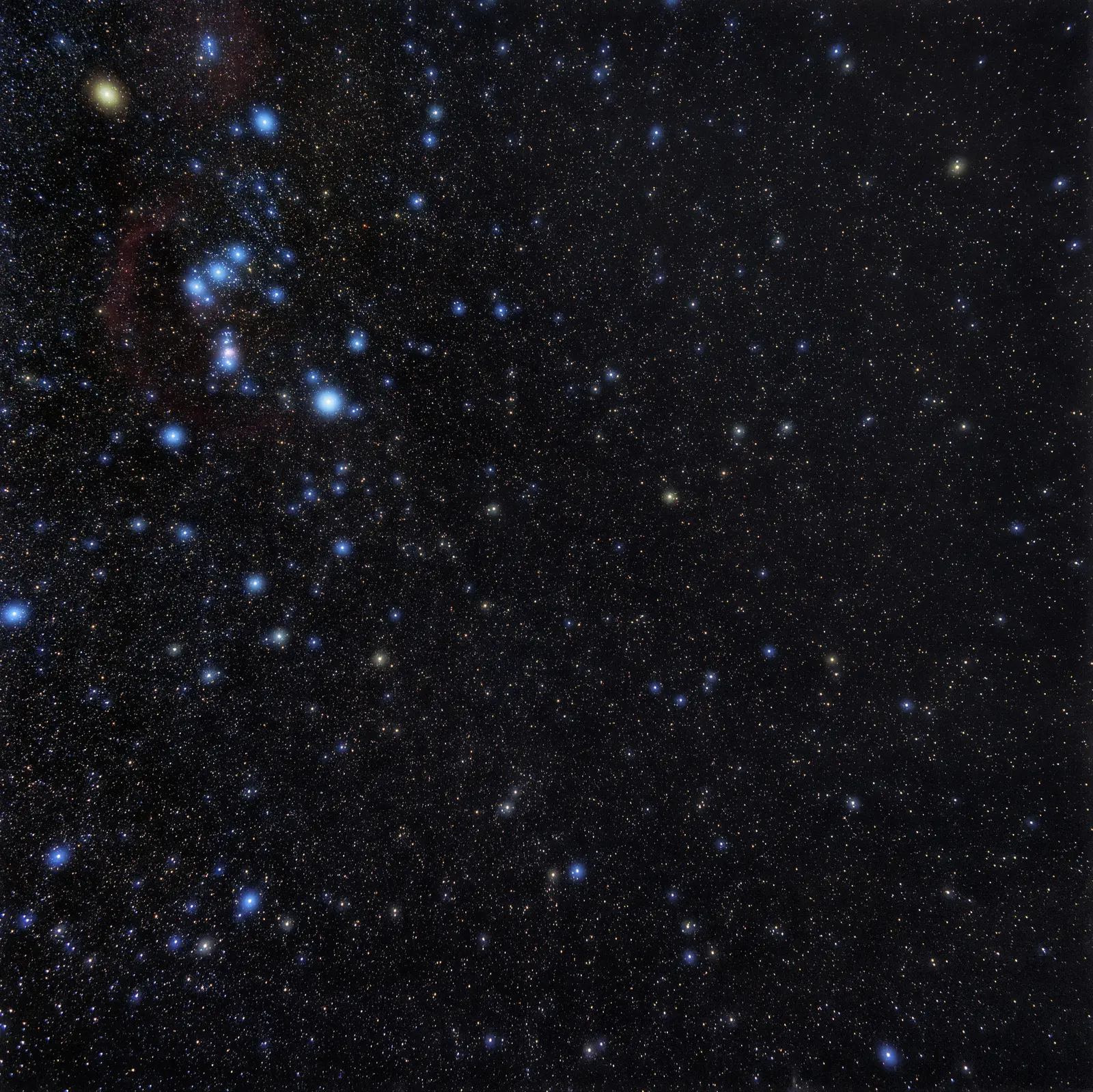
Figure 4. Orion in a wide-field photograph, north up, stars identified from HYG v4.4 positions. Betelgeuse is the yellow-orange star near the top-left corner; Rigel, below and right of the belt, is blue-white.
What is the fuzzy star in Orion's sword?
Below the belt hangs a shorter line of three stars, the sword. Its middle star looks soft. When Christiaan Huygens turned his telescope on it in 1656, twelve stars appeared where the eye sees one, and seven of them "shone as if through a mist" (velut trans nebulam). He printed the scene in Systema Saturnium in 1659.
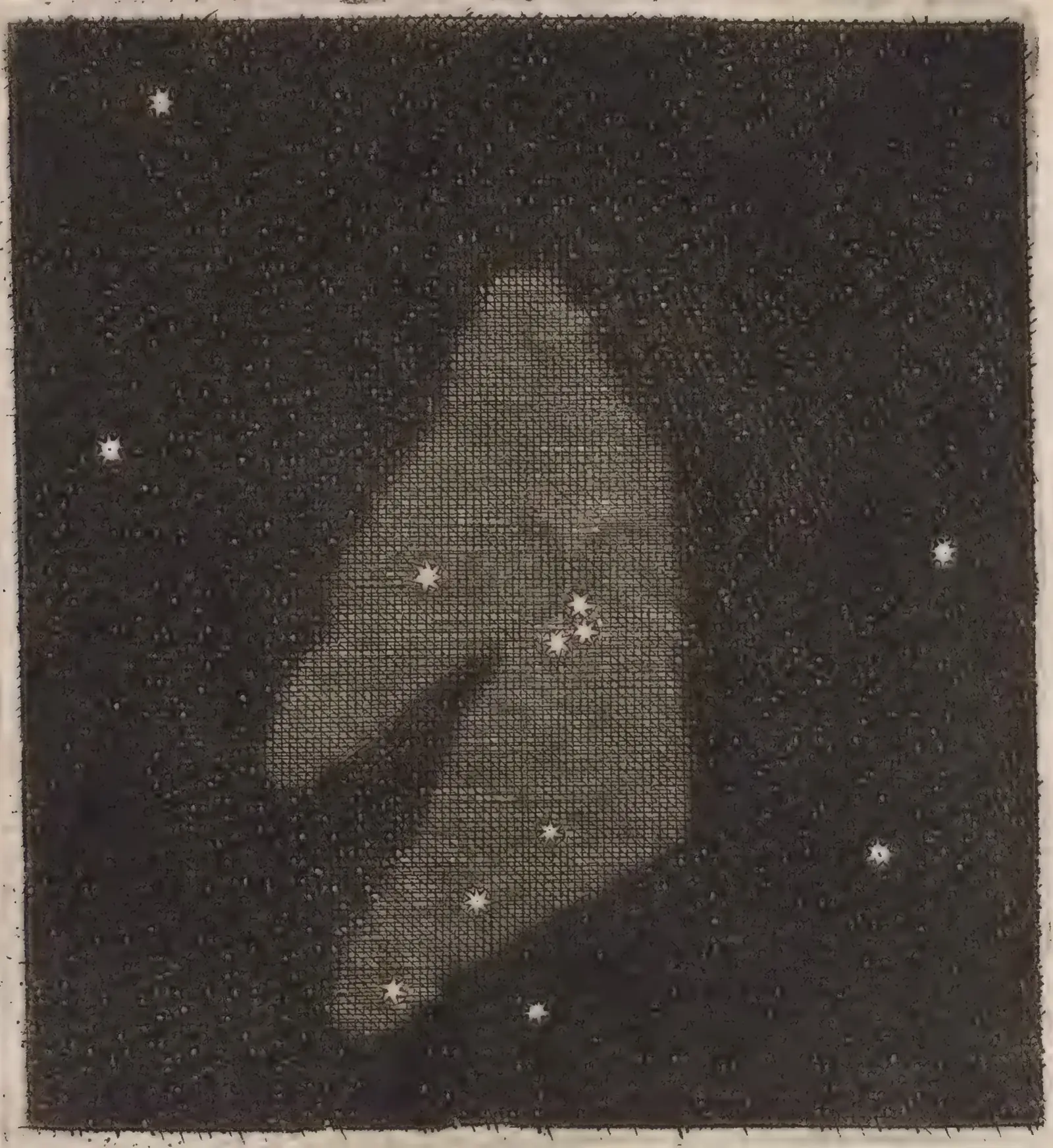
Figure 5. Christiaan Huygens's engraving of the Orion Nebula from Systema Saturnium (1659), page 8: the twelve stars he saw in 1656 at the middle of Orion's sword, three of them almost touching. Smithsonian Libraries copy, cropped to the engraving.
Huygens described it as noticed "by no one so far, as far as I know" (both quotations are this site's translations of his Latin). Others had seen it. Wikipedia says the discovery is generally credited to Nicolas-Claude Fabri de Peiresc, who recorded it through a telescope on November 26, 1610. Ridpath adds that Peiresc never published it.
The first description in print, Ridpath writes, came from Johann Baptist Cysat in 1619. Both sources say neither Ptolemy's Almagest nor al-Ṣūfī's Book of Fixed Stars mentions it, though it is visible to the naked eye.
Light's departure: a 2007 radio parallax by K. M. Menten and colleagues puts the nebula's star cluster at 414 ± 7 parsecs, about 1,350 light-years (light-year). A 2017 radio survey led by Marina Kounkel gives 388 ± 5 parsecs, about 1,270 light-years. On those figures, the light Huygens saw had left it around AD 300 to 400.
Who else saw a figure in Orion?
In Greek myth Orion is a giant hunter whom Homer's Odyssey arms with a bronze club, and the stories of his death conflict, as Ridpath's survey shows. Eratosthenes and Hyginus have Orion brag that he could kill any beast, so the Earth sends a scorpion. Aratus says Artemis brought the scorpion; Hyginus also tells of Apollo tricking Artemis into shooting him; Ovid has him die defending Leto. In the scorpion versions, hunter and scorpion end up on opposite sides of the sky.
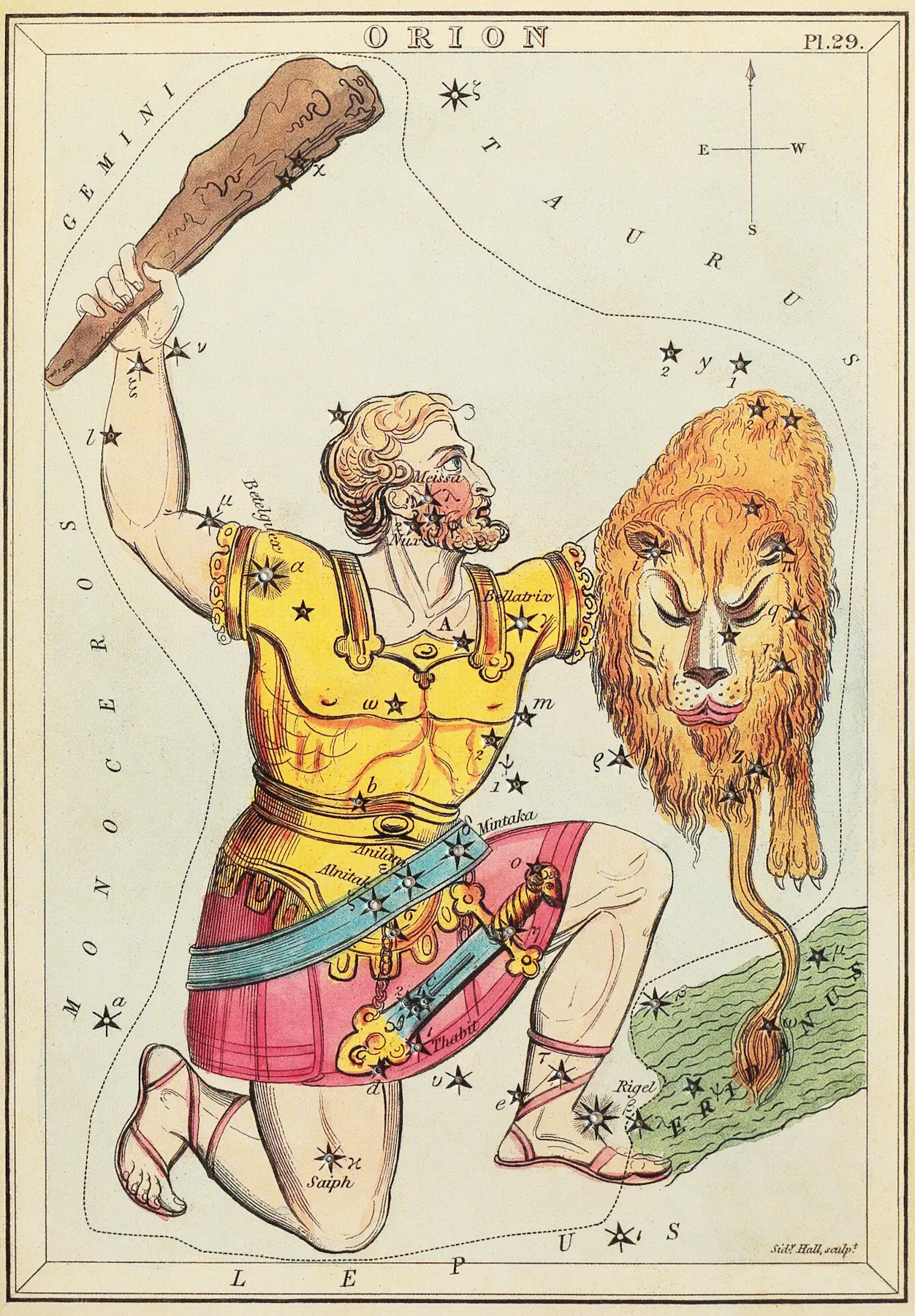

Figure 6. Orion, plate 29 of Urania's Mirror (London, dated 1825), constellation cards engraved by Sidney Hall. The hunter raises a club and holds out a lion's pelt.
Chinese astronomers also saw a hunter or warrior here, Ridpath writes. Its name, Shen ("three stars"), seems first to have meant only the belt; Wikipedia counts seven after four more were added, and Ridpath gives a final form of ten, three in the sword. A legend he retells has an emperor banish two quarreling sons: Shichen to tend the sacrifices to Shen, and Ebo those to Xin, a lunar mansion in present-day Scorpius on the far side of the sky.
Northern skies nearly bear both stories out. By this page's calculation for 40°N, over a flat horizon without refraction, Antares, the brightest star in Scorpius, rises in the southeast about 12 minutes before Betelgeuse sets in the west, and Rigel sets before Antares rises. At 35°N the overlap is about 25 minutes. At 30°S, Betelgeuse and Antares share the sky for about 2 hours 15 minutes a day.
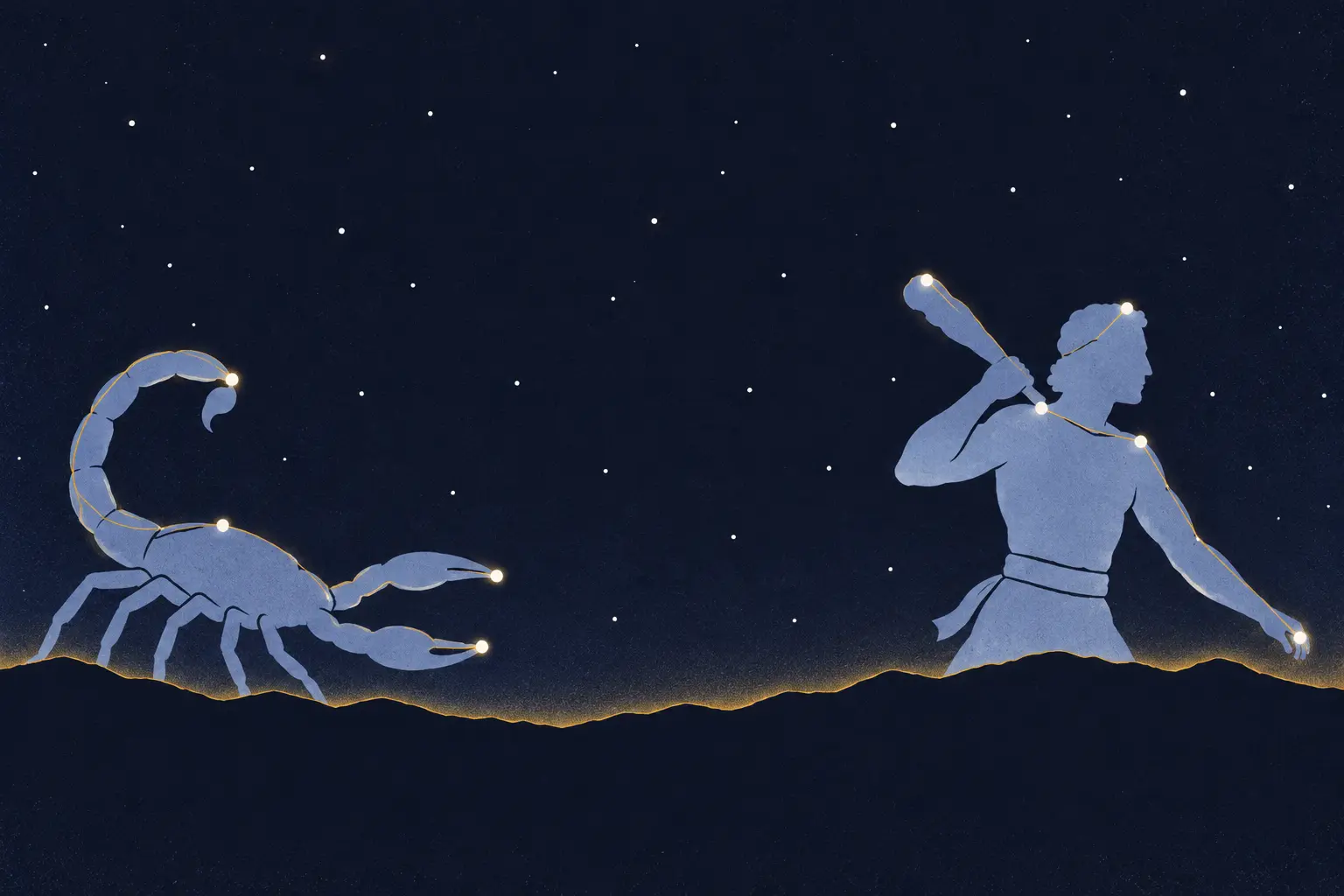
The giant hunter sinks in the west as the scorpion rises in the east. In the scorpion versions of the myth, the two end up on opposite sides of the sky.
Arab sky-watchers saw a woman, al-Jauzā', whose figure took in the stars of Orion and Gemini. Ridpath writes that modern commentators can offer nothing better than something like "the lady in the middle," and that the "middle" may refer to her place astride the celestial equator. Betelgeuse comes from yad al-jauzā', "the hand of al-Jauzā'," and Rigel from rijl, "foot." Wikipedia adds that the name al-jabbār, "the giant," came later, with the Greek figure.
In a 2009 article written for First Nations students and teachers, Wilfred Buck, an Ininew (Cree) educator, draws these stars as Mistapew, a giant who traps the spirits of seven hunting brothers in seven rocks. Their nephew Tikoom frees them through the sweat-lodge ceremony. Buck places the Sweat Lodge in Corona Borealis and its fire and rocks in the Pleiades.
How dark is your sky? Count Orion's stars
Globe at Night, a citizen-science campaign run by NSF's NOIRLab, prints a set of Orion charts that show the constellation's stars down to magnitudes 1 through 7. Find the chart whose faintest stars you can just see, and you have your sky's limiting magnitude. Its 2026 activity guide says to go out at least an hour after sunset with no Moon up, wait at least 10 minutes for your eyes to adapt, and bring a red light to preserve night vision.
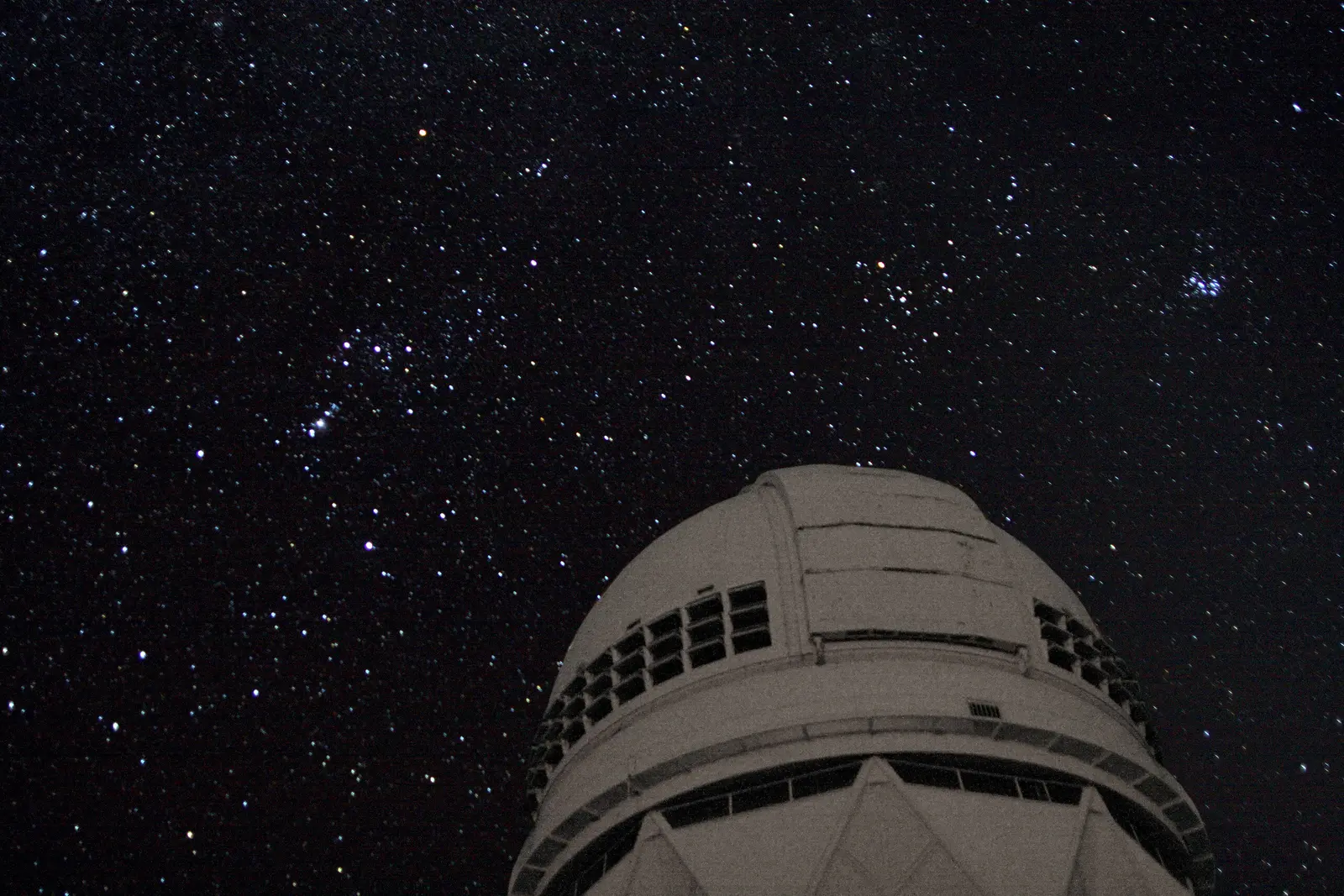
Figure 7. Orion above the Mayall 4-meter Telescope on Kitt Peak, in a photograph released for GLOBE at Night 2008, a campaign that asked people to record how many of Orion's stars they could see.
This page's box count needs no printout. Count the stars inside the box of Betelgeuse, Bellatrix, Rigel and Saiph, leaving out the four corners, and compare with the table below; the catalogue lists some close pairs as separate entries, theta-1 Orionis in the nebula among them, so treat the fainter rows as rough. If you drive somewhere darker to compare, go with someone, tell someone your plan, carry a red flashlight and stay off private land.
| Faintest stars you can see | Stars inside the box |
|---|---|
| Magnitude 2 | 2 |
| Magnitude 3 | 4 |
| Magnitude 4 | 7 |
| Magnitude 5 | 23 |
| Magnitude 6 | 47 |
HYG v4.4, by this page's calculation: stars inside the four straight sides joining the corner stars, corners excluded.
CSV of the 74 stars to magnitude 6.5 (CC BY-SA 4.0) (Data: HYG Database v4.4 by David Nash (astronexus), CC BY-SA 4.0, https://codeberg.org/astronexus/hyg), with its provenance note (JSON)
For what each limit says about your sky, see the Bortle scale. Once the belt is easy to find, it becomes the starting line for the rest of the winter sky.
Sources
- International Astronomical Union, "Constellations" (IAU themes page: Orion, abbreviation Ori, "the Hunter", genitive Orionis; the 88 constellations agreed in 1922; Delporte's boundaries approved in 1928 and published in 1930)https://iauarchive.eso.org/public/themes/constellations/Read: full page
- Wikipedia, "Orion (constellation)" (straddling the celestial equator; 594 square degrees, 26th in size; 26-sided boundary set by Delporte in 1930; bordering constellations; seven brightest stars in an hourglass; belt best seen around 9 p.m. in January; a line from Rigel through Betelgeuse points to Castor and Pollux; al-jabbar adopted later from the Greek figure)https://en.wikipedia.org/wiki/Orion_(constellation)Read: full article text
- Ian Ridpath, "Star Tales – Orion" (genitive, abbreviation, 26th in size; Homer's giant hunter with a bronze club)http://www.ianridpath.com/startales/orion.htmlRead: full page
- Ian Ridpath, "Star Tales – Orion 2" (death of Orion in Aratus, Eratosthenes, Hyginus and Ovid; star names Rigel, Betelgeuse, Mintaka, Alnitak, Alnilam; al-jauzā'; the Orion Nebula, Peiresc and Cysat; Chinese Shen and the legend of Shichen and Ebo)http://www.ianridpath.com/startales/orion2.htmlRead: full page
- David Nash (astronexus), HYG Database v4.4, data README and licence (CC BY-SA 4.0)https://codeberg.org/astronexus/hygRead: full catalogue file (version 4.4) and README
- ERFA (Essential Routines for Fundamental Astronomy), ltpequ.c, ltpecl.c and ltp.c: long-term precession of Vondrák, Capitaine and Wallace (2011, A&A 534, A22), with era00.c and gmst06.c for sidereal timehttps://github.com/liberfa/erfaRead: source code of the five routines
- Wikipedia, "Position of the Sun" (Astronomical Almanac low-precision formulas for the Sun's ecliptic longitude, about 0.01° for 1950–2050)https://en.wikipedia.org/wiki/Position_of_the_SunRead: section "Approximate position"
- Hesiod, Works and Days, lines 597–617, in Hesiod, the Homeric Hymns, and Homerica, translated by Hugh G. Evelyn-White (preface dated 1914), Project Gutenberg eBook #348 (with the translator's notes dating Orion's first appearance to July and its setting to the end of October)https://www.gutenberg.org/ebooks/348Read: full text of the passage and notes
- Wikipedia, "Works and Days" (written by Hesiod around 700 BC)https://en.wikipedia.org/wiki/Works_and_DaysRead: lead section
- SIMBAD Astronomical Database (CDS), "bet Ori" (Rigel): parallax 3.78 ± 0.34 mas from van Leeuwen 2007 (2007A&A...474..653V)https://simbad.cds.unistra.fr/simbad/sim-id?Ident=bet+OriRead: database query (parallax, its error and reference)
- Wikipedia, "Betelgeuse" (usually the second-brightest star in Orion after Rigel; distinctly reddish; apparent magnitude varying between +0.0 and +1.6, infobox +0.50, citing the AAVSO Variable Star Index)https://en.wikipedia.org/wiki/BetelgeuseRead: lead section and infobox
- E. Guinan, R. Wasatonic, T. Calderwood and D. Carona, "The Fall and Rise in Brightness of Betelgeuse," The Astronomer's Telegram #13512 (22 February 2020): mean V = 1.614 ± 0.008 during 7–13 February 2020https://www.astronomerstelegram.org/?read=13512Read: full text
- M. Joyce et al., "Standing on the shoulders of giants: New mass and distance estimates for Betelgeuse through combined evolutionary, asteroseismic, and hydrodynamical simulations with MESA," The Astrophysical Journal 902 (2020), arXiv:2006.09837 (distance 168 +27/−15 pc)https://arxiv.org/abs/2006.09837Read: abstract
- Christiaan Huygens, Systema Saturnium (The Hague: Adriaan Vlacq, 1659), page 8 (Smithsonian Libraries copy, Internet Archive item CristianiHugeni00HuygA, via Wikimedia Commons)https://commons.wikimedia.org/wiki/File:Cristiani_Hugenii_Zulichemii,_Const._f._Systema_Saturnium_-_sive,_De_causis_mirandorum_Saturni_phaenomen%C3%B4n,_et_comite_ejus_Planeta_Novo_(IA_CristianiHugeni00HuygA).pdfRead: page 8 (Latin text and engraving); quotations translated by this site
- Wikipedia, "Orion Nebula," section History (not noted by Ptolemy or al-Sufi; discovery generally credited to Peiresc, 26 November 1610; Cysat's 1619 monograph the first published observation; Huygens's 1659 drawing)https://en.wikipedia.org/wiki/Orion_NebulaRead: History section
- K. M. Menten, M. J. Reid, J. Forbrich and A. Brunthaler, "The distance to the Orion Nebula," arXiv:0709.0485 (2007): VLBA trigonometric parallax, 414 ± 7 pchttps://arxiv.org/abs/0709.0485Read: abstract
- M. Kounkel et al., "The Gould's Belt Distances Survey (GOBELINS) II. Distances and structure towards the Orion Molecular Clouds," The Astrophysical Journal 834, 142 (2017), arXiv:1609.04041: VLBA parallaxes, 388 ± 5 pc towards the Orion Nebula Clusterhttps://arxiv.org/abs/1609.04041Read: abstract
- Wikipedia, "Three Stars (Chinese constellation)" (參宿 Shēn Xiù; in ancient times only the three belt stars, later seven)https://en.wikipedia.org/wiki/Three_Stars_(Chinese_constellation)Read: full article
- Wilfred Buck, "Atchakosuk: Ininewuk Stories of the Stars," First Nations Perspectives 2, 1 (2009): 71–83 (Matootisan, the Sweat Lodge; Figure 5, Mistapew)https://mfnerc.org/wp-content/uploads/2012/11/008_Buck.pdfRead: full text and figures
- Globe at Night (NSF NOIRLab), "Activity Guide: Orion," 2026 campaign, edition for latitude 30°N in English, with magnitude charts prepared by Jenik Hollan (CzechGlobe): Orion charts from below magnitude 1 to magnitude 7; go out at least an hour after sunset, with no Moon; wait at least 10 minutes for the eyes to adapt; a red light to preserve night visionhttps://globeatnight.org/documents/1041/GaN_2026_ActivityGuide_Orion_lat_30N_English.pdfRead: full guide (4 pages)
- Ian Ridpath, "The Constellations 2" (table of constellation areas calculated by A. E. Levin, Handbook of the British Astronomical Association, 1935: Orion 594.1 square degrees, 26th in size)http://www.ianridpath.com/constellations2.htmlRead: full table and its notes (page 1, http://www.ianridpath.com/constellations1.html, gives the Levin source)
- NOIRLab, "A Pantheon Above WIYN," Image of the Week iotw2333a (16 August 2023; credit KPNO/NOIRLab/NSF/AURA/P. Horálek, Institute of Physics in Opava): Sirius at left near the tree, Orion with Betelgeuse and the belt to its right, Taurus and the Pleiades farther right; taken during the NOIRLab 2022 Photo Expeditionhttps://noirlab.edu/public/images/iotw2333a/Read: full image page
- NOIRLab, "Wide-field View of Orion," image 04h26m-15_1679-CC (released 28 January 2025; credit NOIRLab): the area around Orion and the Orion Nebula; centre RA 4h 26m 58.62s, Dec −16° 26′ 6.49″; field 3449.28 × 3446.07 arcminutes; north uphttps://noirlab.edu/public/images/04h26m-15_1679-CC/Read: full image page with its coordinate metadata
- Wikimedia Commons, "Sidney Hall - Urania's Mirror - Orion (best currently available version - 2014).jpg" (file record: "Orion," plate 29 in Urania's Mirror, London, dated 1825; author Sidney Hall; restored by Adam Cuerden; photographed from John Dolby's copy)https://commons.wikimedia.org/wiki/File:Sidney_Hall_-_Urania%27s_Mirror_-_Orion_(best_currently_available_version_-_2014).jpgRead: file page (revision 1132571733)
- NOIRLab, "The Orion constellation as seen over the Mayall 4-meter Telescope on Kitt Peak," image noao0803a (released 18 February 2008; credit J. Glaspey and NOIRLab/NSF/AURA): used to illustrate NOAO Press Release 08-03 on GLOBE at Nighthttps://noirlab.edu/public/images/noao0803a/Read: full image page
- National Optical Astronomy Observatory, "GLOBE at Night 2008 Builds Wider Networks as Big Step Toward IYA 2009," release noao0803 (18 February 2008): the classic GLOBE at Night exercise asks the public to observe and record the number of stars visible in Orion, 25 February to 8 March 2008https://noirlab.edu/public/news/noao0803/Read: full release
Computed by this site (2026-10-12) from source 5, with long-term precession from source 6 and solar positions from source 7: rising, transit and setting times, the dark-sky windows, the late-April and August dates, the 700 BC comparison, belt length and pointer offsets, Mintaka's declination and rising direction, latitude limits, the Orion–Scorpius overlap, the box counts and the Look up next times, heights and offsets. Distances in light-years are converted from the parsec and parallax values in sources 10, 13, 16 and 17.
Corrections
2026-11-01 — The dark-sky check now follows Globe at Night's Orion magnitude charts and observing guide in place of the earlier printable wheel (charts down to magnitudes 1 through 6 → 1 through 7; letting your eyes adjust for 20 minutes → at least 10 minutes), with source 20 replaced, prompted by a recheck.
Look up next:
Castor and Pollux, the bright pair in Gemini. By this page's calculation for October 15 at 40°N, over a flat horizon without refraction, Castor clears the northeast horizon at about 9:55 p.m. local mean solar time, with Betelgeuse; Pollux follows about half an hour later, and by midnight the pair stands 16 to 20 degrees up in the east-northeast. Wikipedia notes that a line from Rigel through Betelgeuse points to them; carried about 33 degrees past Betelgeuse, it passes 4 degrees from Castor and 8 from Pollux. If you head somewhere darker to watch them rise, go with someone, tell someone your plan, carry a red flashlight and stay off private land. Read on: Betelgeuse.
Related entries
- Big Dipper: Not a Constellation, and Two of Its Stars Are Strangers
- Constellation Boundaries: The 88 Borders Run on an 1875 Grid
- Betelgeuse: Sized Up in 1920, Its Distance Still Unsettled
- Bortle Scale: A City Sky Tops Out Near 250 Stars
- Axial Precession: Earth Usually Has No Bright North Star
- Light-Year: Its Year Runs 11 Minutes Longer Than the Seasons
Cite this page
Asterisms & Astrolabes. “Orion Constellation: The Winter Hunter Rises Before Dawn in August.” Asterisms & Astrolabes. Published 13 October 2026; last substantive revision 1 November 2026. https://asterismsandastrolabes.com/constellations/orion-constellation/. Accessed [the date you read it].