Deep explainer
Constellation Boundaries: The 88 Borders Run on an 1875 Grid
TL;DR: The International Astronomical Union fixed the list of 88 constellations in 1922 and published Eugène Delporte's constellation boundaries in 1930. Those borders follow the sky's coordinate lines for the year 1875, so Earth's slow wobble has tilted them against today's grid, and a moving star can still cross one.
In this entry12 sections
- What did the sky look like before 1922?
- How did the IAU choose 88 constellations?
- Who drew the constellation boundaries?
- Why are the borders fixed to 1875?
- Can a star move into another constellation?
- Constellations left out of the 88
- Constellation boundaries FAQ
- Sources
- Corrections
- Look up next
- Related entries
- Cite this page
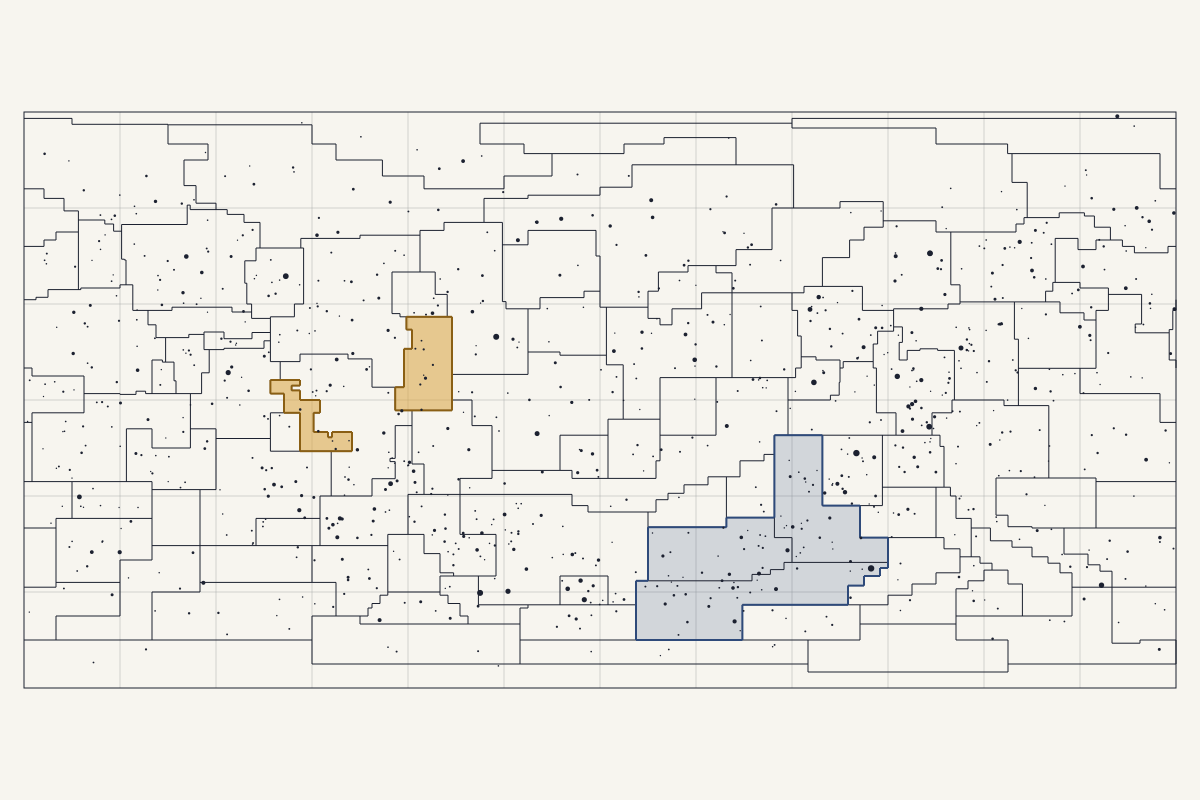
Open the chart full size to zoom in on the detail.
Figure 1. The 88 borders in 1875 coordinates, drawn by this site from the 1930 corner list. Right ascension runs from 24 hours at left to 0 at right, declination from +90° at top to −90° at bottom; grid lines every 2 hours and 30°. Gold: Serpens, the only constellation in two pieces. Blue: Carina, Puppis and Vela, once Argo Navis. Dots: stars to magnitude 4.5.
The sky has borders, and a Belgian astronomer drew them. Before 1922, nothing stopped astronomers from squeezing new figures between old ones; by the nineteenth century, star charts carried more than a hundred between them. That year the International Astronomical Union (IAU) fixed the list at 88 constellations.
Eugène Delporte of the Royal Observatory in Brussels then traced the constellation boundaries along lines of right ascension and declination, the sky's longitude and latitude. The IAU approved his scheme in 1928 and published it in 1930. The list decided which names survived. The borders decided where each one ends.
One more date hides in those borders. They follow the coordinate grid of 1875, and that grid has since slid across the stars.
What did the sky look like before 1922?
Crowded, and fenced with dotted lines. Johann Bode's star atlas Uranographia of 1801 held more than 100 constellations, according to the astronomy writer Ian Ridpath, a member of the IAU's Working Group on Star Names; the IAU notes that new figures were often invented to flatter a patron or a monarch. Over the next century the count thinned. In 1899 the American historian R. H. Allen wrote that "from 80 to 90 constellations may be considered as now more or less acknowledged," as Ridpath quotes him.
The borders were looser still. Chart-makers drew freehand lines snaking between the figures, and the lines changed from atlas to atlas, so a faint star could sit in different constellations on different maps. Some bright stars had two homes. Ptolemy's catalogue placed the star now called Alpha Andromedae both at Andromeda's head and at the navel of Pegasus, and Beta Tauri doubled as the right foot of Auriga, the charioteer.
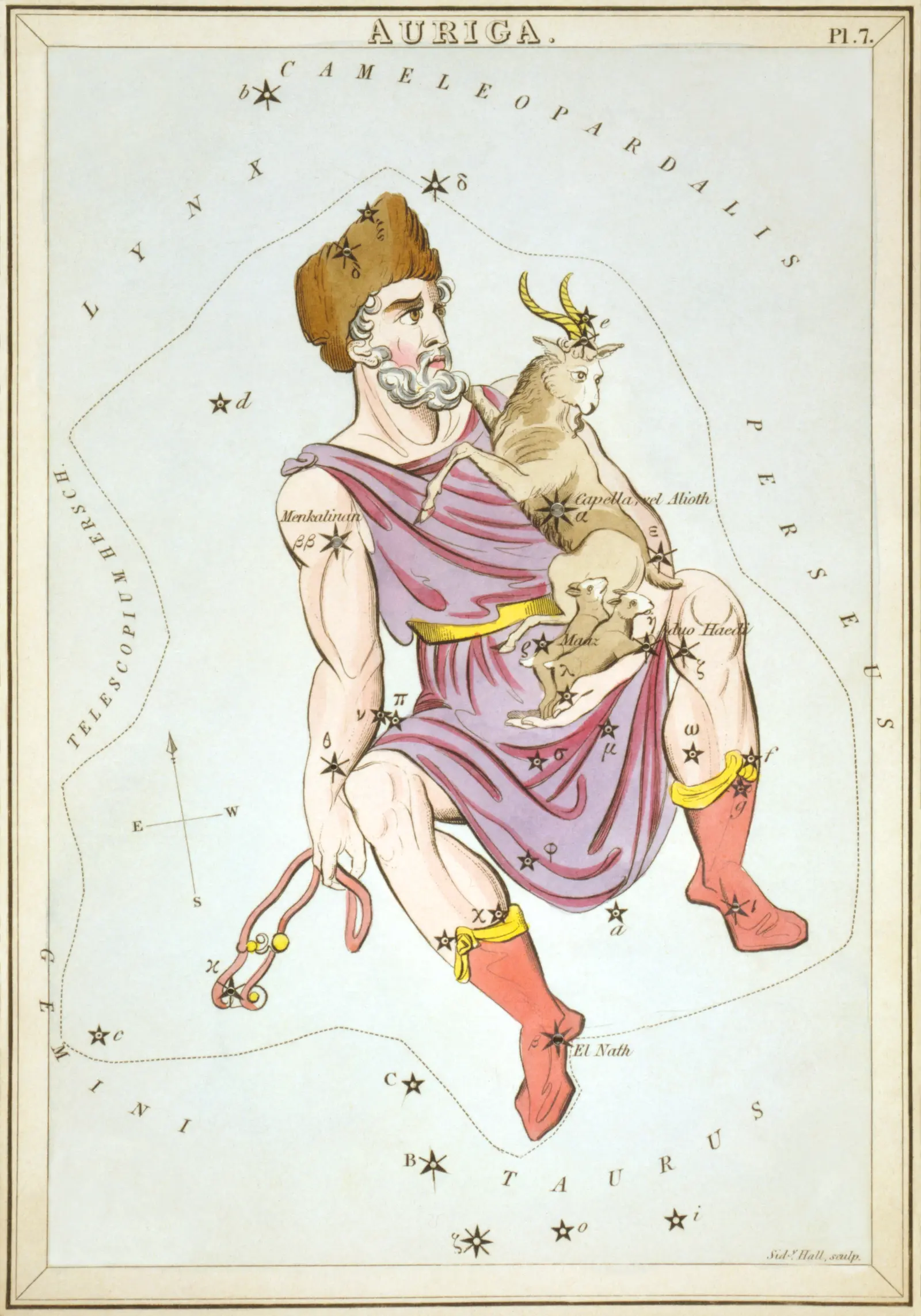

Figure 2. Auriga, plate 7 of Urania's Mirror, a boxed set of constellation cards first published in 1824 and engraved by Sidney Hall; this London copy is dated 1825. The dotted line is the card's own freehand border. The star labeled El Nath at the charioteer's foot was shared with Taurus before the official borders and now belongs to Taurus alone.
How did the IAU choose 88 constellations?
It appears to have adopted a list already in use. At the IAU's first General Assembly, held in Rome in May 1922, its commission on notations agreed on 88 constellations covering the whole sky, each with a three-letter abbreviation of its Latin name. In the October 1922 issue of Popular Astronomy, Henry Norris Russell described how his trial list of abbreviations was passed around on the voyage to Europe and at after-dinner meetings in Rome. A large majority of the committee favored three letters.
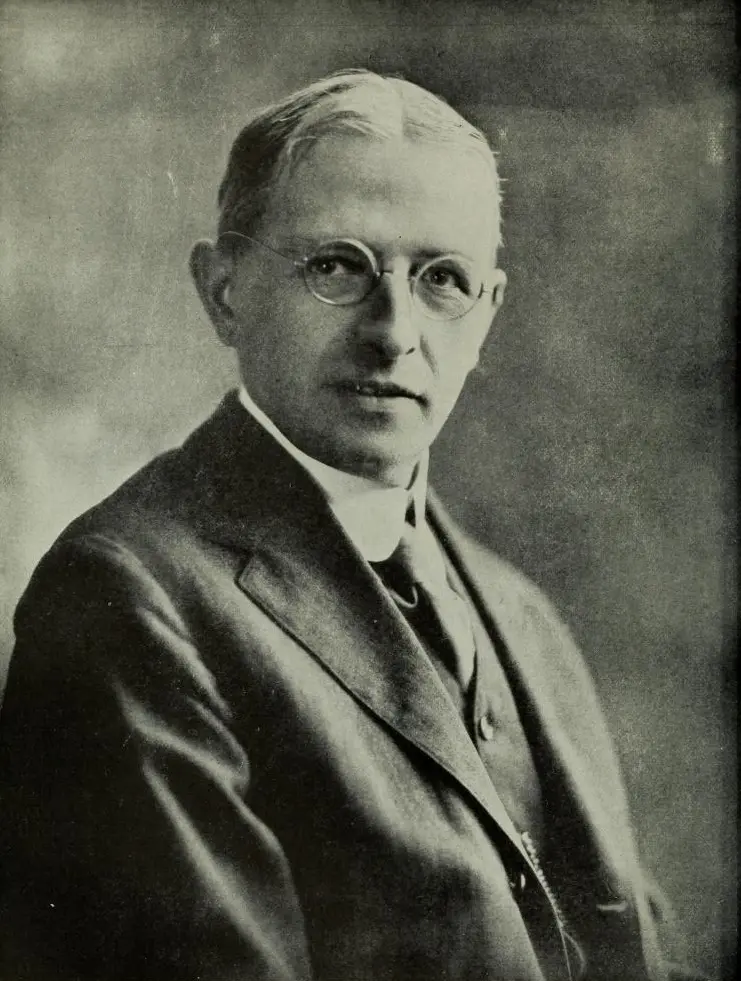

Figure 3. Henry Norris Russell of Princeton University, in a portrait printed in The World's Work in March 1921. In 1922 his trial list of constellation abbreviations was passed around in Rome.
Russell did not explain how he picked the names. Ridpath points out that they match the constellations of the Revised Harvard Photometry, the Harvard star catalogue of 1908 and the standard reference of its day, and concludes that Russell seems simply to have adopted them.
The printed list held one oddity. The version published in the IAU's Transactions contains 89 names, not 88, because the ancient ship Argo appears alongside Carina, Puppis and Vela, the three pieces it had already been cut into. Ridpath calls the inclusion anachronistic. Wikipedia's list of the IAU constellations counts the same 89.
The list settled names, not territory. A constellation still had no edge.
Who drew the constellation boundaries?
Two Belgians proposed them. At the IAU's second General Assembly, in Cambridge, England, in 1925, Delporte presented a paper written with Louis Casteels arguing for official borders. The IAU formed a subcommittee for the northern constellations and gave Delporte the lead; he spent the next two years on it.
One rule shaped the outlines. The IAU required that every known variable star stay in the constellation it had already been assigned, a request Ridpath traces to the IAU's variable-star committee. The result, in the IAU's own words, was "some awkward-looking outlines." Shared stars had to choose a side: Andromeda kept the star at her head, now called Alpheratz, so Pegasus lost its navel; Taurus kept the tip of its horn, El Nath, while Auriga gave up a foot.
Serpens, the snake, is wrapped around Ophiuchus, the serpent bearer, so Delporte cut it into a head on one side of Ophiuchus and a tail on the other. The two pieces still count as one constellation, the only one so divided (gold in Figure 1).
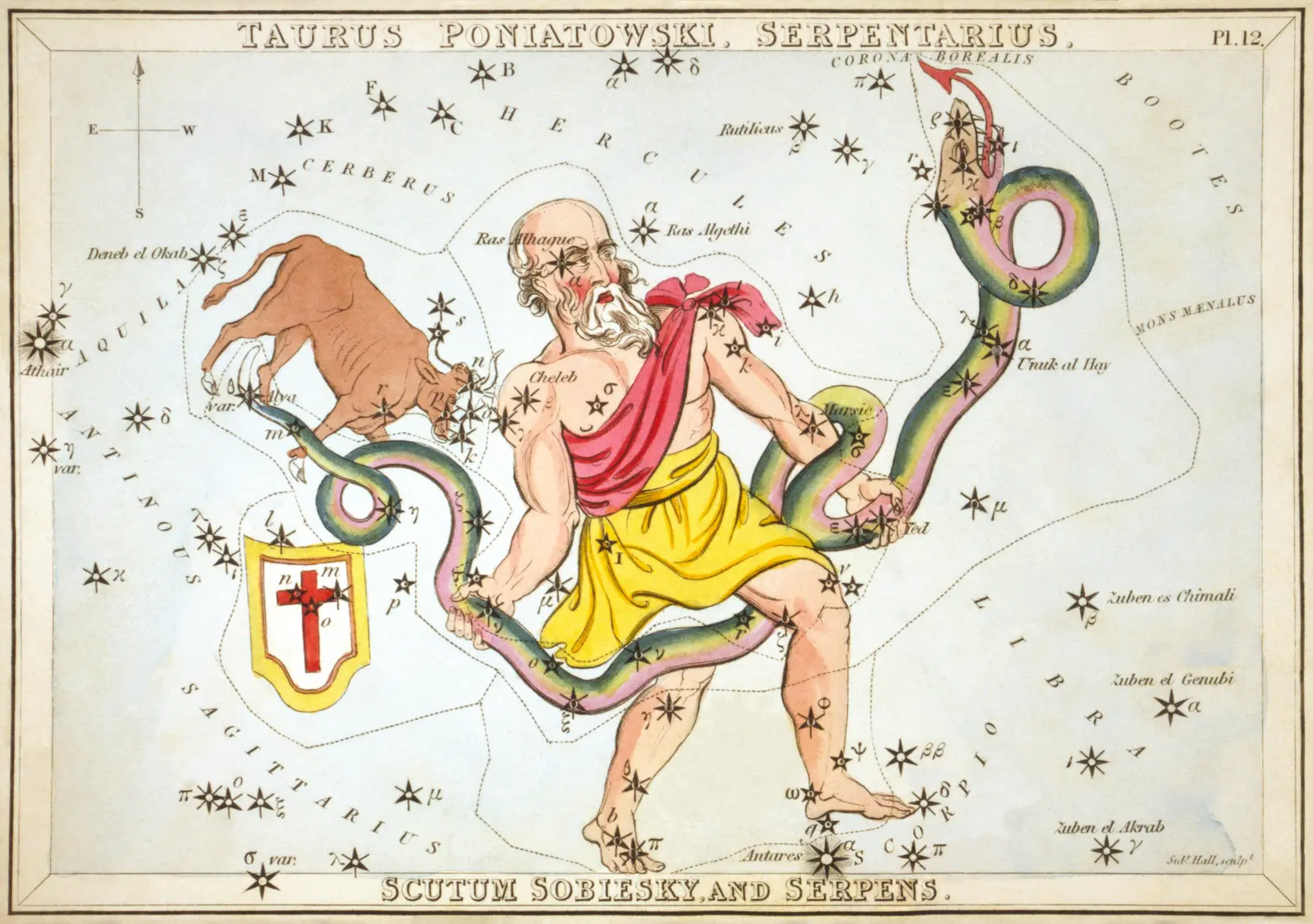

Figure 4. Ophiuchus, labeled Serpentarius, grips Serpens on plate 12 of Urania's Mirror (engraved by Sidney Hall; this copy dated 1825). Delporte's borders split the snake into its head, at right, and its tail, at left.
The 1928 General Assembly in Leiden approved the northern borders and asked Delporte to fit Benjamin Gould's older southern borders into the same scheme, minus Gould's occasional diagonal lines. The finished work appeared in French in 1930: Délimitation scientifique des constellations, published by Cambridge University Press, with a companion volume, Atlas céleste.
From then on, a constellation meant an area of sky. When astronomers say an object is "in" a constellation, the IAU explains, they mean it lies within these borders, not that it belongs to a star pattern. The Big Dipper is an asterism inside Ursa Major's border (Big Dipper: Not a Constellation, and Two of Its Stars Are Strangers), and the Andromeda Galaxy counts as in Andromeda because it falls inside hers (Andromeda Galaxy: Hubble's "VAR!" Was Right, but His Distance Wasn't).
By this page's calculation from the 1875 corner list, the 88 areas total 41,253 square degrees, the whole sphere, and each matches A. E. Levin's 1935 figures as Ridpath tabulates them. Hydra is the largest, at 1,302.8 square degrees; Crux the smallest, at 68.4. End to end, the borders run about 4,550 degrees, more than 12 times around the sky.
Why are the borders fixed to 1875?
Because Benjamin Gould got there first. Gould, an American astronomer who directed Argentina's national observatory at Córdoba, published the Uranometria Argentina atlas in 1877 and its catalogue in 1879. Its southern borders ran along lines of right ascension and declination for 1875, the reference year of his star positions, an idea Ridpath traces to a suggestion by John Herschel some 30 years earlier. Delporte kept Gould's 1875 grid so the two halves of the sky would match.
The borders did not move; the grid did. Earth's axis slowly wobbles, a motion called axial precession (Axial Precession: Earth Usually Has No Bright North Star), and the sky's coordinate grid is tied to that axis, so the grid creeps across the stars. A. C. Davenhall and S. K. Leggett, who digitized the borders in Edinburgh, note that once converted to 2000 coordinates the borders "no longer lie along lines of constant right ascension or declination."
The drift is easiest to see at the north celestial pole. By this page's calculation, the pole has moved about 0.84 degrees across the stars between 1875 and 2026, a bit more than one and a half times the width of the Moon, which spans about half a degree. By the same calculation, Polaris sat 1.36 degrees from the pole in 1875 and sits 0.63 degrees from it now. The border between Ursa Minor and Cepheus, drawn along declination +88° in 1875, now wanders between about +87.5° and +88.8° on today's grid.
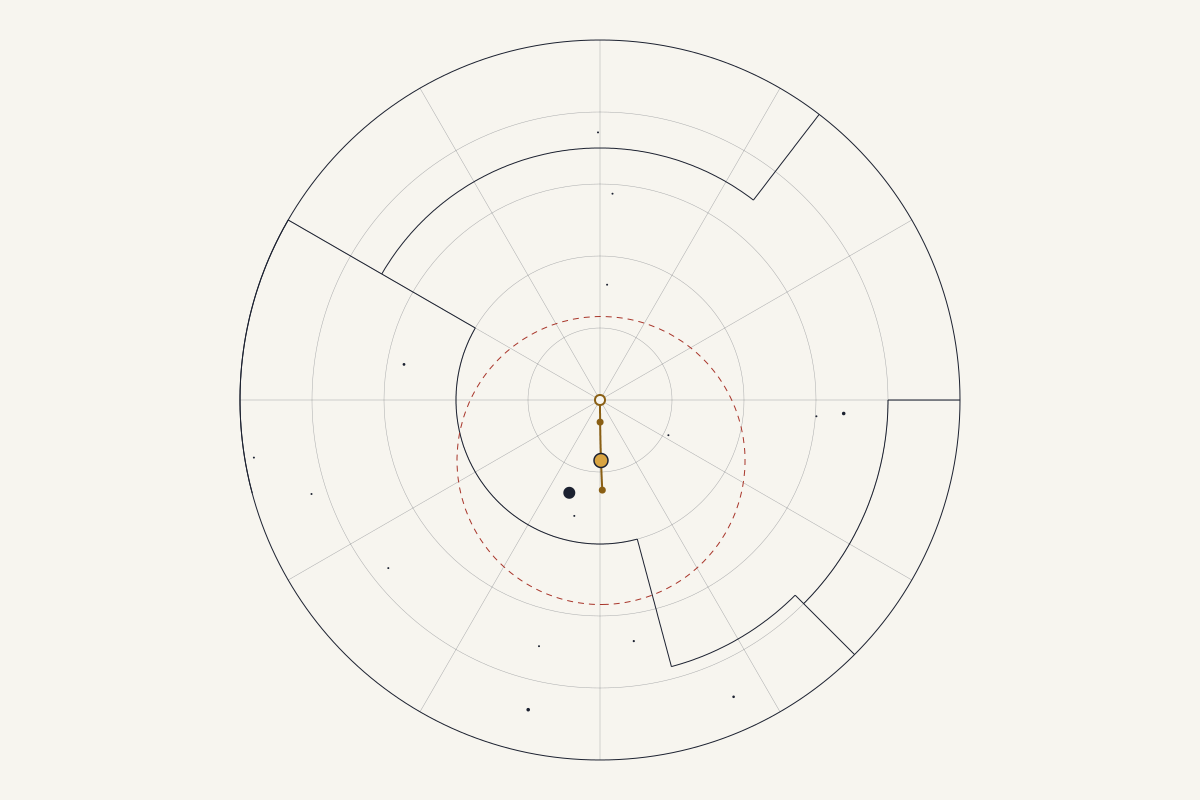
Open the chart full size to zoom in on the detail.
Figure 5. The sky within 5° of the 1875 north celestial pole, in 1875 coordinates, seen facing north: right ascension increases clockwise from 0 hours at the bottom; rings are 1° apart. On a chart centered on the pole, north is the center, not the top. Dark lines: borders. Dark-gold line: the pole's path by this page's calculation (open circle 1875, small dots 1930 and 2100, gold dot 2026). Large black dot: Polaris. Red dashed circle: +88° on the 2026 grid, off-center from the border arc drawn at +88° in 1875.
Think of Delporte's tables as a ledger dated 1875: every corner is entered in that year's coordinates. To file a modern position, you first convert it back to 1875. The lookup table Nancy Roman published in 1987 works this way, and so does this page when it sorts stars into constellations.
Can a star move into another constellation?
Yes, because stars move and the borders do not. Rho Aquilae, a fifth-magnitude star named for Aquila, the eagle, drifts east at about 0.06 arcseconds a year, by this page's calculation from its catalogue motion. That drift carried Rho Aquilae over the line into Delphinus, the dolphin. Its name did not change.
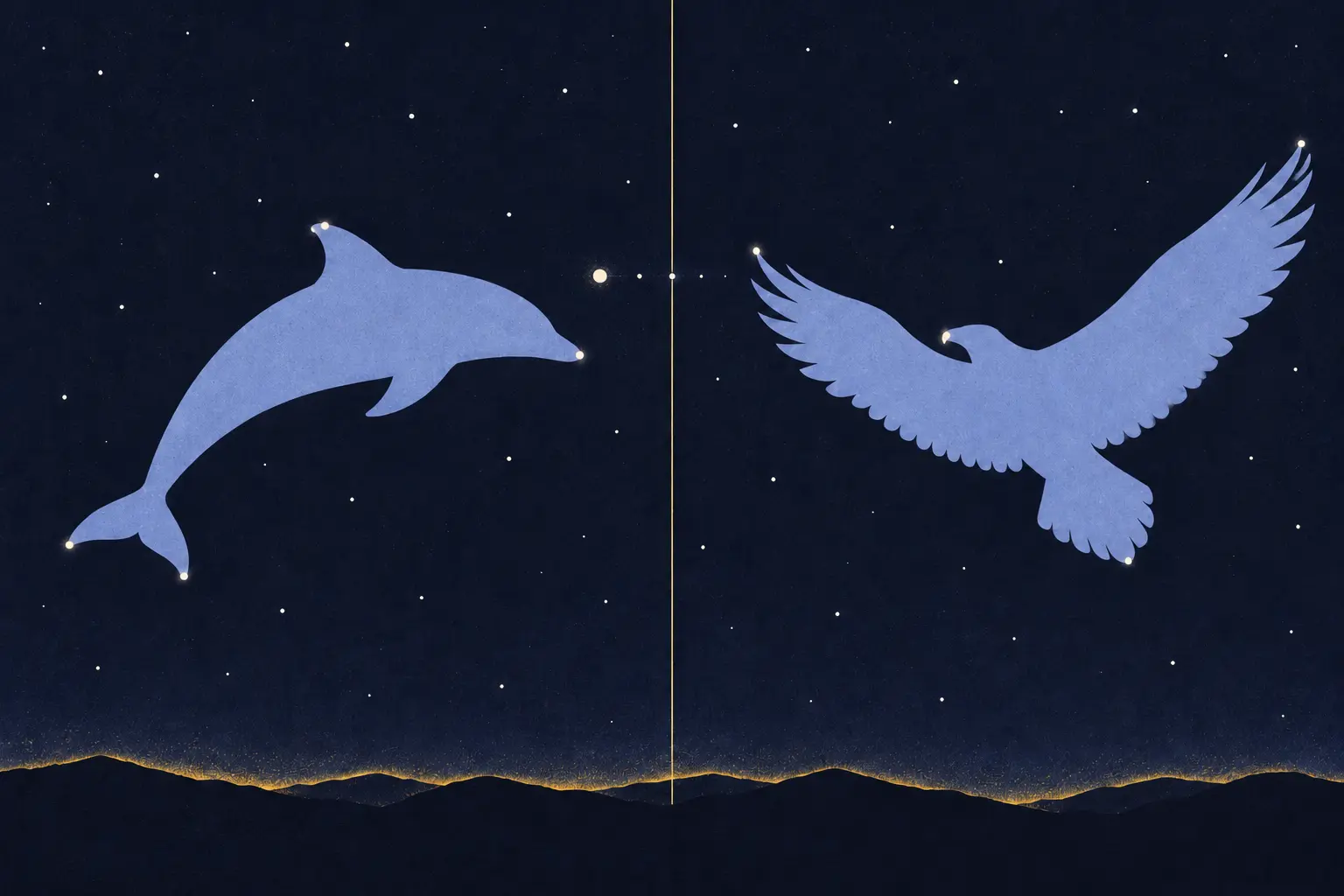
Stars move and the borders do not. Rho Aquilae, named for Aquila, the eagle, drifted over the line into Delphinus, the dolphin, and its name did not change.
The year is disputed. Wikipedia's article gives 1992, citing a 1992 book review in the Journal of the Royal Astronomical Society of Canada and a Patrick Moore book, while Jim Kaler's Stars site gives 1999. By this page's calculation, the crossing came in 1972 with the precession routine Roman published alongside her table, or in 1993 with the IAU's 1976 precession formula. The two formulas place the 1875 border about 1.2 arcseconds apart on the modern J2000 grid, and at 0.06 arcseconds a year that gap is two decades.
Even rounding counts. Round the border to four decimal places of an hour, as Roman's digital table does, and the 1972 date moves to 2003.
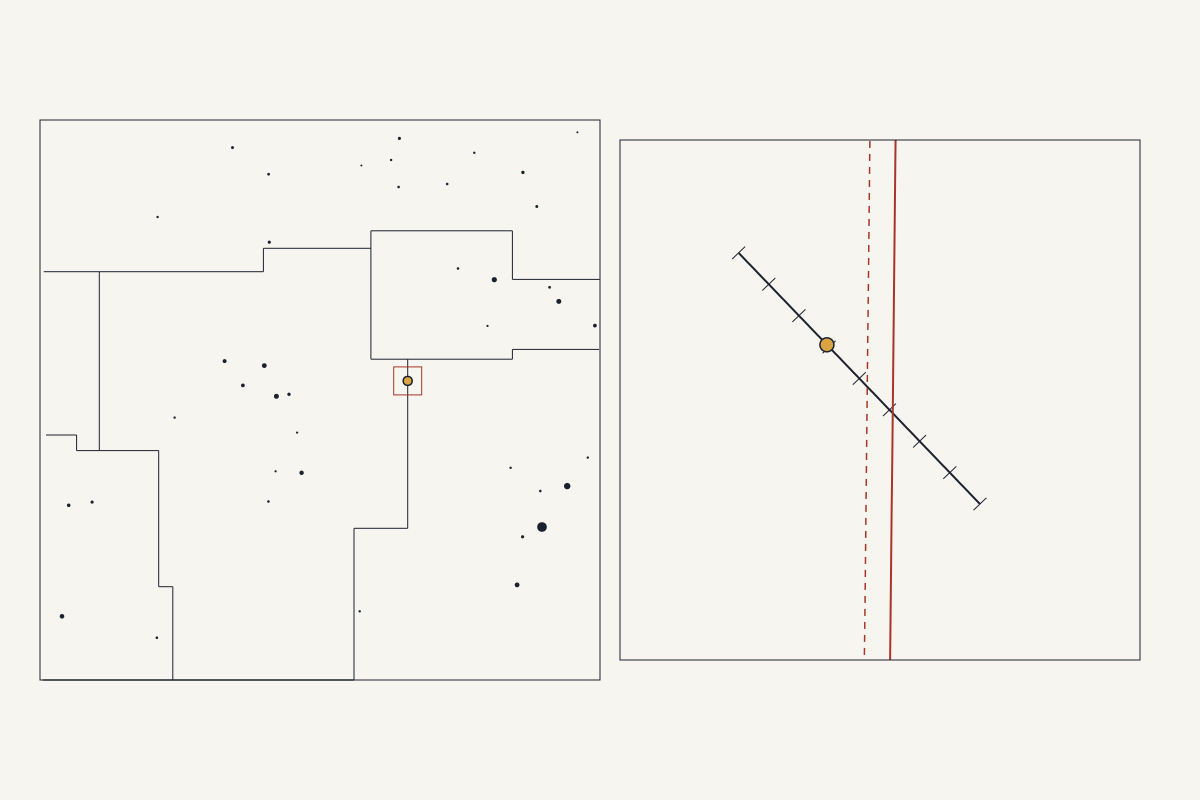
Open the chart full size to zoom in on the detail.
Figure 6. Left: a 24° × 24° field in 1875 coordinates, stars to magnitude 5.5. Altair is the large dot at lower right, the diamond of Delphinus is left of center, and Rho Aquilae (gold, red square) sits on the vertical Aquila–Delphinus border at 20h 08m 30s (1875). Right: a close-up 24 arcseconds across on the J2000 grid. Black: the star's path from 1900 (lower right) to 2100, ticked every 25 years; gold dot: 2026. Red: the border converted by Roman's 1987 routine (solid) and by the IAU 1976 formula (dashed).
Light's departure: the light reaching you from Rho Aquilae tonight left it about 150 years ago by its Hipparcos parallax (2007 reduction) or about 156 years ago by its Gaia parallax (2020), so around the 1870s, the decade of Gould's 1875 grid.
Crossings are rare. This page checked all 8,920 entries of magnitude 6.5 or brighter in the HYG v4.4 catalogue, that catalogue's count for this site's naked-eye budget (Naked-Eye Budget: About 8,400 Entries, Never All in One Sky), moving each star in a straight line from 1875 to 3000. Since the borders were published in 1930, Rho Aquilae is the only one to cross, under either formula.
A sixth-magnitude star, HD 20367, slipped from Perseus into Aries just before publication: in 1923 or at the very end of 1929, depending on the formula. Further ahead, Epsilon Indi, about 12 light-years away, reaches Tucana around 2630.
CSV download: all 10 crossings from 1875 to 3000, with both crossing years (CC BY-SA 4.0) (Data: HYG Database v4.4 by David Nash (astronexus), CC BY-SA 4.0, https://codeberg.org/astronexus/hyg; Constellation lookup table: N. G. Roman (1987), CDS/VizieR catalogue VI/42, https://cdsarc.cds.unistra.fr/ftp/VI/42/; Constellation boundaries: E. Delporte (1930), digitized by A. C. Davenhall and S. K. Leggett (1989), CDS/VizieR catalogue VI/49, https://cdsarc.cds.unistra.fr/ftp/VI/49/), with its provenance note (JSON)
Constellations left out of the 88
What was Quadrans Muralis?
Quadrans Muralis honored a wall-mounted quadrant. Joseph Jérôme de Lalande introduced it in 1795 for the instrument he and his nephew used to measure star positions in Paris. It first appeared as Le Mural in that year's edition of Jean-Baptiste Fortin's Atlas céleste, and Johann Bode latinized the name in 1801. It sat in what is now northern Boötes, near the end of the Big Dipper's handle.
The figure died, but its name lives on. Astronomers recognized a January meteor shower radiating from the area in the 1830s and called it the Quadrantids, whose radiant now lies in Boötes. The 1922 list omitted Quadrans Muralis. In 2025 the IAU's Working Group on Star Names gave the name Quadrans to 44 Boötis A, the brightest star of Lalande's version, in the lost constellation's memory.
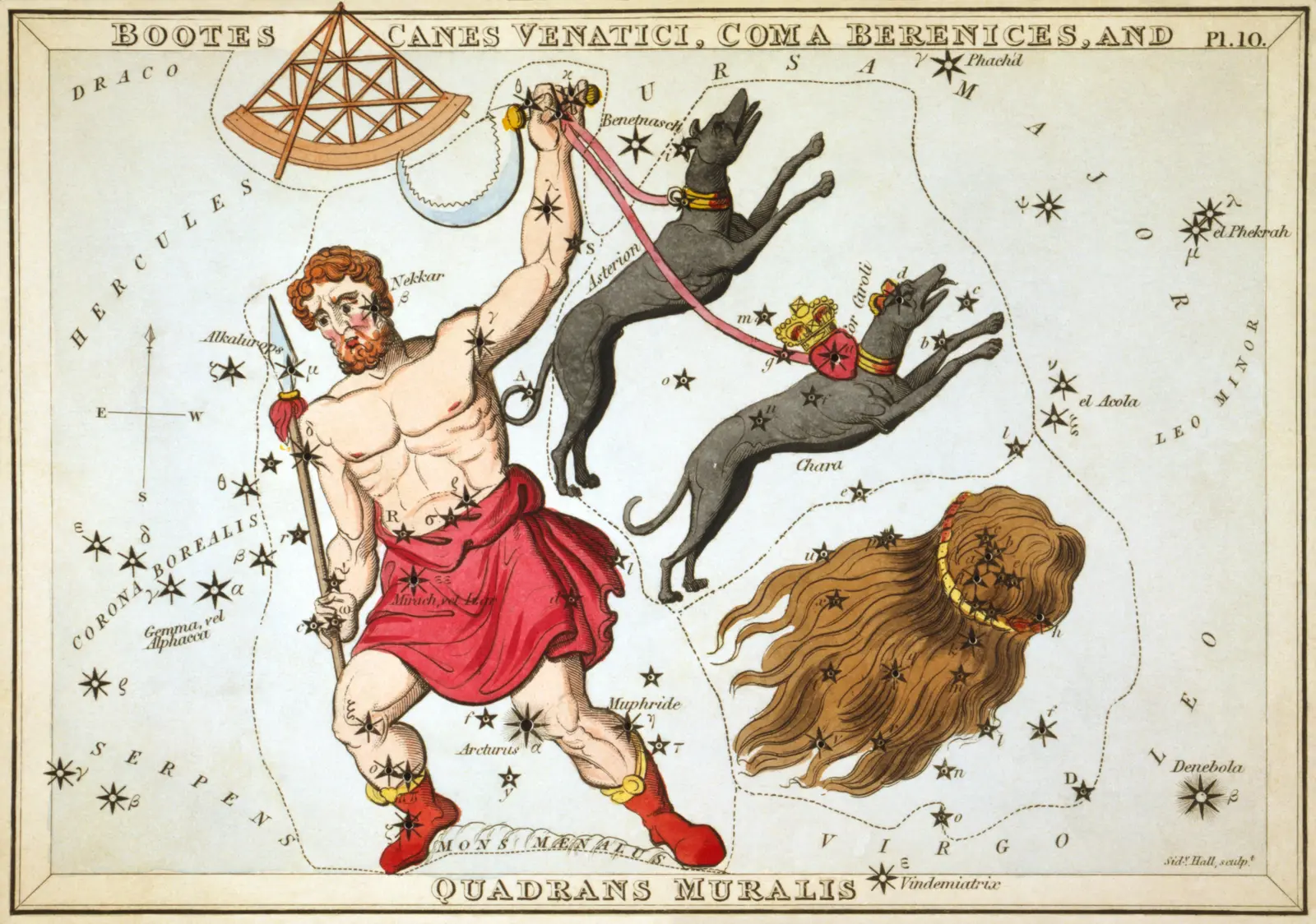

Figure 7. Plate 10 of Urania's Mirror (engraved by Sidney Hall; this copy dated 1825). The quadrant drawn above the raised arm of Boötes is Quadrans Muralis. Under his feet lies Mons Maenalus, another figure absent from the 1922 list.
What happened to Argo Navis?
Argo was taken apart rather than thrown out. Ptolemy listed the ship of Jason and the Argonauts among his 48 constellations. Nicolas Louis de Lacaille, who mapped the southern sky from the Cape of Good Hope, divided it, in his catalogue of southern stars published in 1756, into Carina, the keel; Puppis, the stern; and Vela, the sails.
The ship still shows in its stars' names. Lacaille relettered Argo's stars as if it were one figure, so Alpha and Beta went to Carina's two brightest. Puppis and Vela have neither. Their brightest stars are Zeta Puppis and Gamma Velorum.
Argo also lingered on paper. It is the 89th name on the 1922 list, and Ridpath notes that it stayed on the IAU's own website list of constellations until 2008. Put back together, by this page's calculation from the borders, Carina, Puppis and Vela cover 1,667 square degrees, 28 percent more than Hydra, the largest constellation today.
Constellation boundaries FAQ
Why are there 88 constellations?
Because the IAU adopted a list of that length in Rome in 1922 and has kept it. The names appear to come from the 1908 Revised Harvard Photometry, and the IAU describes them as a mix of the ancient Greek figures recorded by Ptolemy and later additions. The printed list actually ran to 89. The dismantled ship Argo appeared next to its own three pieces.
How many constellations does the Sun pass through?
Thirteen, under the 1930 borders. Through the 2020s and 2030s, by this page's calculation, the Sun sits inside Ophiuchus from November 29 or 30 to December 18 (Universal Time), about 18 days, and inside Scorpius for only about six and a half. Daylight hides those background stars, so the dates come from calculation. Never look at the Sun directly or through binoculars, a telescope or a camera, and ordinary sunglasses are not safe; The American Astronomical Society advises eclipse glasses that meet the ISO 12312-2 standard, or pinhole projection.
Will the constellation borders ever change?
Not on any schedule. The IAU defines a constellation as an area of sky surrounded by its boundary, and Ridpath calls Delporte's work "an international treaty on the demarcation of the sky," a map he judges unlikely to change. The IAU also notes that many cultures keep their own star patterns. The next change this page can foresee is a star's: HR 7914 crosses from Delphinus into Vulpecula around 2081.
Sources
- International Astronomical Union, "The Constellations" (IAU themes page: over a hundred constellations on 19th-century charts, often to flatter a patron or monarch; 1922 Rome list of 88 with three-letter abbreviations; Delporte's 1925 Cambridge proposal; the variable-star requirement and "awkward-looking outlines"; 1928 Leiden approval; 1930 Délimitation scientifique des constellations and Atlas céleste; a constellation as an area of sky; other cultures' own patterns)https://iauarchive.eso.org/public/themes/constellations/Read: full page text
- Ian Ridpath, "Star Tales," Chapter One, page 4 (Bode's Uranographia of 1801 with over 100 constellations; R. H. Allen 1899 quotation; Lacaille at the Cape; Delporte, Gould and the 1875 epoch; "an international treaty on the demarcation of the sky")http://www.ianridpath.com/startales/startales1d.htmlRead: full page text
- Ian Ridpath, "Constellation boundaries: How the modern constellation outlines came to be" (freehand borders; shared stars Alpha Andromedae and Beta Tauri; Delporte and Louis Casteels, 1925; northern subcommittee; variable-star committee request; Serpens split; 1875 epoch; 1928 Leiden; Gould's southern borders modified; 1930 publication in French)http://www.ianridpath.com/boundaries.htmlRead: full page text
- Wikipedia, "Urania's Mirror" (32 constellation cards first published in November 1824; engraved by Sidney Hall; design attributed to Richard Rouse Bloxam)https://en.wikipedia.org/wiki/Urania%27s_MirrorRead: article text
- Ian Ridpath, "The IAU list of the 88 constellations and their abbreviations" (Rome, May 1922; Transactions of the IAU vol. 1, p. 158; 89 names including Argo; H. N. Russell in Popular Astronomy, October 1922; names matching the Revised Harvard Photometry of 1908)http://www.ianridpath.com/iaulist1.htmlRead: full page text
- Wikipedia, "IAU designated constellations" (1922 three-letter abbreviations for 89 constellations, the 88 plus Argo; borders adopted 1928, published 1930)https://en.wikipedia.org/wiki/IAU_designated_constellationsRead: article text
- Ian Ridpath, "Star Tales: Benjamin Gould and the Uranometria Argentina" (Córdoba observatory; borders on lines of right ascension and declination for 1875, after an idea of John Herschel some 30 years earlier; atlas 1877, catalogue 1879)http://www.ianridpath.com/startales/gould.htmlRead: full page text
- A. C. Davenhall and S. K. Leggett, "A Catalogue of Constellation Boundary Data" (Royal Observatory Edinburgh, 1989/1990), CDS catalogue VI/49: ReadMe, constell.txt and constbnd.dat (B1875 corners with neighbours, prepared by Bill J. Gray, 2007); "precession ... distorts the boundaries so that they no longer lie along lines of constant right ascension or declination"https://cdsarc.cds.unistra.fr/ftp/VI/49/Read: ReadMe, constell.txt, constbnd.txt and data file
- N. G. Roman, "Identification of a Constellation from a Position," Publications of the Astronomical Society of the Pacific 99, 695 (1987), CDS catalogue VI/42: ReadMe, data.dat and program.c (lookup table in 1875 coordinates; Herget precession routine)https://cdsarc.cds.unistra.fr/ftp/VI/42/Read: ReadMe, program source and data file
- ERFA (derived from the IAU SOFA library), eraPrec76: IAU 1976 precession model (Lieske 1979, A&A 73, 282), source code and noteshttps://github.com/liberfa/erfa/blob/master/src/prec76.cRead: source file
- David Nash (astronexus), HYG Database v4.4, data README and licence (CC BY-SA 4.0)https://codeberg.org/astronexus/hygRead: README, field definitions and catalogue file
- Wikipedia, "Rho Aquilae" (now in Delphinus; crossing in 1992, citing a 1992 Journal of the Royal Astronomical Society of Canada review of Sky Catalogue 2000.0 and Patrick Moore, The Observer's Year; parallax 21.75 mas)https://en.wikipedia.org/wiki/Rho_AquilaeRead: article text and reference list
- Jim Kaler, "Rho Aquilae," Stars (University of Illinois) (proper motion about 55 milliarcseconds a year to the east; crossed into Delphinus in 1999; name unchanged; about 150 light-years)http://stars.astro.illinois.edu/sow/rhoaql.htmlRead: full page text
- SIMBAD Astronomical Database (CDS), "* rho Aql": parallax measurements 20.9054 ± 0.1363 mas (Gaia EDR3, 2020) and 21.75 ± 0.26 mas (Hipparcos new reduction, van Leeuwen 2007)https://simbad.cds.unistra.fr/simbad/sim-id?Ident=rho+AqlRead: object page and parallax measurement table
- Ian Ridpath, "The Constellations 1: Andromeda–Indus" and "The Constellations 2: Lacerta–Vulpecula" (areas calculated by A. E. Levin, 1935; Argo on the IAU website list until 2008)http://www.ianridpath.com/constellations1.htmlRead: full tables on both pages (second page http://www.ianridpath.com/constellations2.html)
- Ian Ridpath, "Star Tales: Quadrans Muralis" (Lalande, 1795; Le Mural in Fortin's Atlas céleste; Bode, 1801; northern Boötes; Quadrantids named in the 1830s; 44 Boötis named Quadrans in 2025)http://www.ianridpath.com/startales/quadrans.htmlRead: full page text
- Wikipedia, "Quadrantids" (peaks in early January; radiant in Boötes)https://en.wikipedia.org/wiki/QuadrantidsRead: article text
- Wikipedia, "Quadrans Muralis" (omitted from the IAU list in 1922; 44 Boötis brightest in Lalande's version)https://en.wikipedia.org/wiki/Quadrans_MuralisRead: article text
- IAU Working Group on Star Names, "IAU-Catalog of Star Names (CSN)" (Quadrans: 44 Boo A, approved 2025-02-17, commemorating Quadrans Muralis and the Quadrantids)https://exopla.net/star-names/modern-iau-star-names/Read: full table
- Ian Ridpath, "Star Tales: Argo Navis" (one of Ptolemy's 48; split by Lacaille into Carina, Puppis and Vela in his 1756 catalogue; single run of Greek letters, so no Alpha or Beta in Puppis or Vela; Zeta Puppis and Gamma Velorum brightest; almost 28% larger than Hydra)http://www.ianridpath.com/startales/argo.htmlRead: full page text
- Wikipedia, "Position of the Sun" (Astronomical Almanac low-precision formulas, about 0.01 degree, 1950–2050)https://en.wikipedia.org/wiki/Position_of_the_SunRead: article text
- American Astronomical Society, Solar Eclipse Task Force, "How to View a Solar Eclipse Safely," Solar Eclipse Across America (looking at the uneclipsed or partially eclipsed Sun is safe only through special-purpose solar filters, such as eclipse glasses or handheld viewers, that conform to the ISO 12312-2 international standard; ordinary sunglasses, even very dark ones, are not safe; never through an unfiltered camera, telescope, binoculars or other optical device; indirect viewing by pinhole projection)https://eclipse.aas.org/eye-safetyRead: full page
- Wikipedia, "Sidereal time" (Earth rotation angle formula, after Urban & Seidelmann 2013)https://en.wikipedia.org/wiki/Sidereal_timeRead: article text
- The World's Work, vol. 41 (Garden City, N.Y.: Doubleday, Page & Company, 1920–21), March 1921 issue, p. 420: portrait plate "Henry Norris Russell, of Princeton University" (no photographer credited); University of Toronto copy, Internet Archive item worldswork41gardhttps://archive.org/details/worldswork41gard/page/420/Read: volume title page, March 1921 contents and the p. 420 plate with its caption (Internet Archive page image)
- Wikimedia Commons, "Sidney Hall - Urania's Mirror - Taurus Poniatowski, Serpentarius, Scutum Sobiesky, and Serpens.jpg" (file record: plate 12 in Urania's Mirror, London, dated 1825; author Sidney Hall; restored by Adam Cuerden; Library of Congress digital ID cph.3g10061)https://commons.wikimedia.org/wiki/File:Sidney_Hall_-_Urania%27s_Mirror_-_Taurus_Poniatowski,_Serpentarius,_Scutum_Sobiesky,_and_Serpens.jpgRead: file page (revision 896945747)
Computed by this site (2026-10-12) from sources 8 to 11, 14, 21 and 23: the 88 areas and total border length, the pole's drift and Polaris's distance from the pole, the +88° border on today's grid, the Rho Aquilae crossing years and rate, the border-crossing list, the Sun's dates for 2020 to 2039, and the Look up next positions. Stars move in straight lines from HYG v4.4 positions and velocities; crossing years carry the catalogue's uncertainties.
Corrections
2026-11-01 — The pole's drift is now compared with the Moon's width without the fact-sheet figure (roughly 1.6 times the Moon's apparent diameter of 1,896 arcseconds → a bit more than one and a half times the width of the Moon, which spans about half a degree); the eclipse-safety advice now cites the American Astronomical Society; sources renumbered, prompted by a recheck.
Look up next:
Rho Aquilae, the star that changed constellations. On mid-October evenings at 40°N (9 p.m. local mean solar time), this page's calculation puts the small diamond of Delphinus about 54 degrees up in the southwest. Rho Aquilae, magnitude 4.9, sits about 6 degrees west of Rotanev, the diamond's corner nearest bright Altair. It needs a fairly dark sky: go with someone, tell a friend where you'll be, carry a red flashlight, and stay off private land and roads. Read on: Orion Constellation: The Winter Hunter Rises Before Dawn in August.
Related entries
- Big Dipper: Not a Constellation, and Two of Its Stars Are Strangers
- Orion Constellation: The Winter Hunter Rises Before Dawn in August
- Naked-Eye Budget: About 8,400 Entries, Never All in One Sky
- Axial Precession: Earth Usually Has No Bright North Star
- Andromeda Galaxy: Hubble's "VAR!" Was Right, but His Distance Wasn't
Cite this page
Asterisms & Astrolabes. “Constellation Boundaries: The 88 Borders Run on an 1875 Grid.” Asterisms & Astrolabes. Published 13 October 2026; last substantive revision 1 November 2026. https://asterismsandastrolabes.com/constellations/constellation-boundaries/. Accessed [the date you read it].