Atlas entry
Big Dipper: Not a Constellation, and Two of Its Stars Are Strangers
TL;DR: The Big Dipper is an asterism, seven bright stars inside the constellation Ursa Major. Its two outer bowl stars point to Polaris, the North Star. Five of the seven travel through space together. The end stars, Dubhe and Alkaid, move differently, so the shape is slowly changing.
In this entry10 sections
Spec card
- Name
- Big Dipper; the Plough (UK and Ireland); Northern Dipper, Beidou (China)Source: Wikipedia, "Big Dipper"; Ian Ridpath, "Star Tales – Ursa Major 2"
- Type
- Asterism, not one of the IAU's 88 constellationsSource: International Astronomical Union, "Constellations"
- Parent constellation
- Ursa Major (UMa, genitive Ursae Majoris), about 1,280 square degrees, third-largestSource: Wikipedia, "Ursa Major"; Ian Ridpath, "Star Tales – Ursa Major"
- Stars
- 7: Dubhe (α), Merak (β), Phecda (γ), Megrez (δ), Alioth (ε), Mizar (ζ), Alkaid (η)Source: Ian Ridpath, "Star Tales – Ursa Major 2"
- Brightest star
- Alioth, magnitude 1.76Source: HYG Database v4.4
- Distance
- About 80 to 123 light-years (Merak nearest, Dubhe farthest)Source: HYG Database v4.4
- Best evening view (40°N)
- Highest above Polaris late April to mid-May, 9 to 10 p.m.; lowest late October to NovemberSource: Calculated by this site from HYG Database v4.4 positions: local mean solar time, flat horizon, no atmospheric refraction
- Visibility
- Never sets north of about 41°N; none of the seven rises south of about 41°SSource: Calculated by this site from HYG Database v4.4 positions: local mean solar time, flat horizon, no atmospheric refraction
- Myth sources
- Homer, Odyssey ("the Great Bear that men call the Wain"); Ovid, Metamorphoses Book II (Callisto)Source: Ian Ridpath, "Star Tales – Ursa Major"
Download this card as CSV (big-dipper-spec-card.csv)Provenance note for this CSV (JSON)
Magnitudes and distances: HYG Database v4.4. Times and latitudes: our calculation, local mean solar time, flat horizon, no atmospheric refraction.
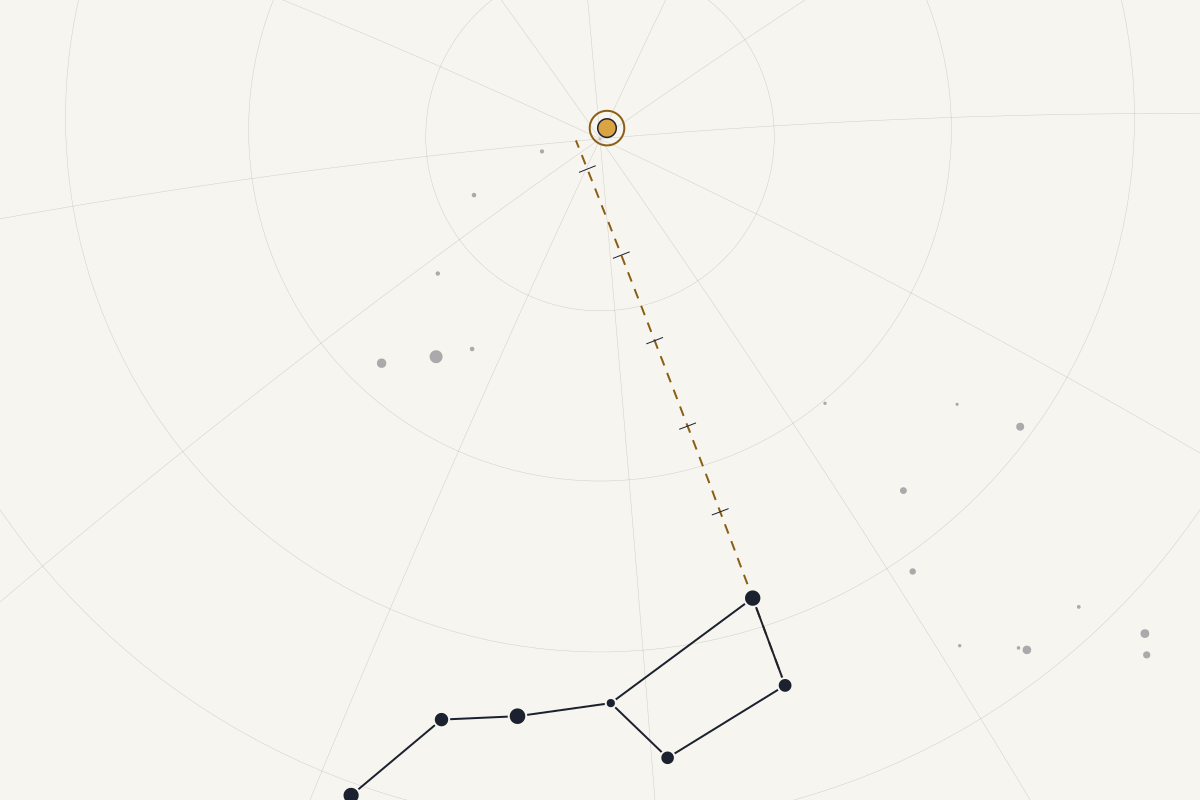
Open the chart full size to zoom in on the detail.
Figure 1. Finder chart computed from HYG v4.4 positions, north up, east left, roughly how the Dipper hangs below Polaris on autumn evenings. Tick marks repeat the Merak to Dubhe gap; Polaris is gold. Line work is this site's own drawing.
Three of the Big Dipper's seven stars outshine the North Star they help you find. The Big Dipper itself is not a constellation. It is an asterism, a star pattern inside the constellation Ursa Major, the Great Bear, made of Dubhe, Merak, Phecda, Megrez, Alioth, Mizar and Alkaid. Draw a line from Merak through Dubhe and carry it about five times their gap to reach Polaris.
Five of the seven stars also travel through space together. The other two do not, so tonight's shape is temporary.
Is the Big Dipper a constellation?
No. The International Astronomical Union (IAU) agreed on a list of 88 constellations in 1922. It approved Eugène Delporte's boundaries in 1928, so today a constellation is an area of sky with official borders.
The IAU lists "the seven bright stars in Ursa Major" as an asterism: a widely recognized pattern that is not one of the 88. Those seven stars form the rump and tail of the bear.
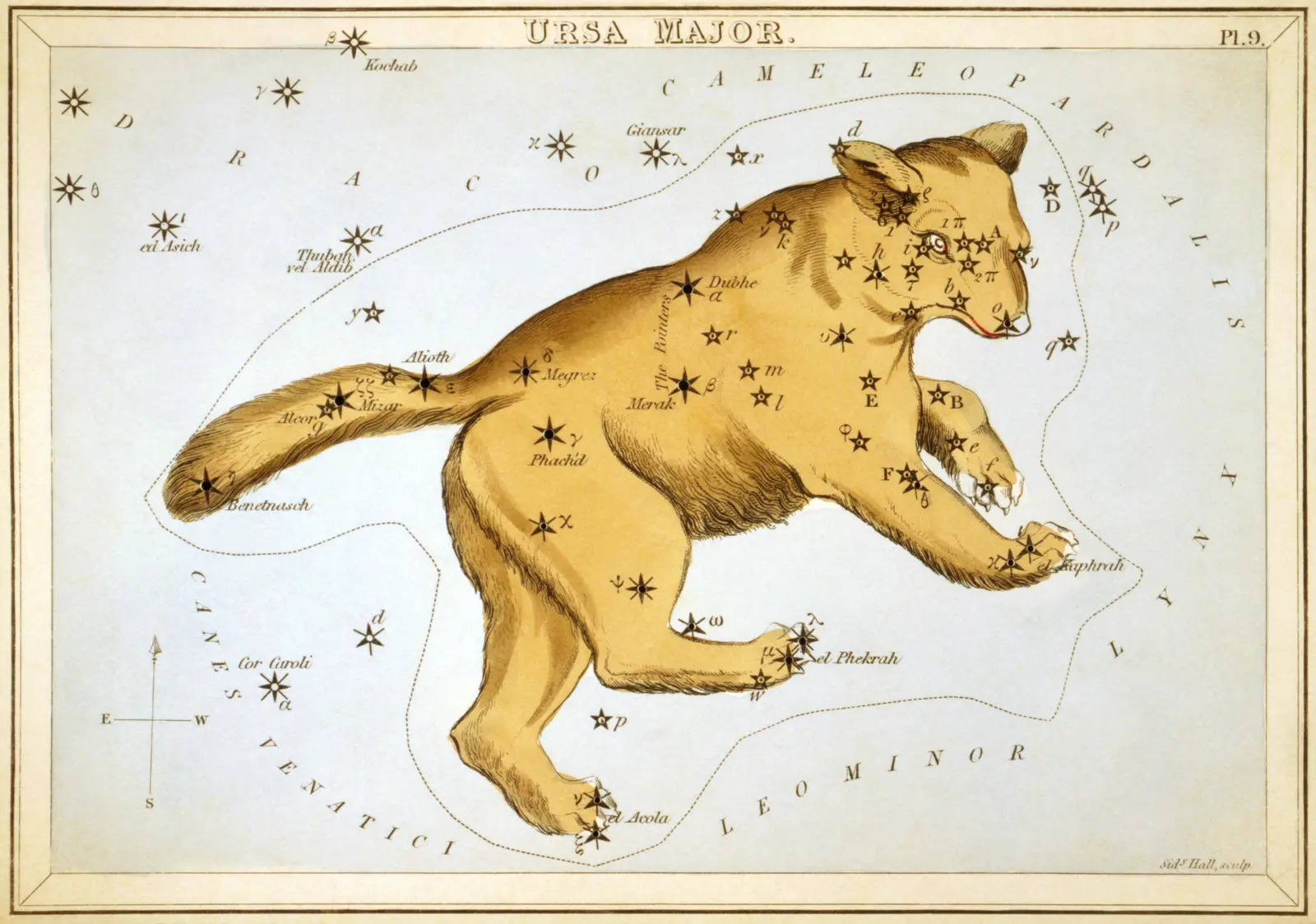

Figure 2. Ursa Major, plate 9 of Urania's Mirror (London, print dated 1825), engraved by Sidney Hall. The Dipper's seven stars, α to η, sit on the bear's body and tail; Alkaid (η) is labeled Benetnasch.
Britain and Ireland call it the Plough. Chinese astronomers knew it as Beidou, the Northern Dipper, and gave each star a name; Dubhe was Tianshu, "celestial pivot." To Latin writers the seven stars were Septentriones, "seven plough oxen," the root of septentrional, an old word for northern.
Arab sky-watchers saw a bier followed by three mourners. All seven of the stars' Western names come from Arabic. Alkaid, from al-qā'id, means "the leader." In Haudenosaunee tradition, the three handle stars are hunters chasing the bear, and in one version faint Alcor is the cooking pot the second hunter carries.
Popular claims, checked
"The Big Dipper is a constellation." The IAU classes it as an asterism inside Ursa Major.
"The North Star is the brightest star in the sky." Polaris, around magnitude 1.98 (lower numbers mean brighter), ranks roughly 47th, and three Dipper stars outshine it.
"'Follow the Drinking Gourd' preserves an Underground Railroad escape map." The Texas Folklore Society first published it in 1928, from collector H. B. Parks. Researcher Joel Bresler found no earlier use of "drinking gourd" as a code for the Dipper in the period newspapers or slave testimonies he searched. The chorus line about "the old man is awaitin'" was written by Lee Hays, about eighty years after the Civil War ended.
How do you use the Big Dipper to find the North Star?
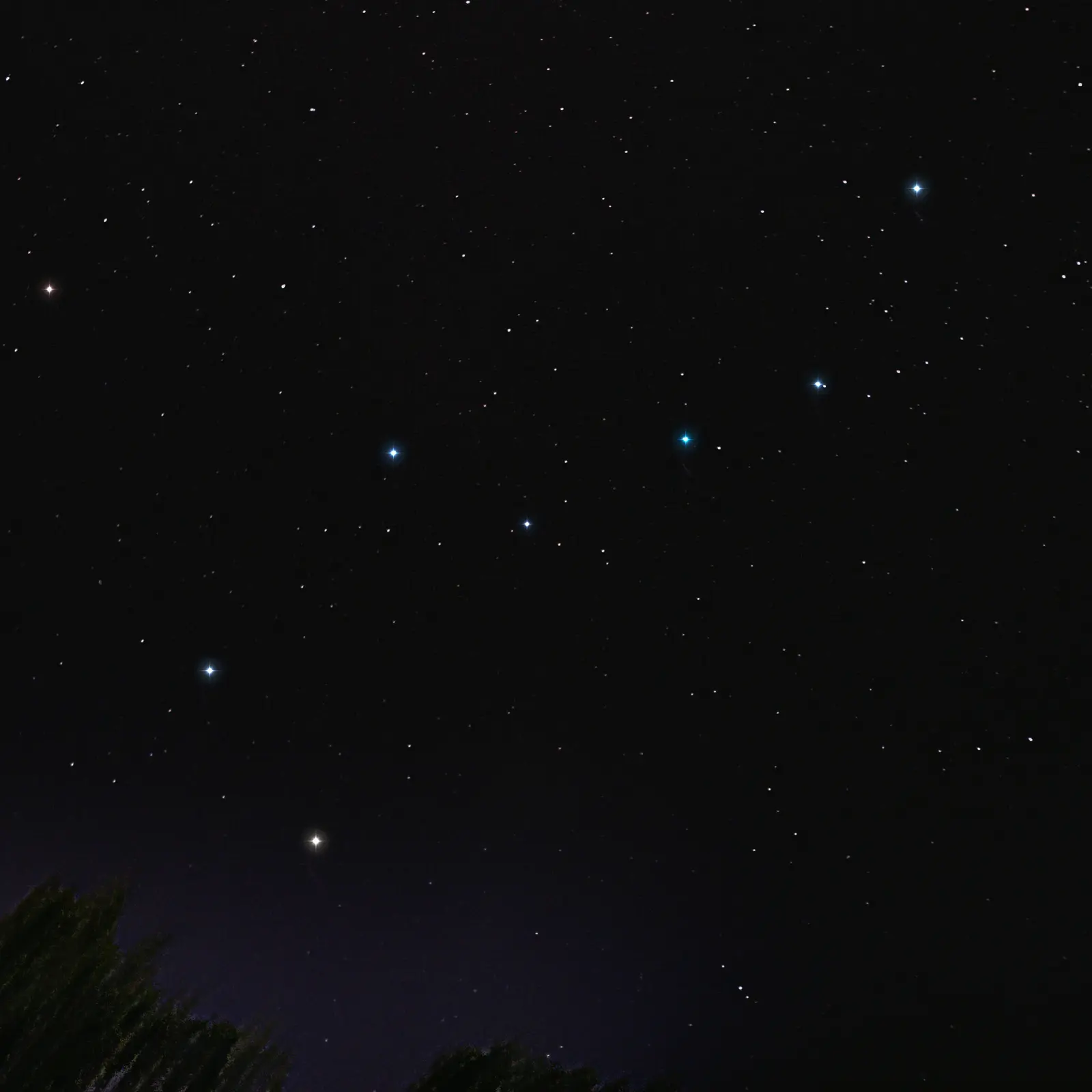

Figure 3. The Big Dipper over treetops in Udupi, India, photographed in May 2021: the bowl at lower left, the handle curving up to the upper right.
- Face north after dark and find seven bright stars in a ladle shape.
- Pick the Pointers, the two stars on the bowl's outer edge: Merak, then Dubhe at the open rim.
- Run a line from Merak through Dubhe, about five times their gap.
- Stop at the first moderately bright star: Polaris, the end of the Little Dipper's handle.
In the HYG star catalogue, Merak and Dubhe sit 5.4 degrees apart, and Polaris lies 28.7 degrees beyond Dubhe, so "five times" is really 5.3. The line misses Polaris by about 2 degrees. That is close enough, because within 12 degrees of the pole no other catalogue star is brighter than magnitude 4. Polaris wins by isolation.
The Dipper wheels around Polaris daily and shifts with the seasons. At 40°N, our calculation puts it highest above Polaris around 10 p.m. in late April and 9 p.m. in mid-May (local mean solar time, not clock time). At those hours in late October and November it skims the northern horizon. When the Dipper is low, Cassiopeia rides high on the opposite side of Polaris.
Megrez, magnitude 3.3, is the faintest of the seven and the first to fade in a bright sky. If you travel somewhere darker, go with someone, tell a friend where you'll be, carry a red flashlight, and stay off roads and away from drop-offs.
Which Big Dipper stars travel together?
Merak, Phecda, Megrez, Alioth and Mizar, five of the seven, belong to the core of the Ursa Major moving group. The group's members share a common motion and a common birth. Dubhe and Alkaid are not members. A 2015 study led by Jeremy Jones measured group stars with the CHARA Array interferometer and put the group's age at 414 ± 23 million years.
That makes the Dipper unusual, because most constellations and asterisms are not physical groups. Its seven stars are seven entries in the naked-eye budget, this site's name for the roughly 8,400 catalogue entries of magnitude 6.5 or brighter across the whole sky (Naked-Eye Budget: About 8,400 Entries, Never All in One Sky). Only part of that total is above your horizon at any moment. Five of these seven entries share one origin.
| Star | Bayer | Magnitude | Distance (ly) | Moving group core | Speed vs. core average (km/s) |
|---|---|---|---|---|---|
| Dubhe | α | 1.81 | 122.9 | No | 36.6 |
| Merak | β | 2.34 | 79.7 | Yes | 1.1 |
| Phecda | γ | 2.41 | 83.2 | Yes | 1.7 |
| Megrez | δ | 3.32 | 80.5 | Yes | 2.7 |
| Alioth | ε | 1.76 | 82.6 | Yes | 0.7 |
| Mizar | ζ | 2.23 | 85.8 | Yes | 3.0 |
| Alkaid | η | 1.85 | 103.9 | No | 33.2 |
Table data: HYG v4.4. Speeds are three-dimensional, relative to the average velocity of the five core stars, computed from HYG's velocity components; they carry the catalogue's radial-velocity uncertainties.
CSV download (CC BY-SA 4.0) (Data: HYG Database v4.4 by David Nash (astronexus), CC BY-SA 4.0, https://codeberg.org/astronexus/hyg), with its provenance note (JSON)
The five core stars stay within about 3 km/s of their shared average. Dubhe and Alkaid move about 33 to 37 km/s relative to that average, more than ten times faster. Across the sky, the five creep east. Dubhe and Alkaid creep west.
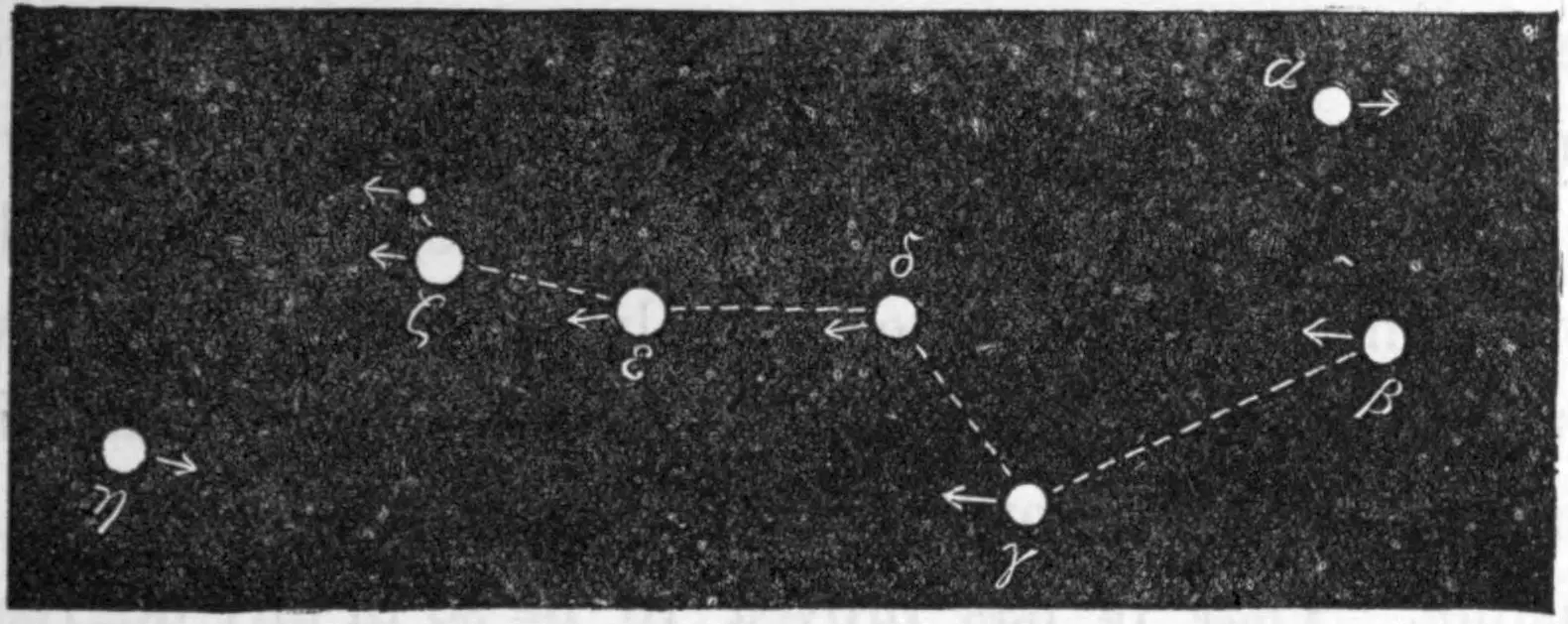

Figure 4. "The Great Bear as it is," from Robert Stawell Ball's In the High Heavens (London, 1910). Arrows on the five middle stars point east; those on Dubhe (α) and Alkaid (η) point west.
Light's departure: the light reaching you from Merak tonight left it about 80 years ago; Dubhe's left about 123 years ago (Light-Year: Its Year Runs 11 Minutes Longer Than the Seasons). Wikipedia's star table gives 79 and 124 light-years, so allow a year or two.
Big Dipper FAQ
Can you see the Big Dipper from the Southern Hemisphere?
Partly, and always in the northern sky. Ignoring atmospheric refraction, Dubhe never rises south of about 28°S, and none of the seven rises south of about 41°S. Closer to the equator, the whole pattern clears the northern horizon on April and May evenings, lower the farther south you go: by our calculation, Dubhe peaks about 18 degrees up at 10°S and 3 degrees at 25°S.
What is the brightest star in the Big Dipper?
Alioth, at magnitude 1.76 in the HYG catalogue. It is the handle star next to the bowl. Its Bayer letter is epsilon because Johann Bayer lettered the seven stars alpha to eta in order of right ascension, the sky's longitude, in 1603, without regard for brightness. Dubhe (alpha, 1.81) and Alkaid (eta, 1.85) follow closely, and all three outshine Polaris.
What will the Big Dipper look like in 100,000 years?
Think of the HYG catalogue as a ledger with a velocity column: carry each star's entry forward, and the Dipper's future shape falls out. We moved every star in a straight line from its catalogued position and velocity, then redrew the pattern 100,000 years back and forward.
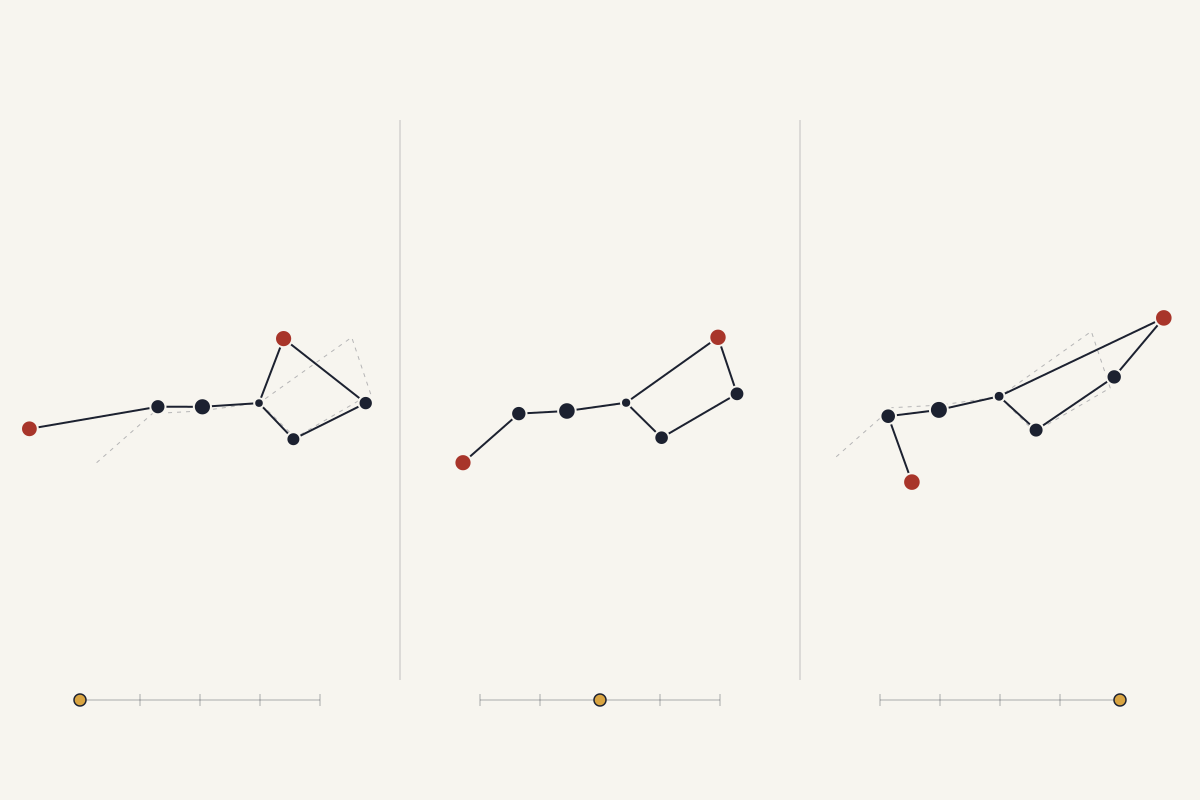
Open the chart full size to zoom in on the detail.
Figure 5. Left to right: 100,000 years ago, today, 100,000 years from now (gold dot marks the epoch). Each panel is aligned on the five core stars (dark), with today's shape dashed; Dubhe and Alkaid are red. North up, east left.
| Measure | 100,000 years ago | Today | In 100,000 years |
|---|---|---|---|
| Handle angle at Mizar (Alioth–Mizar–Alkaid) | 170° | 142° | 78° |
| Pointer gap (Merak–Dubhe) | 9.4° | 5.4° | 6.9° |
| Top edge of bowl (Megrez–Dubhe) | 6.3° | 10.2° | 16.5° |
The middle five change their spacing little. Nearly all the distortion comes from the two outsiders. Alkaid swings back under Mizar, and Dubhe pulls away from Megrez, stretching the bowl.
The chart is a sketch. It ignores the curve of each star's orbit around the galaxy and inherits the catalogue's measurement errors. It uses a fixed coordinate frame, so Earth's slow axial wobble plays no part in the change.
Polaris holds its post on a shorter lease than the Dipper holds its shape: Earth's axis wobbles through a cycle of about 25,770 years, and the pole drifts away from Polaris after their closest approach around 2100 (Axial Precession: Earth Usually Has No Bright North Star).
Sources
- International Astronomical Union, "Constellations" (IAU themes page: 88 constellations, 1922 list, 1928 boundary approval, 1930 publication, asterisms including the seven bright stars in Ursa Major)https://iauarchive.eso.org/public/themes/constellations/
- Ian Ridpath, "Star Tales – Ursa Major" (size ranking, Homer's Wain, Septentrio, Callisto in Ovid)http://www.ianridpath.com/startales/ursamajor.html
- Ian Ridpath, "Star Tales – Ursa Major 2" (Bayer lettering by right ascension; Arabic star names and the bier; Chinese Beidou star names)http://www.ianridpath.com/startales/ursamajor2.html
- David Nash (astronexus), HYG Database v4.4, data README and licence (CC BY-SA 4.0)https://codeberg.org/astronexus/hyg
- D. Hoffleit and W. H. Warren Jr., Bright Star Catalogue, 5th Revised Ed. (CDS V/50), ReadMe and catalogue filehttps://cdsarc.cds.unistra.fr/viz-bin/ReadMe/V/50
- J. Jones et al., "The Ages of A-Stars I: Interferometric Observations and Age Estimates for Stars in the Ursa Major Moving Group," arXiv:1508.05643 (2015)https://arxiv.org/abs/1508.05643
- Wikipedia, "Ursa Major moving group" (core members; Dubhe and Alkaid not members)https://en.wikipedia.org/wiki/Ursa_Major_moving_group
- Wikipedia, "Big Dipper" (the Plough in the UK and Ireland; Pointers; Polaris at the tip of the Little Dipper's handle; septentriones and septentrional; star distance table)https://en.wikipedia.org/wiki/Big_Dipper
- Wikipedia, "Ursa Major" (1,279.7 square degrees; Haudenosaunee hunters and, in one version, Alcor as the pot)https://en.wikipedia.org/wiki/Ursa_Major
- Wikipedia, "Polaris" (magnitude about 1.98; roughly 47th brightest; closest to the pole around 2100)https://en.wikipedia.org/wiki/Polaris
- ERFA (Essential Routines for Fundamental Astronomy, derived from IAU SOFA), source file p06e.c: IAU 2006 precession angles from Capitaine, Wallace and Chapront (2003, A&A 412, 567), with general precession in longitude of 5,028.796195 arcseconds per Julian century at J2000; BSD-3-Clausehttps://github.com/liberfa/erfa/blob/master/src/p06e.cRead: full source file
- Joel Bresler, "Follow the Drinking Gourd: A Cultural History" (Introduction; Collection Story, http://www.followthedrinkinggourd.org/Collection_Story.htm)http://www.followthedrinkinggourd.org/
- Wikimedia Commons, "Sidney Hall - Urania's Mirror - Ursa Major.jpg" (file record: "Ursa Major," plate 9 in Urania's Mirror, London, dated 1825; author Sidney Hall; restored by Adam Cuerden; from Library of Congress print cph.3g10076)https://commons.wikimedia.org/wiki/File:Sidney_Hall_-_Urania%27s_Mirror_-_Ursa_Major.jpgRead: file page (revision 896945476)
- Robert Stawell Ball, In the High Heavens (London: Pitman, 1910), figure 26, "The Great Bear as it is," and pp. 172-173 on the movements of the Great Bear's stars (Wikimedia Commons file page; Internet Archive record inhighheavens00ballrich)https://commons.wikimedia.org/wiki/File:In_the_High_Heavens_-_Ball_(1910)_-_Figure_26.jpgRead: the figure, its Commons file page, the Internet Archive catalogue record and pp. 172-173
Computed by this site (2026-10-07) from sources 4 and 5: Pointer gap and Polaris distance, the 2° miss, brightness order, the 8,404 entries at magnitude 6.5 or brighter in BSC5, circumpolar and rising limits, peak altitudes south of the equator, seasonal transit dates at 40°N, relative speeds, and the 100,000-year positions.
Look up next:
Cassiopeia, the W on the far side of Polaris. On mid-October evenings at 40°N (9 p.m. local mean time), our calculation puts its star Schedar about 64 degrees up in the northeast, while the Dipper's stars sit 5 to 12 degrees above the northern horizon.
Related entries
- Constellation Boundaries: The 88 Borders Run on an 1875 Grid
- Orion Constellation: The Winter Hunter Rises Before Dawn in August
- Naked-Eye Budget: About 8,400 Entries, Never All in One Sky
- Axial Precession: Earth Usually Has No Bright North Star
- Light-Year: Its Year Runs 11 Minutes Longer Than the Seasons
- Bortle Scale: A City Sky Tops Out Near 250 Stars
Cite this page
Asterisms & Astrolabes. “Big Dipper: Not a Constellation, and Two of Its Stars Are Strangers.” Asterisms & Astrolabes. Published 13 October 2026; last substantive revision 13 October 2026. https://asterismsandastrolabes.com/constellations/big-dipper/. Accessed [the date you read it].