Atlas entry
Axial Precession: Earth Usually Has No Bright North Star
TL;DR: Axial precession swings Earth's axis around a loop of sky about once every 25,770 years, so the North Star changes. By this page's calculation, a star of magnitude 3 or brighter (lower numbers are brighter) sits within 5 degrees of the pole for only about a fifth of the cycle, and within 1 degree only during Polaris's run, roughly 1940 to 2250.
In this entry9 sections
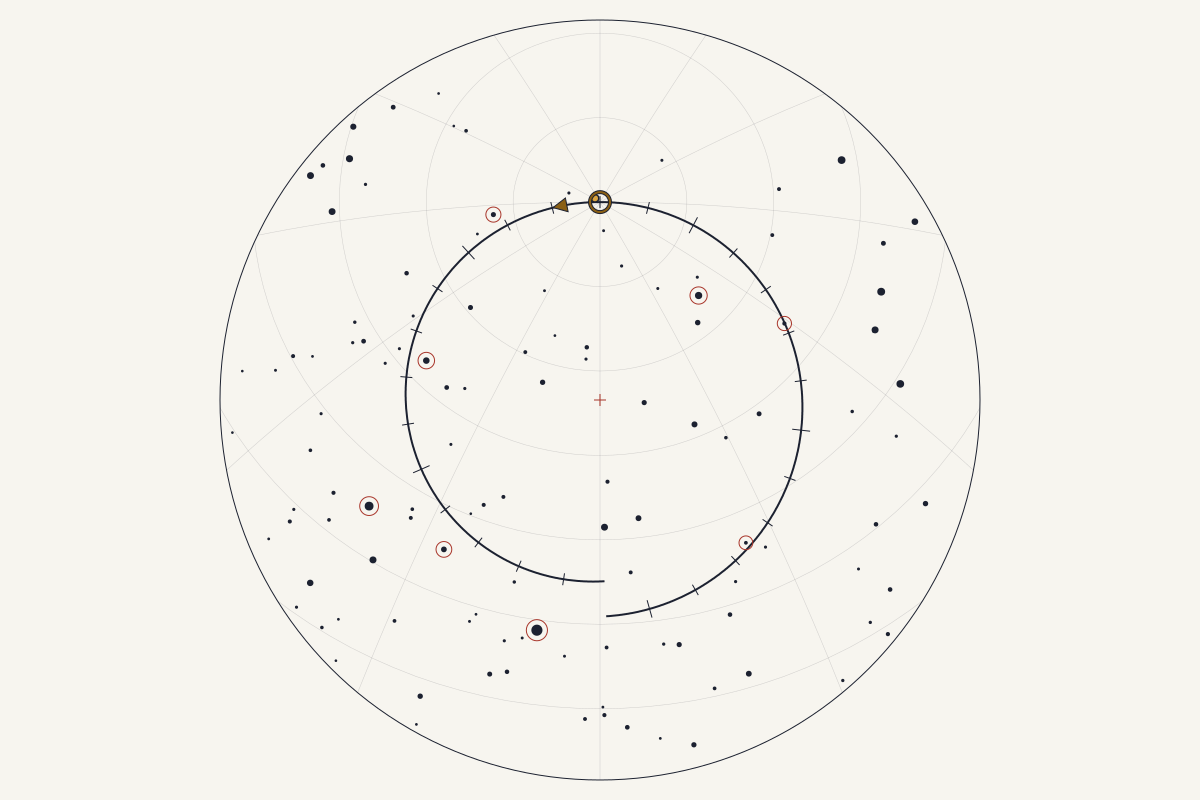
Open the chart full size to zoom in on the detail.
Figure 1. The north celestial pole's path over 25,771.5 years centred on 2000, computed with the 2011 long-term precession formulas of Vondrák, Capitaine and Wallace, around the pole of Earth's orbit (red cross); north up, east left. Ticks every 1,000 years; the arrow shows the direction; the ring at top marks 2000, with Polaris (gold) inside. Red rings, clockwise: Kochab inside the loop at 1:30, Thuban on it at 2, tau Herculis at 4:30, Vega, delta Cygni and Deneb outside it at 6:30, 7:30 and 8, Alderamin at 9:30, Errai at 11. Stars to magnitude 4.5, at 2000 positions.
Polaris marks north only because Earth's axis happens to point near it now. Axial precession, the slow turning of that axis, carries the north celestial pole, the point the sky seems to spin around, through the northern stars. One lap takes about 25,770 years.
Most of that loop is dark. This page followed the pole through one cycle centred on 2000, about 10,900 BC to AD 14,900, in 10-year steps, with HYG catalogue star positions and motions. A star of magnitude 3.0 or brighter lies within 5 degrees of the pole for about 19% of the cycle; even a 7-degree circle catches one only about 39% of the time. Within 1 degree, where Polaris sits now, the share is about 1.2%: roughly 300 years, all of them Polaris's.
What is axial precession?
Earth's axis tilts about 23.4 degrees from the pole of its orbit. The tilt holds nearly steady while the axis sweeps a cone, so the celestial pole circles about 23.4 degrees from the orbit's pole. Wikipedia puts the current rate at about 50.3 arcseconds a year (3,600 arcseconds make a degree), or 1 degree every 71.6 years, measured along the ecliptic, the Sun's yearly path.
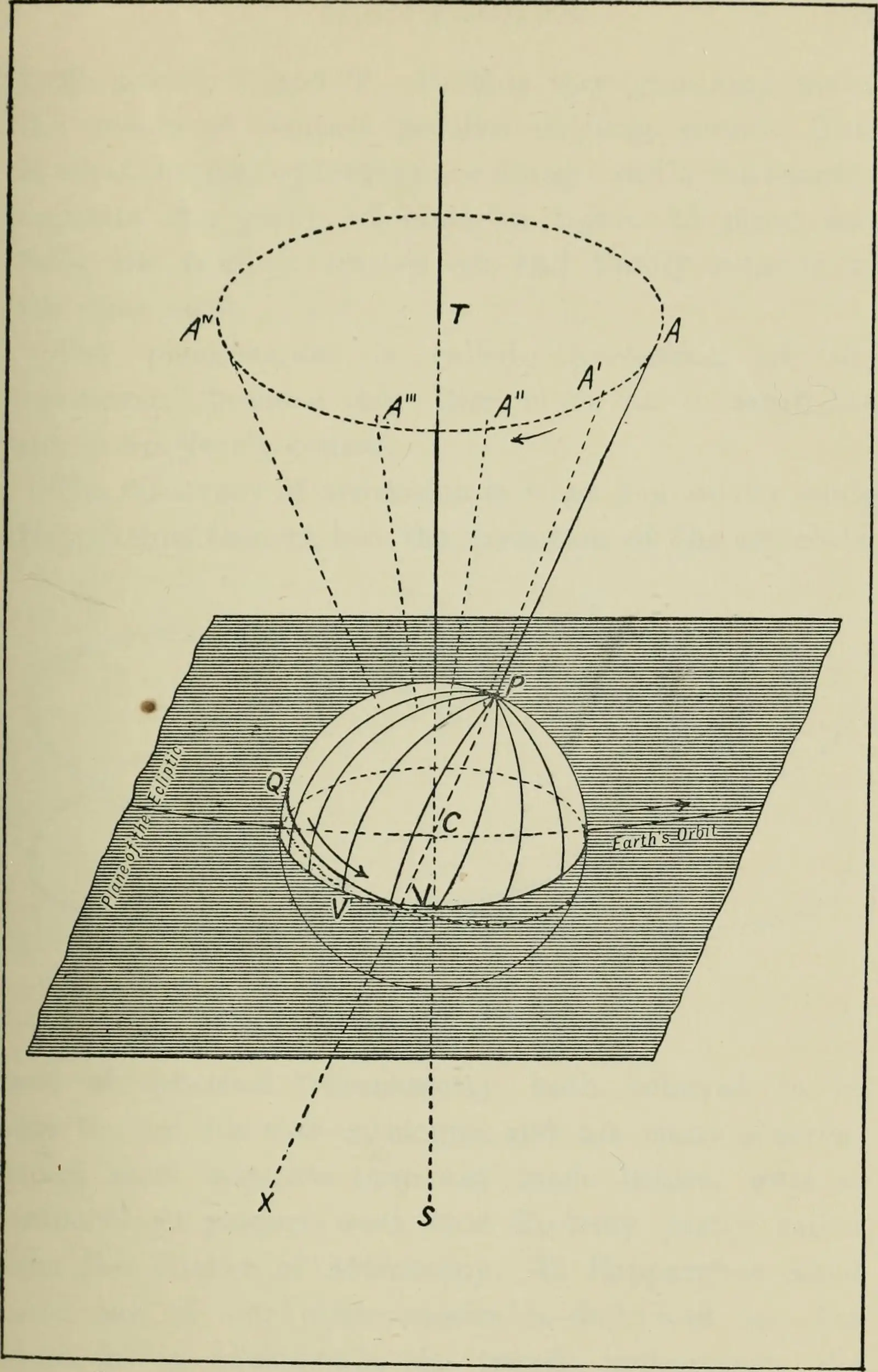

Figure 2. Young's Manual of Astronomy (1902), as reprinted by M. A. Orr: Earth's axis APX keeps its tilt as its end A circles T, so the vernal equinox V, where equator meets ecliptic, gradually shifts.
On the sky the pole creeps about 20 arcseconds a year by this page's calculation, a degree every 180 years. Star coordinates go stale. Polaris's right ascension, the sky's longitude, swings from 2.5 hours in 2000 to 5.9 in 2100 by the same calculation (Wikipedia: 2.5 to 6).
Think of precession as simple interest on a star catalogue: about 50 arcseconds posted each year, never compounding, yet about 30 degrees since 130 BC.
The tilt drifts too. Over the last 200,000 years, by this page's calculation from the same long-term precession model as Figure 1, it has ranged from 22.1 to 24.5 degrees, peaking about every 40,000 years. That drift, plus a slow tilting of Earth's orbit, keeps the loop in Figure 1 from quite closing.
Why does Earth's axis precess?
Earth's spin makes it bulge. Its equatorial diameter is about 43 km greater than its polar diameter, 3.3 mm on a globe 1 m wide (Wikipedia).
Because the axis is tilted, the Sun and Moon usually sit above or below the bulge's plane. Each pulls harder on the near side of the bulge than the far side, the same near-versus-far difference that raises tides. The result is a torque, a twisting force, that would turn the bulge toward Earth's orbital plane; on a spinning body, that twist moves the axis sideways rather than tipping it. So the axis circles.
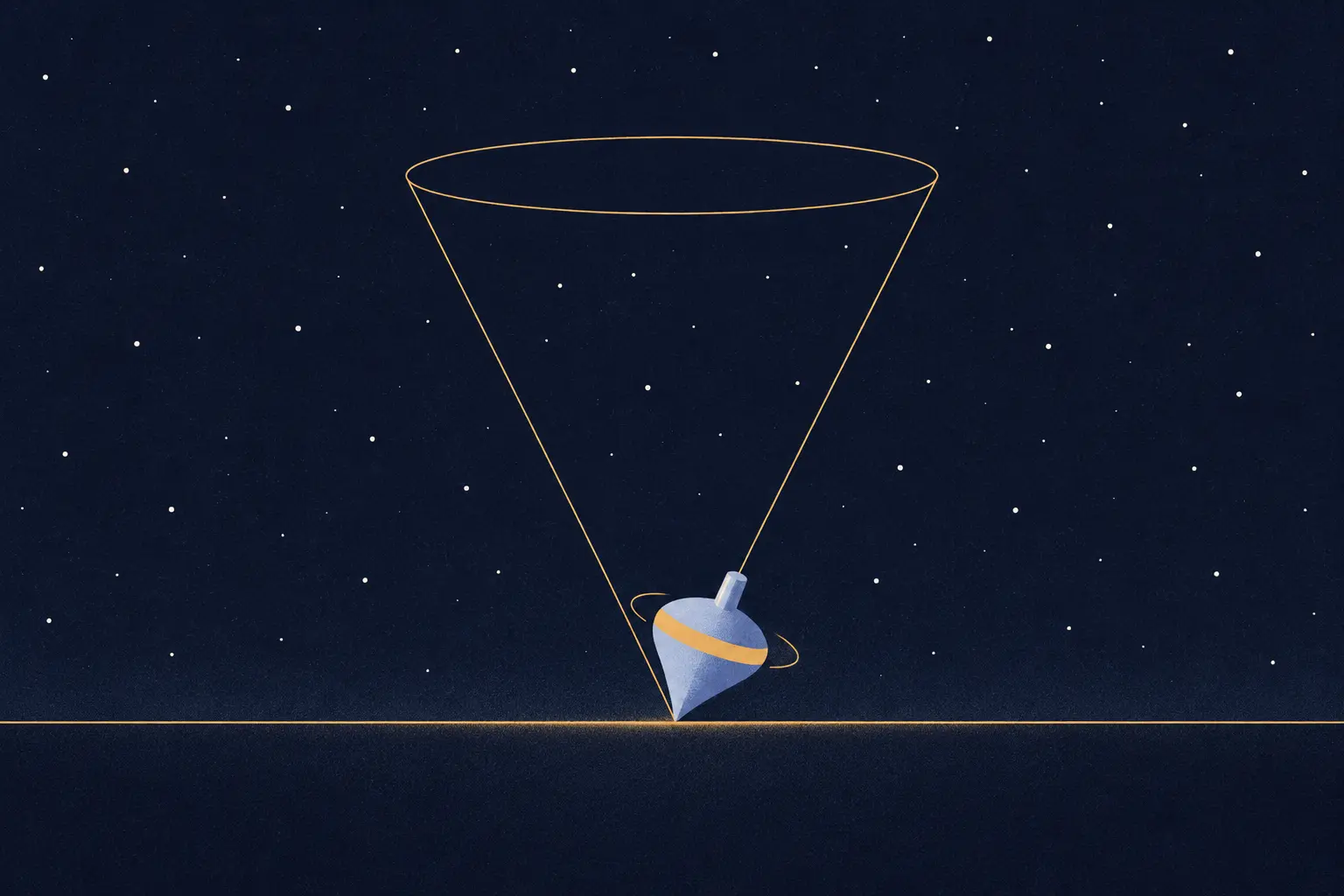
A tilted spinning top, its axis sweeping a cone. On a spinning body, a twist moves the axis sideways rather than tipping it; Earth's axis circles once in about 25,770 years.
The Moon does about twice the Sun's share. Wikipedia, citing Williams, lists about 34.5 arcseconds a year against 15.9. Each share scales with mass over distance cubed, the rule that also gives the Moon its edge in tides.
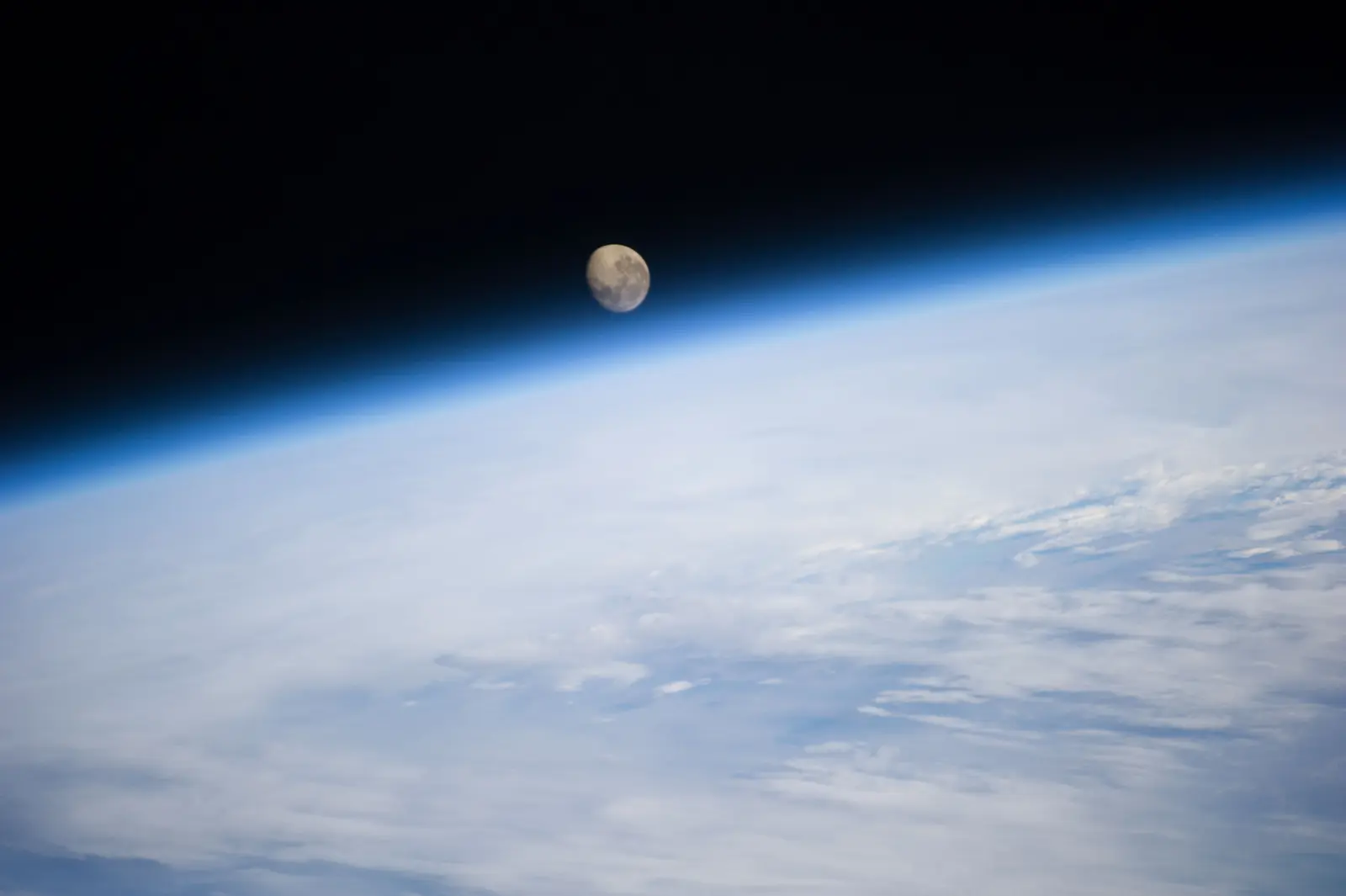
Figure 3. The Moon over Earth's limb from the International Space Station, 13 August 2014; its light left the Moon about 1.2 seconds earlier. The Moon does about twice the Sun's share of the twisting.
This sketch treats Earth as a rigid spinning body and averages the Sun's and Moon's pulls over their orbits. It skips nutation, an 18.6-year nod of about 9.2 arcseconds, and the planets, which turn the plane of Earth's orbit by about 0.47 arcseconds a year (Wikipedia). This page's numbers come from the long-term precession formulas of Vondrák, Capitaine and Wallace (2011) in the open ERFA library, whose notes rate them accurate to a few arcseconds over the historical period, worsening to a few tenths of a degree 200,000 years out.
Which stars have been the North Star?
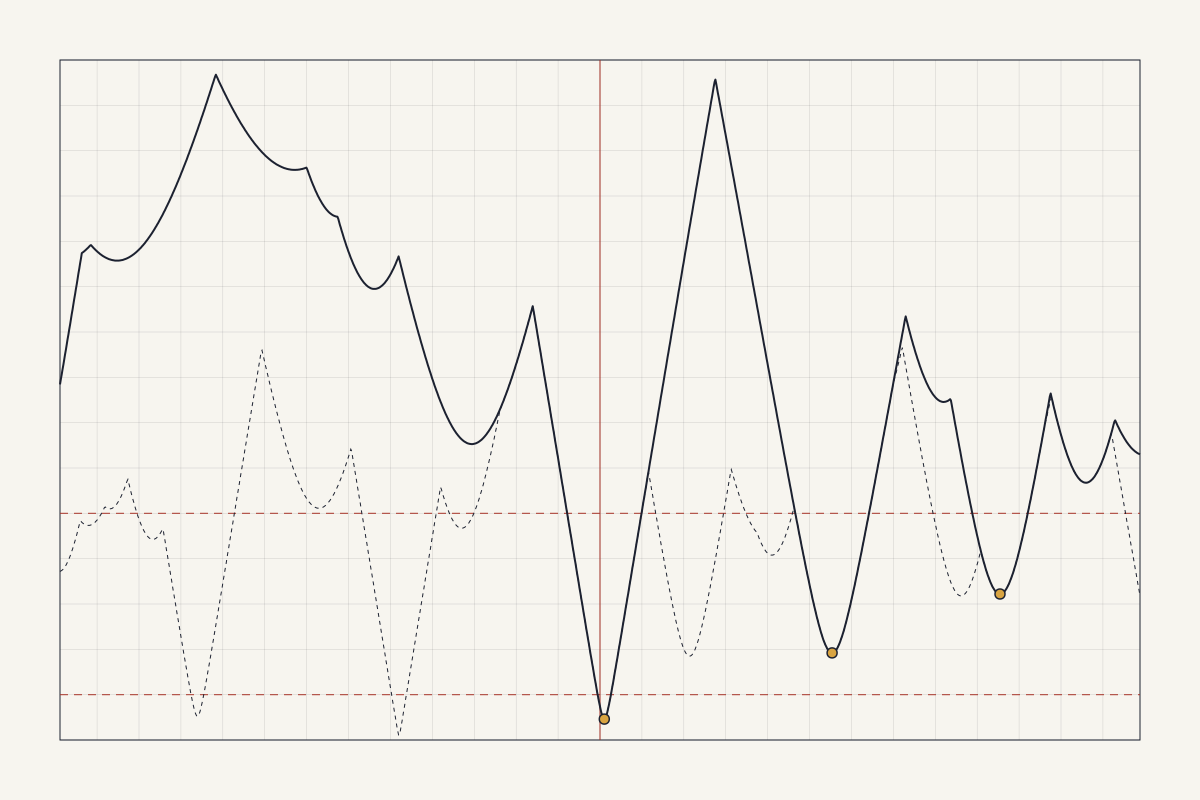
Open the chart full size to zoom in on the detail.
Figure 4. Distance from the pole to the nearest star of magnitude 3.0 or brighter (thick line) or 4.0 or brighter (dashed) over the same cycle, by this page's calculation; red vertical line, 2000. Grid every 1,000 years and every degree, 0 at bottom to 15 at top; red dashes at 1 and 5 degrees. Gold dots, left to right: Polaris, Alderamin, delta Cygni.
| Star | Magnitude | Closest to the pole | Distance from the pole |
|---|---|---|---|
| Tau Herculis | 3.91 | about 7600 BC | 0.5° |
| Thuban (alpha Draconis) | 3.67 | about 2800 BC | 0.1° |
| Kochab (beta Ursae Minoris) | 2.07 | about 1060 BC | 6.5° |
| Polaris (alpha Ursae Minoris) | 1.97 | AD 2102 | 0.46° |
| Errai (gamma Cephei) | 3.21 | about AD 4140 | 1.8° |
| Alderamin (alpha Cephei) | 2.45 | about AD 7540 | 1.9° |
| Deneb (alpha Cygni) | 1.25 | about AD 10,200 | 7.5° |
| Delta Cygni | 2.86 | about AD 11,550 | 3.2° |
| Vega (alpha Lyrae) | 0.03 | about AD 13,600 | 5.7° |
This page's calculation; magnitudes from HYG v4.4. The CSV has all 23 stars to magnitude 4.0 that pass within 8 degrees.
CSV: closest approaches (CC BY-SA 4.0) (Data: HYG Database v4.4 by David Nash (astronexus), CC BY-SA 4.0, https://codeberg.org/astronexus/hyg), with its provenance note (JSON) · CSV: the pole every 100 years (CC BY-SA 4.0) (Data: HYG Database v4.4 by David Nash (astronexus), CC BY-SA 4.0, https://codeberg.org/astronexus/hyg), with its provenance note (JSON)
What marked the pole before Polaris?
Thuban came within about 0.1 degree around 2800 BC by this page's calculation. Wikipedia's Thuban article says 2830 BC and under 10 arcminutes; its pole-star article says 3000 BC. Thuban, magnitude 3.7, is about one-fifth as bright as Polaris.
Then came a gap. Kochab, in the Little Dipper's bowl, got no closer than about 6.5 degrees, around 1060 BC. Its neighbor Pherkad, by this page's calculation, came no closer than about 8.8 degrees. Around 320 BC the Greek navigator Pytheas described the pole as devoid of stars (Wikipedia); this page puts the nearest star of magnitude 4 or brighter then at Kochab, 7.4 degrees off.
How close will Polaris and Vega get to the pole?
Polaris has been closing in for centuries. Gemma Frisius placed it 3°8′ from the pole in 1547 (Wikipedia); the calculation behind Figure 1 gives 3.16 degrees for that year, within about 0.02 degree. Polaris comes closest, about 0.46 degree, around 2100. By 3000 it is about 5 degrees away.
Vega, the bright prize ahead, misses. This page puts its closest pass near AD 13,600, still about 5.7 degrees off. Wikipedia's Vega article gives 13,724 and a declination of +84°14′; its pole-star article gives 14,500 and 5 degrees.
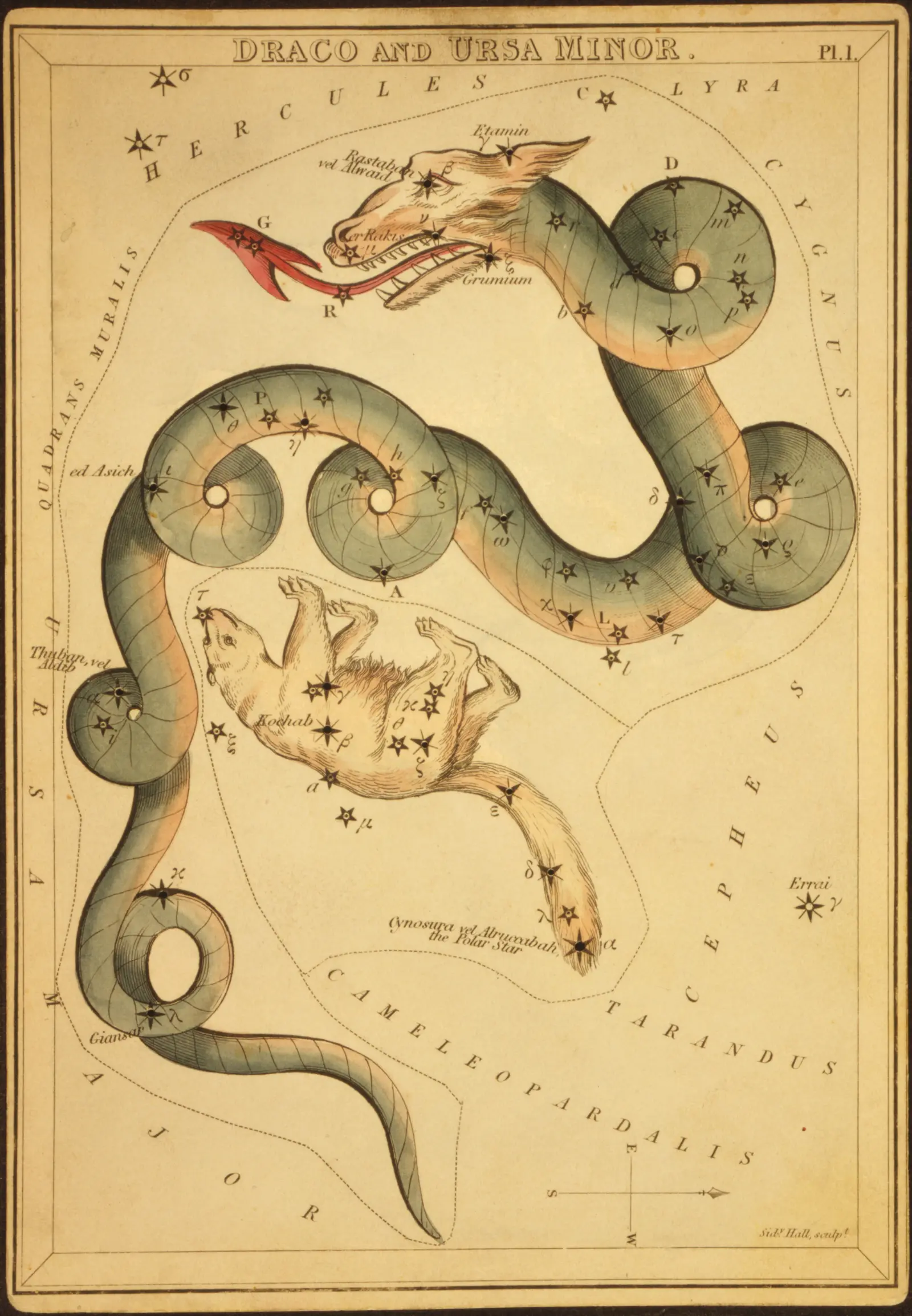
Figure 5. "Draco and Ursa Minor," plate 1 of Urania's Mirror, star cards first published in London in November 1824, engraved by Sidney Hall; Wikimedia Commons, citing the Library of Congress, dates this print 1825. Labels name "Thuban, vel Adib" in the dragon's coils at left, Kochab in the bear, "Cynosura vel Alruccabah, the Polar Star" at its tail and Errai at right.
Why don't the zodiac signs match the constellations?
Hipparchus, a Greek astronomer of the second century BC, usually gets the credit for discovering precession (Wikipedia, citing Ptolemy's Almagest). Comparing his position for Spica with Timocharis's older one, he found a shift of about 2 degrees; from the lengths of two kinds of year, he put the rate at not less than 1 degree a century. Ptolemy, about 265 years later, settled on 36 arcseconds a year. Today's rate is about 50.
Wikipedia records rival claims for Babylonian, Egyptian and Maya knowledge and notes that the Babylonian claim is generally regarded as unsupported, the Egyptian claims are controversial and few other Maya scholars hold the Maya idea.
The tropical zodiac of Western astrology starts at the March equinox point, the cusp of Aries. When Hipparchus defined it around 130 BC, it sat at the western edge of the constellation Aries, hence its other name, the first point of Aries.
The first point of Aries now lies in Pisces (Wikipedia), 29.6 degrees west of its 130 BC spot by this page's calculation. Sidereal astrology keeps its first point in Aries instead. This site covers how the zodiac was built, not whether astrology works.
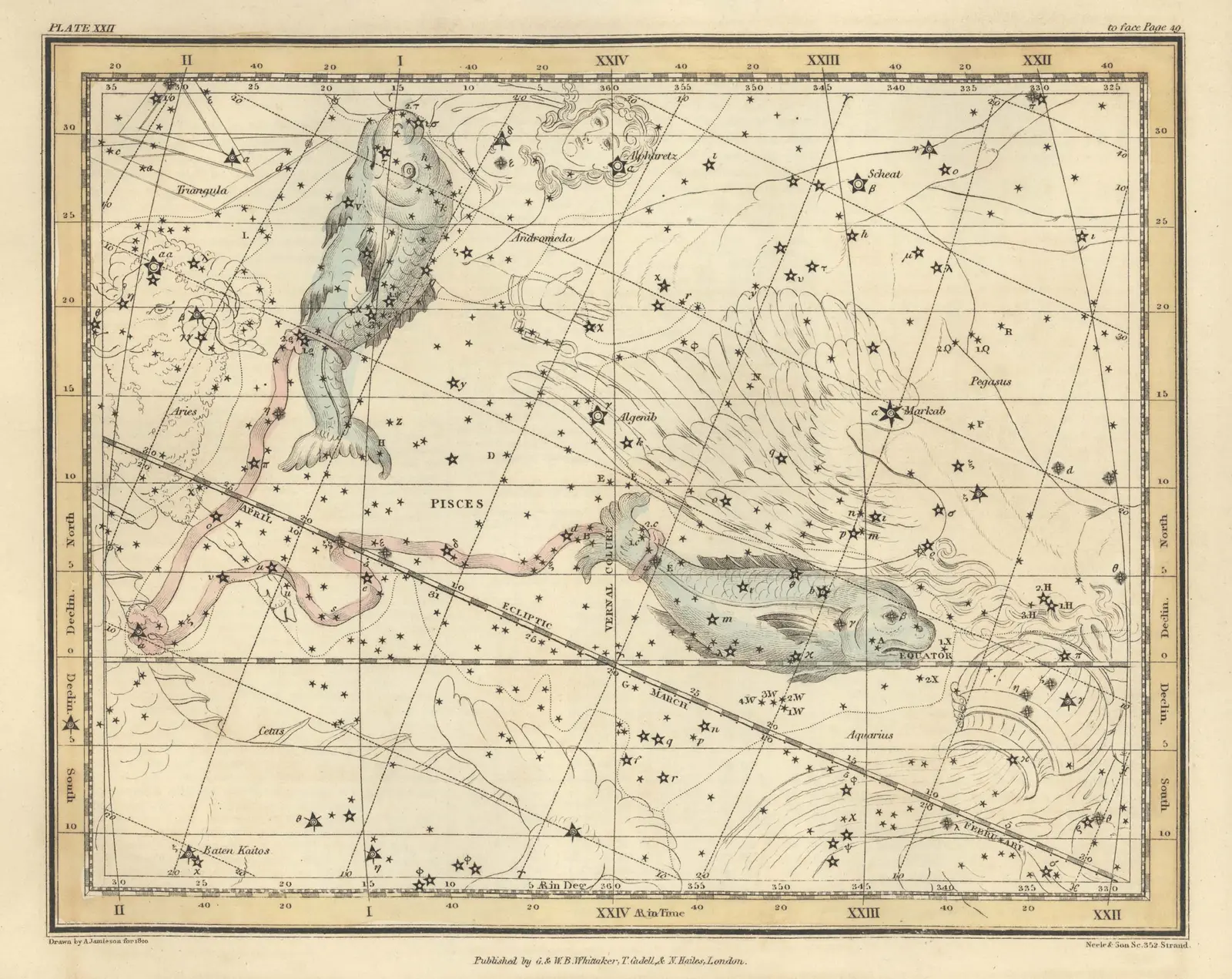

Figure 6. Plate 22 of Alexander Jamieson's Celestial Atlas (London, 1822), drawn for 1820. The ecliptic and equator cross just below the right-hand fish of Pisces, at a point marked with the sign of Aries.
Calendars side with the seasons. The Gregorian calendar tracks the tropical year, equinox to equinox, which runs 20 minutes 24.7 seconds shorter than the sidereal year measured against the stars (Wikipedia), so northern winter will never fall in July. What moves is the season of perihelion, Earth's closest point to the Sun on its elliptical orbit: now northern winter, flipping in about 13,000 years from axial precession alone, half of one lap. Adding the orbit's own slow turn hastens the flip: at today's rates, by this page's arithmetic from the IAU 2006 precession rate and the perihelion drift in E. M. Standish and J. G. Williams's table of orbital elements, the combined cycle is about 21,000 years.
Star charts age too. The 1930 constellation borders follow lines of right ascension and declination (Constellation Boundaries: The 88 Borders Run on an 1875 Grid), and the CDS boundary file gives them in 1875 coordinates. Between 1875 and 2000 the pole moved about 0.7 degree, by this page's calculation.
Next, follow that near-versus-far difference in pull from Earth's bulge to its oceans.
Sources
- ERFA (Essential Routines for Fundamental Astronomy, derived from IAU SOFA), source file p06e.c: IAU 2006 precession angles from Capitaine, Wallace and Chapront (2003, A&A 412, 567), with general precession in longitude of 5,028.796195 arcseconds per Julian century at J2000; BSD-3-Clausehttps://github.com/liberfa/erfa/blob/master/src/p06e.cRead: full source file
- Wikipedia, "Axial precession" (revision 1377974660: rate about 50.3 arcseconds a year, 1 degree every 71.6 years; double cone with half-aperture about 23.4 degrees; Hipparchus, Spica's 2-degree shift against Timocharis, and from tropical against sidereal year lengths a rate not less than 1 degree a century; Ptolemy about 265 years later, 36 arcseconds a year; Babylonian claims generally regarded as unsupported, Egyptian claims controversial, Maya idea held by few other professional scholars of Maya civilization; torque of the Sun and Moon on the equatorial bulge; Moon about 34.46 and Sun about 15.95 arcseconds a year from Williams; nutation 18.6 years, 9.2 arcseconds; planetary precession, a rotation of the ecliptic plane of 0.47 arcseconds a year)https://en.wikipedia.org/wiki/Axial_precession
- Wikipedia, "Equatorial bulge" (revision 1379799802: bulge due to rotation; equatorial diameter about 43 km greater than the polar diameter; 3.3 mm on a globe 1 m across)https://en.wikipedia.org/wiki/Equatorial_bulge
- ERFA (Essential Routines for Fundamental Astronomy, derived from IAU SOFA), source files ltpequ.c, ltpecl.c and ltp.c (long-term precession of Vondrák, Capitaine and Wallace 2011, A&A 534, A22, and 2012 corrigendum, A&A 541, C1; notes: agrees with IAU 2006 at J2000, accurate to a few arcseconds throughout the historical period, worsening to a few tenths of a degree at the end of the +/- 200,000 year span), era00.c and gmst06.c (Earth rotation angle and IAU 2006 mean sidereal time), BSD-3-Clausehttps://github.com/liberfa/erfa
- David Nash (astronexus), HYG Database v4.4, data README and licence (CC BY-SA 4.0)https://codeberg.org/astronexus/hyg
- Wikipedia, "Pole star" (revision 1361624025: Thuban within 0.1 degree in 3000 BC and one-fifth as bright as Polaris; Polaris nearest the pole in 2100, mean position 0.4603 degree in February 2102; Kochab never close enough to mark the pole; Errai around 4200, Alderamin around 7500, Deneb 7 degrees, delta Cygni 3 degrees around 11,250, Vega about 14,500 at 5 degrees)https://en.wikipedia.org/wiki/Pole_star
- Wikipedia, "Thuban" (revision 1374779151: closest to the pole in 2830 BC, less than 10 arcminutes away; not bright enough for badly light-polluted areas; Phecda and Megrez point to it, 15 degrees from Megrez)https://en.wikipedia.org/wiki/Thuban
- Wikipedia, "Polaris" (revision 1378220709: magnitude around 1.98; right ascension 2.5 h in 2000 to 6 h in 2100; closest to the pole around 2100; Pytheas around 320 BC described the celestial pole as devoid of stars; Gemma Frisius in 1547 placed Polaris 3 degrees 8 minutes from the pole)https://en.wikipedia.org/wiki/Polaris
- Wikipedia, "Vega" (revision 1379711246: pole star again around the year 13,724 at declination +84 degrees 14 minutes, less than six degrees from the pole; also around 14,000 CE; precession cycle 25,770 years)https://en.wikipedia.org/wiki/Vega
- Sidney Hall, "Draco and Ursa Minor," plate 1 of Urania's Mirror (London; print dated 1825), Library of Congress Prints and Photographs cph.3g10050, via Wikimedia Commons, file page (public domain, PD-old-100-expired)https://commons.wikimedia.org/wiki/File:Sidney_Hall_-_Urania%27s_Mirror_-_Draco_and_Ursa_Minor_-_Original.tif
- Wikipedia, "Urania's Mirror" (revision 1333597889: 32 star cards first published in November 1824, engraved by Sidney Hall, designer later identified as Richard Rouse Bloxam; second edition 1825)https://en.wikipedia.org/wiki/Urania%27s_Mirror
- Wikipedia, "First point of Aries" (revision 1358078840: also called the cusp of Aries; named because Hipparchus defined it in 130 BCE at the western extreme of Aries; about 30 degrees of shift since, now in Pisces; tropical zodiac no longer matches the constellations; sidereal astrology keeps the first point aligned with Aries)https://en.wikipedia.org/wiki/First_point_of_Aries
- Wikipedia, "Tropical year" (revision 1373945112: sidereal year 20 minutes 24.7 seconds longer than the tropical year because of precession)https://en.wikipedia.org/wiki/Tropical_year
- International Astronomical Union, "Constellations" (IAU themes page: Delporte's boundaries along lines of right ascension and declination, approved 1928, published 1930)https://iauarchive.eso.org/public/themes/constellations/
- Wikipedia, "IAU designated constellations" (revision 1379865991: the CDS boundary file constbnd.dat gives the 1875.0 coordinates of the boundary vertices)https://en.wikipedia.org/wiki/IAU_designated_constellations
- M. A. Orr (Mrs. John Evershed), Dante and the Early Astronomers (London: Gall and Inglis; preface dated October 1913), Fig. 26, "The movement of Earth's axis, which is the true cause of Precession" (V is the vernal equinox, at the intersection of the equator and plane of the ecliptic; as APX slowly revolves round T, the vernal equinox is gradually shifted), credited "From Young's 'Manual of Astronomy,' 1902"; Internet Archive scan danteearlyastron00ever (University of Toronto), via Wikimedia Commons file pagehttps://commons.wikimedia.org/wiki/File:Dante_and_the_early_astronomers_(1913)_(14760606356).jpgRead: figure, caption page (Internet Archive leaf n166 scan), preface and list of illustrations
- Wikipedia, "Charles Augustus Young" (revision 1371979096: 1834–1908; wrote a popular and widely used series of astronomy textbooks, including Manual of Astronomy)https://en.wikipedia.org/wiki/Charles_Augustus_Young
- NASA Image and Video Library, iss040e092688, "Moon setting" (photographer Reid Wiseman, Johnson Space Center: view of the Moon setting over an Earth limb, taken by the Expedition 40 crew aboard the International Space Station; date created 2014-08-13)https://images.nasa.gov/details/iss040e092688
- ERFA (Essential Routines for Fundamental Astronomy, derived from IAU SOFA), source file moon98.c: approximate geocentric position of the Moon after Jean Meeus, Astronomical Algorithms, 2nd edition (1998); BSD-3-Clausehttps://github.com/liberfa/erfa/blob/master/src/moon98.cRead: full source file
- Alexander Jamieson, A Celestial Atlas (London: G. & W. B. Whittaker, T. Cadell and N. Hailes), plate 22, Pisces ("Drawn by A. Jamieson for 1820"; engraved by Neele & Son), United States Naval Observatory Library scan via Wikimedia Commons file page (dated 1822; public domain, PD-old-100)https://commons.wikimedia.org/wiki/File:Alexander_Jamieson_Celestial_Atlas-Plate_22.jpg
- Wikipedia, "Alexander Jamieson" (revision 1352614549: 1782–1850; A Celestial Atlas, 1822, inspired by Bode's atlas and restricted to stars visible to the naked eye)https://en.wikipedia.org/wiki/Alexander_Jamieson
- E. M. Standish and J. G. Williams, "Approximate Positions of the Planets" (Table 1: Keplerian elements and rates, mean ecliptic and equinox of J2000, valid 1800 AD to 2050 AD; longitude of perihelion of the Earth-Moon barycenter advancing 0.32327364 degrees per century)https://ssd.jpl.nasa.gov/planets/approx_pos.htmlRead: full page
Computed by this site (2026-10-12) from sources 4 and 5: the pole's path and the tilt over the cycle, the share of the cycle with a bright star near the pole, each star's closest approach, Polaris's distance in 1547, 2100 and 3000 and its right ascension in 2000 and 2100, the pole's yearly motion and its shift between 1875 and 2000, Kochab's and Pherkad's closest approaches, the equinox shift since 130 BC, and the Look up next positions.
Corrections
2026-11-01 — The tilt's range is now this page's own calculation (over the last million years, 22.1 to 24.5 degrees on a cycle of about 41,000 years → over the last 200,000 years, 22.1 to 24.5 degrees, peaking about every 40,000 years), and so is the combined cycle that carries perihelion through the seasons (about 23,000 years on average → about 21,000 years at today's rates). A fact sheet's 25,771.5-year lap, no longer cited, was removed; the page's about 25,770 years stands. Sources 1 and 19 replaced and source 22 added, prompted by a recheck.
Look up next:
Thuban, the pole star of about 2800 BC. On mid-October evenings at 40°N (9 p.m. local mean solar time), this page's calculation puts it about 22 degrees up in the north-northwest, almost exactly halfway between Mizar, the bend in the low Big Dipper's handle, and Pherkad in the Little Dipper's bowl. At magnitude 3.7 it fades in city light. For a darker site, go with someone, tell a friend your plan, carry a red flashlight and stay off private land. Read on: Tides.
Related entries
- Tides: The Sun Pulls Harder, but Its Tide Is Half the Moon's
- Orbital Eccentricity: Earth's True Orbit Looks Like a Circle
- Big Dipper: Not a Constellation, and Two of Its Stars Are Strangers
- Constellation Boundaries: The 88 Borders Run on an 1875 Grid
- Gregorian Calendar: 1582 Dropped 10 Dates, Not 10 Days
Cite this page
Asterisms & Astrolabes. “Axial Precession: Earth Usually Has No Bright North Star.” Asterisms & Astrolabes. Published 13 October 2026; last substantive revision 1 November 2026. https://asterismsandastrolabes.com/orbits/axial-precession/. Accessed [the date you read it].