Comparison and data page
The 88 Constellations: Hydra Covers 19 Times the Sky of Crux
TL;DR: The 88 constellations are the areas of sky recognized by the International Astronomical Union, and by this page's calculation they fill the whole sphere, about 41,253 square degrees. Hydra is the largest at 1,302.8 square degrees and Crux the smallest at 68.4, and the table here lists all 88 with size rank, brightest catalogue entry, latitude limits and an approximate best evening month.
In this entry8 sections
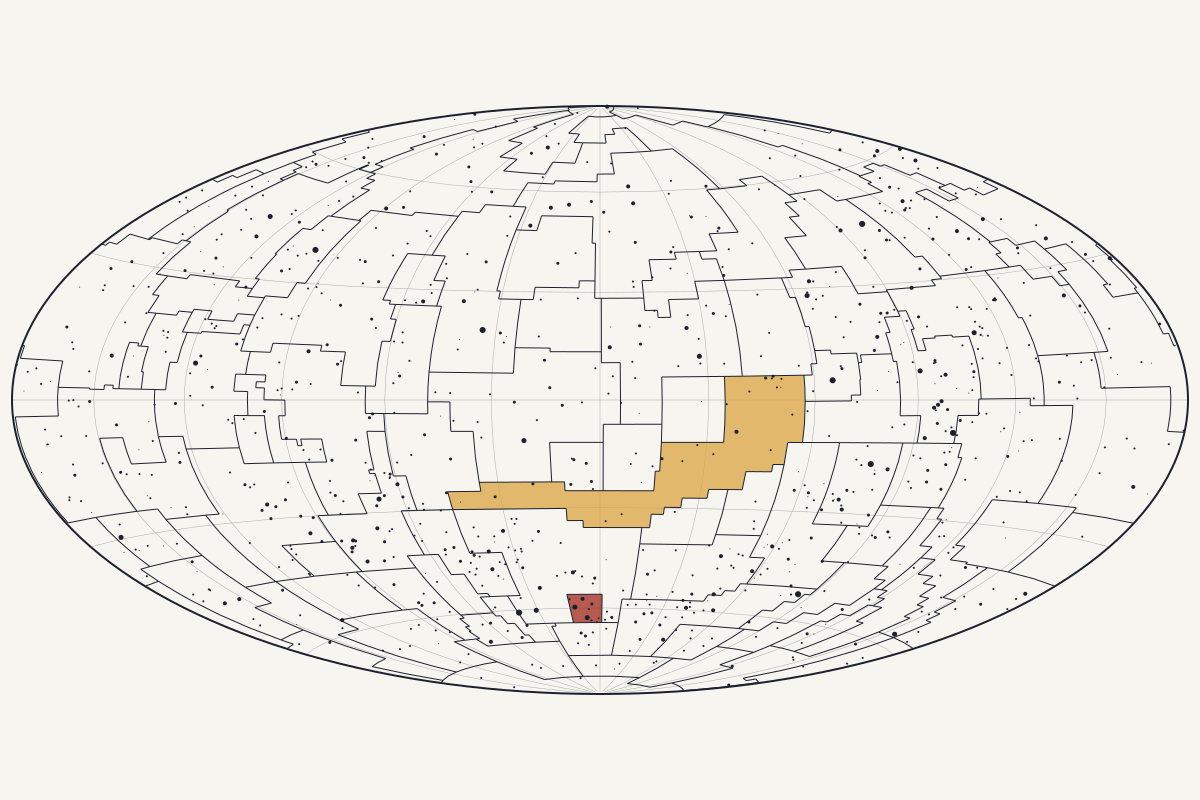
Open the chart full size to zoom in on the detail.
Figure 1. All 88 constellations on an equal-area map of the whole sky, so equal patches of map are equal patches of sky. North is up, east left, centered on right ascension 12h; gridlines every 2 hours and 30°. Gold: Hydra. Red: Crux. Dots: the 925 HYG v4.4 entries to magnitude 4.5.
Hydra covers 19 times as much sky as Crux, yet each counts as one of the 88 constellations. The International Astronomical Union (IAU) calls constellations "scientifically defined areas of sky." By this page's calculation, those areas add up to the whole sphere, so every star falls inside one.
The table on this page lists all 88 in one place: name and abbreviation, area and size rank, brightest star, where on Earth each one climbs 10° above the horizon, and when it stands highest at 9 p.m. The CSV adds a catalogue count. How the list and its borders were fixed is a separate story, told in Constellation Boundaries. This page is for using them.
What are the 88 constellations?
They are a stack of different ages. Ian Ridpath, a member of the IAU's Working Group on Star Names, gives an origin for each in his constellation tables. Tallied from his column, the 88 break down like this:
- 47 Greek constellations listed by Ptolemy in the Almagest
- 3 parts of Argo Navis, a Greek figure dismantled in the 18th century by Nicolas Louis de Lacaille: Carina, Puppis and Vela
- 1 figure the Greeks treated as part of Leo: Coma Berenices, made separate by Caspar Vopel in 1536
- 12 southern constellations of Pieter Dirkszoon Keyser and Frederick de Houtman
- 4 added by Petrus Plancius
- 7 of Johannes Hevelius
- 14 southern constellations of Lacaille

Illustration: Argo Navis, a Greek figure, was dismantled in the 18th century by Nicolas Louis de Lacaille, and three of the 88 come from it: Carina, Puppis and Vela. The stars here are decoration, not a map of those constellations.
Size varies wildly. Five exceed 1,200 square degrees: Hydra (1,302.8), Virgo (1,294.4), Ursa Major (1,279.7), Cetus (1,231.4) and Hercules (1,225.1). The three smallest are Sagitta (79.9), Equuleus (71.6) and Crux (68.4). By this page's calculation, Hydra takes about 3.2 percent of the sky and Crux about 0.17 percent.
These areas are this page's calculation from the 1930 IAU borders. All 88, and every size rank, match A. E. Levin's 1935 figures as Ridpath tabulates them, to 0.1 square degree.
The 88 are not every culture's map, and the IAU says so: many cultures "have had their own asterisms for hundreds or thousands of years and continue to use them." An asterism is a star pattern that is not an official constellation; the Big Dipper is one. The star names in the table reach well past Greece. Tiansi, the name of Gamma Cassiopeiae, comes from a Chinese asterism that the star-name catalogue of the IAU's working group describes as attested for at least 2,000 years.
All 88 constellations in one table
Every row below comes from the same calculation. The same data is free to download. Each small chart shows one constellation's border and its HYG catalogue entries to magnitude 5.5, with the brightest in gold, and has its own scale, so chart sizes can't be compared. Names in the table link to their charts.
Area computed from the 1930 IAU borders (Delporte). Stars, magnitudes and names from HYG v4.4 entries at J2000 positions, placed by a point-in-border test, except where a note names another source. Latitude limits: every listed star peaks at least 10 degrees up, no refraction. Month: area centroid on the meridian at 9 p.m. local mean solar time, 2026.
| Constellation | Area (sq deg) | Size rank | Brightest star | Mag. | All entries peak 10° up from | Best evening month (approx.) |
|---|---|---|---|---|---|---|
| Andromeda And | 722.3 | 19 | Alpheratz (Alpha Andromedae) | 2.07 | 27°S to 90°N | mid-November |
| Tie in HYG: Mirach is also 2.07; the first catalogue entry is listed here. | ||||||
| Antlia Ant | 238.9 | 62 | Alpha Antliae | 4.28 | 90°S to 39°N | early April |
| Apus Aps | 206.3 | 67 | Paradys (Alpha Apodis) | 3.83 | 90°S to 3°S | early July |
| Close call: Gamma Apodis is 3.86 in HYG. From about 23°S or farther south, all its entries to mag 6.5 stay above the horizon, so there the month only marks when it stands highest. | ||||||
| Aquarius Aqr | 979.9 | 10 | Sadalsuud (Beta Aquarii) | 2.9 | 77°S to 55°N | mid-October |
| Close call: Sadalmelik is 2.95 in HYG. | ||||||
| Aquila Aql | 652.5 | 22 | Altair (Alpha Aquilae) | 0.76 | 62°S to 68°N | late August |
| Ara Ara | 237.1 | 63 | Beta Arae | 2.84 | 90°S to 12°N | late July |
| Tie in HYG: Alpha Arae is also 2.84; the first catalogue entry is listed here. | ||||||
| Aries Ari | 441.4 | 39 | Hamal (Alpha Arietis) | 2.01 | 48°S to 90°N | mid-December |
| Auriga Aur | 657.4 | 21 | Capella (Alpha Aurigae) | 0.08 | 24°S to 90°N | early February |
| Boötes Boo | 906.8 | 13 | Arcturus (Alpha Boötis) | -0.05 | 25°S to 87°N | mid-June |
| Caelum Cae | 124.9 | 81 | Alpha Caeli | 4.44 | 90°S to 33°N | mid-January |
| Camelopardalis Cam | 756.8 | 18 | Beta Camelopardalis | 4.03 | 6°N to 90°N | late January |
| From about 38°N or farther north, all its entries to mag 6.5 stay above the horizon, so there the month only marks when it stands highest. | ||||||
| Cancer Cnc | 505.9 | 31 | Tarf (Beta Cancri) | 3.53 | 47°S to 86°N | mid-March |
| Canes Venatici CVn | 465.2 | 38 | Cor Caroli (Alpha2 Canum Venaticorum) | 2.89 | 28°S to 90°N | late May |
| Canis Major CMa | 380.1 | 43 | Sirius (Alpha Canis Majoris) | -1.44 | 90°S to 47°N | mid-February |
| Canis Minor CMi | 183.4 | 71 | Procyon (Alpha Canis Minoris) | 0.4 | 67°S to 80°N | early March |
| Capricornus Cap | 413.9 | 40 | Deneb Algedi (Delta Capricorni) | 2.85 | 88°S to 52°N | late September |
| Carina Car | 494.2 | 34 | Canopus (Alpha Carinae) | -0.62 | 90°S to 4°N | mid-March |
| From about 39°S or farther south, all its entries to mag 6.5 stay above the horizon, so there the month only marks when it stands highest. | ||||||
| Cassiopeia Cas | 598.4 | 25 | Tiansi (Gamma Cassiopeiae) | 2.15 | 2°S to 90°N | late November |
| Close call: Schedar is 2.24 in HYG. Tiansi is flagged variable in HYG; the Yale catalogue (2.47) and the IAU star-name table (2.39) put it behind Schedar, 2.23 in both. From about 43°N or farther north, all its entries to mag 6.5 stay above the horizon, so there the month only marks when it stands highest. | ||||||
| Centaurus Cen | 1060.4 | 9 | Rigil Kentaurus (Alpha1 Centauri) | -0.01 | 90°S to 15°N | late May |
| Magnitude is for this entry alone; HYG lists the companion separately (Toliman 1.35). | ||||||
| Cepheus Cep | 587.8 | 27 | Alderamin (Alpha Cephei) | 2.45 | 8°N to 90°N | mid-October |
| From about 35°N or farther north, all its entries to mag 6.5 stay above the horizon, so there the month only marks when it stands highest. | ||||||
| Cetus Cet | 1231.4 | 4 | Diphda (Beta Ceti) | 2.04 | 69°S to 55°N | late November |
| Chamaeleon Cha | 131.6 | 79 | Alpha Chamaeleontis | 4.05 | 90°S to 4°S | mid-April |
| Close call: Gamma Chamaeleontis is 4.11 in HYG. From about 15°S or farther south, all its entries to mag 6.5 stay above the horizon, so there the month only marks when it stands highest. | ||||||
| Circinus Cir | 93.4 | 85 | Xami (Alpha Circini) | 3.18 | 90°S to 9°N | mid-June |
| From about 35°S or farther south, all its entries to mag 6.5 stay above the horizon, so there the month only marks when it stands highest. | ||||||
| Columba Col | 270.2 | 54 | Phact (Alpha Columbae) | 2.65 | 90°S to 37°N | early February |
| Coma Berenices Com | 386.5 | 42 | Beta Comae Berenices | 4.23 | 46°S to 90°N | mid-May |
| Close call: Diadem is 4.32 in HYG. | ||||||
| Corona Australis CrA | 127.7 | 80 | Alqubba (Beta Coronae Australis) | 4.1 | 90°S to 34°N | mid-August |
| Close call: Meridiana is 4.11 in HYG. Name from the IAU star-name table, adopted 2026-08-13; not in HYG v4.4. | ||||||
| Corona Borealis CrB | 178.7 | 73 | Alphecca (Alpha Coronae Borealis) | 2.22 | 40°S to 90°N | early July |
| Corvus Crv | 183.8 | 70 | Gienah (Gamma Corvi) | 2.58 | 90°S to 55°N | mid-May |
| Close call: Kraz is 2.65 in HYG. | ||||||
| Crater Crt | 282.4 | 53 | Delta Crateris | 3.56 | 87°S to 55°N | late April |
| Crux Cru | 68.4 | 88 | Acrux (Alpha1 Crucis) | 0.77 | 90°S to 15°N | mid-May |
| HYG's 0.77 is the combined light of a close pair; the Yale catalogue lists the brighter star alone at 1.33, fainter than Mimosa at 1.25 in HYG. From about 35°S or farther south, all its entries to mag 6.5 stay above the horizon, so there the month only marks when it stands highest. | ||||||
| Cygnus Cyg | 804.0 | 16 | Deneb (Alpha Cygni) | 1.25 | 20°S to 90°N | mid-September |
| Delphinus Del | 188.5 | 69 | Rotanev (Beta Delphini) | 3.64 | 59°S to 82°N | mid-September |
| Dorado Dor | 179.2 | 72 | Alpha Doradus | 3.3 | 90°S to 10°N | late January |
| From about 39°S or farther south, all its entries to mag 6.5 stay above the horizon, so there the month only marks when it stands highest. | ||||||
| Draco Dra | 1083.0 | 8 | Eltanin (Gamma Draconis) | 2.24 | 4°N to 90°N | late July |
| Long constellation: its stars span 11 hours of right ascension, so one part or another is on the meridian at 9 p.m. from late March to mid-September. From about 42°N or farther north, all its entries to mag 6.5 stay above the horizon, so there the month only marks when it stands highest. | ||||||
| Equuleus Equ | 71.6 | 87 | Kitalpha (Alpha Equulei) | 3.92 | 68°S to 82°N | late September |
| Eridanus Eri | 1137.9 | 6 | Achernar (Alpha Eridani) | 0.45 | 79°S to 22°N | early January |
| Fornax For | 397.5 | 41 | Dalim (Alpha Fornacis) | 3.8 | 90°S to 41°N | mid-December |
| Gemini Gem | 513.8 | 30 | Pollux (Beta Geminorum) | 1.16 | 44°S to 90°N | late February |
| Grus Gru | 365.5 | 45 | Alnair (Alpha Gruis) | 1.73 | 90°S to 26°N | mid-October |
| Hercules Her | 1225.1 | 5 | Kornephoros (Beta Herculis) | 2.78 | 30°S to 84°N | late July |
| Tie in HYG: Rasalgethi is also 2.78; the first catalogue entry is listed here. Rasalgethi is flagged variable in HYG, with 2.57 to 2.97 in HYG's range columns (not necessarily the full range), and can outshine Kornephoros. | ||||||
| Horologium Hor | 248.9 | 58 | Alpha Horologii | 3.85 | 90°S to 13°N | late December |
| Hydra Hya | 1302.8 | 1 | Alphard (Alpha Hydrae) | 1.99 | 73°S to 44°N | mid-April |
| Long constellation: its stars span 7 hours of right ascension, so one part or another is on the meridian at 9 p.m. from early March to late June. | ||||||
| Hydrus Hyi | 243.0 | 61 | Beta Hydri | 2.82 | 90°S to 1°S | mid-December |
| Close call: Alpha Hydri is 2.86 in HYG. From about 32°S or farther south, all its entries to mag 6.5 stay above the horizon, so there the month only marks when it stands highest. | ||||||
| Indus Ind | 294.0 | 49 | Alpha Indi | 3.11 | 90°S to 6°N | late September |
| Lacerta Lac | 200.7 | 68 | Stellio (Alpha Lacertae) | 3.76 | 23°S to 90°N | mid-October |
| Leo Leo | 947.0 | 12 | Regulus (Alpha Leonis) | 1.36 | 48°S to 75°N | mid-April |
| Leo Minor LMi | 232.0 | 64 | Praecipua (46 Leonis Minoris) | 3.79 | 38°S to 90°N | mid-April |
| Lepus Lep | 290.3 | 51 | Arneb (Alpha Leporis) | 2.58 | 90°S to 52°N | late January |
| Libra Lib | 538.1 | 29 | Zubeneschamali (Beta Librae) | 2.61 | 80°S to 50°N | late June |
| Lupus Lup | 333.7 | 46 | Uridim (Alpha Lupi) | 2.3 | 90°S to 24°N | late June |
| Lynx Lyn | 545.4 | 28 | Alpha Lyncis | 3.14 | 18°S to 90°N | early March |
| Lyra Lyr | 286.5 | 52 | Vega (Alpha Lyrae) | 0.03 | 33°S to 90°N | mid-August |
| Mensa Men | 153.5 | 75 | Hoerikwaggo (Alpha Mensae) | 5.08 | 90°S to 5°S | late January |
| Close call: Gamma Mensae is 5.18 in HYG. From about 20°S or farther south, all its entries to mag 6.5 stay above the horizon, so there the month only marks when it stands highest. | ||||||
| Microscopium Mic | 209.5 | 66 | Gamma Microscopii | 4.67 | 90°S to 35°N | mid-September |
| Close call: Epsilon Microscopii is 4.71 in HYG. | ||||||
| Monoceros Mon | 481.6 | 35 | Beta Monocerotis | 3.76 | 68°S to 68°N | mid-February |
| HYG's one row, 3.76, stands for a close triple, apparently as combined light; the Yale catalogue lists the three stars at 4.60, 5.40 and 5.60, each fainter than Alpha Monocerotis, 3.94 in HYG. | ||||||
| Musca Mus | 138.4 | 77 | Alpha Muscae | 2.69 | 90°S to 4°N | mid-May |
| From about 26°S or farther south, all its entries to mag 6.5 stay above the horizon, so there the month only marks when it stands highest. | ||||||
| Norma Nor | 165.3 | 74 | Gamma2 Normae | 4.01 | 90°S to 19°N | early July |
| Octans Oct | 291.0 | 50 | Nu Octantis | 3.73 | 90°S to 9°S | no best month |
| No best month given: Octans surrounds the south celestial pole, so it stands about as high in every season. | ||||||
| Ophiuchus Oph | 948.3 | 11 | Rasalhague (Alpha Ophiuchi) | 2.08 | 65°S to 50°N | late July |
| Orion Ori | 594.1 | 26 | Rigel (Beta Orionis) | 0.18 | 59°S to 69°N | late January |
| Betelgeuse, 0.45 in HYG, varies from about 0.0 to 1.6 by Wikipedia, citing the AAVSO Variable Star Index, so at its peak it can outshine Rigel. | ||||||
| Pavo Pav | 377.7 | 44 | Peacock (Alpha Pavonis) | 1.94 | 90°S to 6°N | late August |
| From about 34°S or farther south, all its entries to mag 6.5 stay above the horizon, so there the month only marks when it stands highest. | ||||||
| Pegasus Peg | 1120.8 | 7 | Enif (Epsilon Pegasi) | 2.38 | 44°S to 82°N | mid-October |
| Close call: Scheat is 2.44 in HYG. | ||||||
| Perseus Per | 615.0 | 24 | Mirfak (Alpha Persei) | 1.79 | 21°S to 90°N | late December |
| Phoenix Phe | 469.3 | 37 | Ankaa (Alpha Phoenicis) | 2.4 | 90°S to 22°N | mid-November |
| Pictor Pic | 246.7 | 59 | Alpha Pictoris | 3.24 | 90°S to 16°N | late January |
| Pisces Psc | 889.4 | 14 | Alpherg (Eta Piscium) | 3.62 | 46°S to 73°N | mid-November |
| Close call: Gamma Piscium is 3.7 in HYG. | ||||||
| Piscis Austrinus PsA | 245.4 | 60 | Fomalhaut (Alpha Piscis Austrini) | 1.17 | 90°S to 44°N | early October |
| Puppis Pup | 673.4 | 20 | Naos (Zeta Puppis) | 2.21 | 90°S to 29°N | early March |
| Pyxis Pyx | 220.8 | 65 | Alpha Pyxidis | 3.68 | 90°S to 42°N | late March |
| Reticulum Ret | 113.9 | 82 | Rhombus (Alpha Reticuli) | 3.33 | 90°S to 13°N | early January |
| From about 36°S or farther south, all its entries to mag 6.5 stay above the horizon, so there the month only marks when it stands highest. | ||||||
| Sagitta Sge | 79.9 | 86 | Telum (Gamma Sagittae) | 3.51 | 58°S to 90°N | early September |
| Name from the IAU star-name table, adopted 2026-06-18; not in HYG v4.4. | ||||||
| Sagittarius Sgr | 867.4 | 15 | Kaus Australis (Epsilon Sagittarii) | 1.79 | 90°S to 34°N | late August |
| Scorpius Sco | 496.8 | 33 | Antares (Alpha Scorpii) | 1.06 | 88°S to 34°N | mid-July |
| Sculptor Scl | 474.8 | 36 | Alpha Sculptoris | 4.3 | 90°S to 41°N | mid-November |
| Close call: Beta Sculptoris is 4.38 in HYG. | ||||||
| Scutum Sct | 109.1 | 84 | Tianbian (Alpha Scuti) | 3.85 | 84°S to 64°N | mid-August |
| Name from the IAU star-name table, adopted 2026-06-18; not in HYG v4.4. | ||||||
| Serpens Ser | 636.9 | 23 | Unukalhai (Alpha Serpentis) | 2.63 | 54°S to 64°N | mid-July |
| Serpens is the only constellation in two separate parts: Serpens Caput, 428.5 sq deg, and Serpens Cauda, 208.4 sq deg, with Ophiuchus between them. The area and counts cover both; the month is for their combined centroid. | ||||||
| Sextans Sex | 313.5 | 47 | Alpha Sextantis | 4.48 | 74°S to 68°N | early April |
| Taurus Tau | 797.2 | 17 | Aldebaran (Alpha Tauri) | 0.87 | 49°S to 78°N | mid-January |
| Telescopium Tel | 251.5 | 57 | Alpha Telescopii | 3.49 | 90°S to 23°N | late August |
| Triangulum Tri | 131.8 | 78 | Alaybasan (Beta Trianguli) | 3.0 | 43°S to 90°N | early December |
| Triangulum Australe TrA | 110.0 | 83 | Atria (Alpha Trianguli Australis) | 1.91 | 90°S to 9°N | early July |
| From about 30°S or farther south, all its entries to mag 6.5 stay above the horizon, so there the month only marks when it stands highest. | ||||||
| Tucana Tuc | 294.6 | 48 | Lang-Exster (Alpha Tucanae) | 2.87 | 90°S to 8°N | early November |
| From about 34°S or farther south, all its entries to mag 6.5 stay above the horizon, so there the month only marks when it stands highest. | ||||||
| Ursa Major UMa | 1279.7 | 3 | Alioth (Epsilon Ursae Majoris) | 1.76 | 7°S to 90°N | late April |
| Close call: Dubhe is 1.81 in HYG. | ||||||
| Ursa Minor UMi | 255.9 | 56 | Polaris (Alpha Ursae Minoris) | 1.97 | 10°N to 90°N | late June |
| Close call: Kochab is 2.07 in HYG. From about 25°N or farther north, all its entries to mag 6.5 stay above the horizon, so there the month only marks when it stands highest. | ||||||
| Vela Vel | 499.6 | 32 | Gamma2 Velorum | 1.75 | 90°S to 22°N | late March |
| Virgo Vir | 1294.4 | 2 | Spica (Alpha Virginis) | 0.98 | 66°S to 57°N | late May |
| Volans Vol | 141.4 | 76 | Beta Volantis | 3.77 | 90°S to 5°N | early March |
| Close call: Gamma2 Volantis is 3.78 in HYG. From about 26°S or farther south, all its entries to mag 6.5 stay above the horizon, so there the month only marks when it stands highest. | ||||||
| Vulpecula Vul | 268.2 | 55 | Anser (Alpha Vulpeculae) | 4.44 | 50°S to 90°N | early September |
| Close call: 23 Vulpeculae is 4.5 in HYG. | ||||||
Each chart is drawn from HYG v4.4 positions and the 1930 IAU border, with no connecting lines. North up, east left, each at its own scale (grid: 10° of declination, 1 h of right ascension, sparser near the pole). Dots: HYG entries to magnitude 5.5 inside the border, bigger is brighter. Gold: the brightest entry.
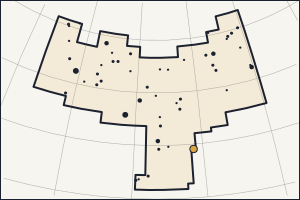
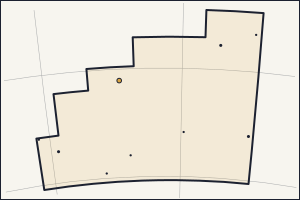
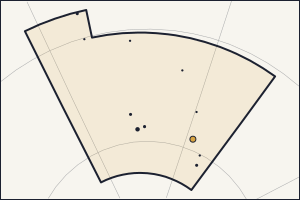
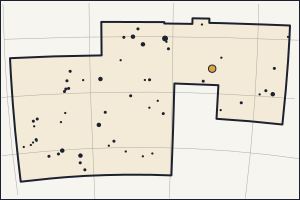
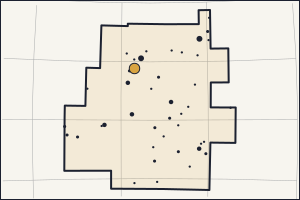
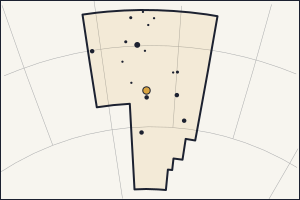
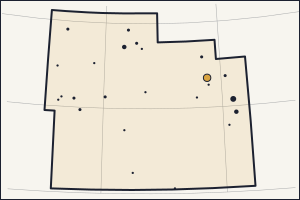
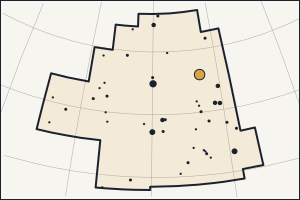
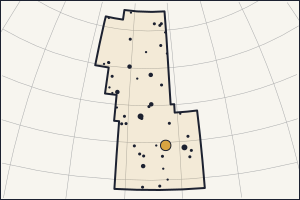
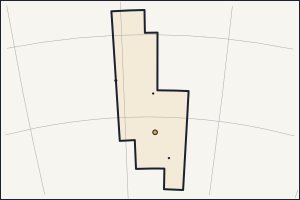
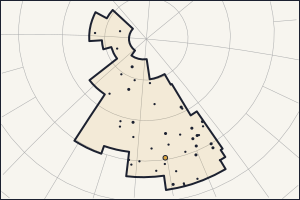
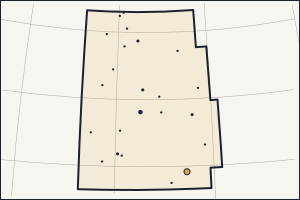
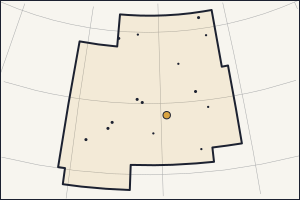
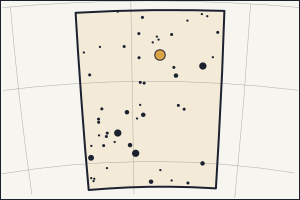
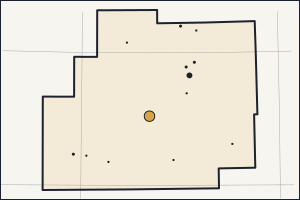
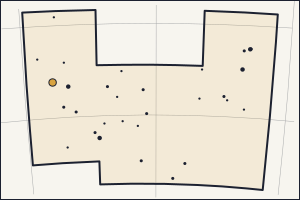
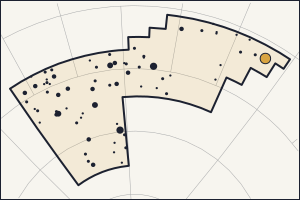
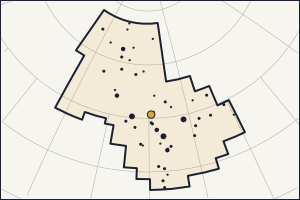
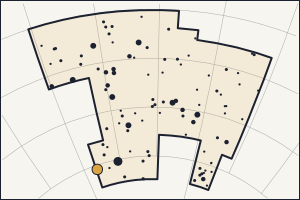
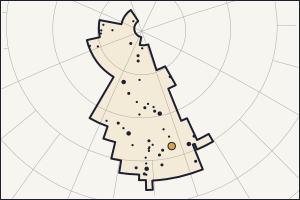
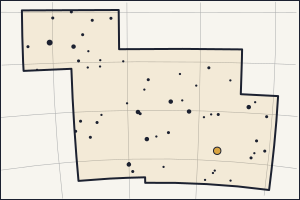
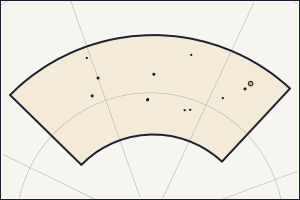
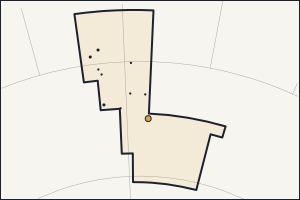
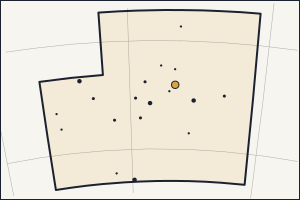
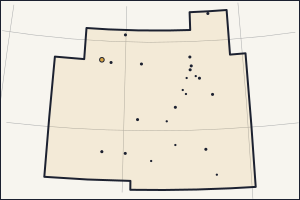
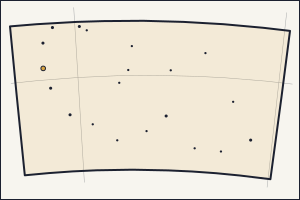
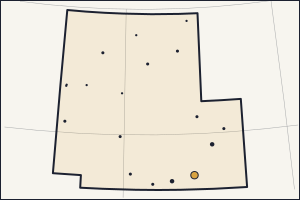
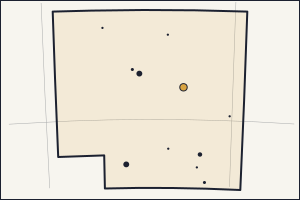
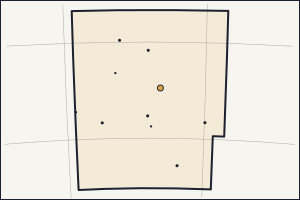
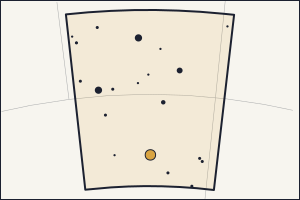
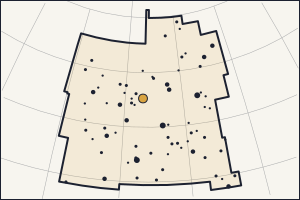
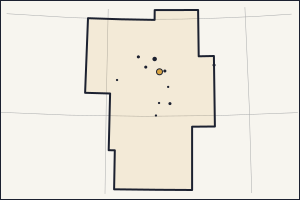
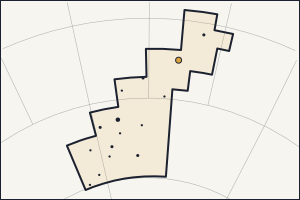
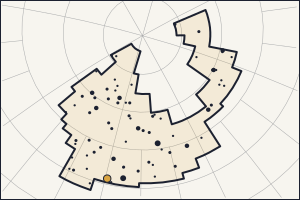
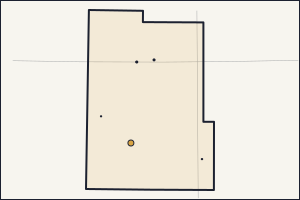
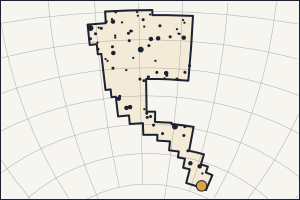
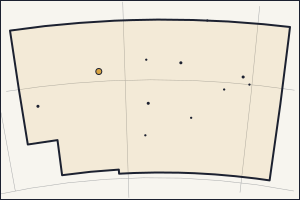
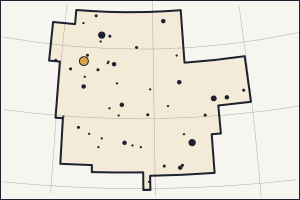
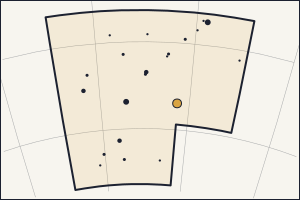
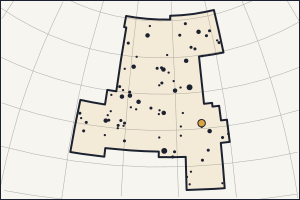
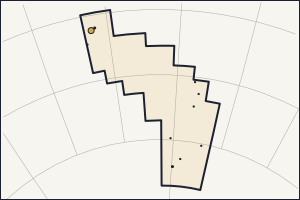
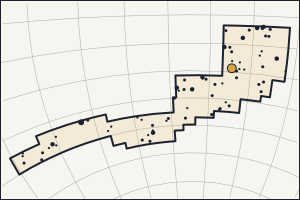
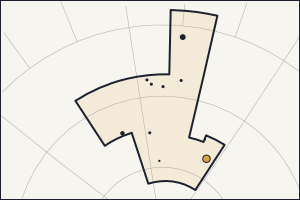
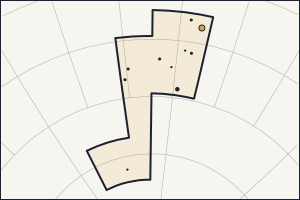
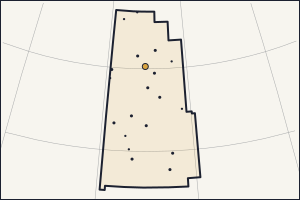
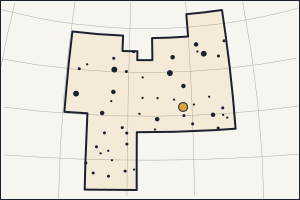
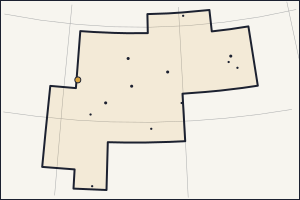
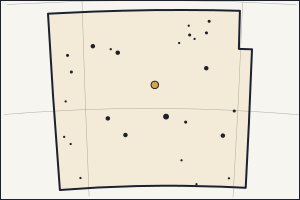
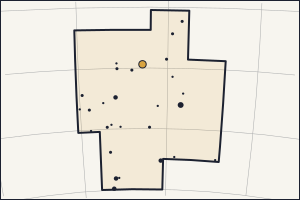
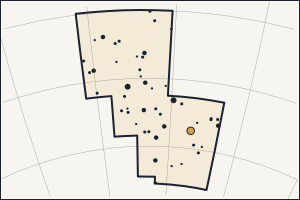
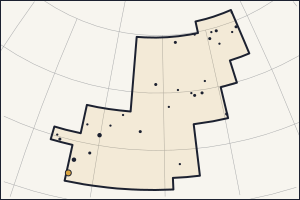
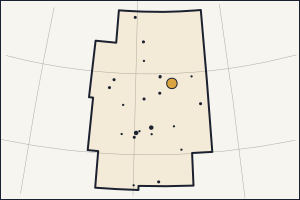
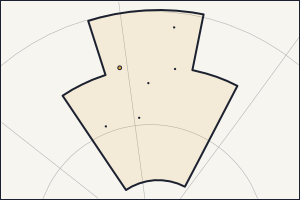
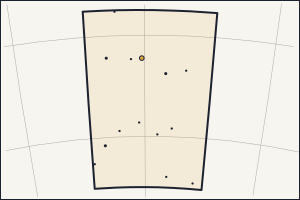
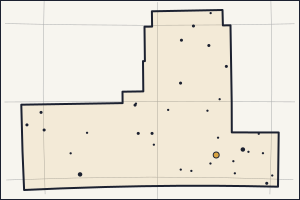
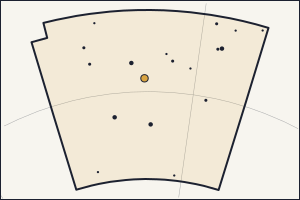
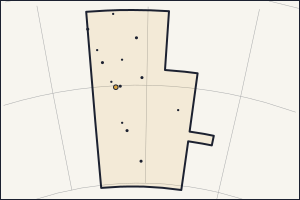
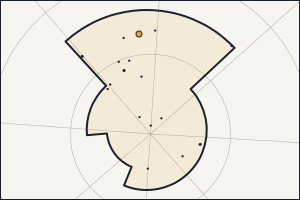
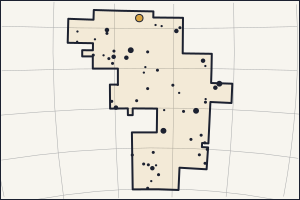
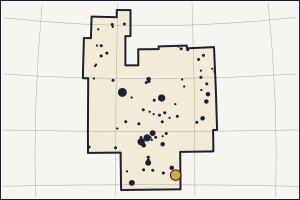
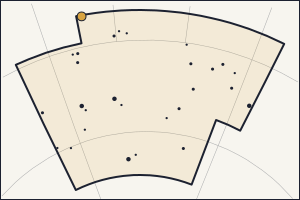
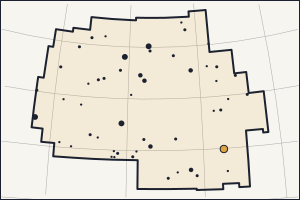
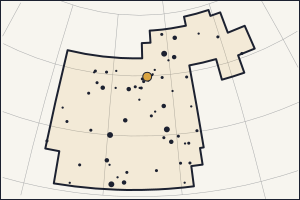
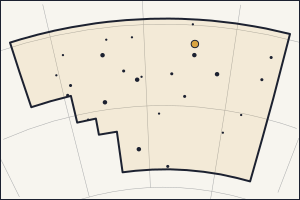
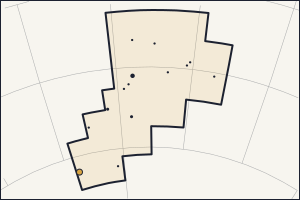
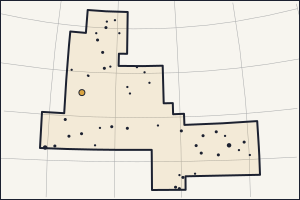
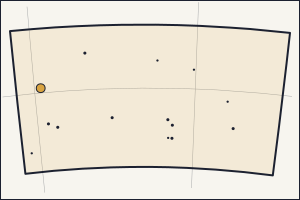
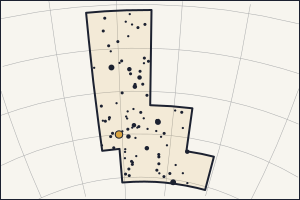
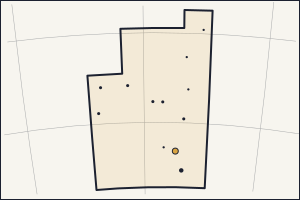
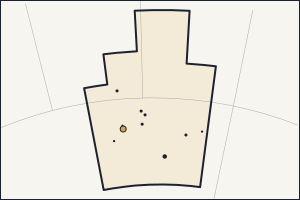
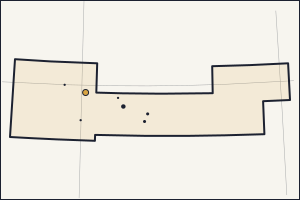
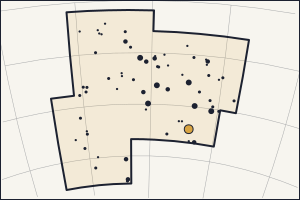
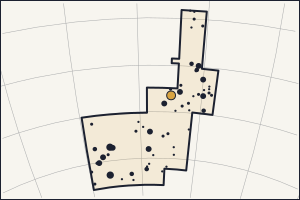
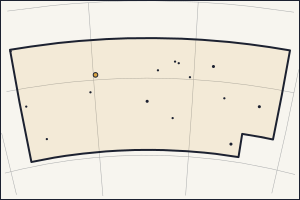
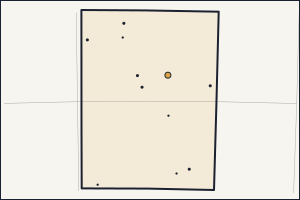
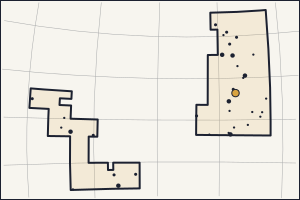
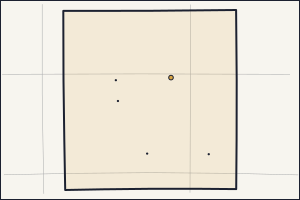
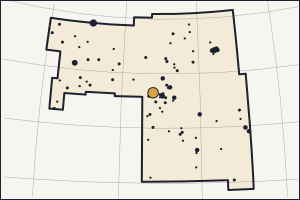
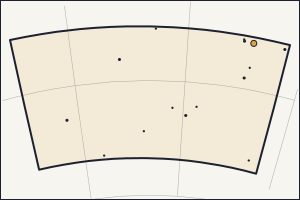
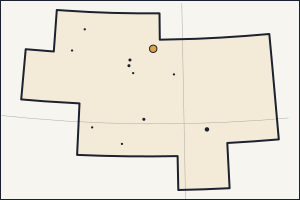
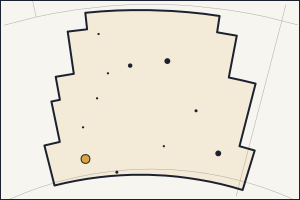
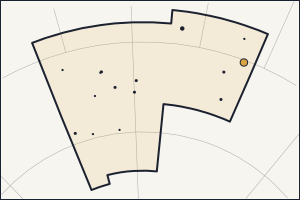
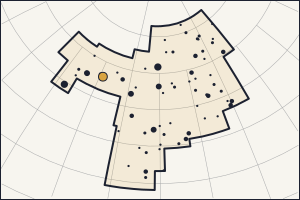
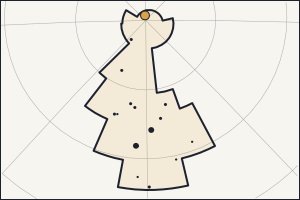
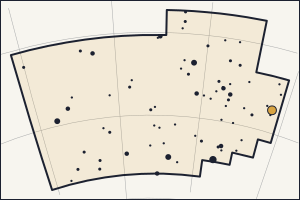
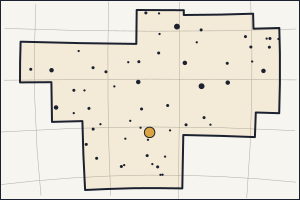
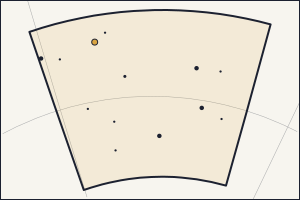
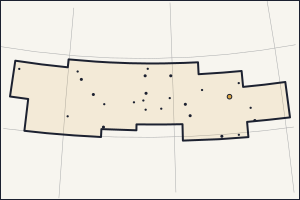
Table: "The 88 constellations: area, brightest star, star count, latitude limits and best evening month" by Asterisms & Astrolabes, https://asterismsandastrolabes.com/constellations/88-constellations/, licensed under CC BY-SA 4.0, https://creativecommons.org/licenses/by-sa/4.0/
Charts: "The 88 constellation charts" by Asterisms & Astrolabes, https://asterismsandastrolabes.com/constellations/88-constellations/, licensed under CC BY-SA 4.0, https://creativecommons.org/licenses/by-sa/4.0/
Whole-sky map: "The 88 constellations on one equal-area map" by Asterisms & Astrolabes, https://asterismsandastrolabes.com/constellations/88-constellations/, licensed under CC BY 4.0, https://creativecommons.org/licenses/by/4.0/
Data: HYG Database v4.4 by David Nash (astronexus), CC BY-SA 4.0, https://codeberg.org/astronexus/hyg; Constellation boundaries: E. Delporte (1930), digitized by A. C. Davenhall and S. K. Leggett (1989), CDS/VizieR catalogue VI/49, https://cdsarc.cds.unistra.fr/ftp/VI/49/
CSV download: all 88 constellations (CC BY-SA 4.0) (Data: HYG Database v4.4 by David Nash (astronexus), CC BY-SA 4.0, https://codeberg.org/astronexus/hyg; Constellation boundaries: E. Delporte (1930), digitized by A. C. Davenhall and S. K. Leggett (1989), CDS/VizieR catalogue VI/49, https://cdsarc.cds.unistra.fr/ftp/VI/49/), with its provenance note (JSON)
What do the columns mean?
- Area and rank. Area is in square degrees, computed exactly from the 1930 borders. Rank 1 is the largest.
- Brightest star. The lowest magnitude among HYG v4.4 entries inside the border; on the magnitude scale, lower numbers are brighter. HYG is an open database that combines the Hipparcos, Yale Bright Star and Gliese catalogues. The note under an entry (
brightest_star_qualifierandnotein the CSV) flags ties, close calls and some variable stars and separately listed companions, so an entry with no note isn't necessarily a steady star. In 24 rows the brightest entry has only a catalogue designation, such as Alpha Antliae, because neither HYG nor the working group's catalogue lists a proper name for it as of November 2026. - HYG entries to magnitude 6.5 (CSV only). A count of catalogue rows, and a row is not always one star, because HYG lists many components of multiple stars separately. The column totals 8,920. This site's naked-eye budget uses the Yale Bright Star Catalogue instead, which holds 8,404 entries at the same cutoff. The two differ because the catalogues differ: 577 of the HYG entries have no Yale number at all.
- Latitude limits. The band of Earth's latitudes where every listed entry climbs at least 10° above a flat horizon at its highest, ignoring refraction. A second column in the CSV does the same for the brightest star alone. The CSV writes south as negative.
- On the meridian at 9 p.m. (best evening month). The time of year in 2026 when the center of the constellation's area crosses the meridian, the north–south line through the point overhead, at 9 p.m. local mean solar time. That is time by the Sun's average position, and it can differ from your clock by an hour or more. The month is this page's calculation, not a published standard, so treat it as a guide.
- Notes. Hydra and other long constellations cross the meridian over months, and near the poles the month only marks when a constellation stands highest. Octans has no month at all, because it surrounds the south celestial pole and stands about as high in every season. Serpens is listed as one constellation in two parts.
The limits are deliberately narrower than published "full visibility" ranges. Ridpath's range, for example, gives the latitudes from which each constellation "rises fully above the horizon," and he warns that stars near the horizon are "considerably dimmed by atmospheric extinction." Entries in a row also peak at different times, so passing the test does not mean they all stand 10° up at once, or after dark.
Worked example: how to read the Orion row
Read across Orion, abbreviation Ori. Its area is 594.1 square degrees, rank 26, about 1.4 percent of the sky. The brightest entry is Rigel (Beta Orionis) at magnitude 0.18, and the note under the row warns that Betelgeuse, a variable star, can outshine it.
The CSV puts 204 HYG entries to magnitude 6.5 in Orion, running from declination +20.3° to −10.5°. Declination is the sky's version of latitude.
A star peaks at 90° minus the gap between its declination and your latitude, so it reaches 10° wherever that gap is 80° or less. Add 80 to the southernmost entry and you get 69.5, listed as 69°N. Subtract 80 from the northernmost and you get −59.7, listed as 59°S. Both are rounded inward.
Ridpath gives Orion a full range of 79°N to 67°S. That figure answers a different question: where the whole constellation rises at all. The table asks where every entry gets clear of the thickest air.
The month reads January: the center of Orion is on the meridian at 9 p.m. in late January. The date depends only on right ascension, the sky's version of longitude, so it is the same in both hemispheres wherever Orion rises. At 40°N you are well inside the limits.
Why does Cassiopeia's row say Tiansi, not Schedar?
Because the table applies one rule to all 88, and HYG v4.4 puts Tiansi (Gamma Cassiopeiae) ahead of Schedar (Alpha Cassiopeiae). Other sources reverse the order:
| Source | Tiansi (Gamma Cas) | Schedar (Alpha Cas) |
|---|---|---|
| HYG v4.4 | 2.15 | 2.24 |
| Yale Bright Star Catalogue, 5th revised edition | 2.47 | 2.23 |
| Star-name catalogue of the IAU Working Group on Star Names, at exopla.net | 2.39 | 2.23 |
If you learned Schedar as the brightest, two of these three agree with you. A single figure can't settle it. Ridpath calls Gamma Cassiopeiae "an erratic variable, given to occasional outbursts in brightness," and HYG flags it as variable too. So the row carries a note rather than a verdict.
Crux shows a related problem. HYG's one row for Acrux gives 0.77, while the Yale catalogue splits Alpha Crucis into two stars of 1.33 and 1.73. Read the note under the row before you quote a brightest star.
Using the table in a lesson
The CSV has one row per constellation and opens in any spreadsheet. Four activities work with it directly:
- Check the whole sky. Add up
area_sq_deg. The total is 41,253.0. Then work out the area of a sphere in square degrees, 4π × (180/π)², which gives 41,252.96. Ask why the two differ. - Make a list for your latitude. Keep the rows where your latitude falls between
all_entries_10deg_up_lat_south_limitandall_entries_10deg_up_lat_north_limit. At 40°N, 53 rows pass. The brightest-star columns let 59 through, and comparing the two lists shows which constellations only partly clear the 10° line. - Build a sky calendar. Sort by
best_evening_month_approx, then choose one constellation for each month and check it against the chart. - Argue with the catalogue. Use the Cassiopeia table above to show that a brightest star depends on the source, and on when a variable star was measured.
The CSV and the 88 small charts are licensed CC BY-SA 4.0, so credit them and share any adaptation under the same licence. Figure 1 is CC BY 4.0. The file holds areas but no border coordinates. Those stay with their source, CDS catalogue VI/49.
88 constellations FAQ
Why are there 88 constellations?
The IAU agreed the list at its first General Assembly in 1922, as Ridpath records, and has kept that number. Constellation Boundaries covers how that happened and why the printed list held 89 names.
Can you see all 88 constellations from one place?
Not on this table's 10° test. The most any latitude manages is 82 of 88, at every whole degree from 5°S to 18°S except 8°S. The equator gets 79; Apus, Camelopardalis, Cepheus, Chamaeleon, Draco, Hydrus, Mensa, Octans and Ursa Minor fall short there. At 30°S the count is 74, and at 40°N it is 53. Drop the 10° margin and the answer changes: Ridpath's full visibility ranges for all 88 include the equator, though Octans and Ursa Minor reach only the horizon line there.
Is Alpha always the brightest star in a constellation?
No. In 32 of the 88 rows, the listed brightest entry isn't an Alpha, by HYG v4.4 magnitudes. That count includes rows where HYG shows a tie, such as Ara, so the notes matter. Orion's Rigel is a Beta, and Leo Minor's Praecipua carries no Greek letter at all.
Which constellation has the most catalogue entries?
Centaurus has the most HYG entries to magnitude 6.5, with 283, followed by Cygnus with 274. Equuleus has the fewest, with 18. Size alone doesn't decide it: Hydra, the largest, holds 243, fewer than Cygnus at 804.0 square degrees.
Which constellation has the faintest brightest star?
Mensa. Its brightest HYG entry, Hoerikwaggo, is magnitude 5.08, so that row asks for a darker sky than any other, and how much sky glow takes away is what the Bortle scale grades.
Sources
- International Astronomical Union, "The Constellations" (IAU themes page: constellations as "scientifically defined areas of sky"; an object "in" a constellation lies within its boundaries; many cultures keep their own asterisms; the list mixes Greek patterns recorded by Ptolemy and later ones)https://iauarchive.eso.org/public/themes/constellations/Read: full page text, from the Internet Archive snapshot of 2026-01-01 (https://web.archive.org/web/20260101151017/https://iauarchive.eso.org/public/themes/constellations/); the live page returned HTTP 502 on 2026-11-09
- Ian Ridpath, "The Constellations 1, Andromeda–Indus" (names and abbreviations recognized by the IAU; the 1922 list; A. E. Levin's 1935 areas; size order; full and partial visibility ranges; stars to magnitude 6.5 in the Hipparcos Catalogue; origin column and notes)http://www.ianridpath.com/constellations1.htmlRead: full table and notes
- Ian Ridpath, "The Constellations 2, Lacerta–Vulpecula" (same table and notes, second half)http://www.ianridpath.com/constellations2.htmlRead: full table and notes
- David Nash (astronexus), HYG Database v4.4, data README and licence (CC BY-SA 4.0): combines the Hipparcos, Yale Bright Star and Gliese catalogues; source of every star, magnitude, entry count and declination in the tablehttps://codeberg.org/astronexus/hygRead: upstream README kept beside the site's copy of the data; catalogue file, rows for Cassiopeia, Crux, Monoceros, Orion and Hercules read directly and all 8,920 rows to magnitude 6.5 counted
- A. C. Davenhall and S. K. Leggett, "A Catalogue of Constellation Boundary Data" (Royal Observatory Edinburgh, 1989/1990), CDS catalogue VI/49, from E. Delporte's 1930 borders (coordinates used for areas, assignment and drawing; not republished)https://cdsarc.cds.unistra.fr/ftp/VI/49/Read: data file constbnd.dat in the site's checked copy; the CDS host timed out on 2026-11-09, so the ReadMe was not reread
- D. Hoffleit and W. H. Warren Jr., The Bright Star Catalogue, 5th Revised Ed. (Preliminary Version) (1991), CDS catalogue V/50 (V magnitudes of HR 168, HR 264, HR 2356, HR 2357, HR 2358, HR 4730 and HR 4731; 8,404 entries at magnitude 6.5 or brighter)https://cdsarc.cds.unistra.fr/ftp/V/50/ReadMeRead: catalogue file in the site's checked copy, these rows read directly; the CDS host timed out on 2026-11-09, so the ReadMe was not reread
- IAU Working Group on Star Names, "IAU-Catalog of Star Names (CSN)," published at exopla.net (Tiansi, HR 264, γ Cas, adopted 2025-11-13, V 2.39, Chinese asterism attested for at least 2000 years; Schedar, HR 168, α Cas, V 2.23)https://exopla.net/star-names/modern-iau-star-names/Read: full table; site imprint at https://exopla.net/imprint/ (names the working group and its chair, links to the group's iau.org page)
- International Astronomical Union, "Division C WG Star Names" (working group page: names visible stars, brighter than magnitude 6.5, from historical and Indigenous asterisms)https://www.iau.org/WG280/WG280/Home.aspxRead: full page text
- Ian Ridpath, "Star Tales: Cassiopeia" (Alpha Cassiopeiae, magnitude 2.2, Schedar; Gamma Cassiopeiae "an erratic variable, given to occasional outbursts in brightness")http://www.ianridpath.com/startales/cassiopeia.htmlRead: section on the stars of Cassiopeia
- Wikipedia, "Betelgeuse" (apparent magnitude varying between +0.0 and +1.6, infobox 0.0–1.6, citing the AAVSO Variable Star Index; the Index itself was not read)https://en.wikipedia.org/wiki/BetelgeuseRead: lead, variability section, infobox and reference 5
Computed by this site (2026-11-09) from sources 4 and 5: the areas and ranks, sky shares and total, the placing of HYG entries inside each border, the entry counts, the latitude limits and the month for each row, using 2026 dates. Star positions are HYG's J2000 values with proper motion not applied. The origin tally is counted from sources 2 and 3.
Look up next:
Equuleus, the second-smallest constellation at 71.6 square degrees. Its row puts the center on the meridian at 9 p.m. local mean solar time in late September, and its brightest star, Kitalpha, magnitude 3.92, peaks about 55 degrees up in the south from 40°N, by this page's calculation. It needs a fairly dark sky: go with someone, tell a friend where you'll be, carry a red flashlight, and stay off private land and roads. Read on: Naked-Eye Budget: About 8,400 Entries, Never All in One Sky.
Related entries
- Constellation Boundaries: The 88 Borders Run on an 1875 Grid
- Orion Constellation: The Winter Hunter Rises Before Dawn in August
- Naked-Eye Budget: About 8,400 Entries, Never All in One Sky
- Big Dipper: Not a Constellation, and Two of Its Stars Are Strangers
- Bortle Scale: A City Sky Tops Out Near 250 Stars
Cite this page
Asterisms & Astrolabes. “The 88 Constellations: Hydra Covers 19 Times the Sky of Crux.” Asterisms & Astrolabes. Published 9 November 2026; last substantive revision 9 November 2026. https://asterismsandastrolabes.com/constellations/88-constellations/. Accessed [the date you read it].