Atlas entry
Three-Clock Problem: 12 Moons Fall 11 Days Short of a Year
TL;DR: The three-clock problem is this site's name for a mismatch every calendar inherits: the day, the Moon's cycle of phases and the year do not divide evenly into one another. Twelve cycles of phases end about 11 days before the year does, so each calendar chooses which clocks to follow, then lets the others slide or patches them with extra days or months.
In this entry7 sections
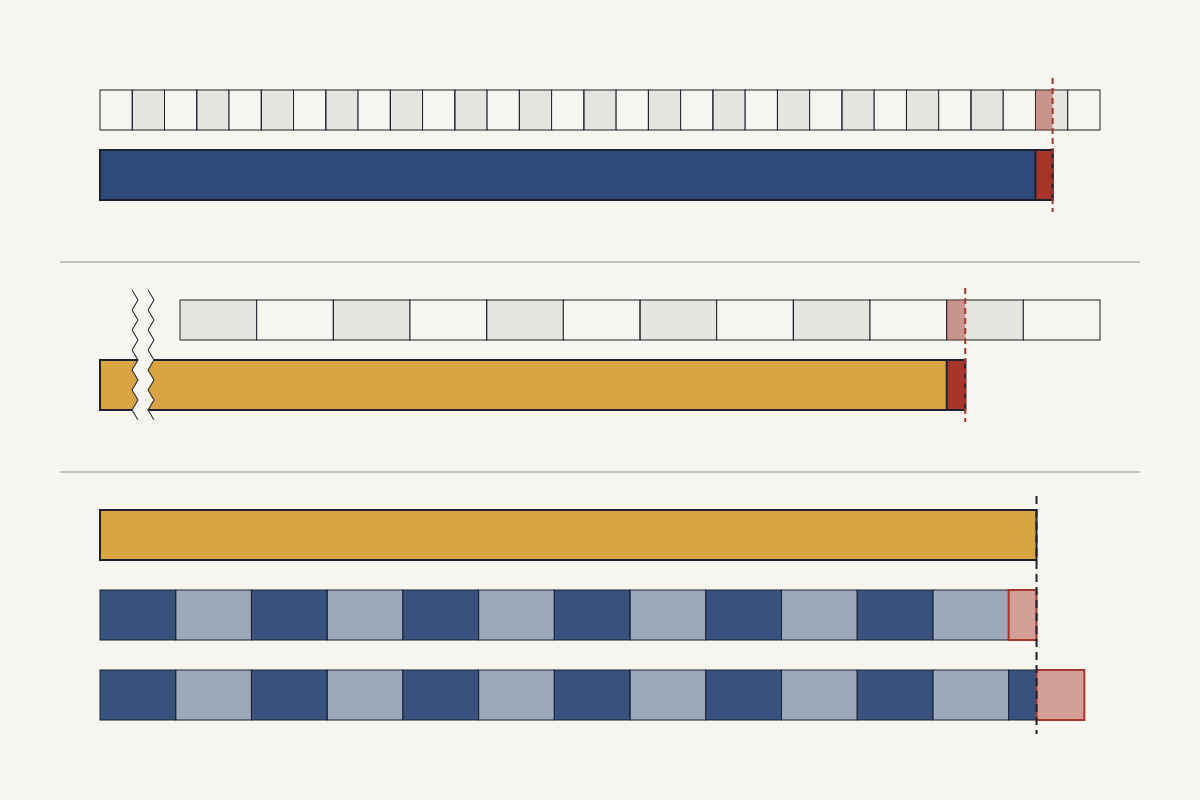
Open the chart full size to zoom in on the detail.
Figure 1. Three pairs of clocks, three remainders. Top: one cycle of the Moon's phases (blue bar) against whole days (cells); it ends 12 hours 44 minutes into day 30 (red). Middle: the last days of one tropical year (gold bar; the zigzag stands for the 355 days left out) against whole days; it ends 5 hours 48 minutes 45 seconds into day 366 (red). Bottom: one year (gold) above 12 cycles of phases, which end 10.88 days early (red gap), and 13, which run 18.66 days past the dashed year-end line (red). Lengths used: 29.530589 and 365.24219 days.
Twelve cycles of the Moon's phases end about 11 days before the year does. Thirteen run about 19 days past it, and neither cycle holds a whole number of days. The day, the Moon's cycle of phases and the year do not divide evenly into one another, which this site calls the three-clock problem. Each calendar is a different compromise with a problem that has no exact solution.
What is the three-clock problem?
The name belongs to this site. The fact behind it does not. The U.S. Naval Observatory (USNO) lists the day, the month and the year as the principal astronomical cycles behind calendars, and explains the trouble in one sentence: "The complexity of calendars arises because the year does not comprise an integral number of days or an integral number of lunar months."
In this site's usage, the three clocks are:
- The day: one turn of Earth timed by the Sun, from noon to noon. Averaged over the year, this mean solar day lasts 24 hours. Wikipedia's solar time article puts it at about 86,400.002 SI seconds as of 2008.
- The month: the Moon's cycle of phases, from new Moon to new Moon, called the synodic month. Its mean length is 29.53 days. The same cycle paces the tides: NOAA notes spring tides twice each lunar month, about every 14.8 days by this page's calculation (tides).
- The year: the cycle of the seasons, called the tropical year. Its mean length in 2000 was 365.24219 days.
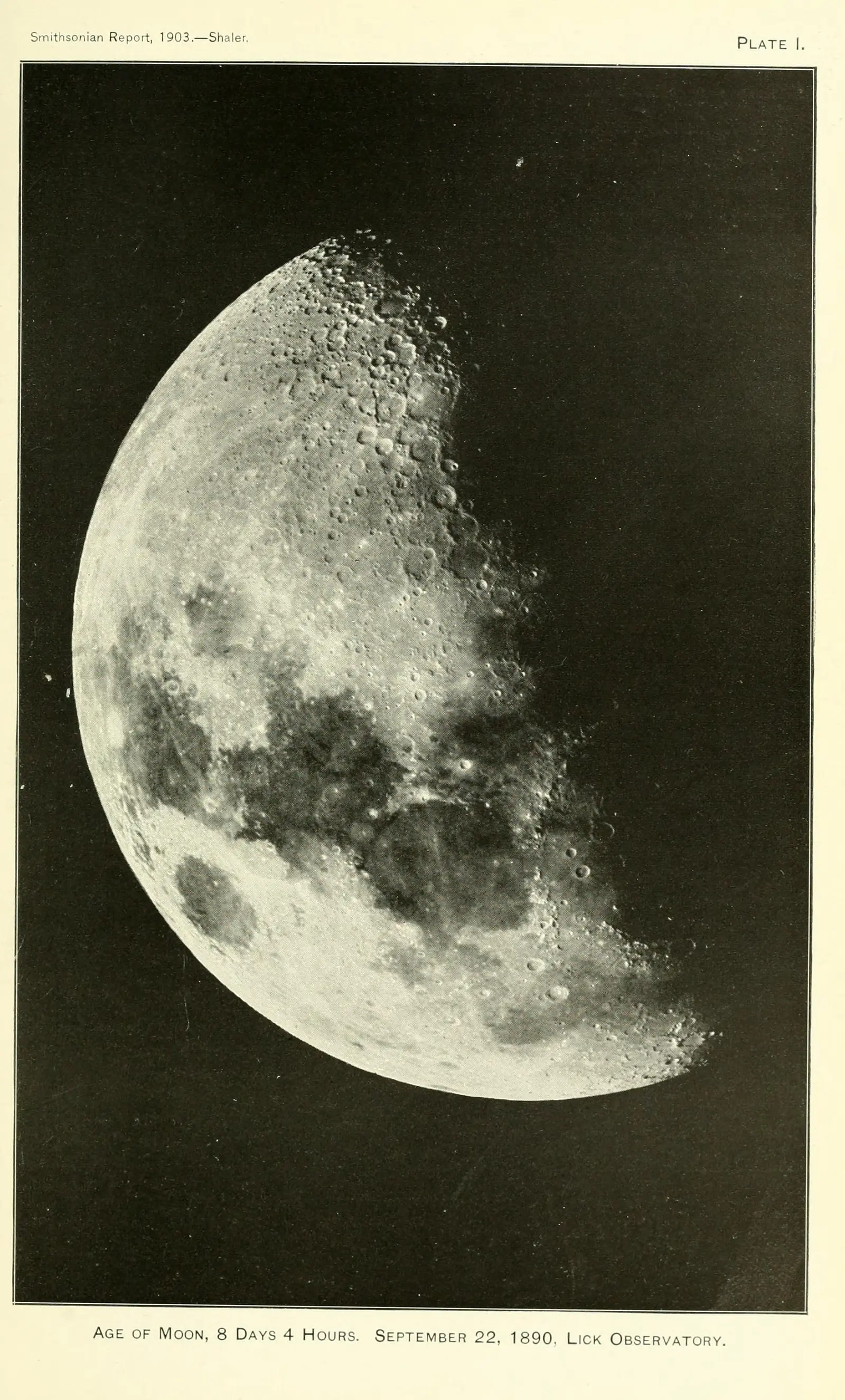

Figure 2. The Moon at an age of 8 days 4 hours, photographed at Lick Observatory on 22 September 1890. As printed in the Smithsonian report for 1903, south is at the top.
Calendars hand out whole days, so the other two clocks are counted in days. Neither comes out even. The month runs 29 days, 12 hours and 44 minutes; the year runs 365 days, 5 hours, 48 minutes and 45 seconds (Figure 1).
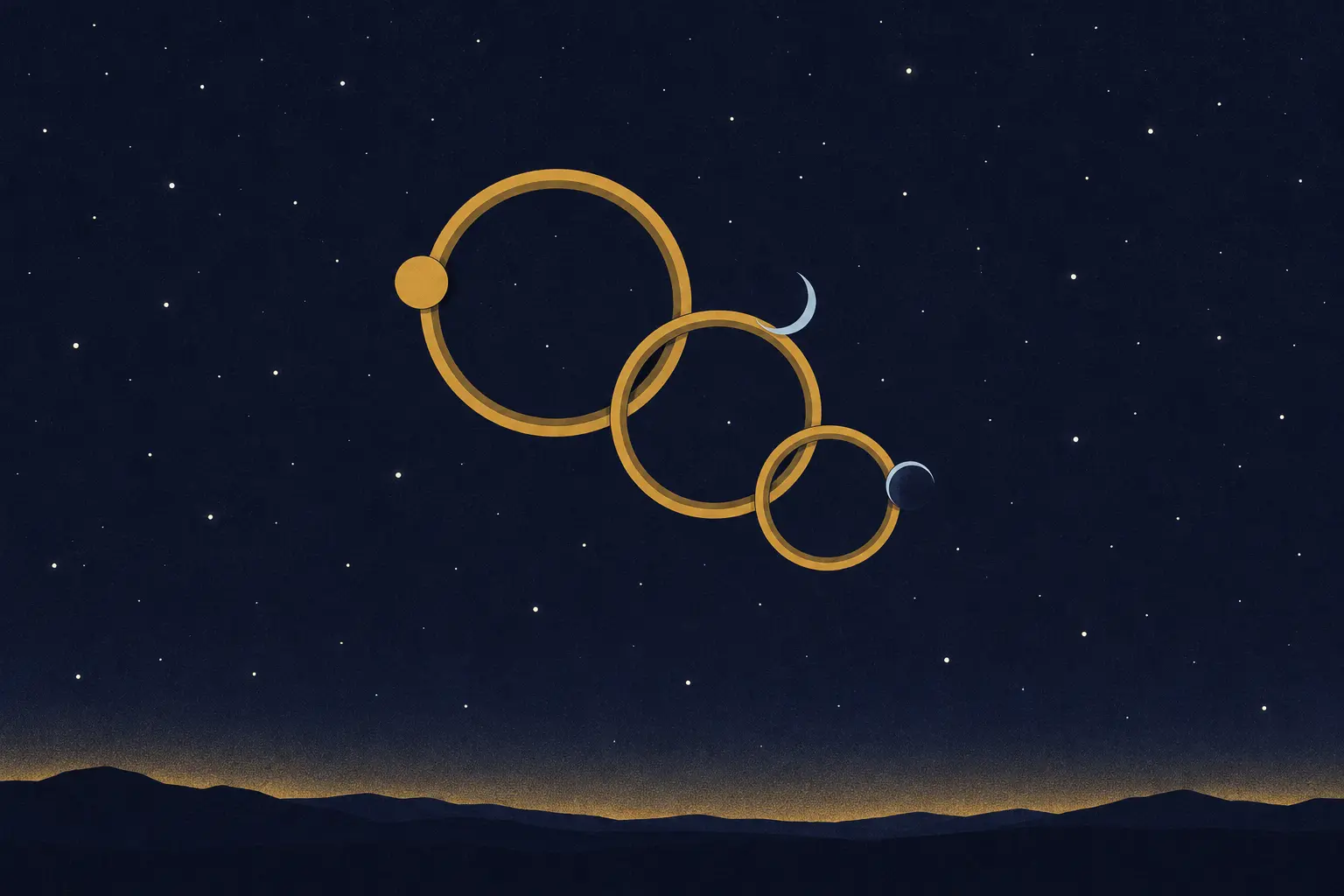
Three rings for three clocks, not drawn to scale: the year (sun), the Moon's cycle of phases (crescent) and the day (dark globe). None divides evenly into another; this site calls that the three-clock problem.
The term also fixes which day, month and year it means. Each clock has a twin. The twin runs against the stars instead of the Sun:
| Clock | Timed against the Sun (this term) | Timed against the stars |
|---|---|---|
| Day | Mean solar day: 24 hours | Sidereal day: 23 h 56 min 4.09 s |
| Month | Synodic month: 29.53 days | Sidereal month: 27.32 days |
| Year | Tropical year: 365.24219 days | Sidereal year: 20 min 24.7 s longer |
Day and night follow the Sun. The phases depend on where the Moon stands relative to the Sun, and the seasons repeat with the tropical year. So the term means the left column.
The twins differ for two reasons. While Earth turns once or the Moon makes one lap, Earth also moves along its orbit. The Sun-timed version needs extra time to catch up: nearly 4 minutes a day and about 2.2 days a month. The two years differ because of the precession of the equinoxes, the slow wobble of Earth's axis (axial precession).
Why does a calendar need leap days or leap months?
Measured in days, the three clocks leave these remainders:
| Pair | Ratio | What is left over |
|---|---|---|
| Month in days | 29.53 | 12 h 44 min into day 30 |
| Year in days | 365.24219 | 5 h 48 min 45 s into day 366 |
| Year in months | 12.37 | 12 months end 10.88 days short; 13 run 18.66 days over |
Ratios and remainders by this page's calculation, from a mean synodic month of 29.530589 days and a mean tropical year of 365.24219 days.
The third row costs the most. Twelve cycles of phases add up to 354.37 days, 10.88 days short of the year. Thirteen add up to 383.90 days, 18.66 days too many.
A calendar cannot split a day. Drop the remainder and it carries into the next cycle. A count of 365 days falls 0.24219 day short of the year, every year, and by this page's calculation that adds up to about 24 days a century. USNO states the general result: without an adjustment, "the seasons will steadily drift through the months."
Keeping in step takes a whole unit now and then: an extra day settles the leftover between days and years, and an extra month does the same for months and years. USNO calls inserting an extra month intercalation; the Gregorian calendar's leap day is an extra day of the same kind (Gregorian calendar).
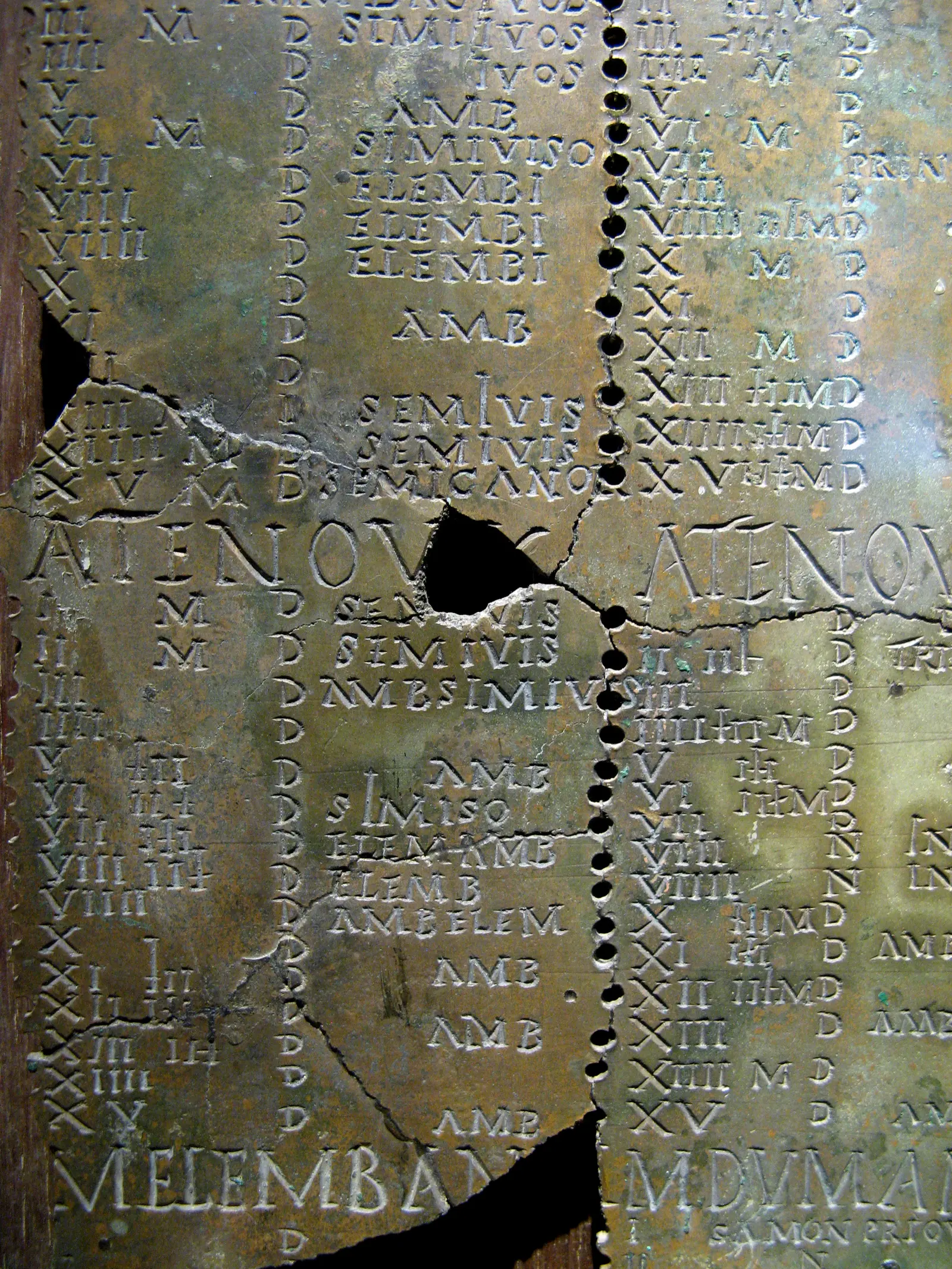

Figure 3. Part of the bronze Coligny calendar, inscribed in Gaulish. Months split into halves at the word atenoux, and an extra month every two and a half years kept the calendar close to the seasons.
Think of a calendar as a reconciliation of three accounts kept in different units. Each leap day or leap month is an adjusting entry, and the remainders start accruing again the next day.
The clocks do not even tick steadily. Wikipedia's lunar month article notes up to seven hours of variation about the mean in any given year. The solar time article adds that the mean solar day is slowly growing longer, as the Moon's tidal pull slows Earth's rotation. Even the unit shifts: the tropical year article gives the mean tropical year of 2000 as 365.24219 days of exactly 86,400 SI seconds, but 365.24217 mean solar days.
Which clocks does each calendar follow?
Every calendar picks its clocks. USNO sorts the main choices into three families. The week runs alongside them:
| Type | Example | Keeps in step | Lets slide |
|---|---|---|---|
| Solar | Gregorian | Days and seasons | The Moon's phases |
| Lunar | Islamic | Days and the Moon's phases | The seasons, a full lap in about 33 years |
| Lunisolar | Hebrew, Chinese | Days, phases and seasons | None by design: extra months pull the year back |
| Week | Seven-day week | Days | The Moon's phases and the seasons |
Solar calendars, in USNO's words, "neglect any attempt to keep the months synchronous with the lunar phases" (Gregorian calendar). The Islamic calendar's 12 months regress through the seasons over about 33 years. Lunisolar calendars try to keep pace with both the year and the phases; USNO counts an extra month every few years among the methods used most often (lunisolar calendars). The week, built from days alone, tracks neither the Moon nor the year (seven-day week).
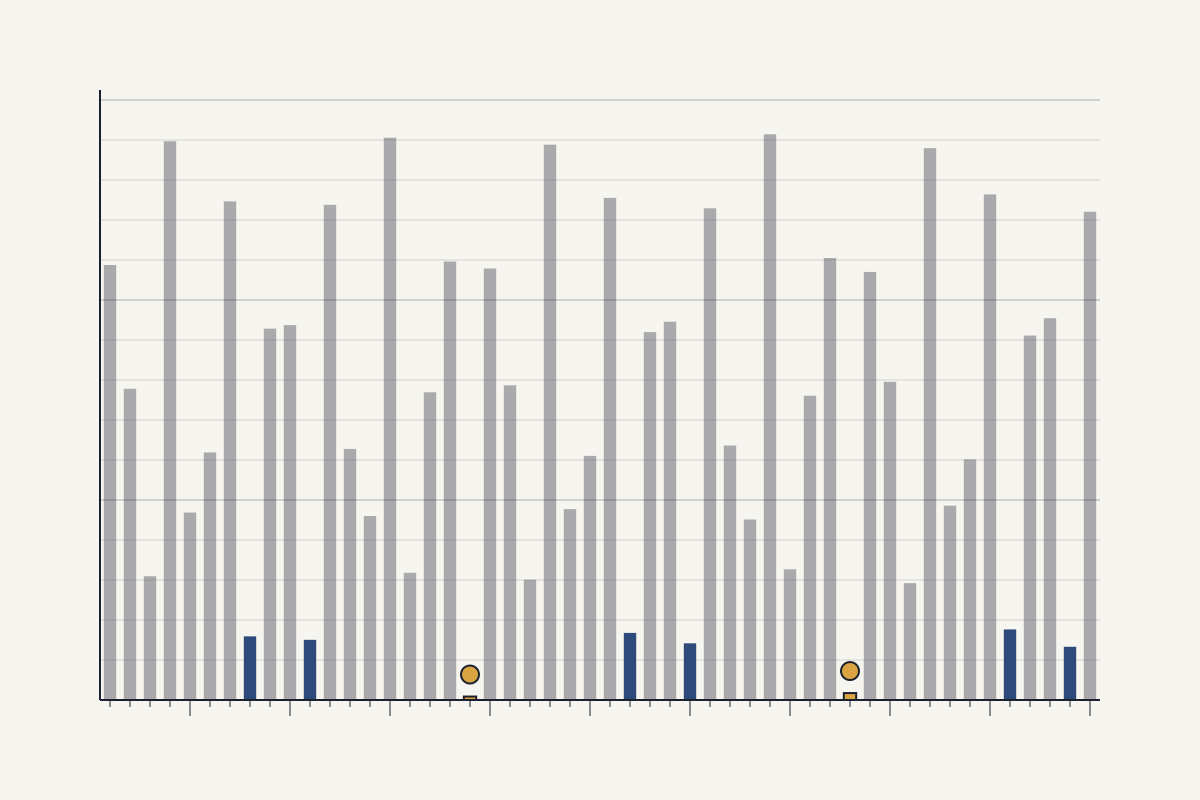
Months and years never line up exactly. For every whole number of years from 1 to 50, this page's calculation finds the nearest whole number of synodic months and measures the gap. No gap reaches zero.
Open the chart full size to zoom in on the detail.
Figure 4. For each whole number of years from 1 (left) to 50 (right; long ticks every 5 years), the bar shows how far that many tropical years lies from the nearest whole number of synodic months. Grid lines every day; the tallest bars reach about 14 days. Gold dots mark 19 and 38 years (2.1 and 4.2 hours); blue bars are the other gaps under 2 days: 8, 11, 27, 30, 46 and 49 years.
CSV download (CC BY 4.0), with its provenance note (JSON)
The smallest gap, about 2 hours, comes at 19 years against 235 months. USNO gives the same figure for that 19-year cycle, which it calls the Metonic cycle and describes as useful for calendar makers (lunisolar calendars). The 38-year bar is two of those cycles, with twice the miss. Below 19 years, the closest are 11 years against 136 months and 8 years against 99, each about a day and a half off.
Each match leaves a remainder, so no calendar can keep all three clocks exactly. The compromises themselves come next: a solar calendar dropping 10 dates in 1582 (Gregorian calendar), and lunisolar calendars adding whole months (lunisolar calendars).
Sources
- U.S. Naval Observatory, Astronomical Applications Department, "Introduction to Calendars" (Internet Archive copy of 13 January 2026; principal cycles day, month and year; solar, lunar and luni-solar calendars; intercalation; Metonic cycle off by about 2 hours; Islamic months regress through the seasons over about 33 years)https://web.archive.org/web/20260113143248/https://aa.usno.navy.mil/faq/calendarsRead: full page (archived copy)
- Wikipedia, "Lunar month" (revision of 1 October 2026; synodic month as the period of the phases, mean 29.53059 days and the Chapront-Touzé and Chapront 1988 expression, up to seven hours of variation about the mean in any given year, sidereal month 27.321661 days and about 2.2 days shorter)https://en.wikipedia.org/wiki/Lunar_monthRead: full article text (revision 1377910813)
- Wikipedia, "Tropical year" (revision of 8 September 2026; mean tropical year in 2000 of 365.24219 ephemeris days, or 365.24217 mean solar days; about 365 days, 5 hours, 48 minutes, 45 seconds; complete cycle of seasons; sidereal year 20 minutes 24.7 seconds longer because of the precession of the equinoxes)https://en.wikipedia.org/wiki/Tropical_yearRead: full article text (revision 1373945112)
- Wikipedia, "Solar time" (revision of 3 August 2026; noon to noon; mean solar day about 86,400.002 SI seconds as of 2008; mean solar day slowly increasing through the tidal acceleration of the Moon)https://en.wikipedia.org/wiki/Solar_timeRead: full article text (revision 1367555612)
- Wikipedia, "Sidereal time" (revision of 11 May 2026; sidereal day about 86,164.0905 seconds, 23 h 56 min 4.0905 s; Earth moves about 1 degree along its orbit per day, so a mean solar day is nearly 4 minutes longer)https://en.wikipedia.org/wiki/Sidereal_timeRead: full article text (revision 1353674495)
- NOAA National Ocean Service, "What are spring and neap tides?" (spring tides occur twice each lunar month)https://oceanservice.noaa.gov/facts/springtide.htmlRead: full page
- David Nash (astronexus), HYG Database v4.4 (CC BY-SA 4.0; Capella's position and magnitude used for the Look up next times and heights)https://codeberg.org/astronexus/hygRead: catalogue file hyg_v44.csv.gz
- ERFA (Essential Routines for Fundamental Astronomy), C source files ltpecl.c, ltpequ.c and ltp.c (Vondrák, Capitaine and Wallace 2011 long-term precession), era00.c and gmst06.c (Earth rotation angle and IAU 2006 Greenwich mean sidereal time), and p06e.c (IAU 2006 precession angles, cross-check)https://github.com/liberfa/erfaRead: the six source files
- N. S. Shaler, "General Description of the Moon," in Annual Report of the Board of Regents of the Smithsonian Institution for the Year Ending June 30, 1903 (Washington: Government Printing Office, 1904), Plate I, "Age of moon, 8 days 4 hours. September 22, 1890. Lick Observatory," with the plate note that the top of each plate is southhttps://archive.org/details/annualreportofbo1903smithRead: title page, the opening of Shaler's chapter, and the Plate I caption and orientation note (Internet Archive page image)
- Lugdunum, Musée et théâtres romains (Lyon), "Le calendrier gaulois," collection catalogue, inv. br.001 (bronze plaque inscribed in Gaulish; a lunisolar calendar of five years of 12 months with two intercalary months, one every 2.5 years, added to limit the gap between calendar time and the seasons; each month in two fortnights separated by the word atenoux)https://lugdunum.grandlyon.com/fr/Oeuvre/2381-Calendrier-gaulois-de-ColignyRead: full catalogue entry (in French)
Computed by this site (2026-10-12) from sources 2, 3, 4, 6, 8 and 9: the clock lengths in days, hours and minutes; the ratios and remainders; 24 days a century; the gaps for 1 to 50 years; 14.8 days and 2.2 days; about 2 hours a month; and Capella's magnitude, its place as Auriga's brightest star, and its times and heights (long-term precession of Vondrák, Capitaine and Wallace 2011 with IAU 2006 sidereal time, 40°N, flat horizon, no atmospheric refraction).
Look up next:
Capella, Auriga's brightest star at magnitude 0.08. In mid-October at 40°N, by this page's calculation for a flat horizon and no atmospheric refraction, it rises in the north-northeast around 5:40 p.m. local mean solar time. At 9 p.m. it stands about 22 degrees up in the northeast. If you head somewhere darker to watch it climb, go with someone, tell a friend where you'll be, carry a red flashlight and stay off private land.
It rises nearly 4 minutes earlier each night, so by mid-November the same calculation puts it about 40 degrees up at 9 p.m., as high as it stood at 11 p.m. in mid-October. That nightly step is the gap between the mean solar day and the sidereal day in the table above, and over a month it adds up to about 2 hours. Read on: the tides follow the Moon and the Sun instead of the stars (tides).
Related entries
- Gregorian Calendar: 1582 Dropped 10 Dates, Not 10 Days
- Lunisolar Calendar: Why 7 Years in 19 Get a 13th Month
- Seven-Day Week: The Day Names Skip Two Planets Each Time
- Tides: The Sun Pulls Harder, but Its Tide Is Half the Moon's
- Axial Precession: Earth Usually Has No Bright North Star
Cite this page
Asterisms & Astrolabes. “Three-Clock Problem: 12 Moons Fall 11 Days Short of a Year.” Asterisms & Astrolabes. Published 13 October 2026; last substantive revision 13 October 2026. https://asterismsandastrolabes.com/calendars/three-clock-problem/. Accessed [the date you read it].