Comparison and data page
Lunisolar Calendar: Why 7 Years in 19 Get a 13th Month
TL;DR: A lunisolar calendar starts its months with the Moon but adds a 13th month in some years, so its holidays stay in their season. The classic rule, still used by the Hebrew calendar, puts 7 extra months in every 19 years, because 235 lunar months run only about 2 hours longer than 19 years of seasons.
In this entry11 sections
- What is a lunisolar calendar?
- How do lunisolar, lunar and solar calendars compare?
- Why 7 leap months in 19 years?
- How does the Hebrew calendar add its 13th month?
- How does the Chinese calendar choose its leap month?
- What happens without a leap month?
- Sources
- Corrections
- Look up next
- Related entries
- Cite this page
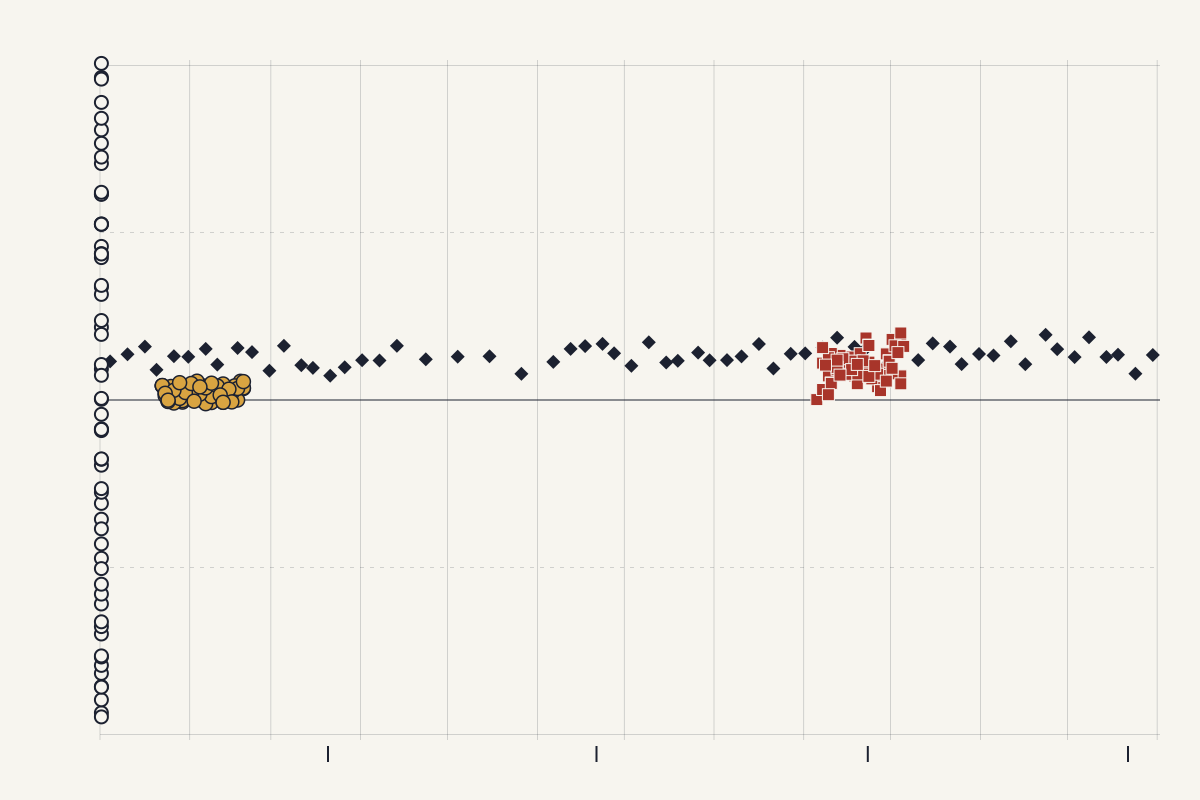
Open the chart full size to zoom in on the detail.
Figure 1. Every New Year's Day from 2000 to 2059 on four calendars, placed on two clocks at once. Left to right is the date in the solar year, January to December, with faint lines at the start of each month and short ticks below for the mean dates of the March equinox, June solstice, September equinox and December solstice. Up and down is the Moon's age at 12:00 Universal Time that day, in days from the nearest new moon: the dark middle line is new moon, the dashed lines are the quarters, and the top and bottom edges are full moon. Open circles are Gregorian January 1, dark diamonds tabular Islamic 1 Muharram, red squares Hebrew 1 Tishrei and gold dots Chinese New Year. Computed by this page; the Islamic marks use the arithmetical (tabular) calendar, so observed dates can differ by a day or two.
About 2 hours separate 235 lunar months from 19 years of seasons. The classic lunisolar rule rests on that near-match. A lunisolar calendar's months follow the Moon's phases while its years follow the seasons. Twelve lunar months fall short of a year, so 7 years in each 19 receive a 13th month.
The Hebrew calendar runs on that rule today. The Chinese calendar reaches nearly the same rhythm by tracking the true Sun and Moon instead.
What is a lunisolar calendar?
A lunisolar calendar answers to two clocks at once. The US Naval Observatory's calendar pages (archived in 2019) describe it as a calendar that tries to stay in step with both the solar year and the phases of the Moon. The day, the Moon's cycle of phases and the year do not divide evenly into one another, which this site calls the three-clock problem (Three-Clock Problem: 12 Moons Fall 11 Days Short of a Year).
Each calendar on this page settles that problem differently. The seven-day week adds a fourth cycle that follows neither the Moon nor the year (seven-day week).
Twelve months are too short. This page uses a mean synodic month, the average time from new moon to new moon, of 29.5305888531 days, the year-2000 value Wikipedia gives from the lunar theory of Chapront-Touzé and Chapront. For the tropical year, the year of the seasons, this page uses Wikipedia's mean value for 2000, 365.24219 days.
With those unrounded values, 12 months come to 354.37 days, 10.88 days short of the year; thirteen months come to 383.90 days, 18.66 days too long. So the calendar mixes 12-month and 13-month years.
The shortfall builds by about 11 days a year, and when it nears a month, the calendar inserts a 13th month.
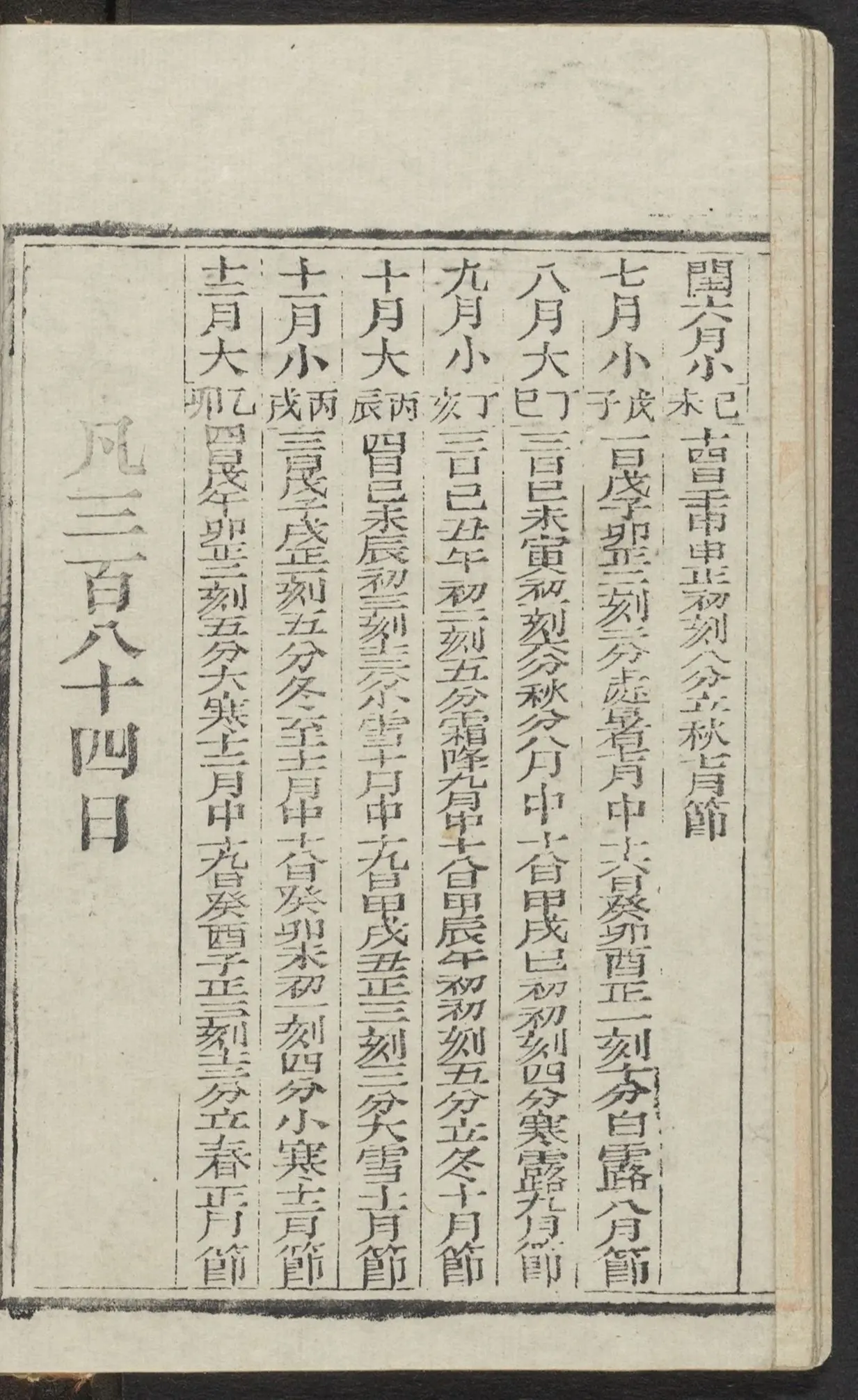
Figure 2. The Qing astronomical bureau's almanac for 1835 lists a leap sixth month (閏六月) and totals the year at 384 days. Each month is marked long (大, 30 days) or short (小, 29).
How do lunisolar, lunar and solar calendars compare?
Each keeps a different pair of clocks.
| Calendar | Months follow the Moon | Years follow the seasons | Days in a year | How it adds time | Drift against the seasons |
|---|---|---|---|---|---|
| Gregorian (solar) | No | Yes | 365 or 366 | A leap day | About 1 day in 3,200 years |
| Islamic, or Hijri (lunar) | Yes | No | 354 or 355 | No leap month; the tabular version adds 11 leap days in 30 years | About 11 days earlier each year; a full lap in about 33 years |
| Hebrew (lunisolar) | Yes, by a mean new moon | Yes | 353 to 355, or 383 to 385 with a 13th month | A 13th month in years 3, 6, 8, 11, 14, 17 and 19 of each 19 | About 1 day in 216 years |
| Chinese (lunisolar) | Yes, by the true new moon | Yes | 353 to 355, or 383 to 385 with a 13th month | A leap month placed by the true Sun | None built in; tied to the true Sun |
Days in a year: Wikipedia and Aslaksen (2010). Drift: this page's calculation from the values above, except two entries. The US Naval Observatory gives the Islamic lap as about 33 years (this page's calculation: 33.6), and the Chinese entry follows from rules tied to the true Sun (Aslaksen).
The arithmetic behind this table, CSV (CC BY 4.0), with its provenance note (JSON)
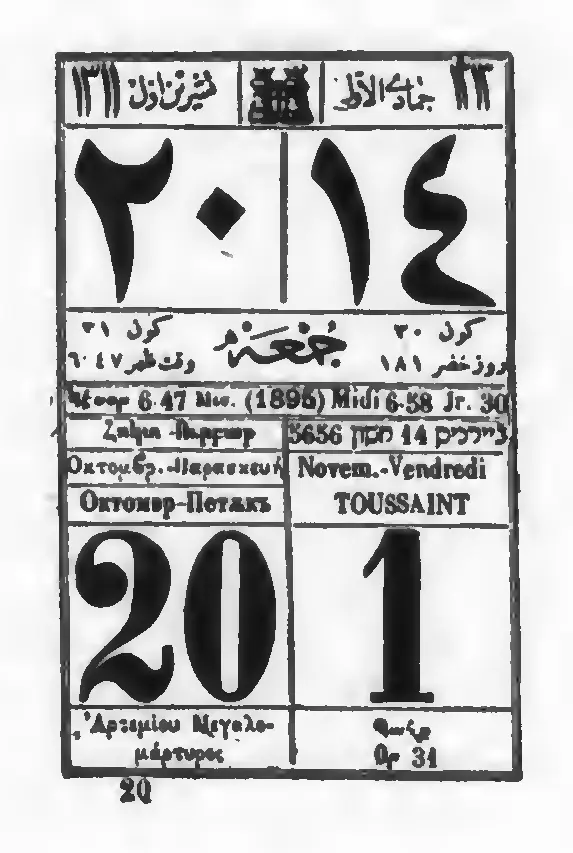
Figure 3. One day's leaf from a calendar printed for Thessalonica: Friday, October 20 in the Julian calendar, November 1 in the Gregorian, with its Islamic and Hebrew dates. From The Biblical World, July 1896.
Why 7 leap months in 19 years?
Divide the year by the month and you get 12.368 months a year, by this page's calculation. The extra 0.368 is how far the calendar falls behind each year, counted in months, and over 19 years that adds up to 6.997 months. Almost exactly 7.
That is the Metonic cycle: 19 years holding 235 months, 7 of them extra. The fit is close but inexact. With the values above, 235 months last 6,939.688 days and 19 years last 6,939.602. The months run about 2.08 hours long in each cycle and gain a full day in about 219 years.
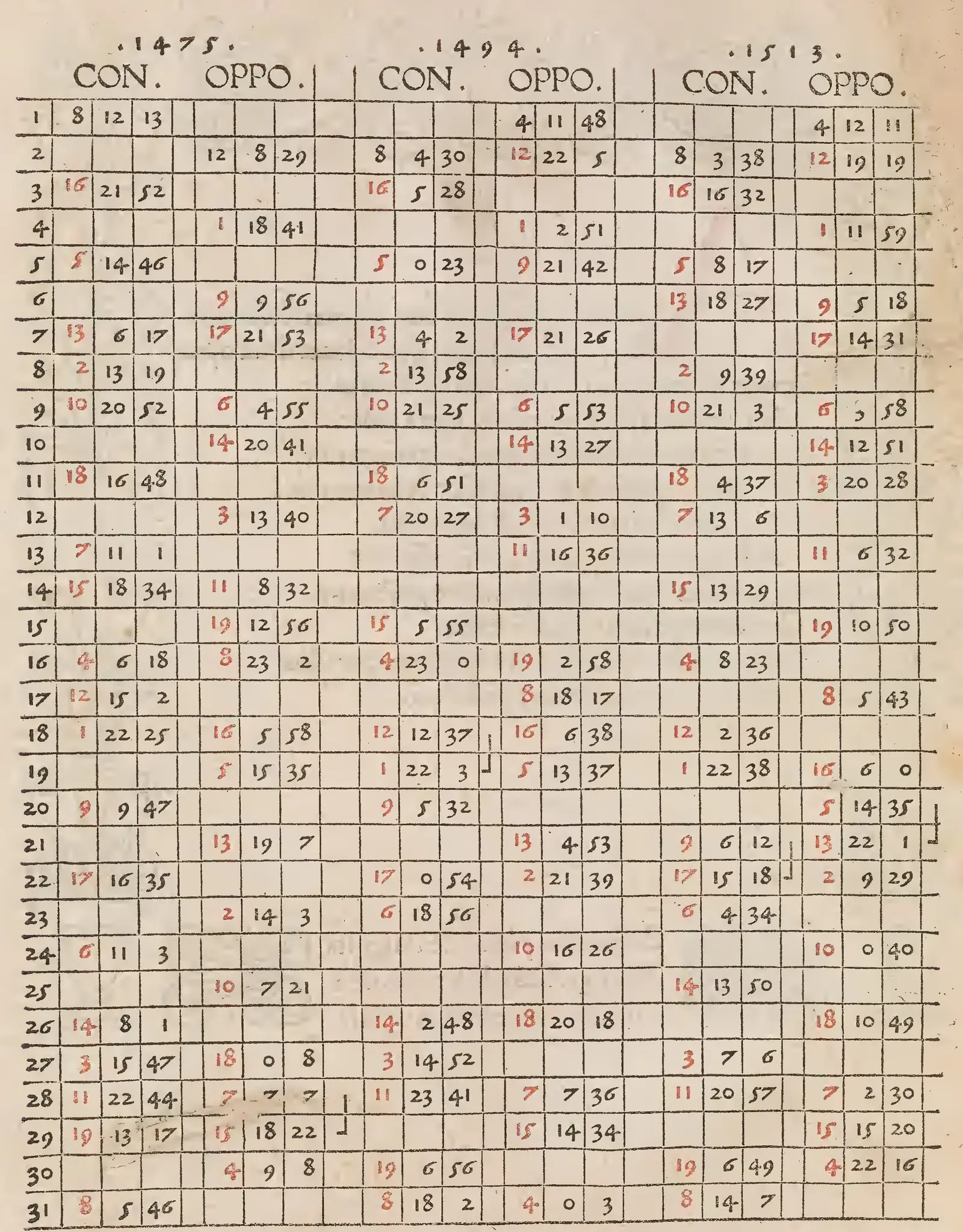
Figure 4. January in Regiomontanus's printed calendar (Venice, 1476): times of new moons (CON.) and full moons (OPPO.) for three 19-year cycles, starting 1475, 1494 and 1513. Red numbers mark each year's place in the cycle.
The US Naval Observatory calls the cycle off by about 2 hours, and Helmer Aslaksen's paper on the Chinese calendar gives one day in about 220 years. Rounding the month to 29.53 days would turn that 2-hour overrun into a 1.24-hour shortfall. The decimals matter here.
No shorter cycle comes within a day, by this page's calculation. The closest are 11 years against 136 months, which fall 1.50 days short, and 8 years against 99 months, which run 1.59 days over. That eight-year cycle is the octaeteris. Wikipedia links it to Cleostratus in ancient Greece and to the calendar of the Olympic Games.
Who found the 19-year cycle has more than one answer. Wikipedia says Meton of Athens introduced it to the Attic calendar in 432 BC. R. H. van Gent of Utrecht University writes that the Babylonian calendar had adopted seven extra months in 19 years after about 500 BCE, and that Greek astronomers later took up the cycle under Meton's name. Aslaksen adds that it was known in China around 600 BCE as the zhāng cycle.
How does the Hebrew calendar add its 13th month?
By fixed arithmetic. Years 3, 6, 8, 11, 14, 17 and 19 of each 19-year cycle have 13 months, Wikipedia explains. In those years Adar is doubled into Adar I and Adar II, and Adar I always has 30 days; sources disagree about which of the two is the added month. Wikipedia ties the leap month to the requirement that Passover fall at the season of the spring barley harvest.

Ripe barley under a spring full moon. Wikipedia ties the Hebrew leap month to keeping Passover at the season of the spring barley harvest.
Months follow the molad, a mean new moon set at 29 days, 12 hours and 793 "parts", with 1,080 parts to the hour. That is 29.530594 days, less than half a second longer than the modern mean month. The molad and the 19-year cycle are both fixed. So the Hebrew year averages about 365.2468 days.
It slips later against the seasons by about a day every 216 years, by this page's calculation and by Wikipedia's. The earliest date for Passover, Wikipedia adds, has moved about eight days since the fourth century. The 15th of Nisan now falls on or after March 26.
This page rebuilt the calendar from its published rules. Between 2000 and 2059, Rosh Hashanah (1 Tishrei) falls between September 5 and October 5, and the first day of Passover between March 26 and April 25. All 120 of those dates match Hebcal's. Each holiday begins at sunset the evening before, as all Jewish holidays do (Wikipedia).
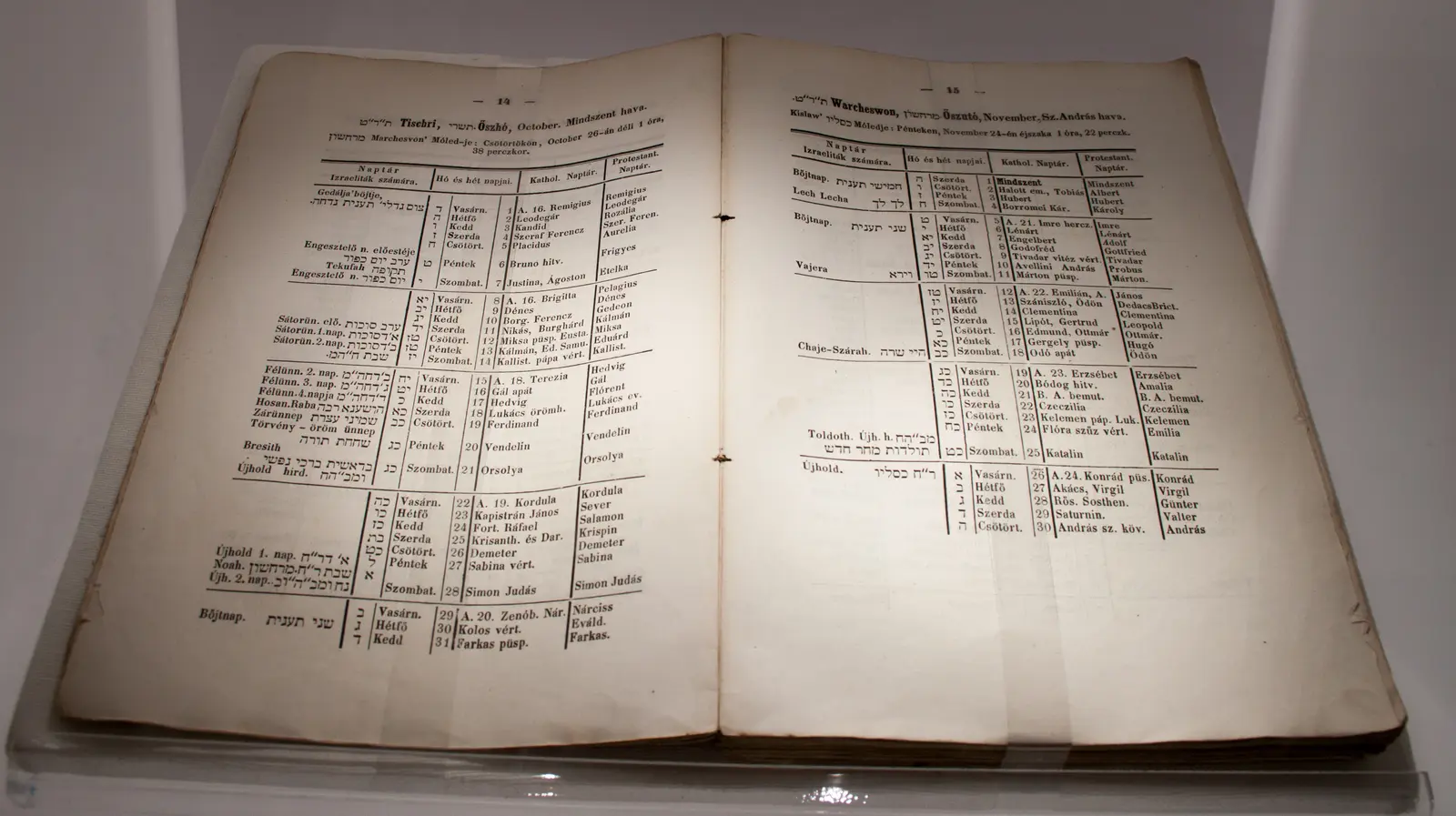

Figure 5. A combined Jewish and Christian calendar from 1848, Hungarian Jewish Museum, open at Tishrei and Marheshvan. Under each month's name it gives a time for the next month's molad (Móled).
How does the Chinese calendar choose its leap month?
By following the true Sun and Moon. Aslaksen sets out the modern rules; the switch to the true Sun dates from the calendar reform of 1645:
- Calculations use the meridian 120° east, the basis of the standard time zone China adopted in 1928; Beijing's meridian was used before 1929.
- Each day starts at midnight, and a month begins on the day of the new moon.
- The December solstice always falls in month 11.
- When 12 complete months fall between one month 11 and the next, the first month that contains no principal solar term, or zhōngqì, is the leap month. It repeats the number of the month before it.
The 12 principal terms are the moments when the Sun has moved a multiple of 30 degrees from a solstice, the December solstice itself among them (Wikipedia). Aslaksen gives their spacing as 29.44 to 31.44 days, closest in winter, when Earth moves fastest. In summer a whole month can fit between two of them. In his count for 1645 to 2644, leap months most often follow the fifth month and very rarely fall between the ninth month and the first.
This page computed the calendar for 1999 through 2061, and it matched all 779 month starts and every solar-term date in the Hong Kong Observatory's conversion tables. Between 2000 and 2059, 22 Chinese years have 13 months, and Chinese New Year falls between January 22 (2004) and February 19 (2015).
Twelve of those 22 leap months follow the fourth, fifth or sixth month, and none follows the 12th or the first. The years also keep a 19-year beat: 2001, 2020, 2039 and 2058 all have a leap month. Its place still wanders, from after month 9 in 2014 to after month 11 in 2033 and after month 8 in 2052.
Why is 2033 unusual?
The rules bite in 2033. That year's eighth month contains no principal term. Yet it is not a leap month, because only 11 complete months fall between the 11th months of 2032 and 2033. The leap month follows the 11th month instead.
Chinese New Year 2034 then lands on the third new moon after the December solstice, not the usual second. Aslaksen writes that until the early 1990s, all Chinese calendars placed the leap month incorrectly for that year.
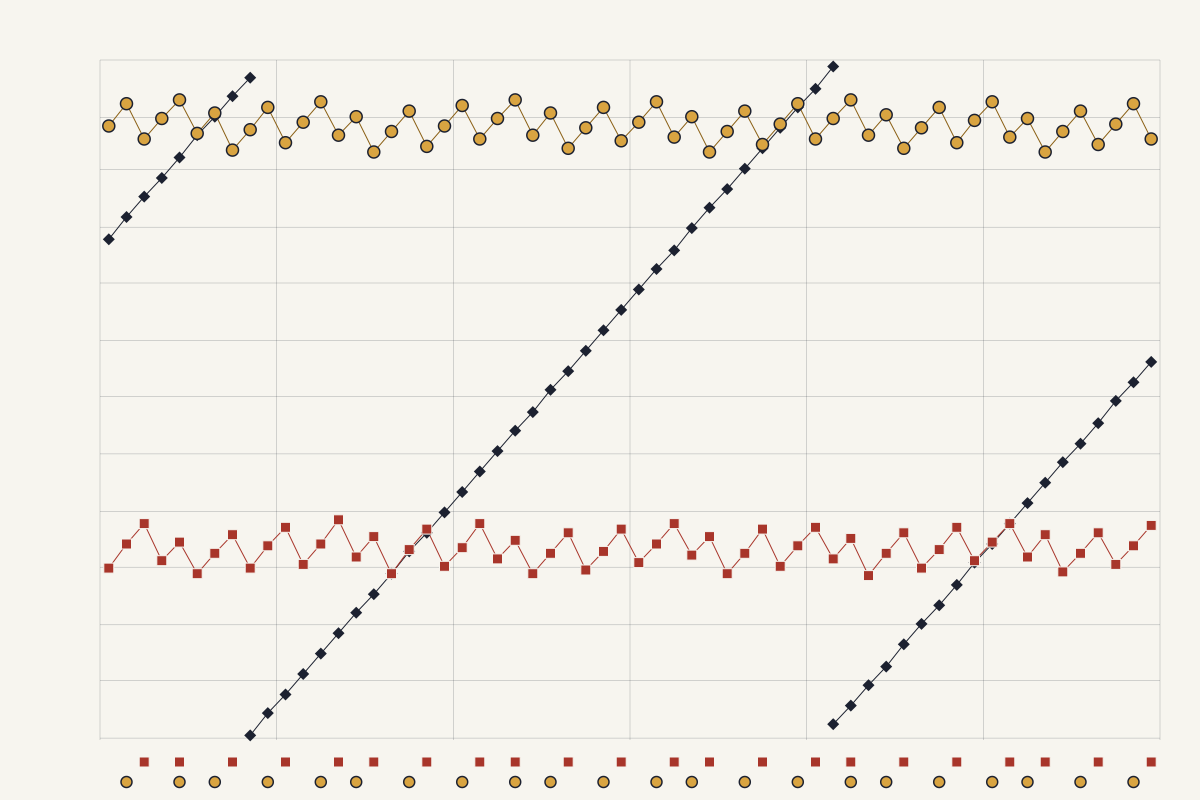
Open the chart full size to zoom in on the detail.
Figure 6. New Year dates year by year, 2000 to 2059. Each column is one Gregorian year; height is the date in that year, January at top and December at bottom. Gold dots are Chinese New Year, red squares Hebrew 1 Tishrei and dark diamonds tabular Islamic 1 Muharram, which wraps through the year twice. Below the plot, red squares (upper row) and gold dots (lower row) mark the years in which a 13-month Hebrew or Chinese year begins. After a 12-month year the next New Year comes 10 to 13 days earlier; after a 13-month year it comes 17 to 20 days later. Computed by this page.
All 242 New Year's Days behind Figures 1 and 6, CSV (CC BY 4.0), with its provenance note (JSON)
What happens without a leap month?
The Islamic, or Hijri, calendar keeps the Moon and lets the seasons go: its 12 months make a year of 354 or 355 days. For religious purposes, a month begins when the thin crescent is first sighted after sunset, a day or so after new moon, the US Naval Observatory notes. The year shifts about 11 days earlier against the civil calendar each year. It laps the seasons in about 33 years.
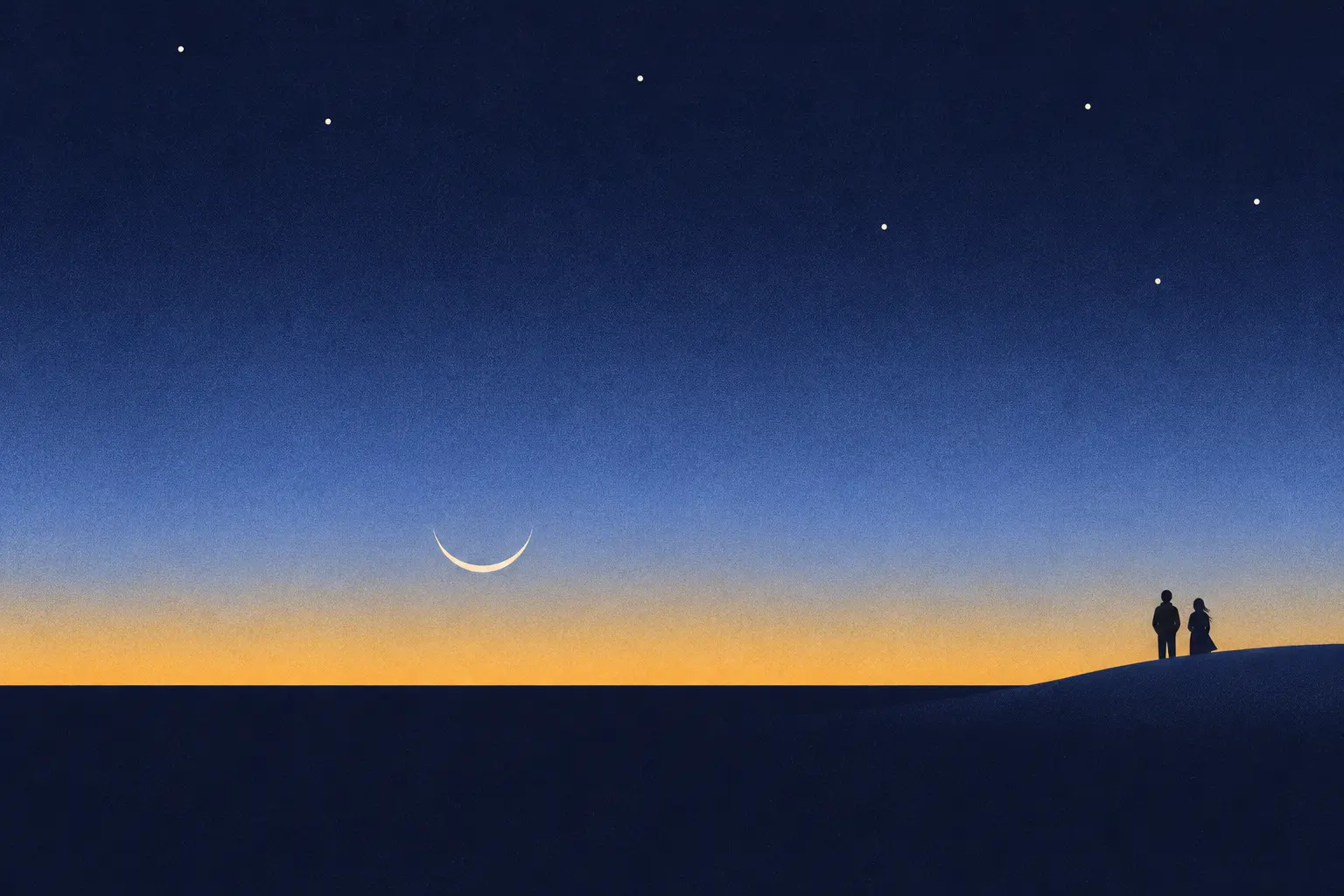
A thin crescent low in the west just after sunset. For religious purposes, an Islamic month begins when this crescent is first sighted, a day or so after new moon (US Naval Observatory).
Wikipedia notes a Quranic prohibition on nasīʾ, a pre-Islamic practice read either as inserting an extra month or as postponing the month of the pilgrimage.
Figures 1 and 6 use the tabular Islamic calendar, an arithmetical version with 11 leap days in each 30-year cycle (US Naval Observatory). Its dates can run a day or two off the sighted ones, Wikipedia notes. In Figure 1 its New Year's Days sit 1.1 to 2.9 days after new moon. They are scattered across the whole year.
The Gregorian calendar makes the opposite trade and tracks only the year (Gregorian calendar). Its January 1 lands on every phase of the Moon in Figure 1. One lunisolar rule survives inside it.
Western churches date Easter from an ecclesiastical full moon set by the 19-year cycle, not by astronomy, Wikipedia explains. Each year's place in that cycle is its golden number.
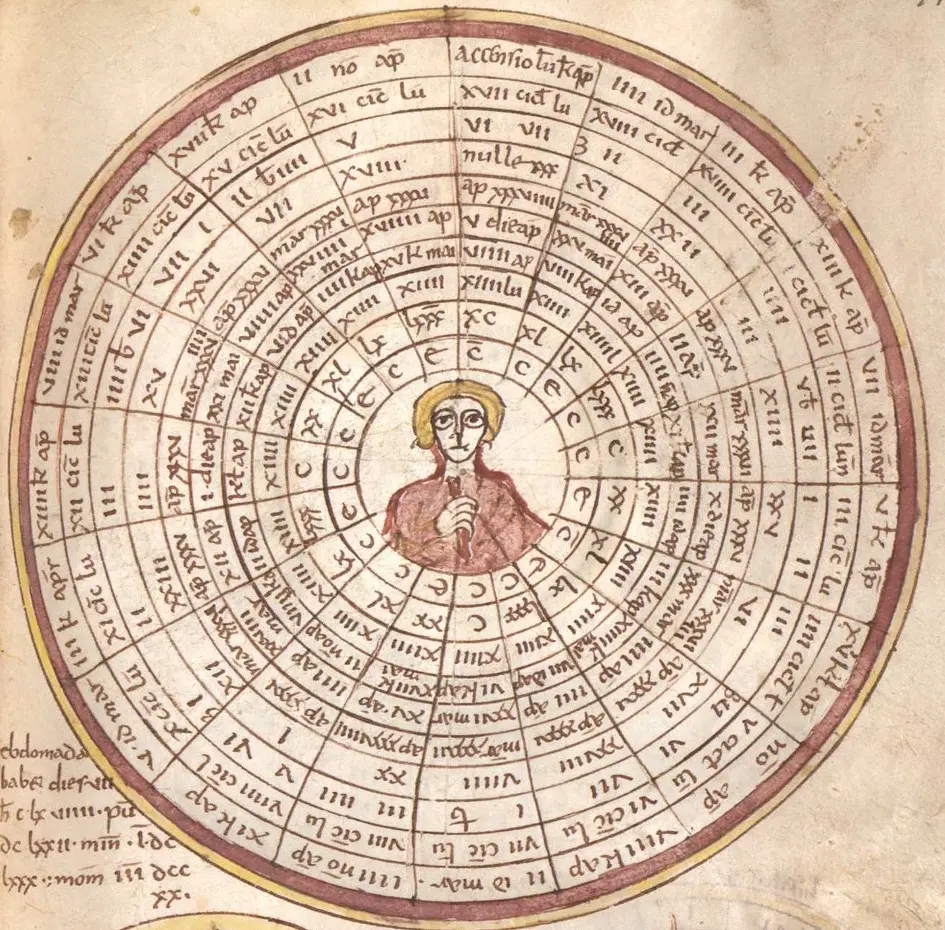

Figure 7. A wheel diagram in a computus manuscript from St. Emmeram's Abbey in Regensburg, now Clm 14456 in the Bavarian State Library (fol. 71r). The Commons file description identifies it as a diagram of the 19-year lunar cycle giving the Julian calendar date of the Easter new moon, labeled accensio lunae. The library dates the manuscript to the second quarter of the ninth century; the Commons file page says before 824.
Chinese leap months will keep shifting with precession: Aslaksen expects one after the first month in 2262, a forecast he says to take with a grain of salt (axial precession).
Sources
- US Naval Observatory, Astronomical Applications Department, "Introduction to Calendars" (page last modified 27 February 2019; Internet Archive copy of 13 June 2019): day, month and year as the principal cycles; lunisolar calendars try to stay synchronous with both the solar year and the Moon's phases; Meton's 235 months in 19 years, off by about 2 hours per cycle; the Islamic months regress through the seasons in about 33 yearshttps://web.archive.org/web/20190613115330/https://aa.usno.navy.mil/faq/docs/calendars.phpRead: full text of the archived page
- Wikipedia, "Lunar month" (mean synodic month 29.5305888531 days at J2000 from the lunar theory of Chapront-Touzé and Chapront, 1988)https://en.wikipedia.org/wiki/Lunar_month
- Wikipedia, "Tropical year" (mean tropical year in 2000: 365.24219 ephemeris days)https://en.wikipedia.org/wiki/Tropical_year
- Wikipedia, "Hebrew calendar" (leap years 3, 6, 8, 11, 14, 17, 19 of the 19-year cycle; Adar I and Adar II, Adar I of 30 days, sources disagree which is the added month; leap month tied to Passover in the spring barley season; molad of 29 days, 12 hours and 793 parts, 1,080 parts to the hour, 29.530594 days; mean year about 365.2468 days; drift of about one day in 216 years; earliest Passover drifted about eight days since the 4th century, 15 Nisan now on or after 26 March; year lengths 353 to 355 and 383 to 385 days)https://en.wikipedia.org/wiki/Hebrew_calendar
- Helmer Aslaksen, "The Mathematics of the Chinese Calendar," National University of Singapore, 17 July 2010 (Internet Archive copy of 21 August 2016): rules 1 to 5; 1645 reform and the true Sun; principal terms 29.44 to 31.44 days apart; leap months 1645 to 2644 most often after the 5th month; 2033 and the third new moon in 2034; 235 months against 19 years, one day in about 220 years; the cycle known in Babylon by about 500 BCE and in China around 600 BCE as the zhāng cycle; year lengths 353 to 355 and 383 to 385 days; a leap month after the 1st month expected in 2262https://web.archive.org/web/20160821170722/https://www.math.nus.edu.sg/~mathelmr/calendar/cal.pdfRead: full text (PDF)
- Wikipedia, "Islamic calendar" (12 lunar months, 354 or 355 days; months begin with sighting of the crescent; interpretations of nasīʾ as intercalation or as postponing the pilgrimage month, and its prohibition)https://en.wikipedia.org/wiki/Islamic_calendar
- Wikipedia, "Octaeteris" (eight-year cycle, moon phase returns one or two days off; noted by Cleostratus; calendar of the Olympic Games)https://en.wikipedia.org/wiki/Octaeteris
- Wikipedia, "Metonic cycle" (Meton introduced the 19-year cycle to the Attic calendar in 432 BC; St. Emmeram manuscript Clm 14456, fol. 71r, as a depiction of the cycle)https://en.wikipedia.org/wiki/Metonic_cycle
- R. H. van Gent, "The Babylonian Calendar," Utrecht University, introduction page (a regular scheme of seven intercalary months in 19 years adopted after about 500 BCE, later adopted by Greek astronomers as the Metonic cycle)https://webspace.science.uu.nl/~gent0113/babylon/babycal.htmRead: introduction frame babycal_introduction.htm
- Hebcal, Jewish holiday API, diaspora holiday lists for 2000 to 2059 (Rosh Hashana and Pesach I dates; used to check this page's Hebrew calendar)https://www.hebcal.com/hebcal?v=1&cfg=json&maj=on&year=2026&month=x&ss=off&mf=off&c=off&geo=none&i=off
- Wikipedia, "Rosh Hashanah" (like all Jewish holidays, it begins the evening before the first day)https://en.wikipedia.org/wiki/Rosh_Hashanah
- Wikipedia, "Chinese calendar" (major solar terms, zhōngqì, at multiples of 30 degrees from a solstice; winter solstice in the 11th month)https://en.wikipedia.org/wiki/Chinese_calendar
- Hong Kong Observatory, "Gregorian-Lunar Calendar Conversion Table" text files for 1998 to 2062 (lunar month starts, leap months, solar terms; used to check this page's Chinese calendar)https://www.hko.gov.hk/en/gts/time/calendar/text/files/T2033e.txt
- US Naval Observatory, Astronomical Applications Department, "A Brief Introduction to the Islamic Calendar" (page last modified 7 June 2016; Internet Archive copy of 5 June 2019): months begin when the thin crescent is sighted after sunset a day or so after New Moon; the year shifts about 11 days earlier each civil year; tabular calendar of a 30-year cycle with 11 leap years; 1 Muharram AH 1 = Friday, 16 July 622 (Julian)https://web.archive.org/web/20190605212233/https://aa.usno.navy.mil/faq/docs/islamic.php
- Wikipedia, "Tabular Islamic calendar" (leap years 2, 5, 7, 10, 13, 16, 18, 21, 24, 26, 29 in the common 30-year form; dates one or two days off the observation-based calendars)https://en.wikipedia.org/wiki/Tabular_Islamic_calendar
- Wikipedia, "Lunisolar calendar" (Western churches date Easter from the ecclesiastical full moon, determined by reference to the Metonic cycle, not astronomy)https://en.wikipedia.org/wiki/Lunisolar_calendar
- Wikipedia, "Golden number (time)" (a year's number in the 19-year Metonic cycle, used in the computus)https://en.wikipedia.org/wiki/Golden_number_(time)
- Wikimedia Commons, "File:CLM 14456 70v71r.jpg" (Clm 14456, fols. 70v/71r, St. Emmeram, Regensburg; fol. 71r top: wheel of the 19-year lunar cycle with Julian dates of the Easter new moon; dated 9th century, before 824; public domain)https://commons.wikimedia.org/wiki/File:CLM_14456_70v71r.jpg
- Bayerische Staatsbibliothek, "Komputistische Texte - BSB Clm 14456," IIIF manifest (Regensburg, second quarter of the 9th century; Public Domain Mark 1.0)https://api.digitale-sammlungen.de/iiif/presentation/v2/bsb00046449/manifest
- Fred Espenak, "Phases of the Moon: 1901 to 2000" and "Phases of the Moon: 2001 to 2100" (new moon times in Universal Time; used to check this page's new moons)https://eclipse.gsfc.nasa.gov/phase/phases2001.html
- Fred Espenak and Jean Meeus, "Polynomial Expressions for Delta T"https://eclipse.gsfc.nasa.gov/SEhelp/deltatpoly2004.html
- David Nash (astronexus), HYG Database v4.4, CC BY-SA 4.0 (Alcyone's position, motion and magnitude for Look up next)https://codeberg.org/astronexus/hyg
- Wikipedia, "MUL.APIN" (intercalation rules using the heliacal rising of the Pleiades and the Moon's position relative to the Pleiades; uncertain how old the rules are)https://en.wikipedia.org/wiki/MUL.APIN
- ERFA (Essential Routines for Fundamental Astronomy), source files ltp.c, ltpequ.c and ltpecl.c (long-term precession of J. Vondrák, N. Capitaine and P. Wallace, 2011, "New precession expressions, valid for long time intervals," Astronomy & Astrophysics 534, A22) and era00.c with gmst06.c (IAU 2006 Greenwich mean sidereal time); used for the Pleiades position in Look up nexthttps://github.com/liberfa/erfa/blob/master/src/ltp.cRead: source code of ltp.c, ltpequ.c, ltpecl.c, era00.c and gmst06.c; the 2011 paper itself was not read
- Qin tian jian (Qing astronomical bureau), 大淸道光十五年歲次乙未時憲書 (almanac for Daoguang 15, 1835), blockprint in red and black, Harvard-Yenching Library 7190.8 6350(1835), scan on Wikimedia Commons: months marked 大 (long) or 小 (short), a leap sixth month 閏六月, year total of 384 dayshttps://commons.wikimedia.org/wiki/File:Harvard_drs_53542140_%E5%A4%A7%E6%B7%B8%E9%81%93%E5%85%89%E5%8D%81%E4%BA%94%E5%B9%B4%E6%AD%B2%E6%AC%A1%E4%B9%99%E6%9C%AA%E6%99%82%E6%86%B2%E6%9B%B8.pdfRead: the month list on PDF pages 7 and 8, and the Harvard-Yenching catalogue data on the Commons file page
- "Notes on Thessalonica" (signed E. D. B.), The Biblical World 8, no. 1 (July 1896), pp. 16 and 19: calendars printed for use in the city; a leaf reproduced at the end of the article, that for Friday, October 20th, old style, November 1st, new style, with lines in Turkish, Armenian, Hebrew-Spanish, Greek, Bulgarian and Frenchhttps://commons.wikimedia.org/wiki/File:THE_BIBLICAL_WORLD_1896-07-_Vol_8_Iss_1_(IA_sim_biblical-world_1896-07_8_1).pdfRead: journal pp. 16 and 19 of the scanned issue
- Wikimedia Commons, "File:Calendar Thessaloniki 1896.jpg" (calendar leaf of 1895 from Thessaloniki; dates in the Rumi, Islamic (14 Jumādā al-Ūlā 1313), Hebrew (14 Cheshvan 5656), Julian (20 October) and Gregorian (1 November) calendars)https://commons.wikimedia.org/wiki/File:Calendar_Thessaloniki_1896.jpg
- Joannes Regiomontanus, Calendarium (Venice: Bernardus Pictor, Petrus Loslein and Erhardus Ratdolt, 1476), Smithsonian Libraries copy, scan on Wikimedia Commons: January table of conjunctions (CON.) and oppositions (OPPO.) of the Sun and Moon; chapters "De aureo numero" and "De coniunctionibus ac oppositionibus luminarium" (golden number in red, then hours and minutes; columns for three 19-year cycles beginning 1475, 1494 and 1513)https://commons.wikimedia.org/wiki/File:Aureus_hic_liber_est_-_non_est_preciosior_ulla_g_ema_kalendario_-_quod_docet_istud_opus_-_aureus_hic_numerus,_lun(a)e_solisq(ue)_labores_monstrantur_facile_-_cunctaq(ue)_sign_(IA_aureushiclibere00regi).pdfRead: title page, the January opening and the chapters on the golden number and on conjunctions and oppositions (Latin, PDF pages 5-7, 43 and 48)
- Wikimedia Commons, "File:Hungarian Jewish Museum, Combined Jewish and Christian calendar.jpg" (photograph by Szilas of a combined Jewish and Christian calendar in the Hungarian Jewish Museum, dated 1848)https://commons.wikimedia.org/wiki/File:Hungarian_Jewish_Museum,_Combined_Jewish_and_Christian_calendar.jpg

Computed by this site (2026-10-12): month and year arithmetic from the Wikipedia values for the mean synodic month and tropical year; new moons from Meeus's lunar-phase formulas with the Espenak–Meeus Delta T polynomials, matching Fred Espenak's catalogue of Moon phases to the minute for 1999 to 2061; solar terms, Chinese months and leap months by Aslaksen's rules, matching the Hong Kong Observatory tables for 1999 to 2061; Hebrew dates from the fixed rules, matching Hebcal for 2000 to 2059; tabular Islamic dates from the US Naval Observatory's 30-year cycle and epoch (1 Muharram AH 1 = Friday, July 16, 622, Julian calendar); the Pleiades position from HYG v4.4 with the long-term precession of Vondrák, Capitaine and Wallace (2011) as coded in ERFA, and IAU 2006 sidereal time, 40°N, flat horizon, no atmospheric refraction.
Corrections
2026-10-23 — The summary shown in search results, on the category page and in the feed applied the 19-year rule to every lunisolar calendar ("A lunisolar calendar adds a 13th month in 7 of every 19 years" → "The classic lunisolar rule gives 7 years in 19 a 13th month. The Hebrew calendar follows it, the Chinese calendar comes close"), prompted by a recheck.
Look up next:
The Pleiades, rising in the east on autumn evenings. On mid-October evenings at 40°N, at 9 p.m. local mean solar time, this page's calculation for a flat horizon and no atmospheric refraction puts Alcyone about 24 degrees up, a little north of due east. At magnitude 2.9, Alcyone is the cluster's brightest star in the HYG catalogue. If you head somewhere darker to see more of the cluster, go with someone, tell someone your plan, carry a red flashlight and stay off private land.
Babylonian tablets built calendar rules on this cluster: Wikipedia's article on MUL.APIN lists intercalation rules based on the Pleiades' first appearance before dawn and on the Moon's position relative to them. How old those rules are is uncertain, the article adds. Read on: how the Moon and Sun raise the tides.
Related entries
- Three-Clock Problem: 12 Moons Fall 11 Days Short of a Year
- Gregorian Calendar: 1582 Dropped 10 Dates, Not 10 Days
- Seven-Day Week: The Day Names Skip Two Planets Each Time
- Tides: The Sun Pulls Harder, but Its Tide Is Half the Moon's
Cite this page
Asterisms & Astrolabes. “Lunisolar Calendar: Why 7 Years in 19 Get a 13th Month.” Asterisms & Astrolabes. Published 13 October 2026; last substantive revision 23 October 2026. https://asterismsandastrolabes.com/calendars/lunisolar-calendar/. Accessed [the date you read it].