Atlas entry
Seven-Day Week: The Day Names Skip Two Planets Each Time
TL;DR: Why there are 7 days in a week is still argued: the Jewish Sabbath cycle, Babylonian Moon days and the seven classical planets all have support. The order of the names is easier. Give each hour to one planet in turn, and each 24-hour day starts three planets further on, skipping two.
In this entry11 sections
- Why are there 7 days in a week?
- How do planetary hours set the order of the days?
- Is the Chaldean order really slowest to fastest?
- What does a Pompeii graffito say about the week?
- How did planet names become Saturday to Friday?
- Does a week fit the Moon or the year?
- Sources
- Corrections
- Look up next
- Related entries
- Cite this page
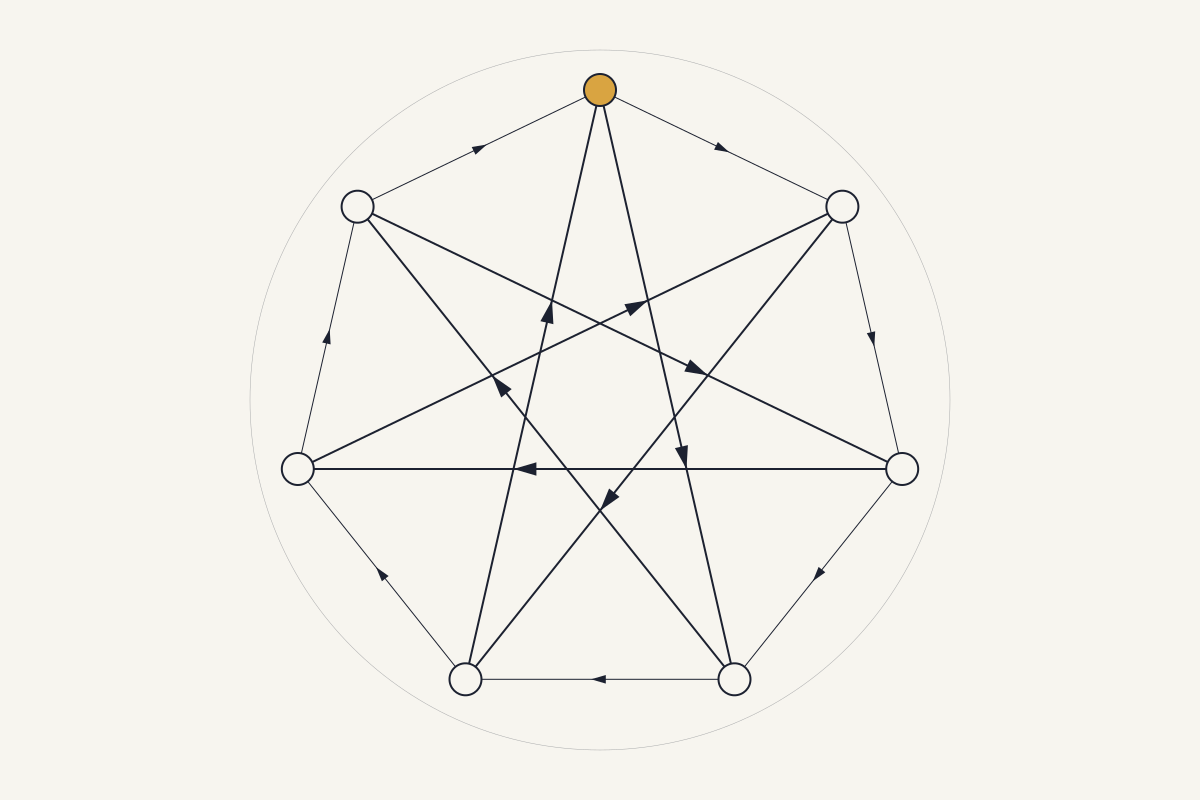
Open the chart full size to zoom in on the detail.
Figure 1. Clockwise from the gold point at the top: Saturn, Jupiter, Mars, Sun, Venus, Mercury, Moon. The thin arrows give the order of the hours. The heavy star gives the days, three points at a time, Saturday through Friday.
Count 24 hours from Saturn, giving each hour to the next planet, and the 25th hour falls to the Sun. Cassius Dio, a Roman historian writing in the early 3rd century AD, used that count to explain why the seven-day week runs Saturday, Sunday, Monday. Why there are seven days has no settled answer.
Why are there 7 days in a week?
Three explanations are on record.
The Sabbath cycle. Genesis 1 numbers the days of creation, and Exodus 20 makes the seventh a day of rest, as Michael Falk notes in a 1999 survey in the Journal of the Royal Astronomical Society of Canada. Wikipedia's article on the week dates the first continuous seven-day cycle, one that ignores the Moon's phases, to Judaism by the 6th century BC at the latest.
Babylonian Moon days. Babylonian months followed the Moon, and the 7th, 14th, 21st and 28th days carried bans on certain activities, each near a quarter of the Moon's cycle of phases (Falk, Table I). A quarter of that 29.53-day cycle is 7.38 days, so four seven-day stretches leave a day or two over. Falk writes that the modern week "appears to have originated in Babylonia" between the 8th and 6th centuries BC.
The seven planets. Seen without a telescope, seven bright bodies move against the stars: the Sun, the Moon, Mercury, Venus, Mars, Jupiter and Saturn. They supplied the names. Whether they also fixed the number is part of the dispute.
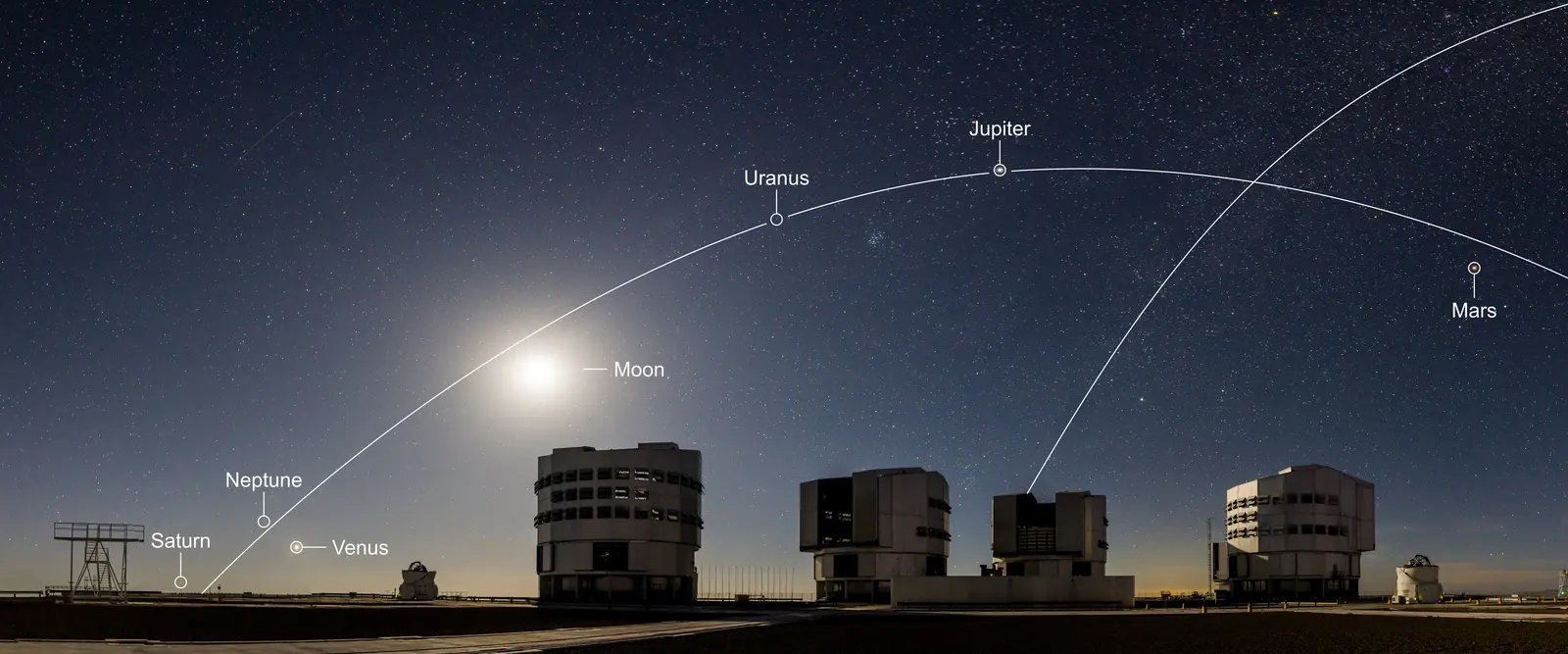

Figure 2. Five of the seven in one sky: the Moon, Venus, Saturn, Jupiter and Mars over ESO's Paranal Observatory in early February 2025. ESO's labels also mark Uranus and Neptune.
The Babylonian link has critics. Eviatar Zerubavel's 1989 book The Seven Day Circle, as Wikipedia quotes it, grants that the number seven may be Mesopotamian but adds that "the ancient dwellers of Mesopotamia themselves did not have a seven-day week." Jeffrey Tigay and others, Wikipedia adds, suggest the Sabbath week may be an independent Israelite creation.
How do planetary hours set the order of the days?
Around AD 100, Plutarch reportedly wrote a treatise, now lost, on why the days named after the planets run in a different order from the planets (Wikipedia).
Take the planets in the order now called Chaldean: Saturn, Jupiter, Mars, Sun, Venus, Mercury, Moon. Give the first hour of a day to Saturn, the second to Jupiter. Keep cycling through day and night. In the 1914 Loeb translation, Dio concludes that "the first hour of the following day comes to the Sun."
A day of 24 hours is three full rounds of seven, plus 3. Think of each day as a ledger page that carries three hours forward, so the next page opens three planets down the list. From Saturn the jumps reach the Sun, Moon, Mars, Mercury, Jupiter and Venus, then Saturn again on the eighth day.
Dio's other account, given just before it, rests on the musical "principle of the tetrachord." Start at Saturn, then "omitting the next two name the lord of the fourth." Skipping two is a jump of three. By this page's calculation, both of Dio's accounts give the same sequence, day for day.
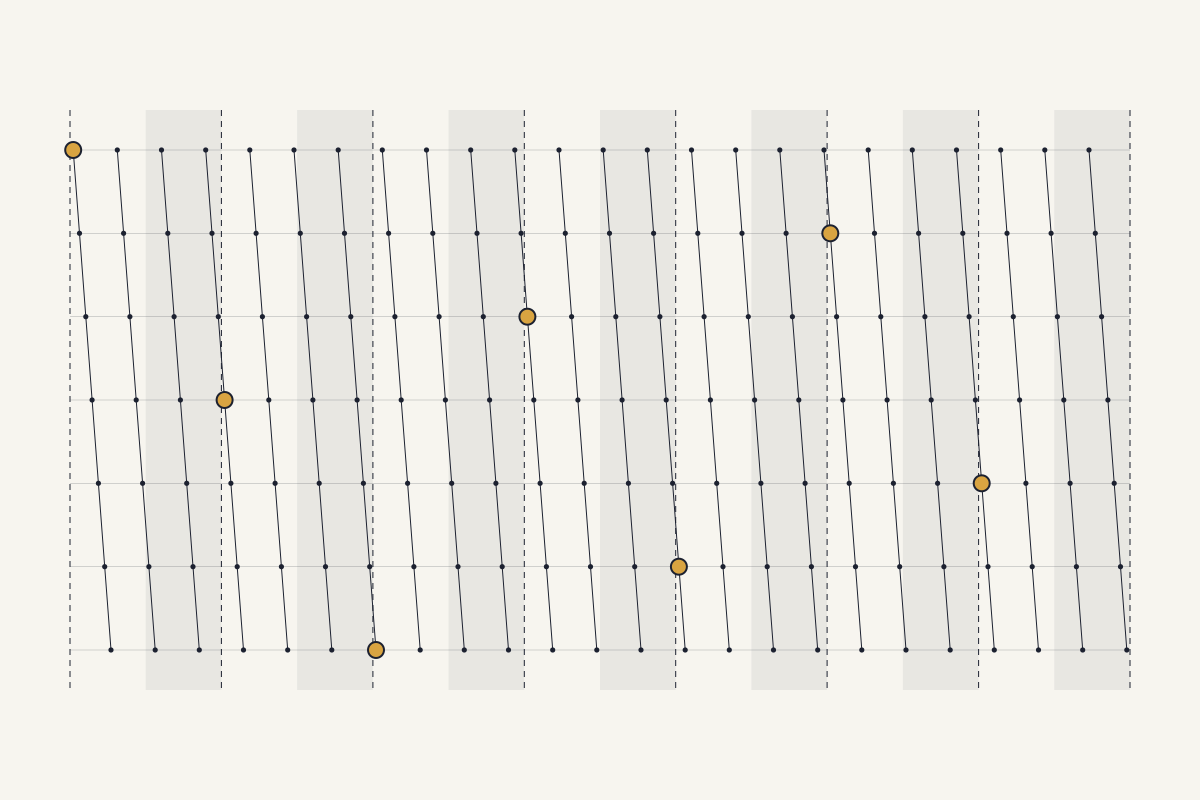
Open the chart full size to zoom in on the detail.
Figure 3. One dot per hour; dashed lines start each day, and shaded bands are the night hours. Rows, top to bottom: Saturn, Jupiter, Mars, Sun, Venus, Mercury, Moon. Each day's first hour (gold) sits three rows below the last, wrapping to the top.
Planetary-hour table, 168 rows (CSV, CC BY 4.0), with its provenance note (JSON)
Dio credited the custom to the Egyptians. Wikipedia calls planetary hours an innovation of Hellenistic astrology, probably of the 2nd century BC, while Bultrighini and Stern (2021), by its account, argue that the custom seems to have appeared earlier in Roman Italy. This page traces that history without grading the astrology.
Is the Chaldean order really slowest to fastest?
Mostly. From the orbital periods, Saturn needs about 29 years to circle the zodiac, Jupiter about 12 and Mars about 2, while the Moon takes about 27 days. Mercury, Venus and the Sun each average one year, so their ranking rested on other arguments; the Loeb editor notes that the order follows distance from Earth in the Earth-centered Ptolemaic system.
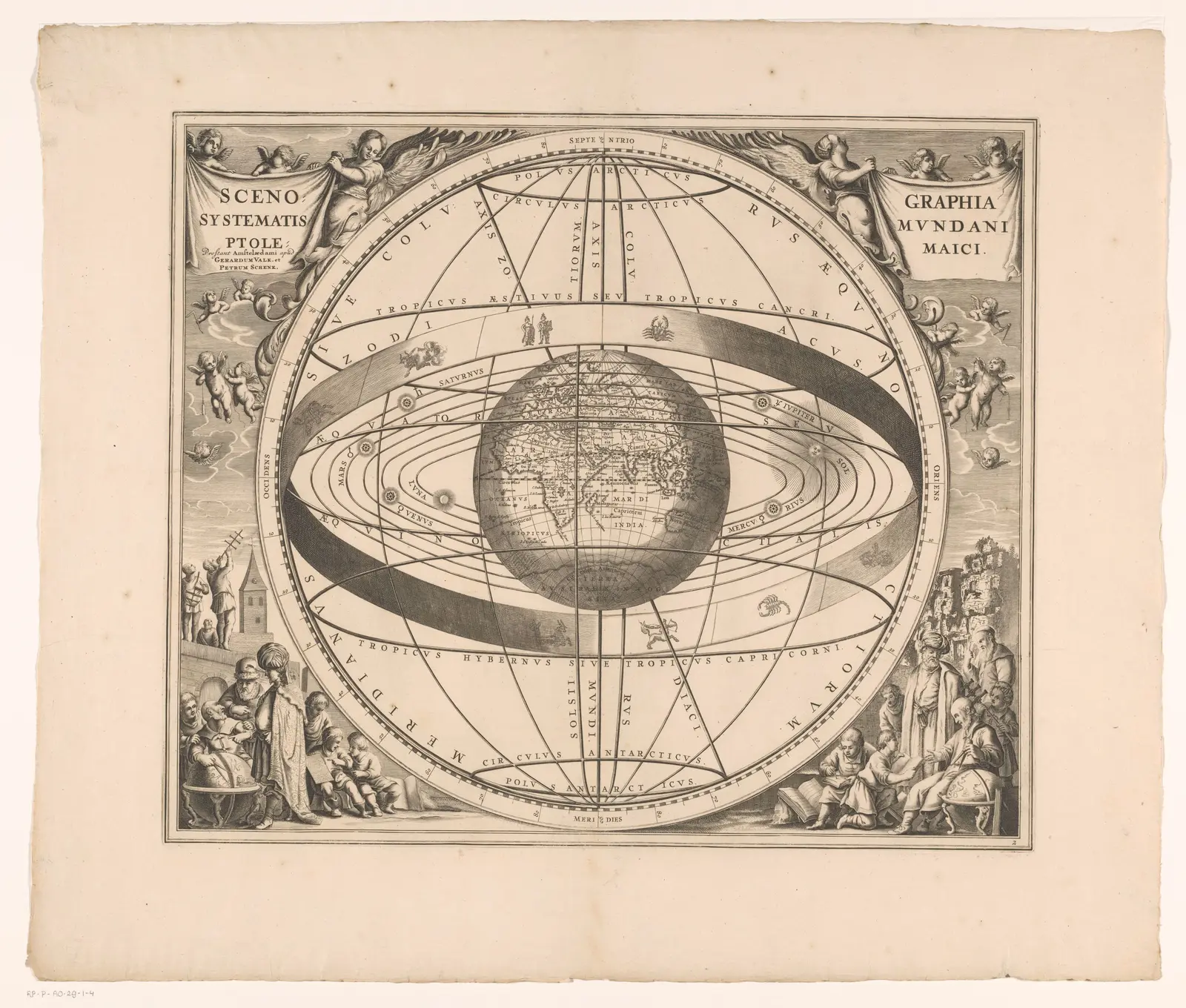

Figure 4. A plate from Andreas Cellarius's Harmonia Macrocosmica: Moon, Mercury, Venus, Sun, Mars, Jupiter and Saturn circle Earth, inside to outside, the Chaldean order reversed. The Rijksmuseum dates this print 1660 and/or 1708.
With Earth's year standing in for the Sun, the periods run from longest to shortest in exactly the Chaldean order: 10,756, 4,333, 687.0, 365.3, 224.7, 88.0 and 27.3 days, by this page's calculation from E. M. Standish and J. G. Williams's orbital elements and, for the Moon, the Meeus lunar series. The orbits behind those numbers are drawn to true shape in Orbital Eccentricity: Earth's True Orbit Looks Like a Circle.
What does a Pompeii graffito say about the week?
A graffito from Pompeii dates itself to 6 February AD 60 and names the day dies solis, the Sun's day. Wikipedia's article on the week calls it the first identifiable date given with its weekday, citing Robert Hannah (2013). Counted back through today's weekday cycle, that Julian-calendar date was a Wednesday.
The gap may lie in the starting hour. Wikipedia's article on planetary hours says the 2nd-century astrologer Vettius Valens began each day at sunset, and suggests the graffito did too. In the hour count, the first hour after the sunset that closes a Wednesday's daylight falls to the Sun. If that reading holds, the article says, the weekday cycle may have run unbroken from the 1st century AD to now.
The same line notes market days, nundinae, at Cumae and Pompeii. That eight-day market cycle had probably lapsed by AD 321, when Constantine officially adopted the seven-day week (Wikipedia).
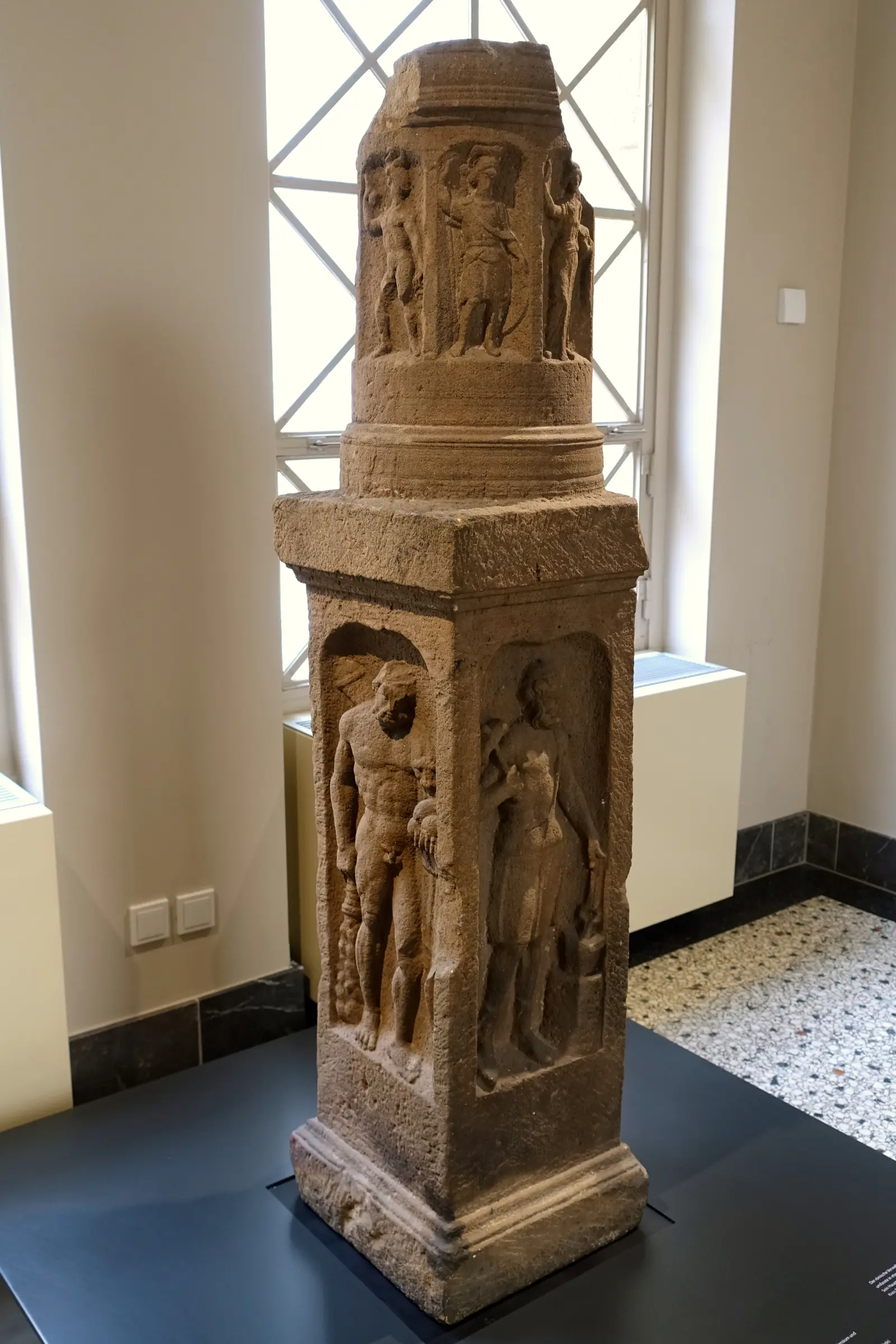

Figure 5. A Roman sandstone monument from Dieburg, Germany, in the Hessisches Landesmuseum Darmstadt. Its Commons file name dates it to AD 200–250 and names the upper reliefs as gods of the weekdays.
How did planet names become Saturday to Friday?
| Planet | Latin | French | German | English |
|---|---|---|---|---|
| Saturn | dies Saturni | samedi | Samstag, Sonnabend | Saturday |
| Sun | dies Solis | dimanche | Sonntag | Sunday |
| Moon | dies Lunae | lundi | Montag | Monday |
| Mars | dies Martis | mardi | Dienstag | Tuesday |
| Mercury | dies Mercurii | mercredi | Mittwoch | Wednesday |
| Jupiter | dies Iovis | jeudi | Donnerstag | Thursday |
| Venus | dies Veneris | vendredi | Freitag | Friday |
Latin from Wikipedia, without macrons; French and German from Falk (1999), Tables III, IX, XI. The CSV adds Old English, Hindi and Japanese.
Day names in seven languages (CSV, CC BY 4.0), with its provenance note (JSON)
Of the Roman gods, English kept only Saturn. Sometime after AD 100 and before Christianity arrived in the 6th and 7th centuries, Germanic speakers put four of their own gods in place of Roman ones: Tiw for Mars, Woden for Mercury, Thunor (Thor) for Jupiter and Frīg for Venus (Wikipedia).


Figure 6. Seven weekday gods on a mid-19th-century Italian bracelet: Diana (Monday), Mars, Mercury, Jupiter, Venus, Saturn and Apollo (Sunday), left to right, as the Walters Art Museum identifies them.
French kept five of the seven and renamed the weekend: dimanche comes from Church Latin for "the Lord's day," and samedi from the Sabbath. German kept Sunday but changed Wednesday. Under Church influence, Falk writes, Wodenstag gave way to Mittwoch, "mid-week." Samstag also traces to the Sabbath, while Sonnabend, used mainly in northern and eastern Germany, means "Sunday eve."
Many languages outside Europe keep the planets. Hindi runs the same seven in the same order under Sanskrit names, from Ravivaar for the Sun to Shanivaar for Saturn (Falk, Table XX). In Japanese, Nichiyoobi is Sun-day and Getsuyoobi Moon-day, and the five planets become fire, water, wood, gold (or metal) and earth (Falk's spellings, Table XXIII). The monk Kūkai brought the system to Japan from China in the 9th century (Wikipedia).
Other languages number the days: Portuguese segunda-feira, Arabic Yaum Al-Itsnain ("day two") and Mandarin Xingqiyi ("week-1") all mean Monday (Falk, Tables VIII, XVII, XXII).
Does the week start on Sunday or Monday?
The week starts on Sunday in common Jewish and Christian practice, because the Bible makes the Sabbath, Saturday, the last day, but the international standard ISO 8601 starts it on Monday, according to Claus Tøndering's Calendar FAQ. The numbered names above take sides. Portuguese and Arabic count from Sunday, which makes Monday the second day, while Mandarin numbers Monday to Saturday from 1 to 6 and calls Sunday Xingqitian, "week-sky" (Falk, Tables VIII, XVII, XXII).
Does a week fit the Moon or the year?
Neither. The day, the Moon's cycle of phases and the year do not divide evenly into one another, which this site calls the three-clock problem (Three-Clock Problem: 12 Moons Fall 11 Days Short of a Year). The week adds a fourth cycle, built from days, that tracks neither the Moon nor the year. A 365-day year is 52 weeks plus 1 day, so a date slides one weekday later each year, or two when a February 29 falls in between.
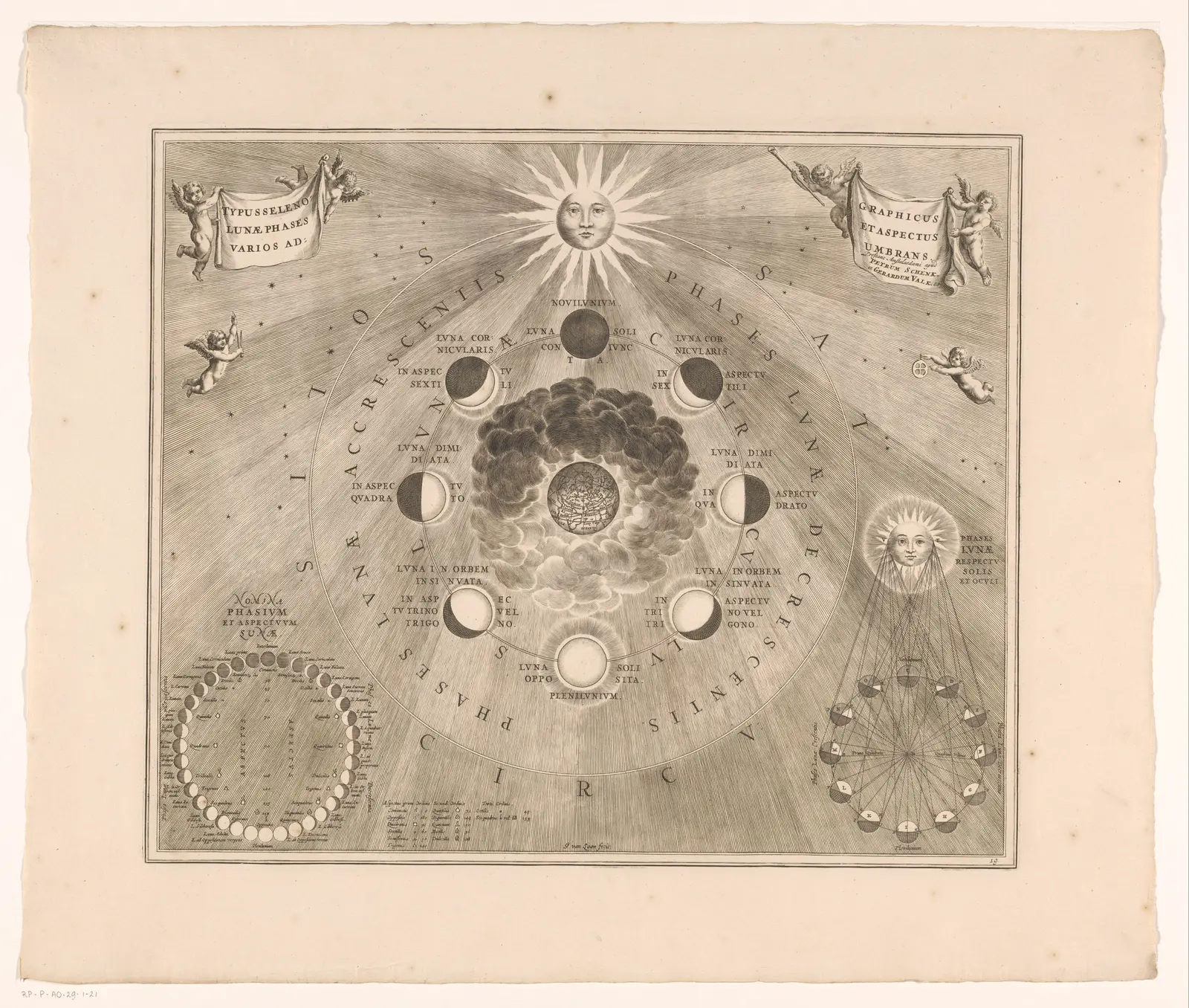

Figure 7. A plate from Cellarius's Harmonia Macrocosmica: the Moon's phases around Earth, new Moon (Novilunium) at top, nearest the Sun, full Moon (Plenilunium) at bottom. The Rijksmuseum dates this print 1660 and/or 1708.
Four hundred Gregorian years hold exactly 146,097 days, or 20,871 weeks, so the whole calendar's weekdays repeat every 400 years: 12 October 1626 and 12 October 2026 both fall on a Monday. The weekday cycle also ran on unbroken through the switch from the Julian calendar (Gregorian Calendar: 1582 Dropped 10 Dates, Not 10 Days). Calendars that follow the Moon and the year at once meet that mismatch head-on (Lunisolar Calendar: Why 7 Years in 19 Get a 13th Month).
Sources
- Cassius Dio, Roman History, Book 37, chapters 16–19, translated by Earnest Cary, Loeb Classical Library, vol. III (1914), text and editor's note 11 on LacusCurtius (Jews and the "day of Saturn"; the custom credited to the Egyptians; the tetrachord and planetary-hour explanations)https://penelope.uchicago.edu/Thayer/E/Roman/Texts/Cassius_Dio/37*.htmlRead: full text of 37.15-37.20 and the Loeb editor's notes (public-domain 1914 translation)
- Michael Falk, "Astronomical Names for the Days of the Week," Journal of the Royal Astronomical Society of Canada 93 (1999): 122–133https://articles.adsabs.harvard.edu/pdf/1999JRASC..93..122FRead: full text (scanned pages via NASA ADS), all 12 pages
- Wikipedia, "Week" (revision 1379590932, 2026-10-10): history of the seven-day week, Zerubavel and Tigay views, Hellenistic and Roman era, Pompeii graffito of 6 February 60, Constantine AD 321, 400-year cyclehttps://en.wikipedia.org/wiki/WeekRead: full article text and footnotes (graffito text cited from Robert Hannah 2013)
- Wikipedia, "Planetary hours" (revision 1344827655): Chaldean order, step of three, Vettius Valens and the sunset convention, the Pompeii graffitohttps://en.wikipedia.org/wiki/Planetary_hoursRead: full article text
- Wikipedia, "Names of the days of the week" (revision 1379550536): Latin and Old English names, interpretatio germanica, Romance Sunday and Saturday, Samstag and Sonnabend, East Asian transmission, Plutarch's lost treatisehttps://en.wikipedia.org/wiki/Names_of_the_days_of_the_weekRead: full article text
- Wikipedia, "Nundinae" (revision 1351582539): the Roman eight-day market cycle, which had probably fallen out of use by AD 321https://en.wikipedia.org/wiki/NundinaeRead: full article text
- Wikipedia, "Vettius Valens" (revision 1326428924): 2nd-century Hellenistic astrologerhttps://en.wikipedia.org/wiki/Vettius_ValensRead: lead section
- E. M. Standish and J. G. Williams, "Approximate Positions of the Planets" (Table 1: Keplerian elements and rates, mean ecliptic and equinox of J2000, valid 1800 AD to 2050 AD; mean-longitude rates of the planets and the Earth-Moon barycenter)https://ssd.jpl.nasa.gov/planets/approx_pos.html
- ERFA (Essential Routines for Fundamental Astronomy, derived from IAU SOFA), source file moon98.c: approximate position of the Moon after Jean Meeus, Astronomical Algorithms, 2nd edition (1998), with the Moon's mean longitude (Simon et al. 1994) advancing 481,267.88123421 degrees and its mean elongation 445,267.1114034 degrees per Julian century; BSD-3-Clausehttps://github.com/liberfa/erfa/blob/master/src/moon98.cRead: full source file
- ESO, "A planetary party portrait above Paranal," Picture of the Week potw2510, released 10 March 2025 (image potw2510c, credit B.Haeussler/ESO)https://www.eso.org/public/images/potw2510c/Read: full caption and image metadata
- Rijksmuseum, "Scenographia systematis mundani Ptolemaici," object RP-P-AO-29-1-4, print dated 1660 and/or 1708, also used in Andreas Cellarius, Harmonia Macrocosmica (Amsterdam: Pieter Schenk and Gerard Valck, 1708)https://id.rijksmuseum.nl/200719915Read: full collection record (same text on the Wikimedia Commons file page)
- Rijksmuseum, "Typus selenographicus lunae phases et aspectus varios ad umbrans," object RP-P-AO-29-1-21, etching and engraving by Johannes van Loon, print dated 1660 and/or 1708, also used in Andreas Cellarius, Harmonia Macrocosmica (Amsterdam: Pieter Schenk and Gerard Valck, 1708)https://id.rijksmuseum.nl/200719982Read: full collection record (same text on the Wikimedia Commons file page)
- Walters Art Museum, "Bracelet," accession no. 41.269, Italy, mid-19th century, museum description as supplied to Wikimedia Commons (gods of the planets in the order of the days of the week, Diana for Monday through Apollo for Sunday)https://commons.wikimedia.org/wiki/File:Italian_-_Bracelet_-_Walters_41269.jpgRead: full museum record on the Commons file page (revision 1247719359)
- Claus Tøndering, "The week" (Calendar FAQ), section "What is the first day of the week?" (Sunday as first day in common Jewish and Christian practice because the Bible makes the Sabbath the last day; Portuguese and Russian day names; ISO 8601 makes Monday the first day)https://www.tondering.dk/claus/cal/week.phpRead: sections Which day is the day of rest? and What is the first day of the week?
Computed by this site (2026-10-12) from sources 1, 2, 3, 8 and 9: the hour count and day order, the match between Dio's two accounts, the first hour after sunset, the weekday of 6 February 60, the 400-year cycle and the two Mondays, the quarter month and the year, the order of the periods and the Moon's hourly motion.
Corrections
2026-10-14 — Added whether the week starts on Sunday or Monday (not covered → Sunday in common Jewish and Christian practice, Monday in the international standard ISO 8601, according to Claus Tøndering's Calendar FAQ; Portuguese and Arabic day names count from Sunday, while Mandarin numbers Monday to Saturday from 1 to 6), with source 14 added, prompted by a recheck.
2026-11-01 — The planets' periods in the Chaldean-order comparison are now sidereal periods calculated from E. M. Standish and J. G. Williams's orbital elements, in place of a fact sheet's tropical periods (Saturn 10,747 → 10,756 days, Jupiter 4,331 → 4,333 days, Earth's year 365.2 → 365.3 days; the order is unchanged), and the Moon's width is now given as about half a degree (about 0.53 → about half a degree). Sources 8 and 9 replaced, prompted by a recheck.
Look up next:
The Moon, last and fastest in the hour count. Note a star beside it, then look again an hour later: by this page's calculation from the same lunar series, it slides about 0.55 degrees east against the stars each hour, roughly its own width of about half a degree. Read on: Lunisolar Calendar: Why 7 Years in 19 Get a 13th Month.
Related entries
- Gregorian Calendar: 1582 Dropped 10 Dates, Not 10 Days
- Lunisolar Calendar: Why 7 Years in 19 Get a 13th Month
- Three-Clock Problem: 12 Moons Fall 11 Days Short of a Year
- Orbital Eccentricity: Earth's True Orbit Looks Like a Circle
Cite this page
Asterisms & Astrolabes. “Seven-Day Week: The Day Names Skip Two Planets Each Time.” Asterisms & Astrolabes. Published 13 October 2026; last substantive revision 1 November 2026. https://asterismsandastrolabes.com/calendars/seven-day-week/. Accessed [the date you read it].