Comparison and data page
Orbital Eccentricity: Earth's True Orbit Looks Like a Circle
TL;DR: Orbital eccentricity measures how far an orbit departs from a circle: 0 is a circle, and values between 0 and 1 are ellipses. Drawn to scale, every planet's orbit looks round, and what gives eccentricity away is the Sun sitting off-center; Earth passes closest to it in early January, during northern winter.
In this entry11 sections
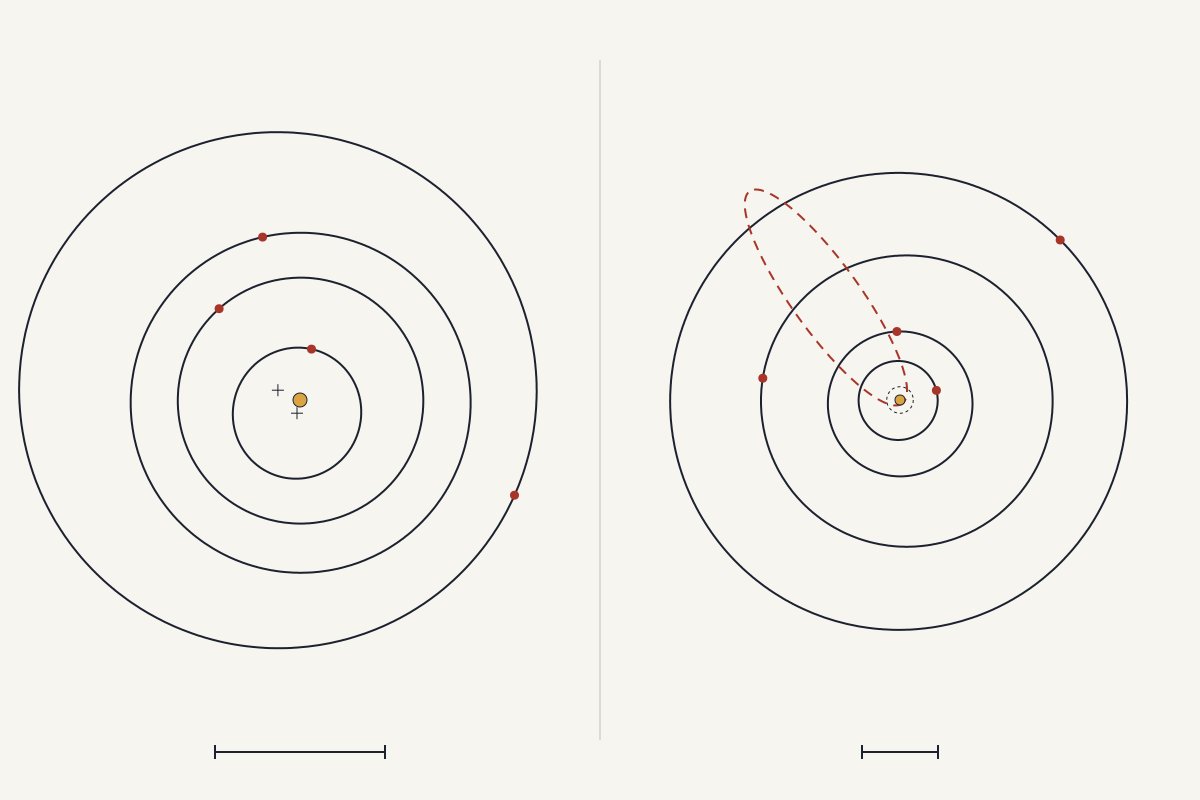
Open the chart full size to zoom in on the detail.
Figure 1. Orbits computed from Standish and Williams's approximate orbital elements (J2000 values), seen from north of the plane of Earth's orbit, with the planets moving counterclockwise. Left, from the Sun outward: Mercury, Venus, Earth, Mars; the bar below is 1 au. Right, from the Sun outward: Jupiter, Saturn, Uranus, Neptune, with Halley's Comet (its osculating orbit for January 1968) as the dashed red ellipse and a small dashed circle marking the area shown at left; the bar is 10 au. Red dots mark each planet's perihelion; the two crosses at left mark the centers of Mercury's orbit (just below the Sun) and Mars's (up and to the left).
Drawn to scale, Earth's orbit looks like a circle. On a drawing 10 cm (about 4 in) across, the true ellipse is 0.014 mm narrower one way than the other, about a thirty-sixth of the width of a 0.5 mm pencil line. Orbital eccentricity, the number that measures how far an orbit departs from a circle, is 0.0167 for Earth in Standish and Williams's table of orbital elements. What a careful drawing does show is the Sun, sitting 0.84 mm from the center.
The same holds for all eight planets. A diagram that shows Earth's orbit as a visible oval is exaggerating it.
What is orbital eccentricity?
Orbital eccentricity is one number for an orbit's shape. Wikipedia's article on the term sets out the scale: 0 is a circle, values between 0 and 1 are ellipses, 1 is a parabola, and anything above 1 is a hyperbola. The last two are open paths that never close into a loop. The planets all sit near zero.
Johannes Kepler published the first two of his laws of planetary motion in Astronomia Nova in 1609. The first says each planet's orbit is an ellipse with the Sun's center at one focus, a point offset from the ellipse's center. The second, that the line from the Sun to a planet sweeps out equal areas in equal times, means the planet moves fastest at perihelion, its closest point to the Sun, and slowest at aphelion, its farthest.
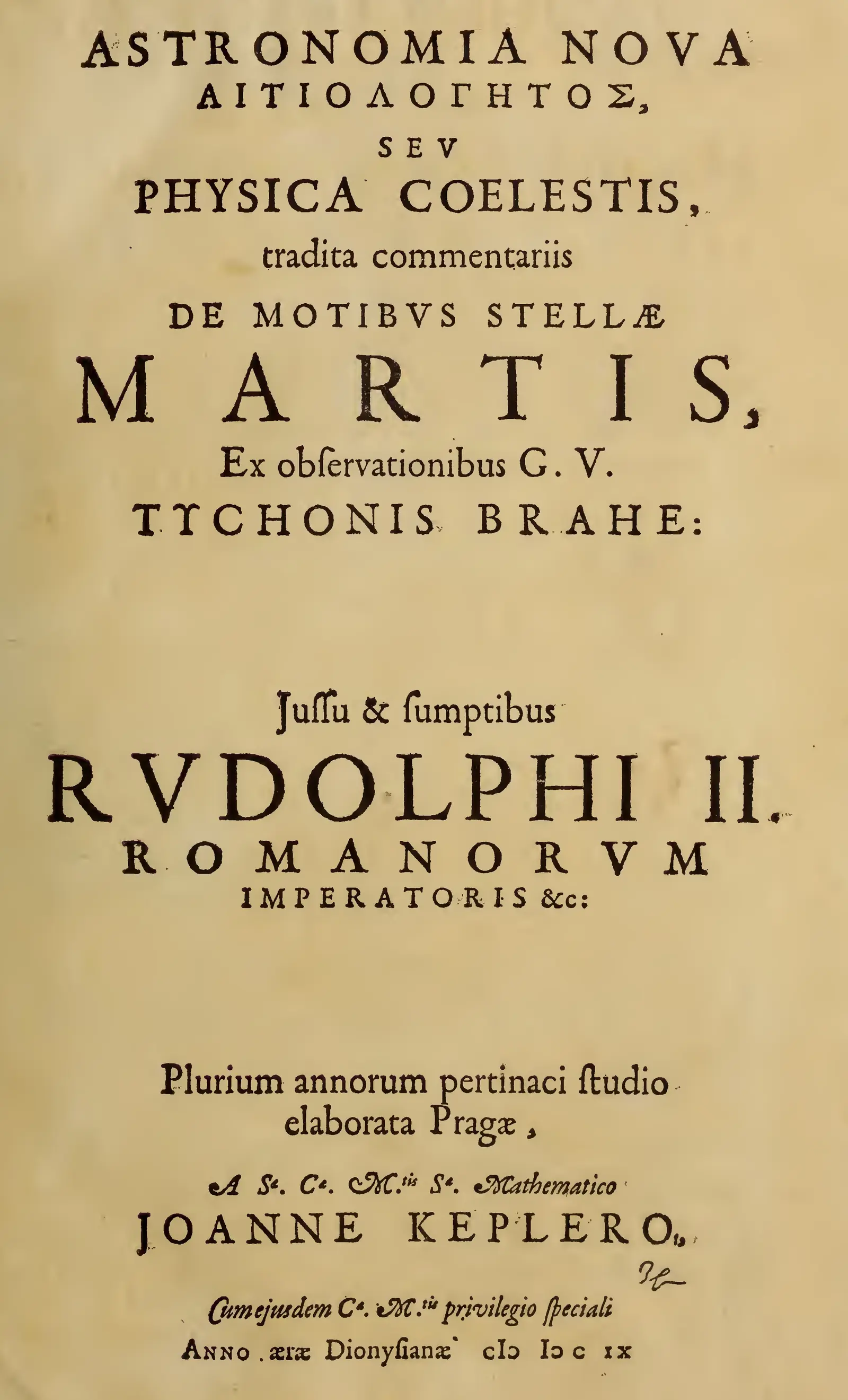
Figure 2. The title page of Johannes Kepler's Astronomia Nova (1609). The Latin title presents the book as commentaries on the motions of Mars, from the observations of Tycho Brahe.
Two numbers fix the ellipse's size and shape: the semi-major axis a, half the long axis, and the eccentricity e. Perihelion is a(1 − e) from the Sun, and aphelion is a(1 + e). The Sun sits ae from the center. Each ellipse here is a two-body result: one planet and the Sun, with the other planets' pulls left out.
Changing pulls from the other planets, along with a slight effect of general relativity, keep Earth's orbit from being exactly elliptical. E. M. Standish and J. G. Williams's table of approximate orbital elements lists a rate of change beside every value, and the authors warn that the elements are a best fit, not valid outside the years they were fitted to, which for their Table 1 are 1800 to 2050.
Why does a true-scale orbit look round?
Eccentricity moves the Sun long before it squashes the orbit. The Sun's distance from the center is e times the semi-major axis, so it grows in step with e. Wikipedia's article on flattening defines the squashing as how much shorter the short axis is than the long one, as a fraction of the long one; that works out to 1 − √(1 − e²), about half of e squared when e is small. Eccentricity is sometimes loosely called flattening; the two rise together, but by the definition above, every planet's flattening is far smaller than its eccentricity.
Think of the squashing as a rounding error on the orbit's ledger: the entry that matters is the offset. For Earth, by this page's calculation from Standish and Williams's elements, the Sun sits 1.7 percent of the semi-major axis from the center, while the orbit is 0.014 percent narrower than it is long. Mercury, the most eccentric planet, puts the Sun 21 percent off-center but is only 2.1 percent narrower.
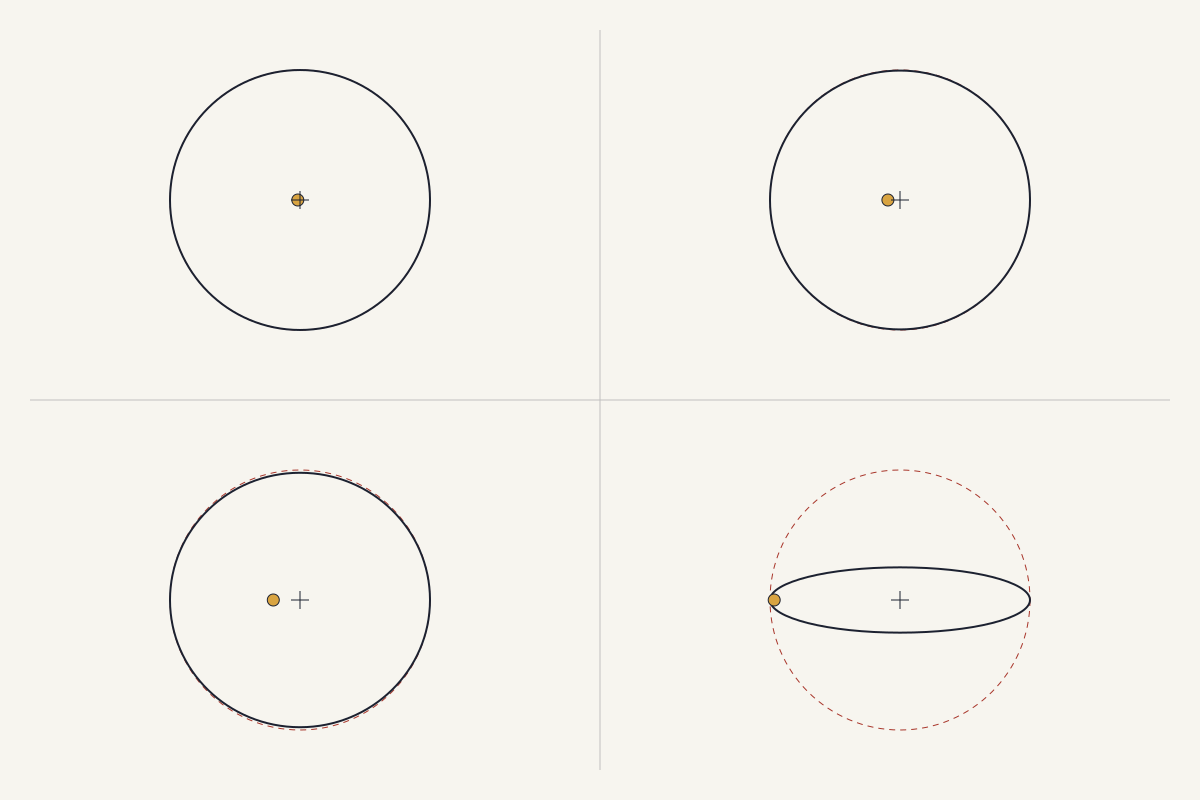
Open the chart full size to zoom in on the detail.
Figure 3. Four orbits drawn with the same semi-major axis: top left Earth (e = 0.017), top right Mars (0.093), bottom left Mercury (0.206), bottom right Halley's Comet (0.968, from its 1968 elements). The dashed red circle shares each ellipse's center and long axis; it hides under the line for Earth and Mars and shows as a thin rim for Mercury. The gold disk is the Sun at one focus, and the cross is the ellipse's center.
Halley's Comet is the opposite case. Its osculating elements for January 1968 give an eccentricity of 0.968, a perihelion of 0.57 au, inside Venus's orbit, and an aphelion of 35 au, beyond Neptune's. An osculating orbit is the ellipse that matches the comet's actual path at one chosen date; this one is 75 percent narrower than it is long, with the Sun almost at one end.
Which planet has the most eccentric orbit?
Mercury, at 0.206 in Standish and Williams's Table 1, followed by Mars at 0.093. Venus has the roundest orbit, at 0.0068, and Neptune's, at 0.0086, is rounder than Earth's. Wikipedia's ranking matches.
| Body | Eccentricity | Perihelion (million km) | Aphelion (million km) | Sun off-center (% of a) | Flattening (%) | Period (years) |
|---|---|---|---|---|---|---|
| Mercury | 0.2056 | 46.0 | 69.8 | 20.6 | 2.1 | 0.241 |
| Venus | 0.0068 | 107.5 | 108.9 | 0.68 | 0.0023 | 0.615 |
| Earth (Earth–Moon barycenter) | 0.0167 | 147.1 | 152.1 | 1.67 | 0.014 | 1.000 |
| Mars | 0.0934 | 206.7 | 249.2 | 9.34 | 0.44 | 1.881 |
| Jupiter | 0.0484 | 740.7 | 816.0 | 4.84 | 0.12 | 11.86 |
| Saturn | 0.0539 | 1,349.8 | 1,503.5 | 5.39 | 0.15 | 29.45 |
| Uranus | 0.0473 | 2,735.0 | 3,006.3 | 4.73 | 0.11 | 84.02 |
| Neptune | 0.0086 | 4,459.8 | 4,537.0 | 0.86 | 0.0037 | 164.8 |
| Halley's Comet | 0.968 | 86.0 | 5,278.2 | 96.8 | 75 | 75.9 |
Planets: Standish and Williams's Table 1 values at J2000 (fit for 1800–2050); the Earth row is the Earth–Moon barycenter. Halley's Comet: osculating elements for January 20, 1968. Distances, offsets, flattening and planetary periods computed by this page; a planet's period is 36,000 divided by the table's mean-longitude rate in degrees per century.
CSV download (CC BY 4.0) (Data: Orbital elements: E. M. Standish and J. G. Williams, Approximate Positions of the Planets, Table 1), with its provenance note (JSON)
A comet over dark fields after dusk, not a portrait of any real one. In the table above, Halley's Comet has an eccentricity of 0.968; Mercury's, the highest among the planets, is 0.206.
Mercury's swing is large enough to matter. By this page's calculation with the inverse-square law, Mercury gets about 2.3 times as much sunlight per square meter at perihelion as at aphelion.
Mars taught Kepler the shape. Wikipedia's summary of Astronomia Nova says one of Kepler's circle-based models still missed Tycho's observations by 8 minutes of arc, and that he had measured Mars's path departing from a circle by about 0.43 percent. Standish and Williams's elements give a flattening of 0.44 percent.
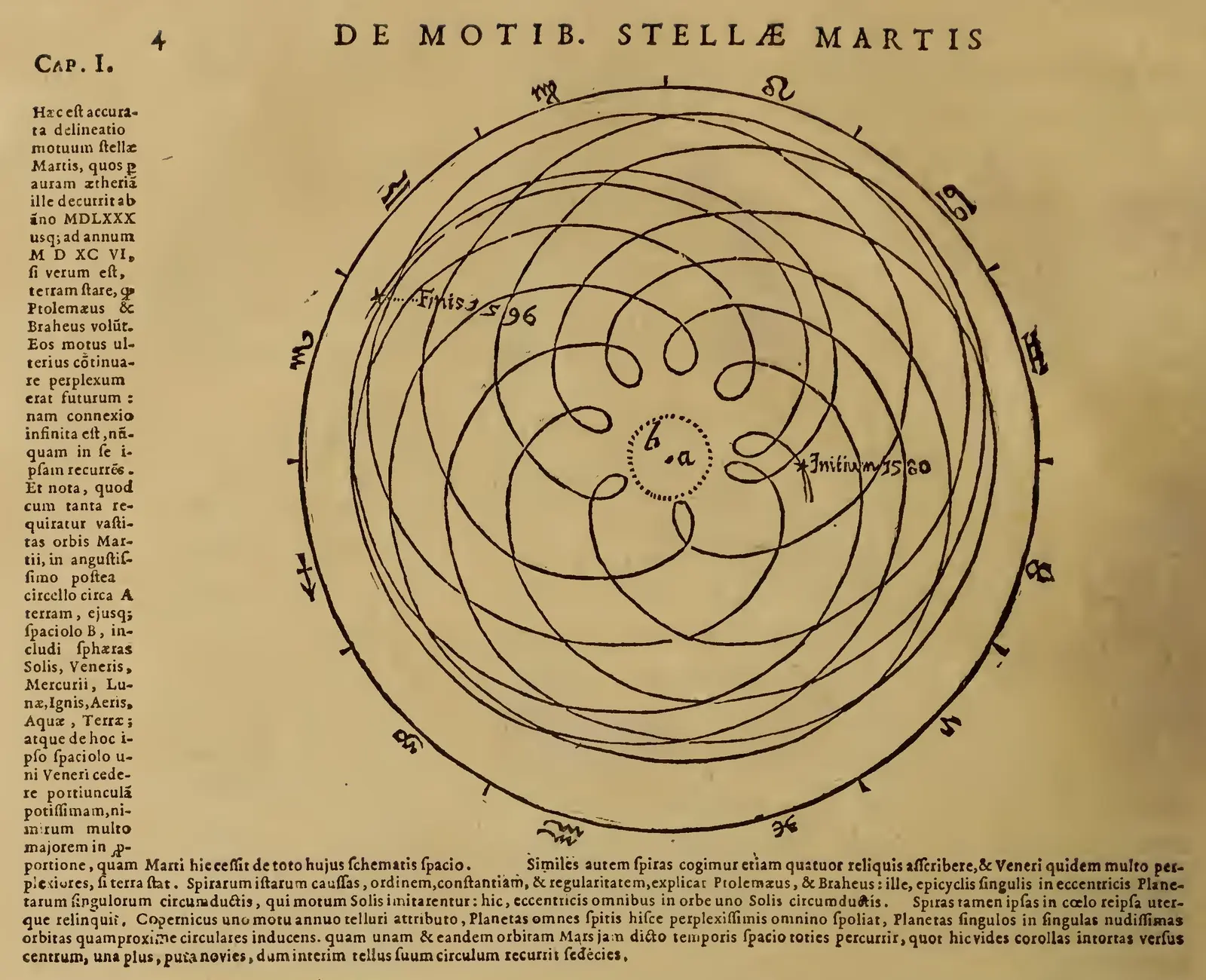
Figure 4. Page 4 of Astronomia Nova: Mars's path from 1580 (Initium) to 1596 (Finis), drawn as if Earth stood still at the center, as the Latin side note says Ptolemy and Tycho Brahe held.
Sort Saturn, Jupiter, Mars, Earth, Venus and Mercury by these periods, longest first, and put the Sun in Earth's slot. The list matches the Chaldean order behind the names of the seven-day week; Wikipedia describes that order as running from slowest to fastest as the planets appear in the night sky, with the Moon last, while noting that the Sun, Venus and Mercury each circle the sky in a year on average.
When is Earth closest to the Sun?
In early January. By this page's calculation with the Earth ephemeris in ERFA, the open-source version of the IAU's SOFA library, Earth's center passes perihelion between January 2 and January 5 (Universal Time) in every year of the 2020s and 2030s, and aphelion between July 3 and July 6. NOAA gives about January 2 and around July 2. Wikipedia's article on apsides traces the year-to-year jumps to the Moon: Earth's center sits on average about 4,700 km from the Earth–Moon balance point, so the date can shift by up to 3 days from one year to the next.
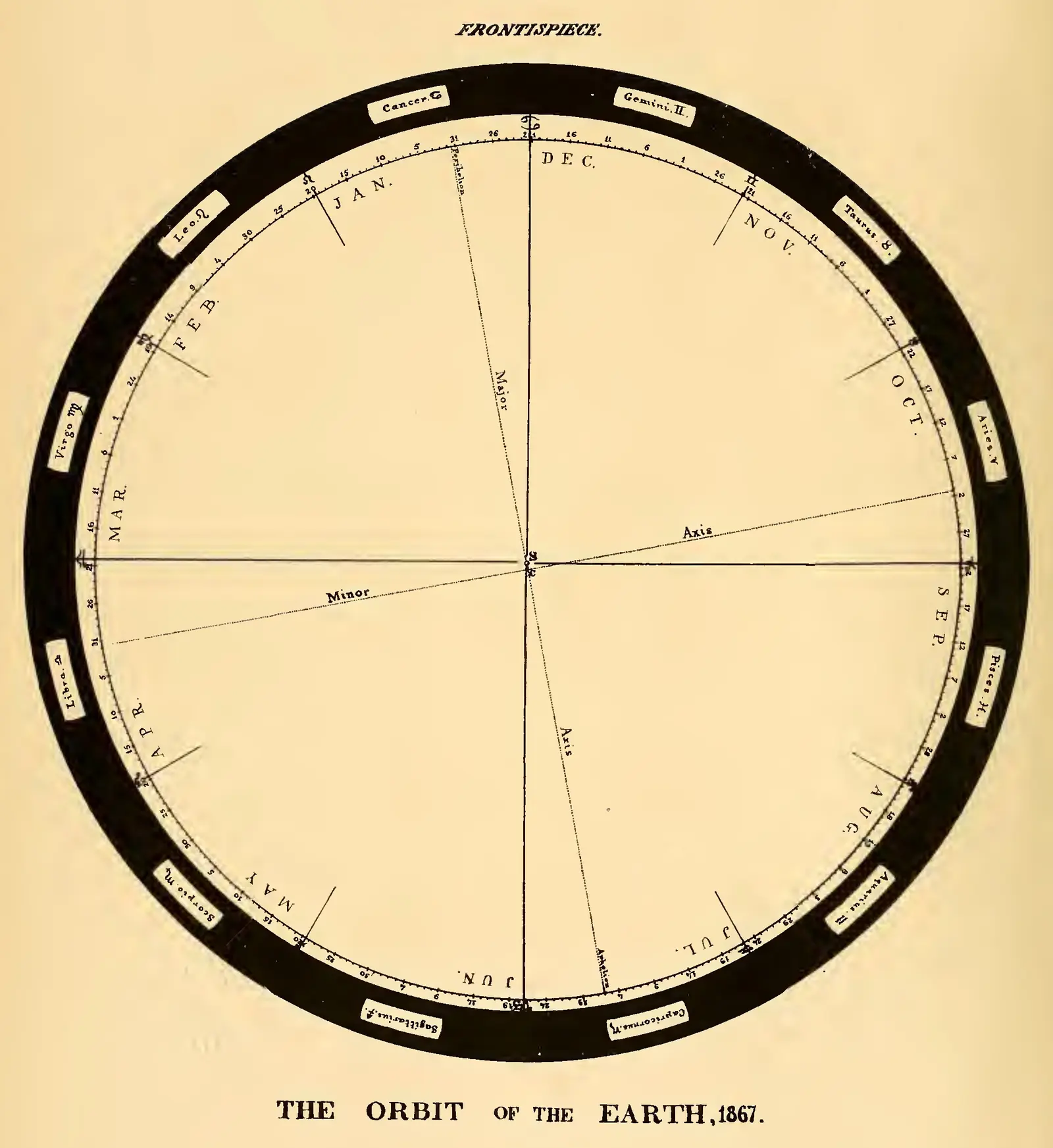
Figure 5. Richard A. Proctor's "The Orbit of the Earth, 1867." Drawn to scale, the orbit looks circular; the Sun, S, sits just off the center, C, and the dotted perihelion line meets December 31.
Standish and Williams's table puts the Earth–Moon pair 147.1 million km from the Sun at perihelion and 152.1 million km at aphelion (91.4 and 94.5 million miles). The gap is about 5.0 million km. Earth also moves faster near perihelion. From those distances and the Sun's gravitational parameter, this page calculates a top orbital speed of 30.29 km/s and a lowest of 29.29 km/s, and Kepler's second law puts the fast stretch at perihelion.
What does the closer pass change?
The Sun's disk is wider in January. Aphelion is 3.4 percent farther from the Sun than perihelion, which makes the disk 3.4 percent wider in early January than in early July, from about 1,887 to 1,951 arcseconds by this page's calculation. The inverse-square law applied to this page's table gives about 6.9 percent more sunlight reaching Earth each January than each July.
You can measure the size change without looking at the Sun. Never look directly at the Sun or at it through binoculars, a telescope, a camera viewfinder or the pinhole itself; sunglasses are not safe. The American Astronomical Society's eclipse safety page calls for eclipse glasses meeting the ISO 12312-2 standard or an indirect method such as pinhole projection, with the Sun at your back. Cast through a pinhole onto a card 2 m (about 6.6 ft) away, the Sun's image is about 18.9 mm wide in early January and 18.3 mm in early July, by this page's calculation, ignoring the blur the pinhole's own width adds.
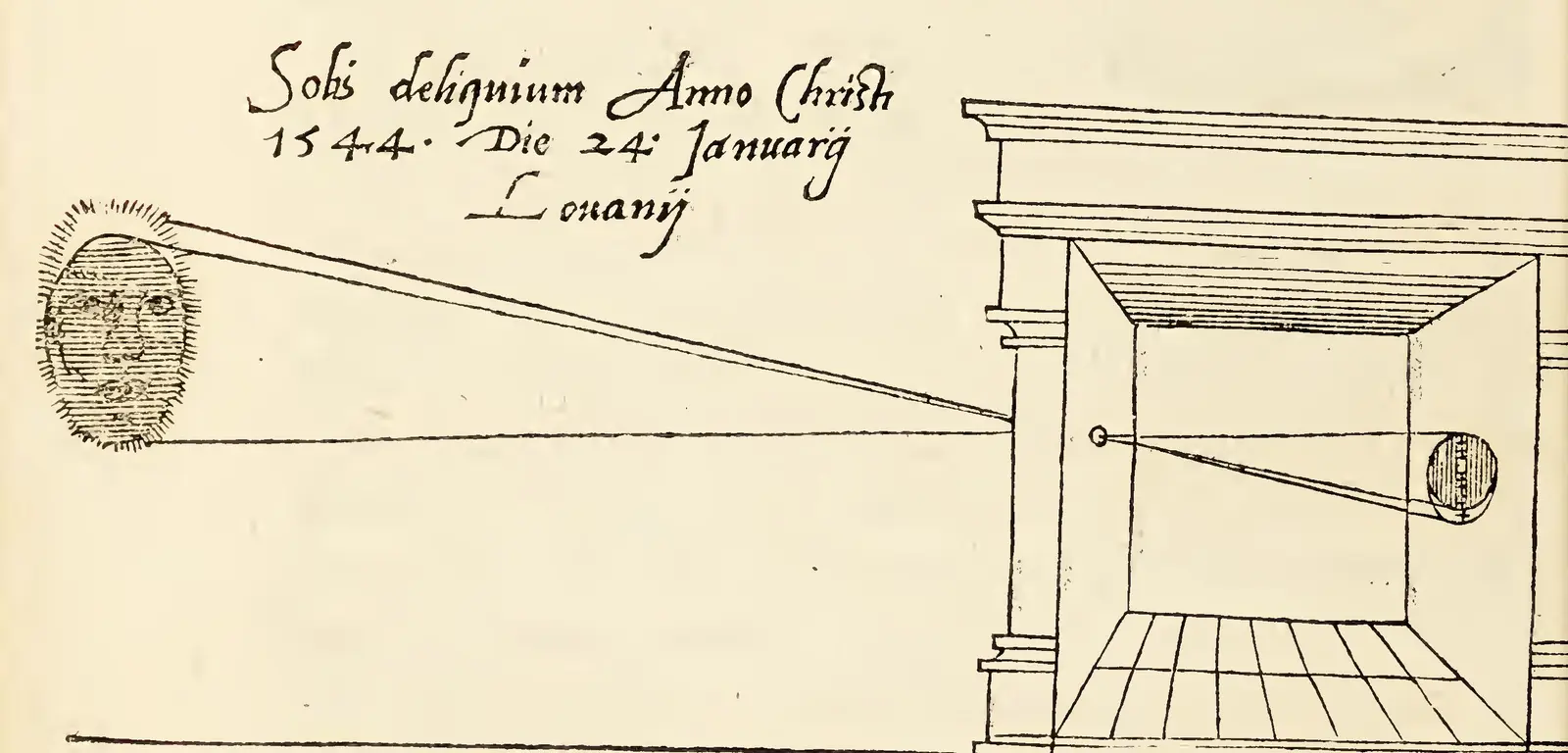
Figure 6. Gemma Frisius's woodcut from De radio astronomico et geometrico (1545): sunlight through a small hole casts the eclipsed Sun onto the opposite wall. Its label dates the eclipse 24 January 1544, at Louvain.
The January pass strengthens the Sun's tide. NOAA notes that tide-generating forces vary inversely as the cube of distance; by this page's calculation, that makes the Sun's tidal pull about 11 percent stronger at perihelion than at aphelion. NOAA also notes enhanced tidal ranges around perihelion (tides).
On a soccer field where Neptune's average distance is 100 m, Earth wanders between 3.27 m and 3.38 m from the Sun over a year (solar system scale model).
If Earth is closest in January, why is it winter up north?
The tilt sets the seasons. Earth's axis leans 23.44 degrees relative to its orbit, the IAU 2006 value for the year 2000, so each hemisphere takes turns getting the Sun's most direct rays. That puts the Northern Hemisphere's winter when Earth is closest to the Sun and its summer when Earth is farthest. The Southern Hemisphere has its summer in January, at the same distance.
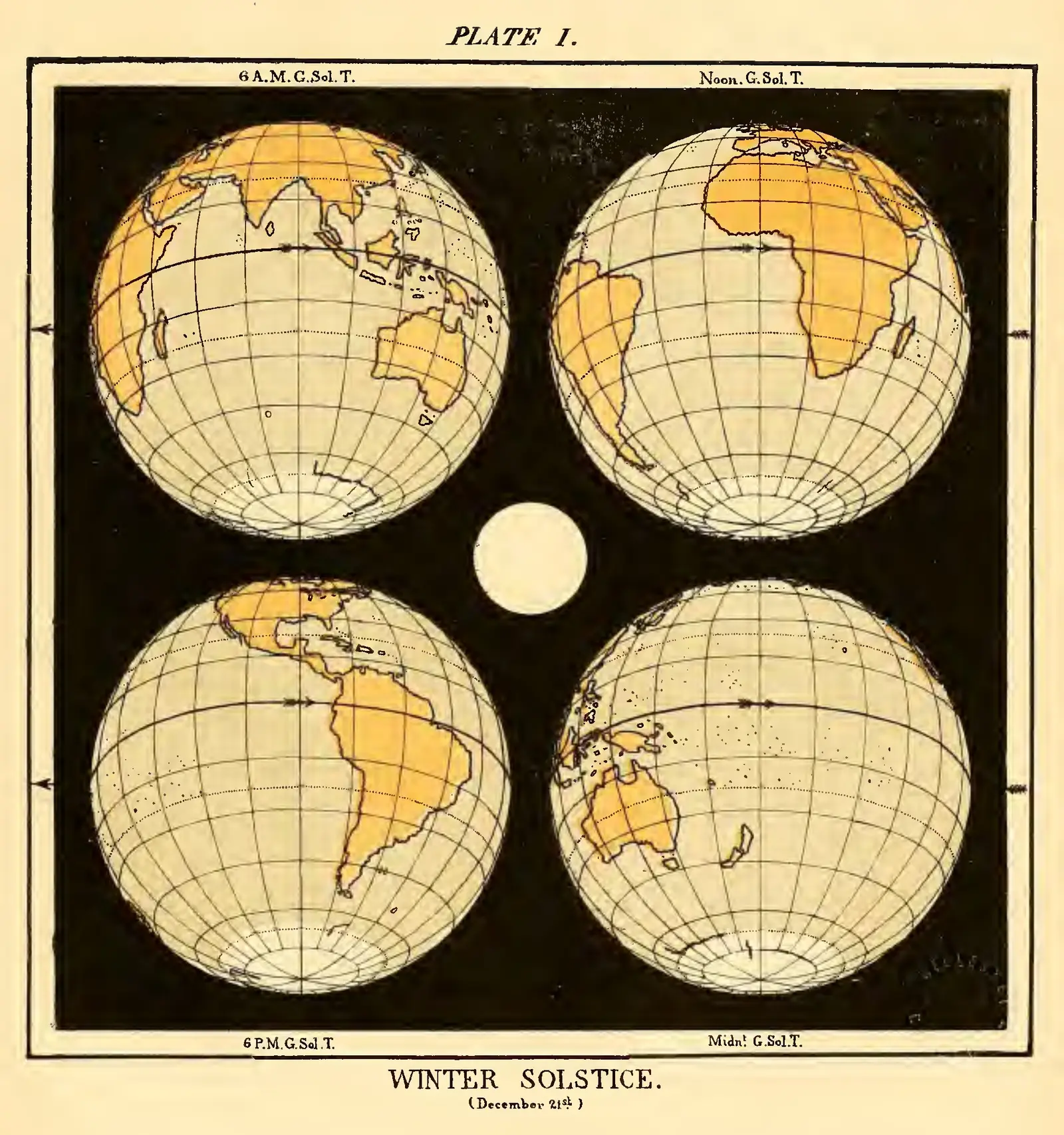
Figure 7. Plate I of Proctor's Sun-Views of the Earth (1867): Earth seen from the Sun on December 21 at four times of day. The South Pole is in view; the North Pole is turned away.
Distance still has a say. With perihelion in southern summer, the extra 6.9 percent of sunlight arrives during the Southern Hemisphere's summer and the Northern Hemisphere's winter.
Eccentricity also makes the seasons unequal. This page's calculation, timing each season from an equinox to a solstice or back, puts northern summer 4.7 days longer than northern winter, and spring 2.9 days longer than autumn, for every year from 2020 to 2039, so the March-to-September half of the year runs about seven and a half days longer than the other half.
The orbit's shape changes, but slowly. Wikipedia's article on orbital eccentricity says Earth's value varies from nearly 0.0034 to almost 0.058 over hundreds of thousands of years, through gravitational attractions among the planets. Standish and Williams's Table 1 fit has it falling by about 0.00004 per century. Even at 0.058, the orbit would be only 0.17 percent narrower than it is long, by this page's calculation, with the Sun 5.8 percent off-center.
Perihelion also drifts through the seasons. Axial precession alone would flip today's arrangement in about 13,000 years, half of its 25,770-year lap. The orbit's own slow turn brings the flip sooner: at today's rates, by this page's arithmetic from the IAU 2006 precession rate and the perihelion drift in Standish and Williams's table, the combined cycle is about 21,000 years. The axis's share of that drift is axial precession, the same slow wobble that trades one pole star for another.
Sources
- E. M. Standish and J. G. Williams, "Approximate Positions of the Planets" (Table 1: Keplerian elements and rates, mean ecliptic and equinox of J2000, valid 1800 AD to 2050 AD; EM Bary = Earth/Moon barycenter; the elements are a best fit and not valid outside the fitted interval)https://ssd.jpl.nasa.gov/planets/approx_pos.htmlRead: full page
- ERFA (Essential Routines for Fundamental Astronomy, derived from IAU SOFA), source files epv00.c (Earth position and velocity, heliocentric and barycentric, from a series fitted to the VSOP2000 analytical theory), ecm06.c (ICRS to ecliptic of date, IAU 2006) and nut06a.c (nutation, IAU 2006/2000A); BSD-3-Clausehttps://github.com/liberfa/erfa/blob/master/src/epv00.cRead: full source file of epv00.c
- IAU Division A Working Group on Numerical Standards for Fundamental Astronomy, "Astronomical Constants: Current Best Estimates" (solar mass parameter GM = 1.327 124 400 41 × 10^20 m^3 s^-2, TDB-compatible) and "Astronomical Constants: Fixed by Convention" (astronomical unit, 1.495 978 707 00 × 10^11 m, IAU 2012 Resolution B2)https://iau-a3.gitlab.io/NSFA/NSFA_cbe.htmlRead: both pages in full
- Wikipedia, "Orbital eccentricity" (0 circle, 0 to 1 ellipse, 1 parabola, above 1 hyperbola; Mercury 0.2056 and Mars 0.0934 the highest; Neptune 0.0086 and Venus 0.0068 the lowest; Earth from nearly 0.0034 to almost 0.058 over hundreds of thousands of years)https://en.wikipedia.org/wiki/Orbital_eccentricity
- Wikipedia, "Flattening" (f = (a - b)/a; f = 1 - sqrt(1 - e^2))https://en.wikipedia.org/wiki/Flattening
- Wikipedia, "Astronomia nova" (a circle-based model missing the oppositions by 8 minutes of arc; Mars path departing from a circle by about 0.43 percent)https://en.wikipedia.org/wiki/Astronomia_nova
- Wikipedia, "Planetary hours" (Chaldean order Saturn, Jupiter, Mars, Sun, Venus, Mercury, Moon, slowest to fastest as seen in the night sky; the Sun, Venus and Mercury all advance by 360 degrees per year on average)https://en.wikipedia.org/wiki/Planetary_hours
- ERFA (Essential Routines for Fundamental Astronomy, derived from IAU SOFA), source file obl06.c: mean obliquity of the ecliptic, IAU 2006 precession model (Hilton et al. 2006), 84,381.406 arcseconds at J2000; BSD-3-Clausehttps://github.com/liberfa/erfa/blob/master/src/obl06.cRead: full source file
- International Astronomical Union, "Resolution B3 on recommended nominal conversion constants for selected solar and planetary properties," XXIX General Assembly, 2015 (nominal solar radius 6.957 × 10^8 m)https://iauarchive.eso.org/static/resolutions/IAU2015_English.pdfRead: full text of Resolution B3 (PDF)
- NOAA National Ocean Service, "Tidal Variations: The Influence of Position and Distance" (perihelion about January 2, aphelion around July 2; tidal ranges enhanced at perihelion and reduced at aphelion)https://oceanservice.noaa.gov/education/tutorial_tides/tides06_variations.html
- NOAA National Ocean Service, "What Causes Tides" (tide-generating forces vary inversely as the cube of the distance)https://oceanservice.noaa.gov/education/tutorial_tides/tides02_cause.html
- ERFA (Essential Routines for Fundamental Astronomy, derived from IAU SOFA), source file p06e.c: IAU 2006 precession angles from Capitaine, Wallace and Chapront (2003, A&A 412, 567), with general precession in longitude of 5,028.796195 arcseconds per Julian century at J2000; BSD-3-Clausehttps://github.com/liberfa/erfa/blob/master/src/p06e.cRead: full source file
- Wikipedia, "Apsis" (perihelion and aphelion dates can vary up to 3 days from one year to another because Earth's center sits on average about 4,700 km from the Earth-Moon barycenter; table of dates 2010 to 2035, which cites F. Espenak's DE405-based list)https://en.wikipedia.org/wiki/Apsis
- American Astronomical Society, Solar Eclipse Task Force, "How to View a Solar Eclipse Safely," Solar Eclipse Across America (looking at the uneclipsed or partially eclipsed Sun is safe only through special-purpose solar filters, such as eclipse glasses or handheld viewers, that conform to the ISO 12312-2 international standard; ordinary sunglasses, even very dark ones, are not safe; never through an unfiltered camera, telescope, binoculars or other optical device; indirect viewing by pinhole projection)https://eclipse.aas.org/eye-safetyRead: full page
- International Meteor Organization, "2027 Meteor Shower Calendar," edited by Jürgen Rendtel (IMO INFO(3-26)): Orionids (008 ORI) active October 2 to November 7, maximum October 22, radiant right ascension 95°, declination +16°https://www.imo.net/files/data/calendar/cal2027.pdfRead: full calendar (PDF), Orionid entries in section 6 and Table 5
- IAU Meteor Data Center, shower list entry "[00008] [ORI] Orionids" (established shower; parent body 1P/Halley)https://www.ta3.sk/IAUC22DB/MDC2022/Roje/pojedynczy_obiekt.php?kodstrumienia=00008Read: full entry
- David Nash (astronexus), HYG Database v4.4, data README and licence (CC BY-SA 4.0)https://codeberg.org/astronexus/hyg
- Johannes Kepler, Astronomia Nova ΑΙΤΙΟΛΟΓΗΤΟΣ seu Physica Coelestis, tradita commentariis de motibus stellae Martis, ex observationibus G. V. Tychonis Brahe ([Heidelberg: G. Voegelinus], 1609): title page; chapter 1, page 4, figure of the motions of Mars from 1580 to 1596, with the side note that it is drawn as if the Earth stands still, as Ptolemy and Brahe holdhttps://commons.wikimedia.org/wiki/File:Astronomia_nova_aitiologetos_(romanized)_sev,_Physica_coelestis_-_tradita_commentariis_de_motibvs_stellae_Martis,_ex_observationibus_G.V._Tychonis_Brahe_-_jussu_%26_sumptibus_(IA_astronomianovaai00kepl).pdfRead: title page and printed page 4 (scan of the University of Toronto copy, Internet Archive astronomianovaai00kepl)
- Richard A. Proctor, Sun-Views of the Earth, or The Seasons Illustrated (New York: G. P. Putnam's Sons, 1867): frontispiece "The Orbit of the Earth, 1867" (one inch to 30,000,000 miles, the Sun at its true proportional size; the path "in appearance, a circle, whose centre C is not coincident with S"), introduction, and Plate I, Winter Solstice (December 21st)https://commons.wikimedia.org/wiki/File:Sun-views_of_the_earth,_or_The_seasons_illustrated-_comprising_forty-eight_views_of_the_earth_as_supposed_to_be_seen_for_the_sun_at_differents_hours_and_seasons_(IA_sunviewsofeartho00proc).pdfRead: full scan (Wellesley College Library copy, Internet Archive sunviewsofeartho00proc)
- Gemma Frisius, De radio astronomico et geometrico liber (Antwerp: Gregorius Bontius; Louvain: Petrus Phalesius, 1545): woodcut of the solar eclipse of 24 January 1544 at Louvain, cast through a small opening onto the wall of a roomhttps://commons.wikimedia.org/wiki/File:Gemmae_Frisii_medici_et_mathematici_De_radio_astronomico_%26_geometrico_liber._-_in_quo_multa_quae_ad_geographia(m),_opticam,_geometriam_%26_astronomiam_vtiliss._sunt_(IA_gemmaefrisiimedi00gemm).pdfRead: the woodcut and its surrounding text (John Carter Brown Library copy, Internet Archive gemmaefrisiimedi00gemm)
Computed by this page (2026-10-12; rechecked 2026-11-01) from sources 1 to 3 and 17: perihelion and aphelion distances, the Sun's offset, flattening and periods in the table; the 10 cm drawing; Mercury's 2.3 sunlight ratio; the 3.4 percent size change, 6.9 percent sunlight and 11 percent tidal figures; Earth's top and lowest orbital speeds, from the solar gravitational parameter in source 3; the pinhole sizes and the Sun's apparent diameter (solar radius 695,700 km, from source 9); the soccer-field distances; the combined precession cycle, from sources 1 and 12; perihelion, aphelion and season lengths for 2020 to 2039, with the Earth ephemeris of source 2; Betelgeuse's October rising times at 40°N and its distance from the Orionid radiant of source 15, from HYG v4.4 positions, flat horizon, no atmospheric refraction. Halley's Comet's elements are its osculating elements for January 20, 1968.
Corrections
2026-11-01 — The Sun's apparent diameter and the combined precession cycle are now this page's own calculations (apparent diameter 1,887 to 1,952 arcseconds → 1,887 to 1,951 arcseconds; the cycle that carries perihelion through the seasons, about 23,000 years on average → about 21,000 years at today's rates). Comparison figures from sources no longer cited were removed: Halley's period of about 76 years (the table's 75.9 remains), 6.8 percent more sunlight in January (the page's 6.9 remains), seasons 4.5 and three days unequal (the page's 4.7 and 2.9 remain), a 100,000-year eccentricity cycle, and the tropical periods of the planets. The Orionid note now cites the International Meteor Organization and the IAU Meteor Data Center; sources renumbered, prompted by a recheck.
Look up next:
The Orionid meteors, dust from Halley's Comet, the dashed ellipse in Figure 1. The IAU Meteor Data Center lists 1P/Halley as the shower's parent body. The International Meteor Organization's calendar for 2027 has the Orionids active from October 2 to November 7 and peaking around October 22, from a radiant about 10 degrees northeast of Betelgeuse by this page's calculation. At 40°N, on a flat horizon with no atmospheric refraction, Betelgeuse rises between about 9 and 11 p.m. local mean solar time through October, by this page's calculation. Watch with someone, tell a friend your plan, carry a red flashlight, and stay off private land and roads.
Related entries
- Tides: The Sun Pulls Harder, but Its Tide Is Half the Moon's
- Axial Precession: Earth Usually Has No Bright North Star
- Solar System Scale Model: On a Soccer Field, Four Planets Fit in the Goal Area
- Seven-Day Week: The Day Names Skip Two Planets Each Time
- Betelgeuse: Sized Up in 1920, Its Distance Still Unsettled
Cite this page
Asterisms & Astrolabes. “Orbital Eccentricity: Earth's True Orbit Looks Like a Circle.” Asterisms & Astrolabes. Published 13 October 2026; last substantive revision 1 November 2026. https://asterismsandastrolabes.com/orbits/orbital-eccentricity/. Accessed [the date you read it].